Ionic Bonding (AQA A-Level Chemistry): Revision Notes
📚Revision Notes
1.4.2 Ionic Bonding
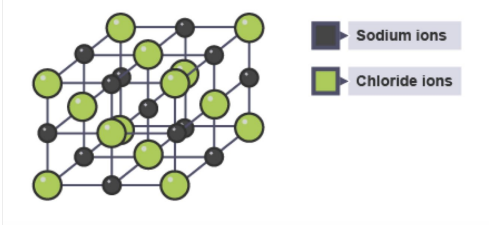
Ionic bonding occurs when electrons are transferred from a metal atom to a non-metal atom, forming charged ions. The bond is the result of electrostatic attraction between oppositely charged ions, which form a giant ionic lattice.
Process of Ionic Bonding
1. Transfer of Electrons
- Ionic bonds form between metals and non-metals.
- Metals lose electrons, becoming positively charged ions (cations).
- Non-metals gain electrons, becoming negatively charged ions (anions).
2. Formation of Ions
- After the transfer of electrons, the atoms become ions with full outer electron shells.
- For example, sodium (Na) loses one electron to become , while chlorine (Cl) gains one electron to become .
3. Electrostatic Attraction
- The oppositely charged ions attract each other due to electrostatic forces, forming a strong ionic bond.
- These ions arrange themselves into a regular, repeating pattern called a giant ionic lattice, which maximises the attractive forces and minimises repulsion.
Note
Example: Sodium Chloride (NaCl) Sodium chloride is a common example of an ionic compound:
- Sodium (Na), a metal, loses one electron to form
- Chlorine (Cl), a non-metal, gains that electron to form
- These ions then attract each other to form the ionic compound NaCl, where the ions arrange in a giant ionic lattice.
Properties of Ionic Compounds
- High melting and boiling points: Ionic compounds have strong electrostatic forces of attraction between the ions, requiring a large amount of energy to overcome.
- Conductivity: Ionic compounds conduct electricity when molten or dissolved in water because the ions can move and carry charge.
- Solubility: Many ionic compounds are soluble in water, as water molecules can surround and separate the ions.
Predicting Ion Charges
The charge on a simple ion can be predicted based on its position in the Periodic Table:
- Group 1 metals form +1 ions (e.g., , )
- Group 2 metals form +2 ions (e.g., , )
- Group 7 non-metals form 1 ions (e.g., , )
- Group 6 non-metals form 2 ions (e.g., , )
Compound Ions
In addition to simple ions, some ions consist of groups of atoms bonded together with an overall charge. These are known as compound ions or polyatomic ions.
Some common examples include:
- Sulfate ()
- Hydroxide ()
- Nitrate ()
- Carbonate ()
- Ammonium ()
Constructing Formulas for Ionic Compounds
When constructing the formula for an ionic compound, the total charge must balance. The charges on the cations and anions must add up to zero.
Method
- Identify the charge of the metal (cation) and the non-metal (anion).
- Balance the charges so that the overall charge of the compound is zero.
Note
Example: Calcium Nitrate ()
- Calcium (⁺) has a charge of +2.
- Nitrate () has a charge of -1.
- Two nitrate ions are required to balance one calcium ion:
By following these steps, you can construct the correct formula for any ionic compound.
Note
Summary
Ionic bonding forms when electrons are transferred between metals and non-metals, resulting in oppositely charged ions that attract each other through electrostatic forces. These ions form a giant lattice structure, giving ionic compounds their characteristic properties. Understanding how to predict ion charges and construct formulas for ionic compounds is essential for mastering this topic.