Metallic Bonding (AQA A-Level Chemistry): Revision Notes
📚Revision Notes
1.4.6 Metallic Bonding
Note
Metallic bonding is the type of bonding found in metals and alloys. It involves the attraction between positively charged metal ions and delocalised electrons in a lattice structure. This unique bonding gives metals their characteristic properties, such as conductivity and malleability.
Structure of Metallic Bonding
Metallic lattice
Metals consist of a lattice of positive ions (cations) arranged in a regular pattern. These ions are held together by the attraction to the surrounding sea of delocalised electrons.
Delocalised electrons
In metallic bonding, the outer electrons of metal atoms become delocalised. These electrons are free to move throughout the entire structure, which is why metals can conduct electricity.
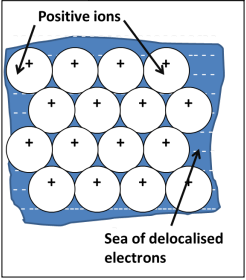
Electrostatic attraction
The strong electrostatic forces of attraction between the positive metal ions and the negative delocalised electrons hold the metallic lattice together.
Strength of Metallic Bonds
Charge on the ion
Metals with a higher positive charge release more delocalised electrons, resulting in stronger metallic bonds. For example, magnesium (Mg²⁺) has stronger metallic bonding than sodium (Na⁺) because it releases more electrons into the sea of delocalised electrons.
Size of the ion
Larger ions, like barium (Ba²⁺), have a weaker attraction to the delocalised electrons due to their larger atomic radius, which leads to a decrease in the strength of the metallic bond.