Contingency Tables (AQA A-Level Further Maths): Revision Notes
📚Revision Notes
Contingency Tables
Introduction to association
Association describes the relationship between two categorical variables. Unlike correlation, which measures linear relationships between numerical variables on a scale, association examines whether categorical variables are related to each other.
When investigating whether two categorical variables are associated, we use a contingency table to organise and display the data. This table shows the frequencies of observations for each combination of categories.
Note
Key Difference from Correlation:
While correlation quantifies the strength and direction of linear relationships between numerical variables (like height and weight), association tests whether categorical variables (like region and food preference) are related. Association is about presence or absence of a relationship, not about measuring its direction or strength numerically.
What is a contingency table?
A contingency table (also called a cross-tabulation or two-way table) displays the frequency distribution of two categorical variables simultaneously. The table shows how many observations fall into each combination of categories.
Each cell in the table indicates how many observations share both the row category and the column category. For example, a cell might show how many people from the north of a city prefer beef.
Note
Structure of a Contingency Table:
The table includes:
- Row totals - sum of frequencies across each row
- Column totals - sum of frequencies down each column
- Grand total - total number of observations
These totals are essential for calculating expected frequencies in the hypothesis test.
Observed and expected frequencies
Observed frequencies (O_i)
Observed frequencies are the actual counts recorded in your study. These are the raw data values that appear in your contingency table.
Expected frequencies (E_i)
Expected frequencies are the theoretical counts we would anticipate if the two variables were completely independent (not associated).
To calculate the expected frequency for any cell:
Important
Critical Requirement: The "Five Alive" Rule
For the chi-squared test to be valid, every expected frequency must be at least 5. If any expected frequency falls below 5, you must group similar categories together before conducting the test.
This requirement exists because the chi-squared distribution is a continuous approximation to discrete data, and this approximation breaks down when expected frequencies are too small.
The chi-squared test statistic
The chi-squared (X²) statistic measures how much the observed frequencies deviate from the expected frequencies. It quantifies the difference between what we observed and what we would expect under independence.
Formula:
Where:
- = observed frequency for cell
- = expected frequency for cell
- The sum is taken over all cells in the contingency table
Note
Interpreting the Chi-Squared Statistic:
- Larger X² values indicate greater deviation from independence - suggesting stronger evidence of association
- X² is always positive or zero because we square the differences
- The chi-squared distribution is continuous, but our data is discrete, so we use it as an approximation
- A value of zero would mean perfect agreement with independence
Hypothesis testing procedure
To test for association between two categorical variables:
Step 1: State the hypotheses
Null hypothesis (H₀): There is no association between the variables.
Alternative hypothesis (H₁): There is some association between the variables.
Important
No Direction Testing
You test only for the presence of association, not whether it is positive or negative. The chi-squared test is always two-tailed in this sense - it detects any deviation from independence, regardless of direction.
Step 2: Set the significance level
Common significance levels are 5% (0.05), 10% (0.10), or 1% (0.01).
Step 3: Calculate expected frequencies
Use the formula for each cell:
Check that all expected frequencies are at least 5. If not, group categories appropriately.
Step 4: Calculate the X² test statistic
Calculate the contribution from each cell:
Sum all contributions to get the X² statistic.
Step 5: Determine degrees of freedom
For an contingency table:
Where = number of rows and = number of columns.
Step 6: Find the critical value
Look up the critical value in the chi-squared distribution tables using your degrees of freedom and significance level.
Alternatively, calculate the p-value using P(X ≥ x) where x is your test statistic.
Step 7: Make a decision
Compare the test statistic to the critical value:
- If critical value, reject H₀ (sufficient evidence of association)
- If critical value, do not reject H₀ (insufficient evidence of association)
Or compare the p-value to the significance level:
- If p-value < significance level, reject H₀
- If p-value ≥ significance level, do not reject H₀
Degrees of freedom
The degrees of freedom for a contingency table depend on its dimensions.
For an table (m rows, n columns):
Note
Examples of Degrees of Freedom:
- 2×2 table: degree of freedom
- 3×3 table: degrees of freedom
- 2×3 table: degrees of freedom
Memory Aid: "Rows minus one, columns minus one, multiply done!"
The degrees of freedom tell you which chi-squared distribution to use when finding critical values.
Yates' correction for 2×2 tables
For 2×2 contingency tables only, you should apply Yates' correction (also called the continuity correction). This adjustment improves the approximation when using the continuous chi-squared distribution with discrete data.
Formula:
Important
Yates for 2-by-2 Only!
Key points about Yates' correction:
- Apply Yates' correction only to 2×2 tables - never use it for larger tables
- The correction reduces the X² value slightly, making the test more conservative
- Use 1 degree of freedom for a 2×2 table
- All other rules (expected frequencies ≥ 5) still apply
- The correction accounts for the fact that we're using a continuous distribution to approximate discrete data
Common Mistake: Applying Yates' correction to tables larger than 2×2. Remember: "Yates for 2-by-2" only!
Grouping categories
When any expected frequency falls below 5, you must group similar categories together before conducting the test.
Note
Guidelines for Grouping Categories:
- Combine categories that are logically similar - for example, parties with similar policies or age groups that are adjacent
- Recalculate expected frequencies after grouping - the table structure has changed
- Adjust degrees of freedom to match the new grouped table dimensions
- Ensure complete rows and columns remain after grouping
- Any conclusion drawn applies to the grouped categories
Important: After grouping data, your conclusion must acknowledge that categories were treated together. For example, "There is evidence of association between location and voting intention for Red/Green parties combined versus Blue party."
Worked example 1: Regional meat preferences
Example
Worked Example: Testing Association Between Region and Meat Preference
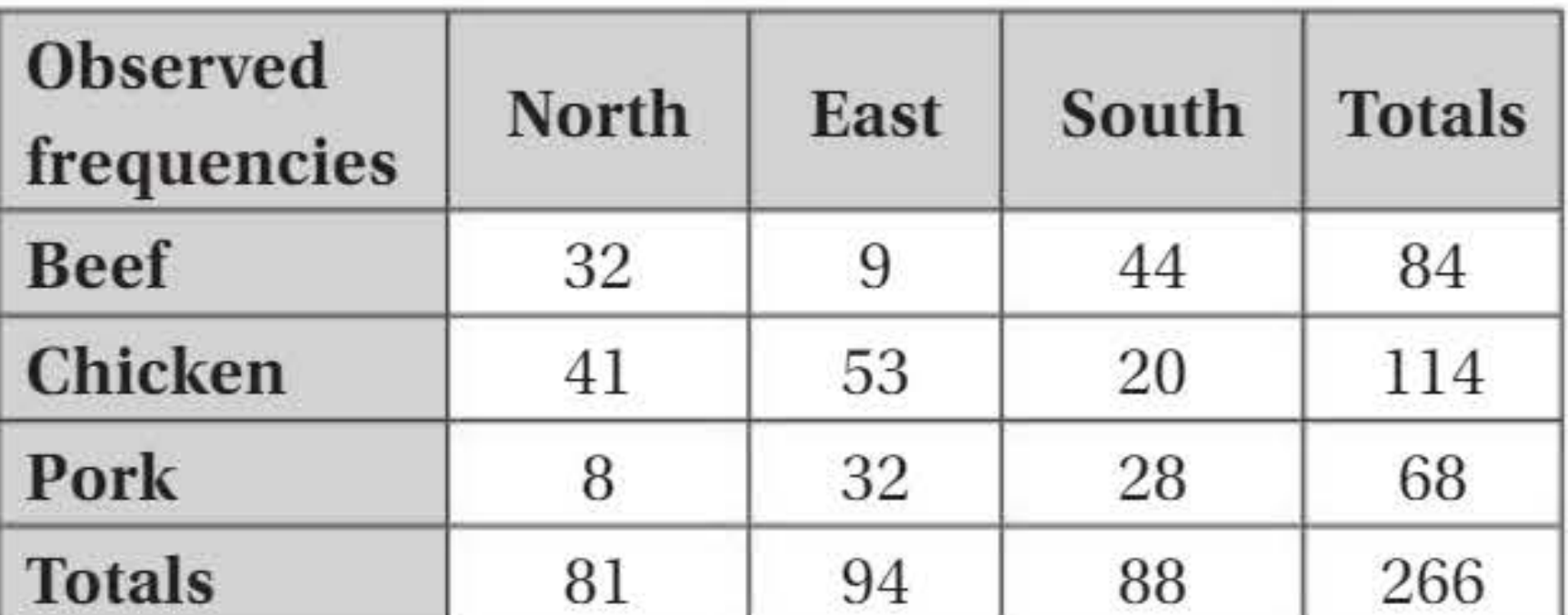
A sample of 266 people from the north, east, and south of a city were asked which meat they liked most: beef, chicken, or pork.
Step 1: Calculate expected frequencies
If the variables (region and meat preference) are independent, the expected frequency for each cell is:
For example, for north and beef:
The complete table of expected frequencies:
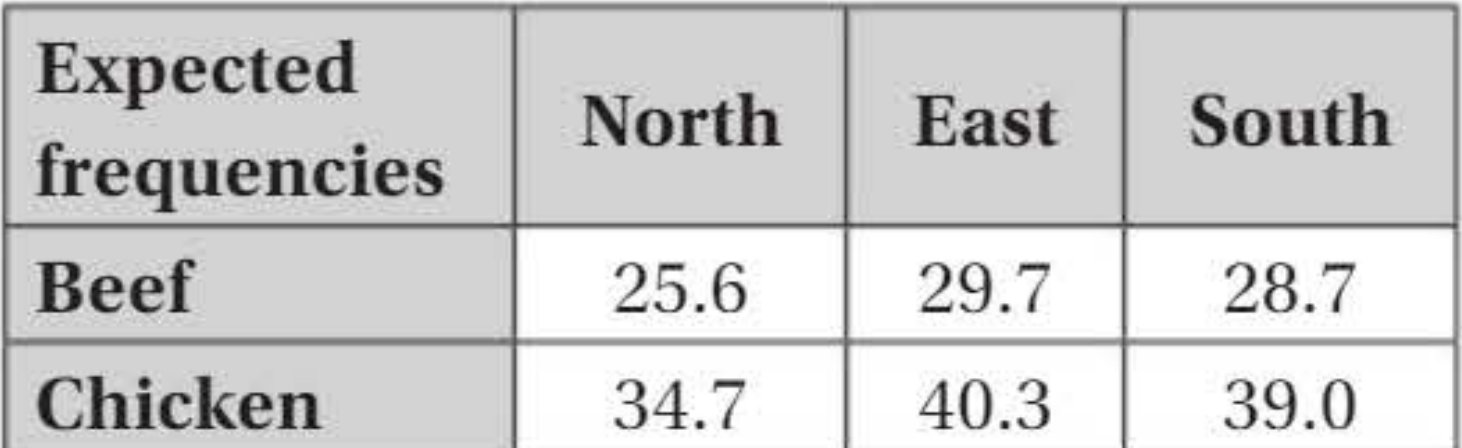

All expected frequencies are above 5, so we can proceed with the test.
Step 2: Set up hypotheses
H₀: There is no association between region and meat preference.
H₁: There is some association between region and meat preference.
Test at the 5% significance level.
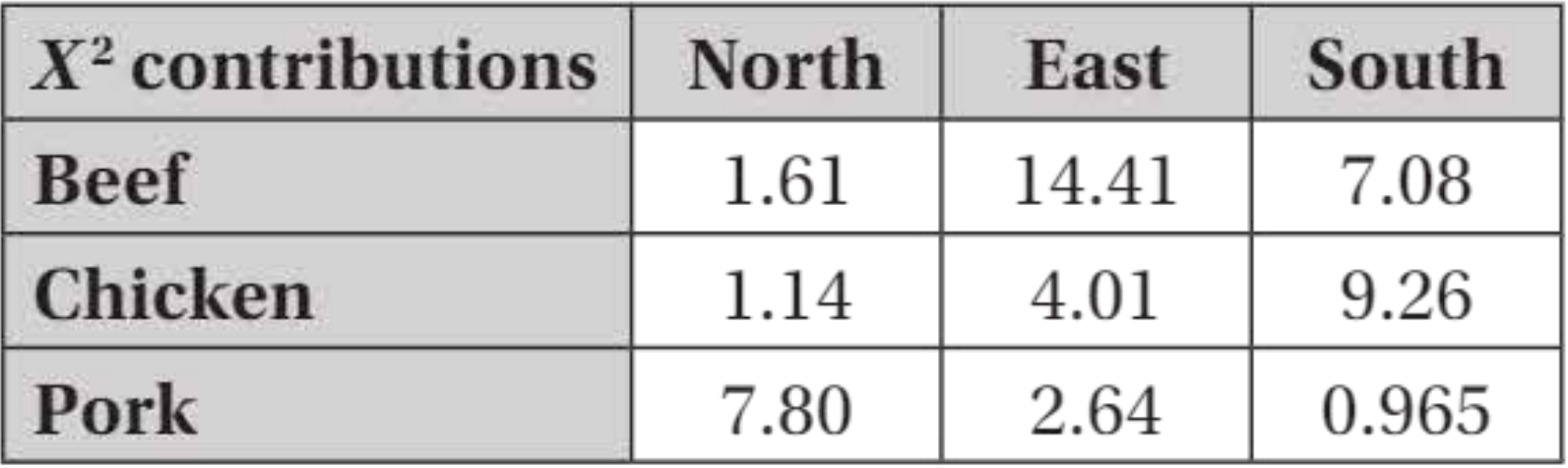
Step 3: Calculate X² contributions
For each cell, calculate:
Step 4: Calculate the test statistic
Sum all contributions:
Step 5: Determine degrees of freedom
This is a 3×3 table, so:
Step 6: Find the critical value
From chi-squared tables, at 5% significance: critical value = 9.49
Step 7: Make a decision
Since , we reject H₀.
Conclusion: There is sufficient evidence at the 5% level to suggest an association between region and meat preference.
Worked example 2: Movie genre and age
Example
Worked Example: Age and Movie Genre Preferences
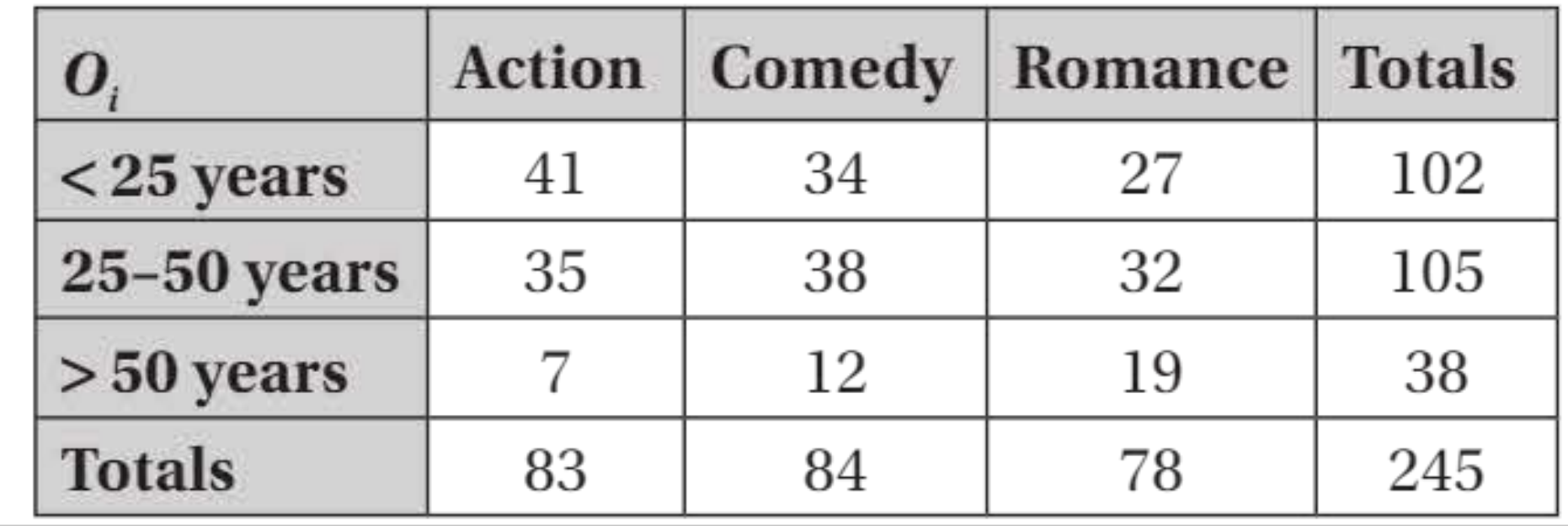
A test examines whether there is association between age and movie genre preferences.
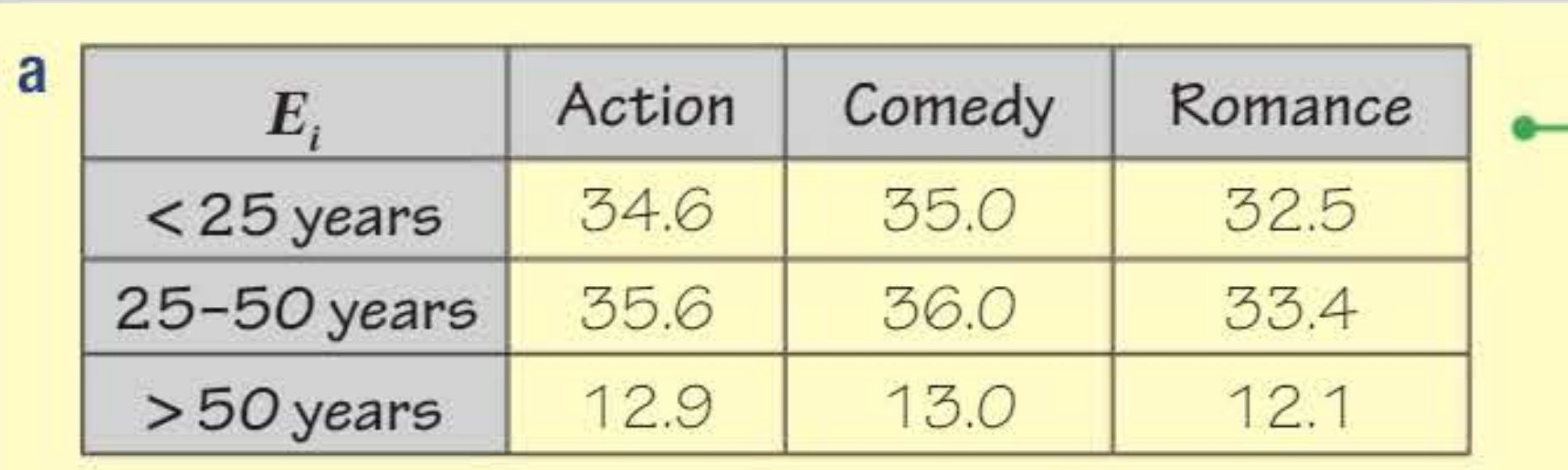
Calculate expected frequencies
For the cell corresponding to Action and under 25 years:
Complete expected frequency table:
Calculate X² contributions
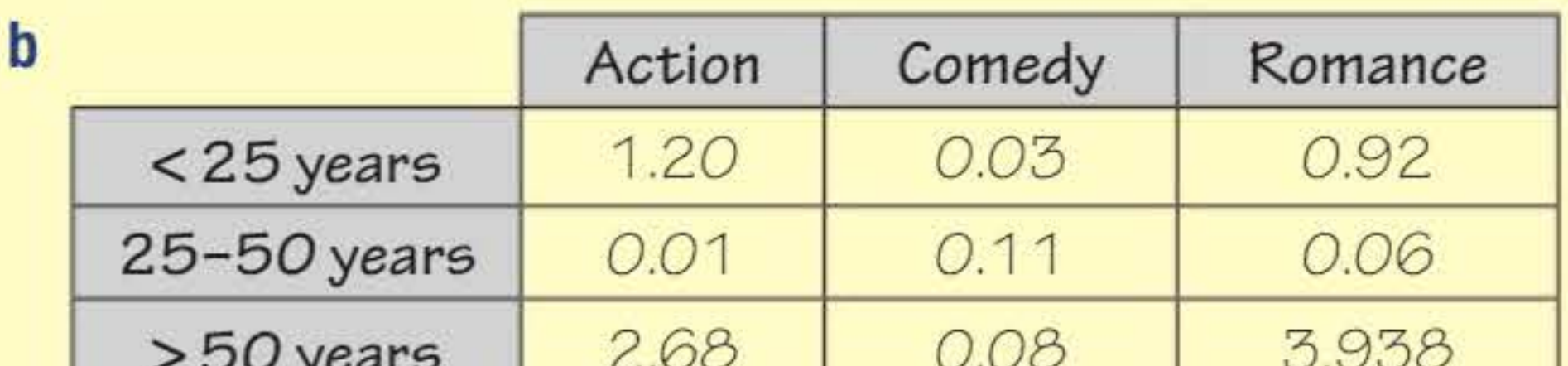
Calculate the test statistic
Total: (to 3 sf)
Degrees of freedom
This is a 3×3 table:
p-value approach
The p-value is P(X ≥ 9.03) = 0.06 where X follows distribution.
Conclusion
Since the p-value (0.06) is larger than the significance level (0.05), there is insufficient evidence to reject the null hypothesis. We do not have sufficient evidence of an association between age and movie genre preference.
Worked example 3: Voting intentions with grouping
Example
Worked Example: Voting Intentions Requiring Category Grouping
Voters in three constituencies were polled about their voting intentions for the Red, Green, and Blue parties.
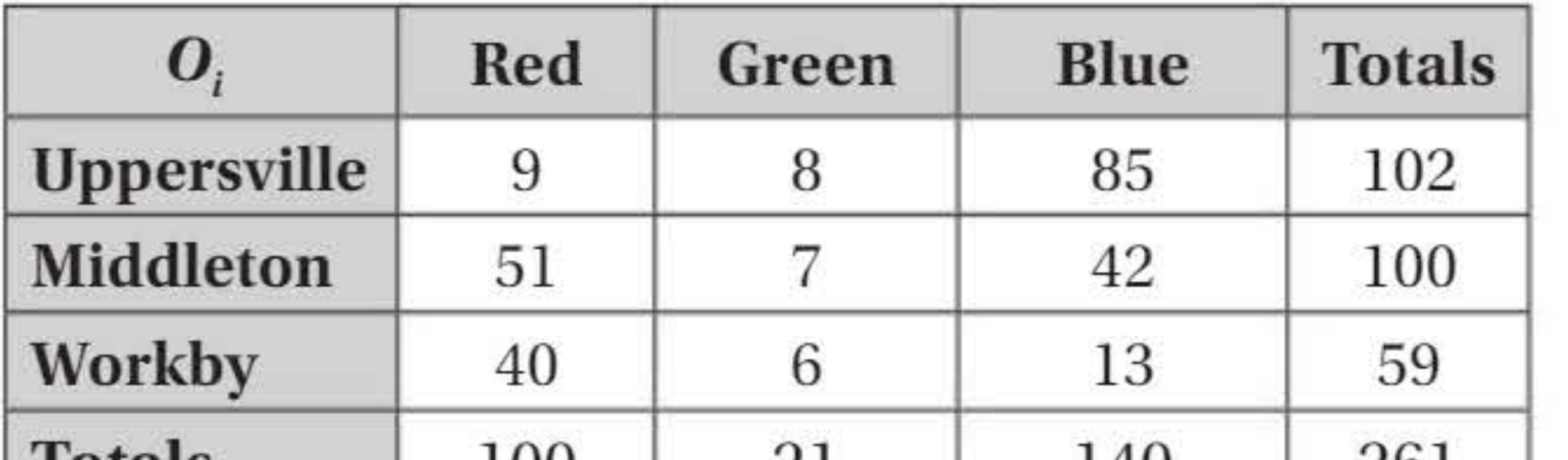
Problem identified: The expected frequency for Green voters in Workby is below 5.
Solution: Group Red and Green together (they have similar policies).
After grouping:
| O_i | Red and Green | Blue | Totals |
|---|---|---|---|
| Uppersville | 17 | 85 | 102 |
| Middleton | 58 | 42 | 100 |
| Workby | 46 | 13 | 59 |
| Totals | 121 | 140 | 261 |
Calculate expected frequencies
The grouped table now has all expected frequencies above 5.
Degrees of freedom
After grouping: degrees of freedom
After calculating:
Critical value at 5% with 2 df: 5.99
Conclusion
Since , there is sufficient evidence to suggest association between location and voting intention.
Important note: Having grouped the data, our conclusion must treat Red and Green intentions together. We cannot make separate claims about Red or Green party support individually.
Worked example 4: Lunch choices (2×2 table with Yates' correction)
Example
Worked Example: 2×2 Table with Yates' Correction
Year 12 and Year 13 students were asked whether they prefer fish 'n' chips or salad.
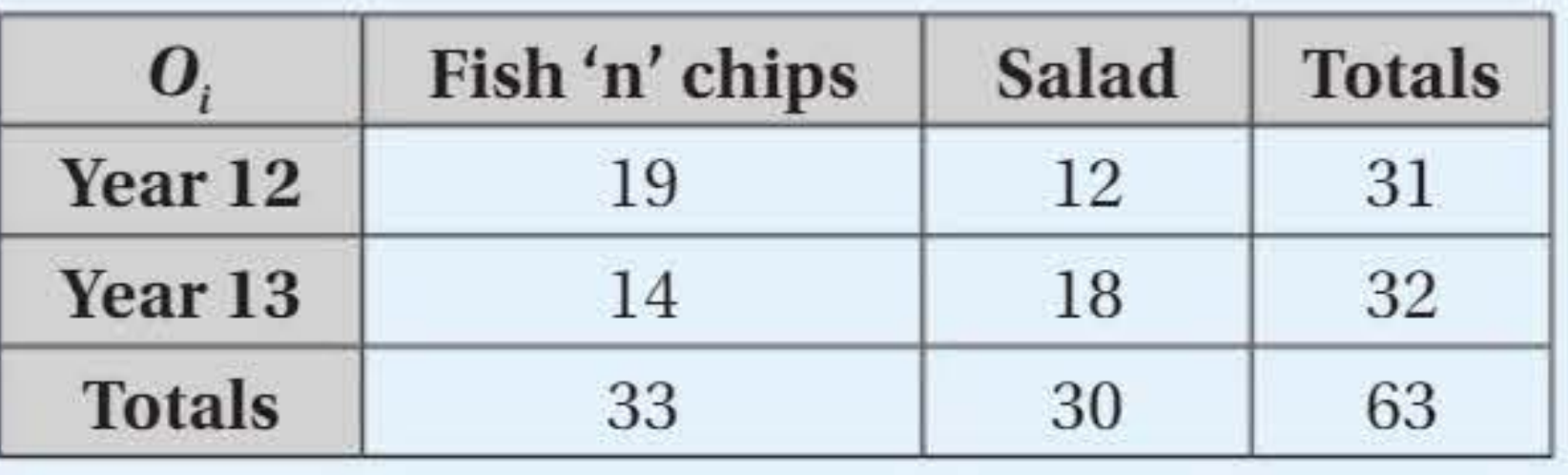
Calculate expected frequencies
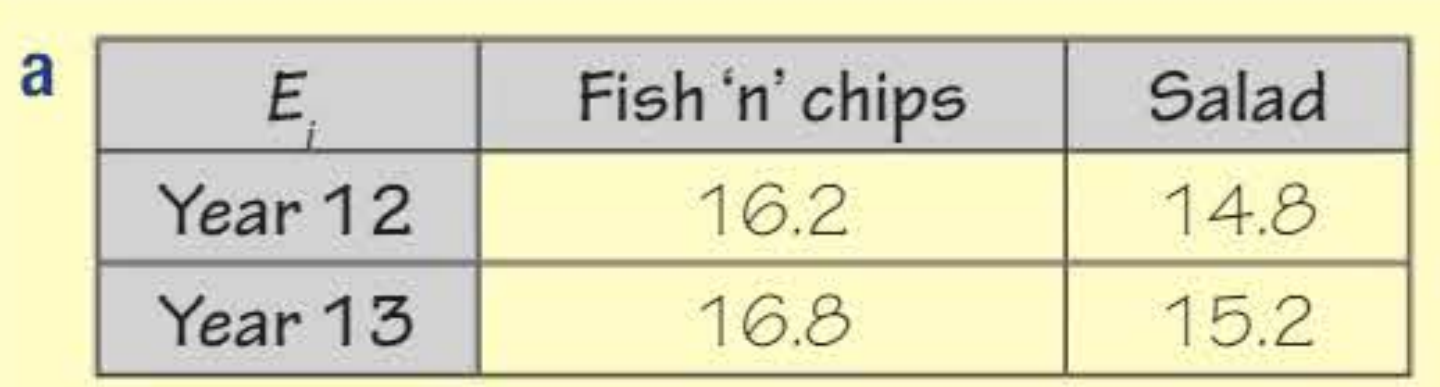
Apply Yates' correction
Since this is a 2×2 table, use:
The X² contributions become:
| Fish 'n' chips | Salad | |
|---|---|---|
| Year 12 | 0.32 | 0.35 |
| Year 13 | 0.31 | 0.34 |
Calculate the test statistic
(to 3 sf)
Degrees of freedom
For a 2×2 table:
Critical value
At 10% significance with 1 df: critical value = 2.71
Conclusion
Since , there is insufficient evidence to reject the null hypothesis.
There is insufficient evidence of association between year group and lunch choice.
Worked example 5: Height and legroom opinions
Example
Worked Example: Height and Legroom Opinions
An airline surveyed passengers of various heights about their opinions on the amount of legroom.
| O_i | >1.80m | <1.50m | Between 1.50m and 1.80m | Totals |
|---|---|---|---|---|
| Too little | 67 | 32 | 304 | 403 |
| Too much | 19 | 48 | 415 | 482 |
| About right | 48 | 51 | 379 | 478 |
| Totals | 134 | 131 | 1098 | 1363 |
Key observations:
The large contributions from people over 1.80m show that their opinions differ most from what is expected.
Looking at observed versus expected frequencies:
- There is evidence for a strong positive association between being tall and believing there is too little legroom
- There is a strong negative association between being tall and believing there is too much legroom
- Short people's opinions about "too much" legroom are very close to expected values
X² statistic: 41.0 (to 3 sf)
Degrees of freedom:
Critical value: At 5% significance with 4 df: 9.49
Conclusion
Since , there is sufficient evidence to reject the null hypothesis.
There is sufficient evidence to suggest an association between height and opinions on legroom.
Exam tips
Important
Common Exam Traps to Avoid:
- Forgetting to check expected frequencies are ≥ 5 - this is a validity condition that must be verified
- Using Yates' correction on tables larger than 2×2 - remember "Yates for 2-by-2" only!
- Calculating degrees of freedom incorrectly - always use
- Not grouping categories when expected frequencies are too low
- Stating conclusions about positive/negative association - you only test for presence of association
- Forgetting to acknowledge grouped categories in conclusions
Note
Problem-Solving Strategy:
- Always construct the expected frequency table first
- Show your calculation for at least one expected frequency - this demonstrates understanding
- Create a table of X² contributions to avoid arithmetic errors
- Double-check your degrees of freedom calculation
- State your hypotheses clearly before beginning calculations
- Write conclusions in context, referencing the original variables
Note
Step-by-Step Exam Approach:
- Write out hypotheses H₀ and H₁
- Calculate and present expected frequencies table
- Check all expected frequencies ≥ 5 (group if necessary)
- Calculate X² statistic with working
- State degrees of freedom with calculation
- State critical value or p-value
- Make comparison and decision
- Write conclusion in context
Remember!
Summary
Key Points to Remember:
-
Contingency tables display the relationship between two categorical variables, showing observed frequencies for each combination of categories.
-
Expected frequencies are calculated assuming independence: , and must all be at least 5 for the test to be valid.
-
The chi-squared test statistic is , which measures how much observed data deviates from expected values under independence.
-
Degrees of freedom for an table are , and for 2×2 tables only, apply Yates' correction: .
-
When any expected frequency is below 5, group similar categories together, recalculate expected frequencies, and adjust degrees of freedom accordingly before conducting the test.
Memory Aids:
- "Five alive" - expected frequencies must be at least 5
- "Yates for 2-by-2" - only use correction for 2×2 tables
- "Rows minus one, columns minus one, multiply done" - degrees of freedom formula
- "O-E-D" process - Observe, Expect, Decide