Continuous Distributions 2 (AQA A-Level Further Maths): Revision Notes
📚Revision Notes
Continuous Distributions 2
Introduction to continuous distributions
When working with continuous random variables, we need to understand how to calculate probabilities and find key statistical measures. Unlike discrete variables, continuous variables require integration to find probabilities over intervals.
Note
For continuous random variables, we cannot calculate the probability of a single exact value (which is always zero). Instead, we focus on probabilities over intervals using integration.
For a continuous random variable with probability density function , the probability that lies between two values and is:
The mean (expected value) and variance of are given by:
These formulas extend the concepts you learned for discrete distributions to the continuous case.
The cumulative distribution function
Definition
The cumulative distribution function (CDF), denoted , is a powerful tool for calculating probabilities and finding percentiles. It tells you the probability that a random variable takes a value less than or equal to a particular value.
Key definition: For a continuous random variable , the CDF is defined as:
Important
For continuous distributions, , so . This is different from discrete distributions where the probability at a specific point can be non-zero.
Calculating the CDF from the PDF
Since represents the probability up to value , we can calculate it by integrating the probability density function from to :
This integral accumulates all the probability from the lowest possible value up to .
Note
Properties of the CDF:
- is always non-decreasing
- and
- is continuous for continuous random variables
Finding the PDF from the CDF
The relationship between the PDF and CDF works both ways. If you know the CDF, you can find the PDF by differentiation:
This relationship comes from the fundamental theorem of calculus. It means the PDF is the rate of change of the CDF.
Important
Verification Check: Always check that your PDF integrates to 1 over its entire domain. This is a quick way to verify your answer is correct and catch potential errors early.
Finding parameters using normalization
The total probability for any random variable must equal 1. This principle is called normalization and is used to find unknown parameters in probability density functions.
If is a valid PDF, then:
For a PDF defined on a finite interval :
Example
Worked Example 1: Finding parameter values
A continuous random variable has probability density function:
Part a: Find the value of .
Solution:
Using the normalization condition:
Therefore, for .
Part b: Find the cumulative distribution function .
Solution:
For :
The complete CDF is:
Part c: Find the median value of .
Solution:
The median is the value where or equivalently where .
Working with exponential-type distributions
Exponential distributions are commonly used to model waiting times, lifetimes, and decay processes. The exponential CDF has the characteristic form for , where is a positive parameter.
Example
Worked Example 2: Exponential CDF
A random variable has cumulative distribution function for .
Part a: Find the probability density function of .
Solution:
Using the relationship :
Chain Rule Reminder: When differentiating exponential functions, remember the chain rule. The derivative of is (multiply by the derivative of the exponent).
Part b: Write the modal value of .
Solution:
The mode is the value where is maximum. For , this occurs when (the exponential function decreases as increases).
Mode = 0
Part c: Prove that when two values are chosen at random, the probability that one is less than and the other is more than is .
Solution:
This is a problem about two independent outcomes:
- Probability first value less than :
- Probability second value more than :
The outcome can occur in two ways (first less and second more, OR first more and second less):
:::
Piecewise probability density functions
Some PDFs are defined differently over different intervals. These require careful integration, with separate calculations for each piece.
Important
When working with piecewise functions, always:
- Integrate each piece separately over its specified interval
- Add the results from all pieces when calculating total probability
- Remember to include contributions from earlier intervals when building the CDF
Example
Worked Example 3: Piecewise PDF
A continuous random variable has probability density function:
Part a: Show that .
Solution:
Using normalization over the entire domain:
First integral:
Second integral:
Therefore:
Part b: Find the cumulative distribution function .
Solution:
We need to integrate the PDF in pieces:
For :
For :
The complete CDF is:
Part c: Find the median and interquartile range of .
Solution:
The median satisfies . Since , the median is M = 1.
For quartiles, we need and .
For (in the first interval):
For (in the second interval):
Solving this quadratic equation gives (2 dp).
The interquartile range is:
The rectangular (uniform) distribution
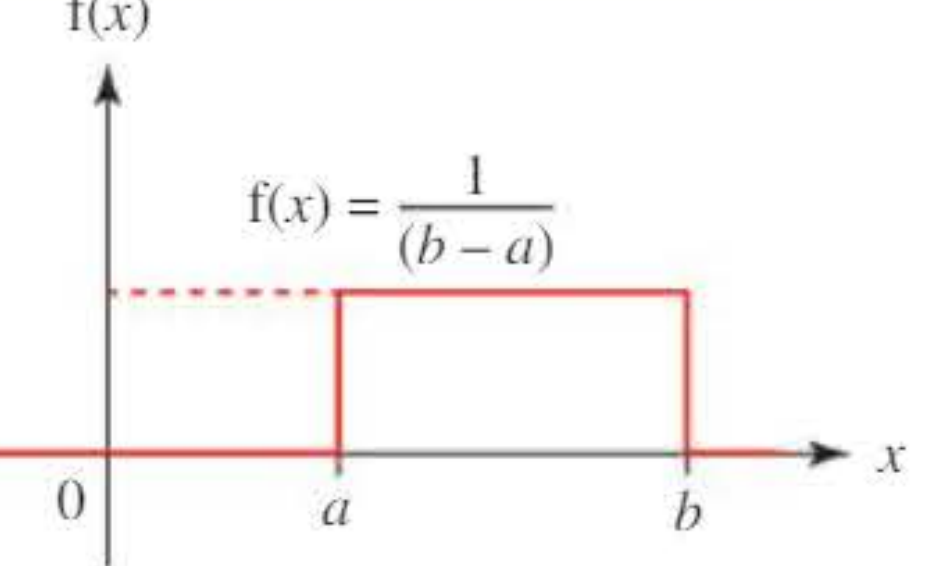
The rectangular distribution (also called the uniform distribution) is one of the simplest continuous distributions. It models situations where all values in an interval are equally likely to occur.
Definition and properties
Definition: A random variable follows a rectangular distribution on the interval if all values in this interval are equally likely. We write .
The probability density function is constant over the interval:
Note
The constant ensures that the total area under the PDF equals 1. Since the PDF forms a rectangle of width and height , the area is .
Mean of rectangular distribution
The mean (expected value) of a rectangularly distributed random variable is:
This makes intuitive sense: the mean is the midpoint of the interval.
Variance of rectangular distribution
The variance requires calculating first:
Using the factorisation :
Then:
After algebraic manipulation (expanding and simplifying):
Important
Key formulas for rectangular distribution:
These formulas are essential for working with uniform distributions efficiently. Remember them!
Example
Worked Example 4: Measurement error
The length of a line segment is measured to the nearest millimetre. Calculate the mean and variance of the error in any recorded length.
Solution:
Let be the error (in mm) in the recorded length. The error can be anywhere from mm to mm, with all values equally likely:
Here and .
Mean:
This makes sense: on average, the error is zero (measurements are equally likely to be too high or too low).
Variance:
Rounding Error Tip: Rounding errors typically follow a rectangular distribution with range equal to the rounding interval. For "nearest millimetre", the range is 1 mm, giving variance . For "nearest centimetre", it would be cm², and so on.
:::
Mixed distributions
Some random variables are partly discrete and partly continuous. For example, queuing times may be exactly zero with some probability (discrete), or take positive continuous values.
Important
When working with mixed distributions:
- Calculate the discrete probabilities separately
- Integrate the continuous PDF over its domain
- Ensure the sum of all discrete probabilities plus the integral of the continuous PDF equals 1
- For expectations, add the discrete contribution (value × probability) to the continuous contribution (integral)
Example
Worked Example 5: Supermarket waiting times
Supermarket checkout waiting times, minutes, have the following distribution:
Part a: Prove that .
Solution:
The total probability must equal 1. This includes the discrete part and the continuous part:
Evaluating the integral:
Therefore:
Part b: If the probability of zero waiting time is 0.4, show that the expected waiting time is 54 seconds and find the probability that the waiting time exceeds one minute.
Solution:
Given :
Expected waiting time:
So minutes seconds.
Probability waiting time exceeds 1 minute:
Summary
Problem-solving strategy
When working with continuous distributions:
1. Integrate the PDF to find probabilities and the cumulative distribution function. Remember that probabilities are areas under the curve.
2. Recognise rectangular distributions and use the formulas and when appropriate.
3. Calculate mean and variance using the standard formulas with integration. For rectangular distributions, use the shortcut formulas.
4. Handle mixed distributions carefully, treating discrete and continuous parts separately. The total probability is the sum of discrete probabilities plus the integral of the continuous PDF.
Exam tips:
- Always check your PDF integrates to 1 (accounting for any discrete probabilities)
- When finding the CDF, remember to include constant terms from earlier intervals
- For the median, solve
- Sketch the PDF when possible to visualise the distribution
- Watch for negative signs in exponential distributions when differentiating
Summary
Remember!
Key Concepts:
-
The cumulative distribution function gives the probability up to any value.
-
The PDF and CDF are related by differentiation: , and integration works the other way.
-
For the rectangular distribution : the PDF is , the mean is , and the variance is .
-
Always use the normalization condition to find unknown parameters in a PDF.
-
Mixed distributions require treating discrete and continuous parts separately, ensuring total probability equals 1.