Importance of Place (AQA A-Level Geography): Revision Notes
📚Revision Notes
Importance of Place
Place is fundamental to human geography. It shapes how we see ourselves, where we feel we belong, and our overall quality of life. Understanding why places matter helps us appreciate the deep connections between people and the locations they inhabit.
Note
The relationship between person and place is not one-way. While places shape our identity and experiences, we also actively shape and give meaning to the places we inhabit through our daily activities and emotional attachments.
The importance of place in human life and experience
Places are not just physical locations on a map. They carry meaning and significance that affects our daily lives in numerous ways:
-
Personal identity: We define ourselves through the places we live in and the activities we carry out there. The relationship between a person and a place develops over time and becomes part of who we are.
-
Marketing and tourism: The promotion of holiday destinations relies heavily on the appeal of place. Tourist boards market locations based on their unique characteristics and attractions.
-
Food and products: Many foods are strongly associated with their place of origin. The Glastonbury Music Festival, for instance, is linked to the reputation and character of its location. This connection affects how people perceive both the event and the place.
-
Consumption patterns: People may 'buy into' or 'consume' place. Those who enjoy countryside living might holiday in rural areas, read books set in rural locations, watch countryside television programmes, purchase walking equipment and maps, and even furnish their homes in a rustic country style. Products are marketed to help people embrace the concept of rural living.
The placemaking movement has grown significantly in recent years, emphasising these connections and recognising that place affects three key aspects of human experience:
- Identity
- Belonging
- Well-being
Note
These three dimensions - identity, belonging, and well-being - form the foundation of what geographers call our "lived experience" of place. They are interconnected: where we feel we belong influences our identity, and both contribute to our overall well-being.
Identity and place
Place plays a critical role in constructing our identity. This connection manifests at multiple scales, from our immediate local area to our sense of national belonging.
Development of place identity
Our sense of place begins with our home and local geographical area. Simple activities help foster this connection:
- Reading local newspapers
- Playing sport for a local team
- Attending local festivals or events
These everyday experiences build a sense of local place that becomes part of our identity.
Scales of place identity
Identity related to place operates at different geographical scales, from the local to the national level. Understanding these different scales helps us appreciate how place identity works at multiple levels simultaneously.
Important
Three key scales of place identity:
People identify with places at different geographical levels - local (localism), regional (regionalism), and national (nationalism). These scales are not mutually exclusive; a person can simultaneously feel strong attachments to their neighbourhood, their region, and their nation.
Localism
Localism is an affection for or emotional ownership of a particular place. It rarely manifests as formal political organisation but demonstrates itself through community attachment.
One expression of localism is nimbyism (not in my backyard). This occurs when people resist development in their local area, showing their emotional connection to and desire to protect their place.
Regionalism
Regionalism refers to consciousness of, and loyalty to, a distinct region with a population that shares similarities.
In some parts of the UK, regional identity has led to calls for greater self-governance.
Example
Regional Identity: Cornwall and Mebyon Kernow
Cornwall provides a clear example of strong regionalism within the UK. The Mebyon Kernow party campaigns for a National Assembly for Cornwall, arguing that the county has its own distinct identity, language and heritage.
They believe Cornwall should have the same right to self-rule as Scotland and Wales, which have already achieved devolution. This demonstrates how regional place identity can translate into political movements seeking recognition and autonomy.
Nationalism
Nationalism means loyalty and devotion to a nation, which creates a sense of national consciousness. Patriotism can be considered an example of a sense of place at the national scale.
At the national level, people identify with place through:
- A common language
- A national anthem
- A flag
- Cultural and sporting events
The resurgence of the Welsh language and culture in recent years has highlighted a stronger national identity among the Welsh population.
Religion and place identity
Religion can foster a strong sense of identity linked to place. At a local level, religious buildings serve as community gathering points:
- Churches, mosques and synagogues bring people from the same religious identity together for worship
- Larger sacred places such as Bethlehem or Mecca attract pilgrims from around the world
- These locations become central to religious identity and practice
Note
Religious places operate at multiple scales, from the local community centre (a neighbourhood mosque or church) to global pilgrimage destinations (Mecca, Jerusalem, Vatican City). This mirrors the broader concept of place identity operating at different geographical levels.
Place and protests
The power of place in political protest has become increasingly evident. Throughout the early twenty-first century, people have used significant locations to challenge unpopular political regimes and issues related to capitalism, racial inequality and climate change.
In 2011, Tahrir Square in Cairo became the focal point of the Egyptian Revolution against former president Hosni Mubarak. Despite Egypt's effective banning of public protests, the square transformed into a powerful symbol representing the pursuit of democracy in Egypt.
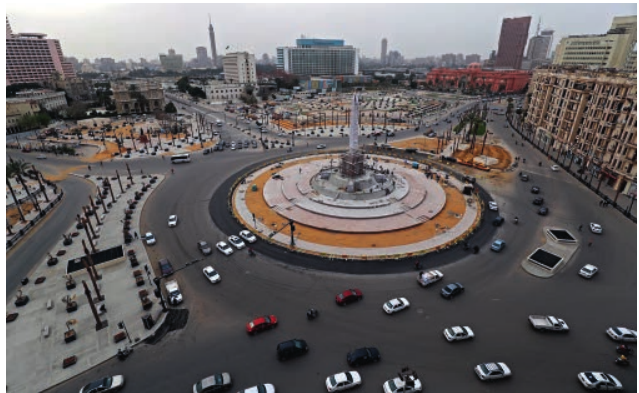
In London, from 2018 onwards, climate change activists led by Extinction Rebellion held peaceful protests centred around Parliament Square. Activists recognised the symbolic power of place, choosing recognisable locations around the world to attract attention and embed their message in people's memories.
Note
Protesters strategically select places with symbolic significance. By occupying spaces associated with power and national identity, they create powerful visual statements that resonate with wider audiences and media coverage. The place itself becomes part of the protest message.
Case study: Trafalgar Square, London
Trafalgar Square demonstrates how place can embody multiple meanings and change over time. The square was named after a naval victory and features a statue of Admiral Lord Nelson at its centre, commemorating British leadership and military success. City planners in the 1800s intended this place to inspire pride and patriotism.
Example
Changing Meanings: Trafalgar Square Through Time
The square traces change over time through various developments. The Fourth Plinth Programme, which began in 1999, transformed a vacant plinth into a centrepiece for provocative contemporary public art. This has helped position London as both a place of tradition and a centre for innovation and diversity.
Commissions have included diverse artistic expressions, such as a marble torso of a pregnant artist and controversial contemporary plinth sculptures. Art installations like 'One and other' involved 2,400 members of the public spending one hour each on the plinth, showcasing whatever they wanted.
Trafalgar Square has also been used for protests. When people rally against the British state, they often choose this location rather than simply supporting or celebrating it. Climate activists have held numerous demonstrations in recent years, and the traces left by protestors transform Trafalgar Square into a very different place depending on the time and context.
A global sense of place
Geographer Doreen Massey challenged traditional ideas about place in important ways. She questioned the assumption that places are static and argued instead that places are dynamic with multiple identities and no fixed boundaries.
Massey used her own local area to demonstrate that place is influenced by constantly changing elements from the wider world. She wrote about Kilburn High Road, her local shopping centre in north-west London:
"Take, for instance, a walk down Kilburn High Road, my local shopping centre. It is a pretty ordinary place, north-west of the centre of London... Thread your way through the traffic diagonally across the road from the newsstand and there's a shop which as long as I can remember has displayed saris in the window. Four life-sized models of Indian women and reams of cloth. On the door a notice reads about a forthcoming concert at Wembley Arena: Anand Miland presents Rekha, live, with Aamir Khan, Jahi Chawla and Ravenna Tandon. On another newsagents' ad, for the end of the month, is written, 'All Hindus are cordially invited.' In another shop I chat with the man who keeps it, a Muslim unutterly depressed by events in the Gulf."
Massey argued that the character of a place can only be understood by linking that place to places beyond it. She concluded: 'What we need, it seems to me, is a global sense of the local, a global sense of place.'
Important
Massey's Key Arguments:
Traditional views saw places as:
- Static and unchanging
- Having single, fixed identities
- Bounded with clear edges
Massey argued places are actually:
- Dynamic and constantly evolving
- Having multiple identities
- Shaped by connections to other places
- Influenced by global flows of people, culture, and ideas
This challenges us to think about places not as isolated entities, but as nodes in a network of global connections.
Globalisation of place
Some geographers argue that globalisation has diminished the importance of place. The forces of global capitalism have eroded local cultures and produced identical or homogenised places worldwide. This process can be observed through:
- International chain stores appearing in every city
- Standardised architecture and urban design
- Similar consumer products available globally
- Loss of distinctive local character
Important
The Homogenisation Concern:
There is growing concern that globalisation is creating "clone towns" - places that look the same everywhere. When the same shops, restaurants, and architectural styles appear in cities across the world, places risk losing their unique local character. This raises critical questions: Are places becoming less distinctive? Is local identity being weakened by global economic forces? Can local cultures survive in an increasingly globalised world?
Summary
Key Points to Remember:
-
Place is central to human identity, affecting how we define ourselves at local, regional and national scales.
-
Our lived experience of place encompasses three key dimensions: identity, belonging and well-being.
-
Place identity operates at multiple scales: localism (attachment to local area), regionalism (loyalty to distinct regions), and nationalism (devotion to nation).
-
Places serve as powerful symbols in political protests, with locations like Tahrir Square and Parliament Square becoming focal points for social movements.
-
Doreen Massey's concept of a 'global sense of place' argues that places are dynamic and interconnected with the wider world, rather than static and bounded.
-
Globalisation creates tension between local place identity and homogenisation, raising concerns about the loss of distinctive local character.