Media Representation of Place (AQA A-Level Geography): Revision Notes
📚Revision Notes
Media Representation of Place
Introduction
Media plays a powerful role in shaping how we understand and perceive places. Different forms of media—including television, film, photography, art, books, newspapers and the internet—reach large audiences worldwide and therefore significantly influence broader perceptions of place. This widespread media coverage has made geographical distance less relevant for learning about places. People can now gain instant knowledge about distant locations through media sources, even if they've never visited.
Note
This blurring of near and far places means people may develop strong attachments to places they've only experienced through media. You might feel connected to a city you've seen in films or a countryside you've read about in novels, even without physically visiting them.
Photographs
In today's digital age, photo-editing has become commonplace. Places can easily be 'photoshopped' or filtered to make them appear different and, particularly for tourist destinations, more attractive. The photograph you may have seen of a place versus the reality is often significantly different. These differences can result from:
- Weather conditions at different times
- The season when the photo was taken
- Advanced editing technology used to enhance the image
Marketing photographs are particularly selective. They tend to focus on the natural beauty or scenic landscapes of places whilst removing any disturbance from human presence. The reality for many tourist destinations may be vastly different, as shown in the contrasting images of the Toshogu shrine.
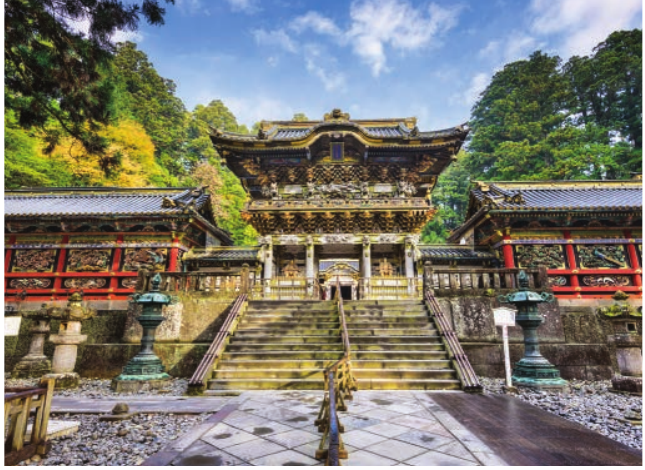
The Toshogu shrine in Nikko, Japan is a UNESCO World Heritage site. This tourist image presents the shrine set in a beautiful forest, with ornate architecture including woodcarvings and gold-leaf decoration. The image is carefully composed to showcase the site's aesthetic appeal.
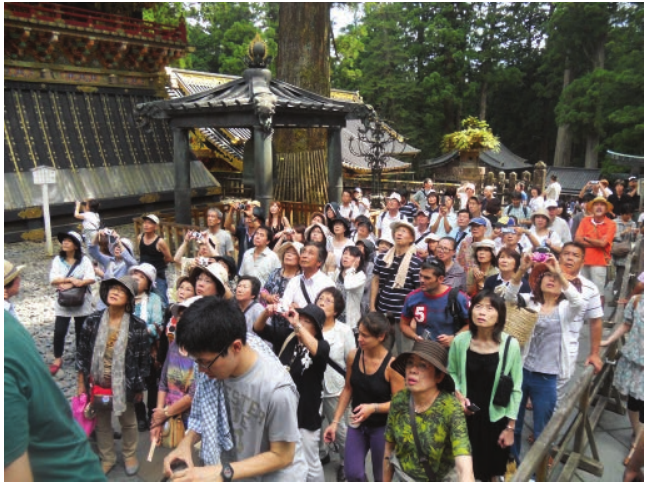
However, this second image shows the reality of visiting Nikko when tourist numbers are at their highest. The shrine is crowded with visitors, creating a very different experience from the idealised tourist image.
Important
Critical Analysis of Place Photographs
When analysing photographs of places, consider why and when the image was taken. What has been included and, crucially, what has been left out? The conditions under which a photograph was taken are just as important as what it shows. Some photographers have created entire galleries of 'before and after' photo editing to demonstrate how dramatically images can be altered.
Textual sources
Novels can evoke a powerful sense of place, giving readers the feeling that they know what it's like to 'be there'. Some places have become so strongly associated with particular authors and their stories that they are now promoted or advertised based on these literary connections. Examples include:
- Thomas Hardy's Dorset - The southwestern English countryside featured in his novels
- Brontë country - West Yorkshire and East Lancashire, associated with the Brontë sisters' works
These literary associations have become part of the places' identities, influencing tourism and how people perceive these regions.
Poetry
Poetry has long been used to describe and evoke a sense of place. Many famous poets are closely linked to particular locations:
- William Wordsworth - Associated with the Lake District
- Seamus Heaney - Wrote extensively about his Irish roots
- William Blake - Famously described the poverty and despair of industrial London
Poets refer to specific places in personal and expressive ways, but they also enable readers to sense and imagine what it's like to be in those locations.
Contrasting representations: London through different eyes
Two famous poems about London demonstrate how the same place can be represented in completely different ways:
Example
Worked Example: Contrasting Poetic Representations of London
William Blake's "London" (1794) presents a bleak, oppressive view of the city. Blake describes wandering through streets where he encounters "marks of weakness, marks of woe" in every face. His poem depicts:
- The "mind-forg'd manacles" of oppression
- The crying of chimney-sweepers
- Soldiers' blood running down palace walls
- The curse of young prostitutes
- Plagues afflicting marriages
- Overall despair and suffering throughout the city
William Wordsworth's "Composed upon Westminster Bridge, September 3, 1802" offers a dramatically different perspective. Wordsworth presents London as beautiful and majestic:
- "Earth has not anything to show more fair"
- The city wearing "the beauty of the morning"
- Ships, towers, domes, theatres and temples lying "bright and glittering in the smokeless air"
- Houses that "seem asleep"
- The river gliding "at his own sweet will"
- A "mighty heart" lying still
The contrast between these poems illustrates how place can be represented in vastly different ways through literature, depending on the author's perspective, experiences and the social conditions of the time.
Contemporary poetry: Multicultural Britain
Daljit Nagra is a contemporary British poet born in England to parents who are traditional Sikh Punjabis. He writes extensively about Britain where Indians came and settled. His poetry enables readers to be immersed in the Sikh community and experience Sikh Britain from the 'inside'.
Nagra explores the thoughts, feelings and cultural attitudes of first, second and third generation descendants towards their own community, other minority ethnic communities and the indigenous white population. His poem "Our Town with the Whole of India!" describes the district of Southall in London which migrants had transformed into a 'Little India' in the 1970s.
The poem celebrates the multicultural nature of the area, describing features such as:
- Temples, mandirs and mosques on promised streets
- A parade with banners and tridents
- Guy Fawkes' Diwali celebrations with rockets
- References to Rama and Sita from Hindu mythology
- Sunny Radio and its listeners
- Pizza Hut alongside Somali cab joints
- Reggae music where Caribbeans once gathered
- The transformation into a Halal Boys hotel
The poem captures the changes which occurred in the community over the years, celebrating the multicultural nature of the area whilst also highlighting potential tensions accompanying it.
Music
Music can effectively evoke a sense of place. Different types of music may be associated with particular geographical areas, such as reggae with Jamaica.
Song lyrics can also help portray specific places. In 2010, Newport rapper Alex Warren and singer Terema Wainwright created an internet sensation with their parody of Jay-Z and Alicia Keys' song about New York, "Empire State of Mind". The spoof version received almost 200,000 views in just two days on YouTube.
Example
Worked Example: Music as Place Representation - Newport Parody
Like the original music video, this version was shot in black and white with the singers referring to famous landmarks and cultural references. However, rather than the Manhattan skyline as a backdrop, the local duo celebrated the sights of the Welsh city. Rather than a grand piano in Times Square, Wainwright played a battered synthesizer on the riverfront and sang in a thick Welsh accent about Newport's distinctive features:
"Never been to concrete jumble nothing in order / When you're in Newport / Chips, cheese, curry makes you feel brand new / washed down with a Special Brew"
The song deliberately repeated "Newport, Newport" to emphasise place identity. Similar parodies have been created for numerous other UK places, demonstrating how music can celebrate and represent local identity.
Television and film
Places serve as vital backdrops to most dramas. We associate certain places with different types of stories—derelict houses in horror films or space ships in science fiction. However, television shows and films also play a significant role in representing place, which can have both positive and negative impacts.
Positive representations
Example
Case Study: Poldark and Cornwall
The 2015 television dramatisation of the Poldark novels had a positive impact on Cornish tourism. Viewers, inspired by shots of the dramatic coastline and beautiful beaches, flocked to the county to experience the atmosphere.
Key impacts:
- The Visit Cornwall website saw traffic soar by 65% after just the first episode
- Property website Rightmove reported that house-hunting enquiries more than doubled
- The 'Poldark effect' is anticipated to be felt well into the 2020s
This demonstrates the long-term impact of positive media representation on place perception and economic activity.
Example
Case Study: Game of Thrones and Northern Ireland
On a global scale, The Game of Thrones television series has become synonymous with Northern Ireland.
Economic impact:
- Estimated 350,000 tourists visit the region annually because of the programme
- Spending an average of $50 million per year
- The series has brought over $250 million into the economy since 2010
The government and local agencies recognise the importance that the television series has had on boosting many aspects of the regional economy and supporting positive representation of the region. Between the 1960s and 1990s, global media representations of Northern Ireland mainly focused on conflict and the troubles, which had a huge impact on investment and visitors to the country. The Game of Thrones has created a much more positive representation of place in the media.
Negative representations
Many crime dramas are located in urban settings, but not all crime occurs in cities. The sites chosen for filming can portray the same place in very different ways. Compare, for example, the representation of London in EastEnders (BBC, 1985–present) with the more glamorous skylines and buildings of The Apprentice (BBC, 2005–present) or the settings for the crime dramas Sherlock (BBC, 2011–2017) and Killing Eve (BBC, 2018–present).
Example
Example: Liverpool and Media Representation
The city of Liverpool is one of several (mainly northern) British cities that has historically suffered from negative portrayal in the British media. Unemployment, economic deprivation, gangs, rioting and drugs problems were all characteristic of 'Scouse' depictions in the press in the late twentieth century.
The city authorities adopted an aggressive rebranding strategy to distance the city from this poor media image. In 2008, the city was awarded the status of European Capital of Culture, reflecting Liverpool's more positive architectural, musical and sporting heritage.
Note
Research Tip: Using Historical Media Archives
When researching media representations of your chosen place studies, visit the British Pathé website and YouTube channel. British Pathé is a multimedia resource with film, documentary and newsreel archive material. Over the course of the twentieth century, British Pathé reported on everything from armed conflicts and political crises to the hobbies and eccentric lives of ordinary British people.
The resulting archive is a useful audio-visual source which can be used to document changes in place and population over time. The archive is available to view online for free.
Art
Art has long been used to represent place, most famously seen in landscape paintings of the eighteenth and nineteenth centuries. Certain painters became synonymous with geographical places:
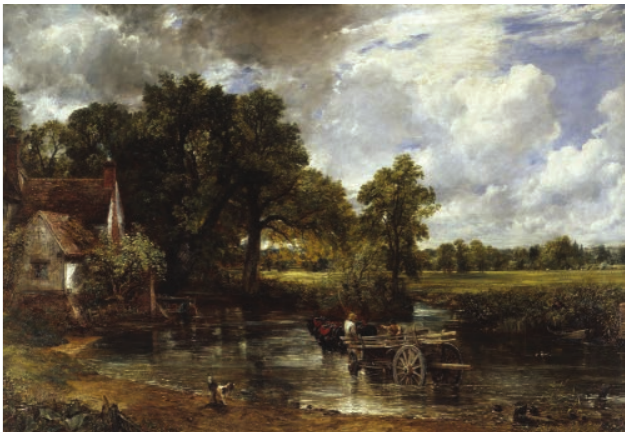
- Gainsborough and Constable - Known for their landscapes of Suffolk, now sometimes referred to as 'Constable Country'
- Paul Cézanne - French artist who painted Provence in southern France
- Hiroshi Yoshida - Japanese artist famous for his iconic wood block prints of Japanese landscapes
Critique of pastoral fantasies
The common criticism of such landscape paintings is that they were pastoral fantasies, giving the impression of a rural idyll which didn't exist for the majority of people living in the countryside at that time. These paintings reflected a romantic vision which still shapes many people's mental images of the countryside today and is perpetuated through tourist brochures, chocolate boxes and jigsaw puzzles. Such constructs of rural places are powerful because they shape views on what the countryside is actually like and what it should be like.
Important
Critical Questions for Analysing Art Representations of Place
When analysing art that depicts place, ask yourself:
- What and who are shown in the picture, and why?
- What and who are not shown, and why?
- Why did the artist paint this scene and who commissioned it?
These questions help reveal the biases, perspectives and social contexts that shape artistic representations of place.
L.S. Lowry and industrial landscapes
Paintings may be considered less reliable than photographs because there's more scope for individual interpretation and selection. However, they can also show a deeper understanding of place because they allow the painter to convey more of the character of what is present.
An artistic representation of an urban place can be seen in the work of L.S. Lowry, famous for his matchstick human figures and depictions of life in northern mill towns. Lowry became interested in the industrial landscape after he moved to Salford with his family. Although he made many drawings there, his mill scenes (a combination of the real and the imagined) have remained his most famous works.
Example
Case Study: Lowry's Legacy and Place Regeneration
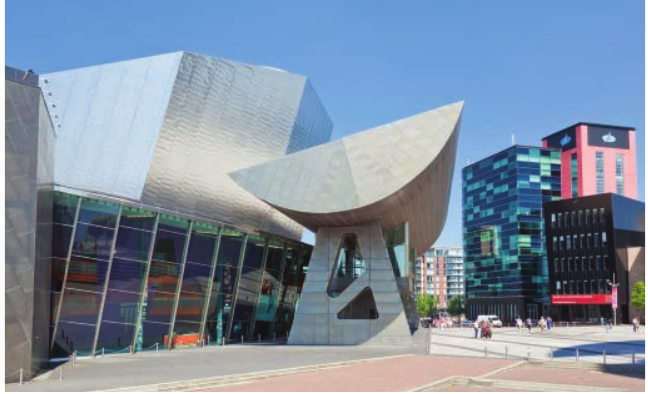
Lowry's legacy and association with Salford have continued into the twenty-first century and been used for place regeneration. The Lowry Centre has become a key part of the redevelopment of the Salford Quays in Greater Manchester.
The iconic Lowry Centre opened in 2000 on the site of the old docks and now sits at the heart of Media City UK, having a major influence on the cultural landscape of the north-west. This demonstrates how artistic heritage can drive modern urban regeneration.
Sculpture and place regeneration
Art has traditionally represented place, but it can also make a place distinctive and be used in the regeneration of an area.
Example
Case Study: The Kelpies, Scotland
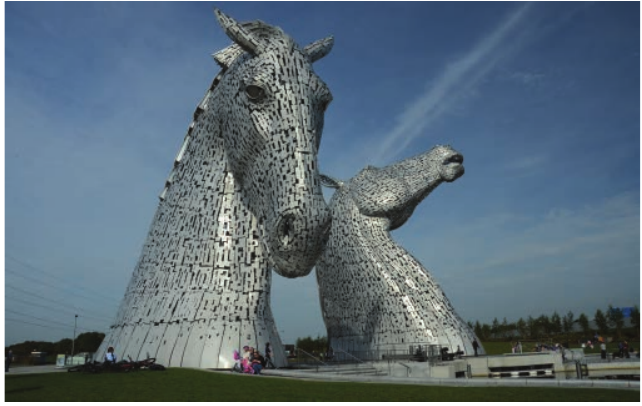
The Kelpies sculpture is located near Falkirk in Scotland and forms a landmark feature of the Helix Environmental Regeneration Scheme on the Forth and Clyde Canal. The sculptures are modelled on heavy horses and represent the industrial history of Scotland and the Falkirk/Grangemouth area.
Historical significance: Heavy horses were once the powerhouse of the area, working in the foundries, the fields, farms and the canal itself.
Impact on place: The Kelpies sculpture has been used to regenerate place here, but their national and international prominence has also helped to develop a sense of pride and ownership in the local place. Indeed, they were the front cover image of a 2014 book entitled Scotland: The Best 100 Places, demonstrating their iconic status.
Graffiti and street art
Graffiti is writing or drawing that has been placed illicitly on a wall or other surface, often in a public place. It has traditionally been associated with youth cultures claiming ownership of a place. However, the famous UK graffiti artist Banksy argues that the importance of graffiti is also to give a voice to people who aren't normally heard in the mainstream.
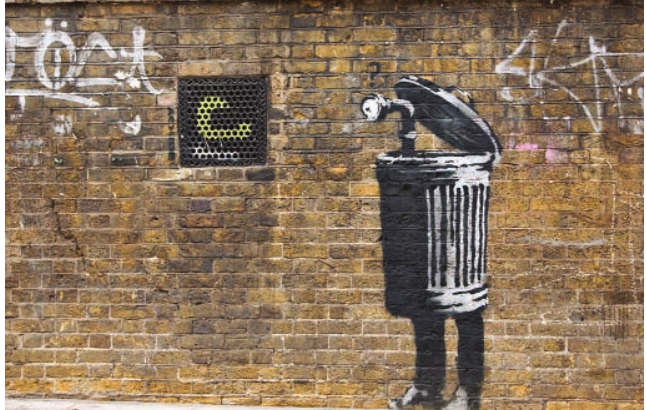
Many consider graffiti a type of vandalism and authorities are keen to remove it from public areas. Increasingly however, graffiti is being accepted into mainstream culture and art galleries now stock graffiti images. In these places, graffiti is seen not as being 'out of place' but as something which can be bought and sold. It is also being used as a type of street art in the regeneration of places.
Example
Case Study: Dismaland, Weston-Super-Mare, Somerset
An unusual type of art installation brought thousands of visitors and greater place recognition to the seaside resort of Weston-Super-Mare in the summer of 2015.
The installation: Based in a derelict seafront lido and billed as a 'bemusement park', Banksy's Dismaland featured artworks on themes including the apocalypse, anti-consumerism and celebrity culture.
Context: Unlike other British seaside resorts like Margate in Kent, which has built up a more positive representation following the opening of the Turner art gallery, Weston-Super-Mare relies on its beaches and traditional seaside attractions for visitors.
Economic impact: Banksy's work brought significant benefits to a resort which has experienced significant decline in the last few decades:
- An additional 150,000 people visited the town as a result of the attraction
- They added $20 million to the local economy
- Local tourist chiefs were delighted that it helped to put the place of Weston-Super-Mare more firmly on the map
Place and architecture
As well as designing buildings, architects are responsible for planning places. This planning is seen as increasingly important in terms of creating sustainable and healthy places. Architecture can also play a pivotal role in the redevelopment and rebranding of a place.
Some redevelopment schemes utilise the existing style or heritage of buildings and areas they're modernising, whilst others involve more radical change as part of a rebranding process. Compare, for example:
- The redevelopment of the SouthGate shopping centre in Bath to the redevelopment of the Bull Ring in central Birmingham
- The former mimics the city's original and popular Georgian architecture with a Bath-stone façade
- The Bull Ring was a much more radical redevelopment, incorporating the construction of the iconic Selfridges department store with a façade of 15,000 aluminium discs mounted onto a blue background
The latter has been seen as one of several architectural landmarks, including the city library, which have made a major contribution to the regeneration of central Birmingham.
Gentrification
Redevelopment of place comes at a cost to some. The process of gentrification has been strongly promoted by local government in many British cities as a method of economic regeneration.
Important
Gentrification: Definition and Consequences
Gentrification is the improvement of housing in an area that was formerly poor and run-down. It is mainly carried out by middle-class residents or newcomers who purchase properties at cheaper prices and make repairs and improvements which increase the housing value. The nature of the whole area may improve and this leads to greater wealth in this particular place.
Critical impact: Unfortunately, not everyone benefits and the original poorer residents may find themselves 'displaced' as they can no longer afford to live in the area. A similar process has occurred in some British coastal resorts where second-home owners have effectively priced less affluent locals out of the housing market.
Digital or 'augmented' place
The rise in the use of digital technology such as smartphones has led to much discussion about the notion of digital place. Parallel interactive places such as Second Life and Fortnite have existed for some time, but these are seen as virtual places rather than real places.
The increased use of digital technology is changing how people experience and interact with places, creating new forms of place attachment and identity beyond physical location.
Remember!
Summary
Key Points to Remember: Media Representation of Place
-
Media powerfully shapes place perception - Different forms of media (TV, film, photography, art, music, poetry) all influence how we understand and feel about places, often more than direct experience.
-
Representations can differ dramatically from reality - Tourist photographs, marketing images and idealised portrayals often present places very differently from everyday reality, as seen in the Toshogu shrine comparison.
-
Media can have significant economic impacts - Positive media representation can boost tourism and regeneration (Poldark in Cornwall, Game of Thrones in Northern Ireland), whilst negative representation can harm a place's reputation and economy.
-
Different perspectives reveal different truths - The same place can be portrayed in contrasting ways (Blake's versus Wordsworth's London), reflecting different experiences, social conditions and viewpoints.
-
Art and architecture actively shape place identity - From landscape paintings creating the 'rural idyll' to sculptures like the Kelpies or buildings like the Lowry Centre, artistic representations don't just reflect places—they actively create place identity and can drive regeneration, though this may lead to gentrification and displacement.