Nature and Importance of Places (AQA A-Level Geography): Revision Notes
📚Revision Notes
Nature and importance of places
Understanding the concept of place
Place is a fundamental concept in geography that goes beyond simply identifying a location on a map. When we think about 'place', we often think of somewhere meaningful to us - perhaps our home, where we store our possessions and create memories. However, the geographical meaning of place is more complex and has been debated by academics across different disciplines.
What makes place different from space?
The key difference between place and space is that places have meaning to people. Space becomes place as we get to know it better and develop connections with it. For many people, the most familiar example of place is their home, where they feel most attached and can be themselves.
Important
Place is defined as a location with meaning. Places can be meaningful to individuals in personal ways, or they can be meaningful at a social or cultural level. These meanings may be shared by different groups of people.
Geographers study the multidimensional aspects of place, which may include:
- Emotional responses to places
- Film and photography of places
- Art representations
- Media portrayals and representations
The three aspects of place
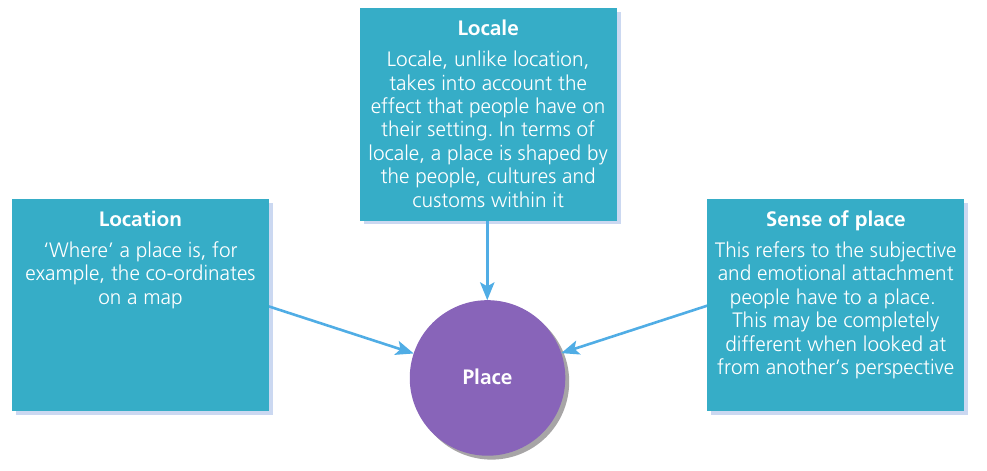
Geographers recognise three main aspects when studying places: location, locale and sense of place. Understanding all three dimensions gives us a complete picture of any place.
Location
Location is the starting point for understanding place, but places are far more significant than simply being points on a map.
Note
Location refers to where a place is - for example, the coordinates on a map.
Location provides the geographical position and can be described using:
- Coordinates (latitude and longitude)
- Distance from other places
- Physical characteristics of the position
Locale
Locale takes into account the physical characteristics of a place and how people interact with their setting.
Note
Locale is where something happens or is set, or that has particular events associated with it. In terms of locale, a place is shaped by the people, cultures and customs within it.
Locale considers:
- How people shape their environment
- The activities that take place there
- Cultural practices and customs
- The built environment and infrastructure
Sense of place
This is perhaps the most personal and subjective aspect of place.
Note
Sense of place refers to the subjective and emotional attachment people have to a place. This may be completely different when looked at from another person's perspective.
Sense of place involves:
- Emotional connections
- Personal experiences
- Memories associated with the location
- How a place makes different people feel
The concept of topophilia describes the affective bond between people and place. Geographers Yi-Fu Tuan and Edward Relph developed this term to explain how human perception and experience help us to know places. They argued that the degree of attachment, involvement and concern that a person or group has for a particular place is critical to our understanding of that place.
Case study: Glastonbury
Glastonbury provides an excellent example of how all three aspects of place work together to create a location with deep significance.
Location
Glastonbury is situated in the county of Somerset in south-west England.
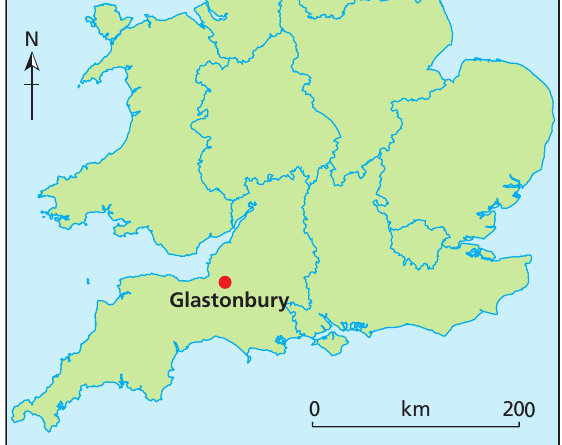
Specific location details:
- 23 miles south of Bristol
- Latitude: 51.1456N
- Longitude: 2.7144W
- Situated at a dry point on the low-lying Somerset Levels
Locale
Glastonbury has a unique character shaped by its visitor attractions and the people who visit or live there. The town is home to:
- Glastonbury Abbey - an early centre of pilgrimage with connections to myth and legend
- Glastonbury Tor - a distinctive hill with spiritual significance
Note
The Visit Britain website describes Glastonbury as being "alive with a history that sits comfortably alongside myth and legend. The Abbey was an early centre of pilgrimage and many believe King Arthur is buried amid the ruins. It is said that a young Christ also visited Glastonbury and that the Holy Grail is hidden nearby. Quirky independent shops abound selling everything from healing crystals to cakes."
The National Trust describes Glastonbury Tor as a spiritual magnet for centuries, for both Pagans and Christians. The site is steeped in tales that have grown from history, with truth and embellishment blending together over time.
Sense of place
For different groups of people, Glastonbury evokes various emotions and holds different meanings:
Spiritual significance: Glastonbury is a place of great spiritual importance for people interested in:
- Paganism
- Religious connections
- The King Arthur affiliation
- Alternative spirituality
Cultural importance: The internationally famous Glastonbury Festival takes place each year at Worthy Farm in Pilton, on the edge of Glastonbury.

Example
Cultural Evolution: The Glastonbury Festival
The first Glastonbury Festival took place in June 1970, attended by 1,500 people with a $1 entry fee that included free milk from the farm.
Today, it has grown into one of the world's most famous music festivals, creating a unique sense of place for attendees and contributing to Glastonbury's cultural identity.
Key geographical terminology
Understanding the specific vocabulary used to describe places is essential for geographical analysis.
Note
Media refers to means of communication including television, film, photography, art, newspapers, books and songs. These reach or influence people widely.
Note
Meaning relates to individual or collective perceptions of place - what a place signifies to different people or groups.
Note
Placemaking is the deliberate shaping of an environment to facilitate social interaction and improve a community's quality of life.
Note
Subjective means based on or influenced by personal feelings, tastes or opinions rather than objective facts.
Theoretical approaches to place
The nature and meaning of place has been debated extensively in geography. There are three main approaches to understanding place, and for A-level Geography it's important to consider all three perspectives. Places are not simply geographical locations - they should be understood as dynamic areas where people, ideas and information come together.
1. A descriptive approach
This approach views the world as a set of places, with each place being distinct and able to be studied individually.
Key idea: Each place has unique characteristics that can be identified and described.
Cultural geographer Jon Anderson argues that places can be defined and given meaning by the traces that exist within them:
Note
Material traces are physical additions to the environment, including:
- Buildings and structures
- Signs and markers
- Statues and monuments
Non-material traces include:
- Events that occur in that place
- Performances and activities
- Emotions and experiences associated with the location
2. A social constructionist approach
This approach sees place as a product of a particular set of social processes occurring at a particular time.
Key idea: Places are created and shaped by historical, social and political forces.
Example
Historical Context: Trafalgar Square
Trafalgar Square was built to commemorate a British naval victory in the 1800s. Using a social constructionist approach, we can understand this place as a product of empire and colonialism - reflecting the values and priorities of British society at that specific time in history.
3. A phenomenological approach
This approach focuses on how individual people experience places, recognising the highly personal relationship between place and person.
Key idea: Understanding place comes through human perception and experience, not just physical characteristics.
Rather than asking why a place was constructed or what makes it unique, this approach examines how people actually experience and feel about places. The work of geographers Yi-Fu Tuan and Edward Relph particularly emphasises the affective (emotional) bond between people and place.
Important
There is overlap between these three approaches, and no single approach is more important than the others. For A-level Geography, you should consider all three perspectives. Places hold meaning, and different groups of people may see places differently and have different scope to change these places.
Case study: Trafalgar Square, London
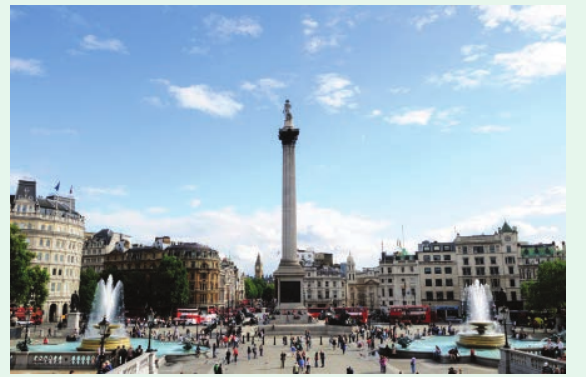
Trafalgar Square demonstrates how the descriptive approach can be applied to understand place through material and non-material traces.
Example
Applying the Descriptive Approach: Trafalgar Square
Material traces in Trafalgar Square:
- The statue of Admiral Lord Nelson
- The tall column on which the statue stands
- The large public square itself
- Two decorative fountains
Non-material traces:
- Events and performances that occur in the square
- Emotions people feel when visiting
- Historical significance of the British naval victory
- Contemporary use as a tourist attraction and gathering space
However, to fully understand Trafalgar Square, we need to look beyond these immediate traces. We should consider the meanings behind them and the aims of the people who constructed these features. The square represents not just physical features, but also historical power, national identity and colonial history.
Summary
Key Points to Remember:
-
Place is more than location - it has meaning to people, which distinguishes it from the abstract concept of space
-
The three aspects of place work together: location (where it is), locale (how it's shaped by people and culture), and sense of place (emotional and subjective attachments)
-
Different people experience places differently - sense of place can vary completely depending on individual perspectives and experiences
-
Three theoretical approaches help us understand places: descriptive (identifying unique characteristics), social constructionist (understanding historical/social creation), and phenomenological (focusing on personal experience)
-
Places are dynamic - they bring together people, ideas and information, and their meanings can change over time for different groups