Case Study: Mumbai (AQA A-Level Geography): Revision Notes
📚Revision Notes
Case Study: Mumbai
Introduction and location
Mumbai is India's most populous city, with an estimated population exceeding 25 million in 2020. Although it is not the nation's capital, Mumbai serves as the financial and commercial hub of India. The city is also home to the famous Bollywood film industry.
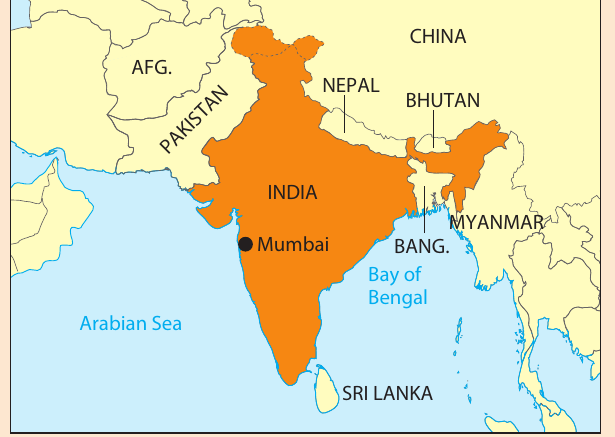
Mumbai is situated on the west coast of India and is the capital of Maharashtra state. The city's strategic coastal position has been crucial to its development throughout history.
Note
Mumbai's location on India's west coast has made it a natural gateway for maritime trade and commerce, connecting India to the Middle East, Africa, and Europe for centuries.
Historical development
Mumbai's origins lie in its role as a trading post, where merchants sold valuable goods including gold, jewellery and textiles. The city's modern development began when the East India Company arrived in the early seventeenth century, leading to the establishment of the British Raj (Empire).
During the colonial period, raw cotton was regularly shipped from Mumbai to Britain for manufacturing. Originally, the city consisted of a series of islands separated by swamps. However, by 1845, these swamps had been filled in and Mumbai occupied one large island.
Note
From Islands to City:
The transformation of Mumbai from seven separate islands into a single landmass was a massive engineering undertaking. This land reclamation project created the foundation for the modern city we see today.
A key geographical advantage is Mumbai's natural deep-water harbour. This strategic location became even more important after the opening of the Suez Canal in 1869, as it positioned Mumbai as a major port in the Arabian Sea.
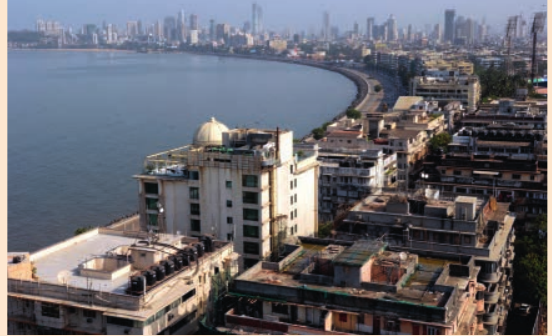
Following India's independence from Britain in 1947, Mumbai experienced rapid development. The city acquired modern infrastructure including high-rise buildings, the Bombay Stock Exchange, tarred roads and a booming manufacturing and services sector. This transformation elevated Mumbai's status on the world stage.
Economic importance
Mumbai has become a megacity and now holds the distinction of having the highest population density of any city in the world. This enormous concentration of people places inevitable strain on the urban infrastructure.
Important
What is a Megacity?
A megacity is a metropolitan area with an exceptionally large population, typically over 10 million people. Mumbai is classified as a megacity due to its population exceeding 25 million.
The city's economic significance to India is substantial:
- 33% of India's income tax revenue
- 6.16% of the country's GDP (the largest single contributor)
- 25% of industrial output
- 40% of foreign trade
These figures demonstrate Mumbai's critical role in driving India's economy forward.
Social characteristics and challenges
Mumbai's population has more than doubled since 1991. This dramatic growth is largely due to the influx of migrants from other parts of India who are seeking better employment opportunities.
The resulting population is remarkably diverse, with 16 major languages of India spoken within the city. However, this rapid growth has brought significant social challenges.
Important
Poverty and Inequality Crisis
Poverty and inequality are two of the most pressing issues facing Mumbai. It is estimated that around 60% of Mumbaikars live in 'slums'. To put the wealth disparity in perspective, the average Indian would need to work for three centuries to afford a luxury home in Mumbai.
Dharavi slum
There are numerous informal slum areas throughout Mumbai, but Dharavi in central Mumbai is perhaps the most famous. It gained international attention through the Oscar-winning film Slumdog Millionaire in 2008.
Origins and development
The area that became Dharavi was originally mangrove swamp inhabited by Koli fishermen. When the swamp was filled in with coconut leaves, rotten fish heads and human waste, the Koli people lost their fishing grounds. However, this created land area for others to settle.
The Kumbhars came from Gujarat to establish a pottery colony. Tamil and Telugu families also arrived, and thousands more travelled from areas such as Uttar Pradesh to work in the rapidly expanding textiles industry. The result was a very diverse neighbourhood in a diverse city.
Economic activity
Cottage industries have thrived in Dharavi. The area is home to thousands of micro-industries, including:
- Garment-makers
- Tanners
- Welders
- Potters
These small-scale businesses produce over US$650 million worth of goods annually.
Living conditions
Despite this economic activity, the living and working conditions remain very poor. Years of government neglect have resulted in inadequate hygiene standards. Dharavi is said to have the highest population density in the world at over 300,000 people per square kilometre.
Note
Infrastructure Challenges in Dharavi:
Housing quality is poor and areas within the slum lack basic infrastructure. In some parts of the slum, toilets are shared by as many as 1,000 people, and services such as water and electricity are not always available.
Redevelopment efforts
Due to the northward expansion of the city, Dharavi now finds itself occupying an area of prime land in the new business district of India's richest city. This has made it a key target for developers eager to make money from the construction of high-end apartments.
The government has been keen to improve the appearance and reputation of the area. The Dharavi Redevelopment Project will see all residents who can prove residency since 2000 provided with a new, 300-square-foot house for free.
However, the scheme has not been without controversy. The main concern has been the potential loss of the community networks and businesses which have built up in the area over generations.
Physical environmental conditions
Mumbai has a tropical climate. The south-west monsoon brings heavy rainfall to the city between June and September each year.
Although Mumbaikars adapt to the wet conditions, the rains can be devastating for the city, which is mainly built on low-lying land. In 2019, Mumbai received more rainfall than usual during the monsoon season:
- More than 250 mm fell on one day in August
- 403 mm fell in just four days in early September
- This compares with the monthly expected average rainfall of 341 mm
Impact of the 2019 monsoon
Important
Devastating Consequences of the 2019 Monsoon:
The consequences of this extreme rainfall were severe:
- Several people were washed away and others killed by collapsing walls
- Electricity, water supply, communication networks and public transportation were shut down or collapsed
- More than 400 people died
- Over 10,000 homes were destroyed
- The city suffered losses running into billions of pounds
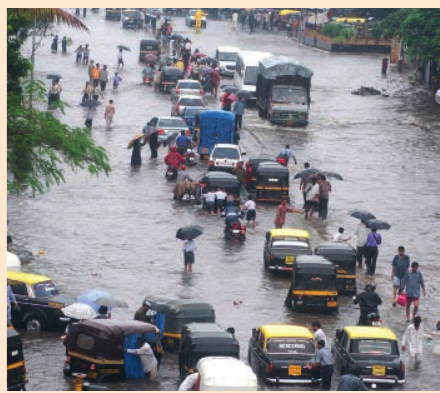
Urban growth was partly to blame for the severity of the flooding. There was nowhere for the rainwater to go because rapid and often uncontrolled development had replaced most of the public parks, private gardens, beaches, mangrove swamps and wetlands with a built environment.
The Greater Mumbai Disaster Management Action Plan
This plan was created in response to flooding in 2005. It identified the risks and vulnerabilities the city could face in the future, including earthquakes and cyclones. The plan created the Disaster Management Cell to coordinate relief and rescue efforts.
The plan also widened and deepened the Mithi River which drains out into the Arabian Sea. This is clearly a positive strategy for Mumbai and shows the government is keen to address the major flood issue.
Note
Ongoing Flood Vulnerabilities:
However, environmentalists are concerned that there are still too many factors which make Mumbai vulnerable to flooding again:
- Continued construction on the floodplain
- Removal of mangrove forests
- Clogging of storm drains and waterways with plastic waste
In addition to flooding risks, the Intergovernmental Panel on Climate Change (IPCC) has predicted that the increase in rainfall, heat, humidity and sea-level rise associated with climate change will make Mumbai the second most at-risk city in the world.
Environmental issues
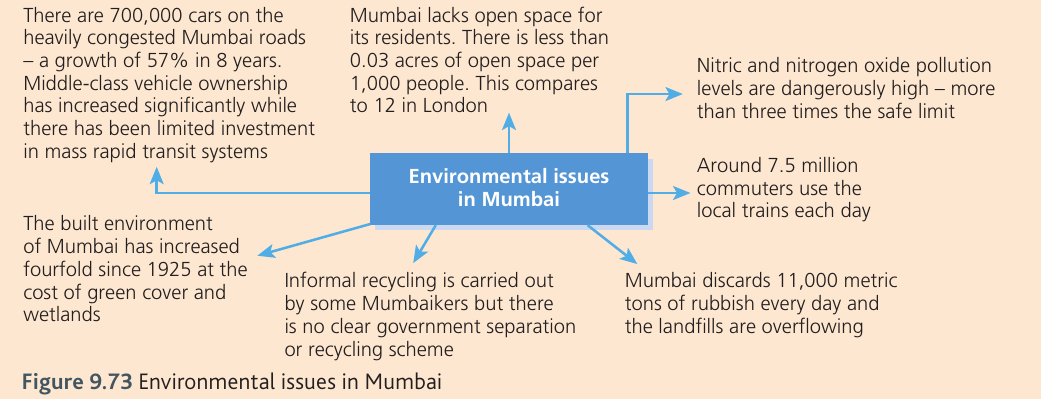
Mumbai faces considerable environmental pressures as Figure 9.73 demonstrates. The city's rapid growth has created multiple interconnected challenges.
Traffic congestion and air pollution
There are 700,000 cars on the heavily congested Mumbai roads – a growth of 57% in 8 years. Middle-class vehicle ownership has increased significantly, but there has been limited investment in mass rapid transit systems.
Note
Air Quality Crisis:
This heavy traffic contributes to dangerously high levels of air pollution. Nitric and nitrogen oxide pollution levels are dangerously high – more than three times the safe limit.
Waste management
Mumbai discards 11,000 metric tons of rubbish every day and the landfills are overflowing. Informal recycling is carried out by some Mumbaikars, but there is no clear government waste separation or recycling scheme.
Lack of green space
The built environment of Mumbai has increased fourfold since 1925 at the cost of green cover and wetlands. Mumbai lacks open space for its residents. There is less than 0.03 acres of open space per 1,000 people. This compares to 12 acres in London.
Public transport pressures
Around 7.5 million commuters use the local trains each day. This places enormous strain on the city's transport infrastructure.
The future
Economic growth has clearly brought wealth to many in Mumbai, and new housing projects are attempting to address the shortage of housing. However, this megacity is struggling to cope with its rapid growth.
Services are stretched or non-existent, and water supplies are polluted. Air quality is growing worse, and over half the population still lives in slums. The Indian government has pledged to make India's cities, including Mumbai, 'smarter' in terms of the economy and environment.
In addition, non-government organisations have been working towards improving the lives of slum dwellers in Mumbai. However, Mumbai faces considerable environmental pressures and much greater investment and long-term planning are essential if the city is to become truly sustainable in the twenty-first century.
Summary
Key Points to Remember:
- Mumbai is India's most populous city (over 25 million) and serves as the nation's financial and commercial hub, contributing 33% of income tax and 40% of foreign trade.
- Around 60% of the population lives in slums, with Dharavi being the most famous – it has over 300,000 people per square kilometre and hosts thousands of cottage industries.
- The 2019 monsoon brought devastating flooding (403mm in 4 days), killing over 400 people and destroying 10,000+ homes, demonstrating the impact of building on low-lying land and removing natural drainage.
- Environmental challenges include severe traffic congestion (700,000 cars), air pollution (nitrogen oxides 3x safe limit), massive waste generation (11,000 metric tons daily), and critically low green space (0.03 acres per 1,000 people).
- Climate change predictions suggest Mumbai will become the second most at-risk city globally due to increased rainfall, heat, humidity and sea-level rise.