Case Study: Sustainable City, Copenhagen (AQA A-Level Geography): Revision Notes
📚Revision Notes
Case Study: Sustainable City, Copenhagen
Overview of Copenhagen's sustainability
Copenhagen, the capital of Denmark, consistently ranks at the top of global lists for the world's most sustainable cities. In 2019, the city received recognition as the European Green Capital, acknowledging its outstanding environmental achievements and commitment to sustainability.
The city has developed an ambitious climate action plan (established in 2011) with a clear vision: to become a green, smart, carbon-neutral city by 2025. This makes Copenhagen a global leader in urban sustainability and provides an excellent example of how cities can address climate change whilst maintaining high quality of life.
Important
Carbon-neutral city
A carbon-neutral city is one where the amount of carbon dioxide released into the atmosphere is balanced by the amount removed or offset, resulting in net-zero carbon emissions.
Note
Copenhagen's success demonstrates that ambitious environmental targets can be achieved without compromising economic prosperity or quality of life. The city serves as a model for other urban areas worldwide seeking to balance sustainability with development.
Copenhagen's climate action plan targets
To achieve its carbon-neutral goal by 2025, Copenhagen has set specific, measurable targets:
- Energy generation: Installing 100 additional wind turbines to increase renewable energy production
- Energy efficiency: Reducing both heat and commercial electricity consumption by 20%
- Sustainable transport: Encouraging 75% of all journeys to be made by bicycle, on foot, or by public transport
- Waste management: Implementing the biogasification of all organic waste to generate energy
- Solar power: Installing 60,000 m² of new solar panels across the city
- Renewable heating: Meeting 100% of the city's heating requirements through renewable energy sources
These targets demonstrate Copenhagen's comprehensive approach to sustainability, addressing energy, transport, and waste simultaneously rather than focusing on just one area.
Note
Why Comprehensive Targets Matter
By addressing multiple aspects of urban sustainability simultaneously – energy generation, efficiency, transport, and waste – Copenhagen ensures that progress in one area supports and reinforces progress in others. This integrated approach is more effective than tackling issues in isolation.
Social development
Copenhagen has created an urban environment that prioritises the wellbeing and quality of life of its residents. The city's approach to social sustainability goes beyond environmental measures to consider how people actually live their daily lives.
Work-life balance
One remarkable statistic highlights Copenhagen's approach to working culture: only 2% of employees in the city work more than 40 hours per week. This contrasts sharply with many other major cities where long working hours are common. The benefits of this approach include:
- More time available for family, friends and hobbies
- Increased opportunity for recreational activities
- Significantly lower stress levels among the population
- Better overall mental and physical health
Cycling culture and infrastructure
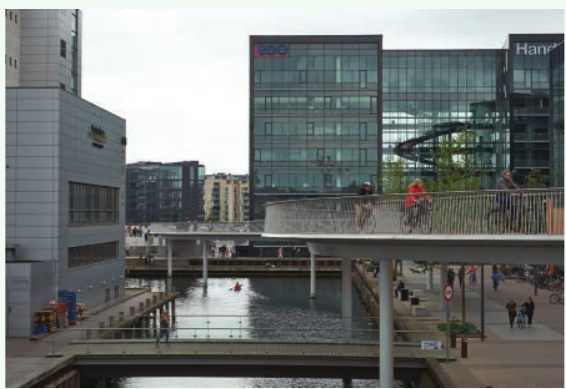
Copenhagen has developed one of the world's most extensive cycling networks, with 249 miles of dedicated cycle lanes throughout the city. This infrastructure makes cycling both easy and safe, encouraging more than half of commuters to travel to work or school by bicycle each day.
Note
Innovative Cycling Infrastructure
In 2015, Copenhagen opened the Cykelslangen (meaning "Cycle Snake"), an elevated two-way bridge spanning 220 metres. This bridge creates a pleasant, stress-free environment for cyclists, pedestrians and other users, demonstrating how infrastructure can be both functional and enjoyable.
Health benefits
The emphasis on cycling has delivered tangible health benefits. It is estimated that Copenhagen residents experience one million fewer sick days simply because they cycle so frequently. Regular cycling improves cardiovascular health, reduces obesity, and boosts mental wellbeing – demonstrating how sustainable transport choices can simultaneously improve public health and reduce environmental impact.
Economic development
Copenhagen's success as a sustainable city is underpinned by strong economic performance. The city serves as Denmark's economic and financial centre, hosting numerous international companies and successful business clusters, particularly in:
- Information technology (IT)
- Biotechnology
- Pharmaceuticals
High wages and employment
Copenhagen offers some of the highest wages in the world whilst maintaining low unemployment rates. This economic prosperity enables the city to invest in sustainability initiatives and provides residents with financial security and high living standards.
Entrepreneurial culture
The city has maintained a distinctive entrepreneurial spirit that values independent businesses. In Copenhagen, many people have "held on" to their independent shops, cafes and small boutiques rather than being replaced by global chains. This creates a unique local character and ensures that economic benefits remain within the community.
Note
The city also maintains reasonable rents compared to other European capitals, which allows young start-up companies to flourish. This supportive environment for new businesses ensures continued economic innovation and job creation.
Environmental management
Copenhagen has implemented comprehensive environmental management strategies that address multiple aspects of urban sustainability.
Harbor transformation
The harbor that bisects Copenhagen has undergone a dramatic transformation. Previously an industrial zone, it has been converted into a cultural and residential hub that residents can enjoy. A key achievement has been water quality improvement:
- Investment in reservoirs and conduits has addressed the problem of wastewater overflow
- Where 100 overflow channels previously carried wastewater into the harbor after heavy rain, these systems now capture and treat the water
- The harbor water is now so clean that residents can safely swim in it
This transformation shows how former industrial areas can be regenerated for recreational and residential use whilst improving environmental quality.
Integrated public transport
Copenhagen is served by an integrated public transportation network that makes car ownership less necessary:
- A driverless Metro system that operates efficiently
- Regional trains connecting the city with surrounding areas
- Buses complementing the rail network
- All systems coordinated for easy connections
This comprehensive approach reduces private car use and associated emissions.
Renewable energy
In 2001, a large offshore wind farm was constructed just off Copenhagen's coast at Middelgrunden. This wind farm produces approximately 4% of the city's total energy needs. Whilst this may seem modest, it represents significant progress and demonstrates the city's commitment to diversifying its energy sources.
Important
Protecting Green Spaces: The Finger Plan 2007
Copenhagen's Finger Plan 2007 represents a strategic approach to urban planning that protects the city's green belt from development and limits urban sprawl. The "finger" concept allows urban development along transport corridors whilst preserving green spaces between them, ensuring that natural areas remain accessible to all residents.
Green belt protection
Copenhagen's Finger Plan 2007 represents a strategic approach to urban planning. This plan:
- Protects the city's green belt from development
- Limits urban sprawl through better use of existing city land
- Ensures that green spaces remain accessible to residents
- Maintains biodiversity corridors
Innovative waste management
In 2019, Copenhagen opened the Amager resource centre, demonstrating how waste management facilities can serve multiple purposes. This waste incinerator building:
- Converts waste to energy through incineration
- Incorporates hiking and running trails around the facility
- Features a street fitness gym
- Includes an 85-metre climbing wall – the world's highest outdoor climbing wall
- Transforms waste management into a community resource
Example
Multi-Purpose Infrastructure: Amager Resource Centre
The Amager resource centre exemplifies Copenhagen's creative approach to sustainability. Rather than simply being a waste facility hidden from public view, it serves multiple functions:
Step 1: Primary function – waste-to-energy incineration reduces landfill and generates electricity
Step 2: Recreational use – hiking trails, running tracks, and fitness facilities attract visitors
Step 3: Tourist attraction – the 85-metre climbing wall and unique design make it a destination
This project demonstrates how necessary infrastructure can also provide recreational opportunities and become a community asset rather than an eyesore.
Urban governance
Copenhagen's sustainability achievements are supported by effective governance structures and social policies that promote equality and citizen participation.
Taxation and welfare
Denmark maintains one of the highest taxation levels in the world. However, this taxation funds extremely generous state welfare provision, which:
- Reduces inequality between rich and poor
- Provides universal healthcare
- Ensures free education
- Offers unemployment support and social services
This approach demonstrates that higher taxation can be accepted when it delivers visible benefits and creates a fairer society.
Note
The Social Contract
Copenhagen's model shows how high taxation can gain public support when citizens see tangible benefits. The generous welfare system creates a safety net that reduces social inequality and builds the social cohesion necessary for collective action on sustainability challenges.
Citizen participation
The Citizen's Dialogue Project represents a publicly financed scheme that involves direct public participation in planning decisions. This ensures that:
- Residents have a genuine voice in how their city develops
- Planning decisions reflect community needs and preferences
- There is greater public buy-in for sustainability initiatives
- Democratic principles are embedded in urban development
Social equality
Denmark boasts very high income equality and gender equality compared to most other countries. The society is perceived to be very fair and egalitarian, which:
- Reduces social tensions
- Creates a sense of shared purpose in achieving sustainability goals
- Ensures that sustainability benefits are distributed fairly
- Builds social cohesion necessary for collective action on climate change
Summary
Key Points to Remember:
-
Copenhagen received the European Green Capital award in 2019 and aims to be carbon-neutral by 2025 – demonstrating global leadership in urban sustainability with specific, measurable targets including 100 new wind turbines, 20% reduction in energy consumption, and 75% sustainable transport journeys.
-
The city prioritises quality of life through exceptional work-life balance (only 2% work over 40 hours weekly) and world-class cycling infrastructure (249 miles of cycle lanes) – showing that sustainability and wellbeing go together. The health benefits are significant, with one million fewer sick days attributed to cycling.
-
Copenhagen combines strong economic performance with sustainability – high wages, low unemployment, and support for entrepreneurship prove that environmental goals need not compromise economic success. The city maintains its unique character through independent businesses and reasonable rents.
-
Environmental management is comprehensive and innovative – from harbor transformation (now clean enough for swimming) and renewable energy (4% from offshore wind farm) to the multi-purpose Amager resource centre, Copenhagen finds creative solutions that serve multiple purposes.
-
High taxation funding generous welfare, the Citizen's Dialogue Project for public participation, and strong income and gender equality create the social foundation for sustainability – demonstrating that effective governance and fair societies enable ambitious environmental action.