Cultural Diversity (AQA A-Level Geography): Revision Notes
📚Revision Notes
Cultural Diversity
What is cultural diversity?
Cultural diversity refers to the existence of a variety of cultural or ethnic groups within a society. Culture encompasses many aspects of life including nationality, ethnicity, age and traditions, with immigration being a major influence on cultural patterns.
Urban areas, particularly large cities, are places where cultural diversity tends to flourish. Cities such as London, New York and Amsterdam have received migrants from around the globe, leading to the development of multicultural urban societies. London is considered one of the most diverse cities globally, with over 300 languages spoken and at least 50 non-indigenous communities with populations exceeding 10,000 people.
Important
Diaspora is a term commonly used to describe a large group of people with a similar heritage or homeland who have settled elsewhere in the world.
Globalisation has increased movement around the world, making it common to find people from different parts of the world living in major urban areas. In some global cities, these diasporas make up a larger proportion of the population than the indigenous residents.
Case study: Dubai
Example
Case Study Example: Dubai's Multicultural Population
The United Arab Emirates state of Dubai provides an excellent example of diaspora populations. The majority of the city's population comprises expatriates, with two-thirds of the population being of Asian descent. People have migrated from India, Pakistan, Bangladesh and Sri Lanka.
Arabic is the official language, but many languages are readily spoken, including:
- English
- Urdu
- Punjabi
- Tagalog
- Bengali
- Hindi
- Persian
- Chinese
Case study: Los Angeles
Example
Case Study Example: Los Angeles Cultural Enclaves
In Los Angeles, 57 per cent of the population is multilingual. The city contains distinct cultural enclaves that reflect its diversity, including:
- Chinatown
- Koreatown
- Thai Town
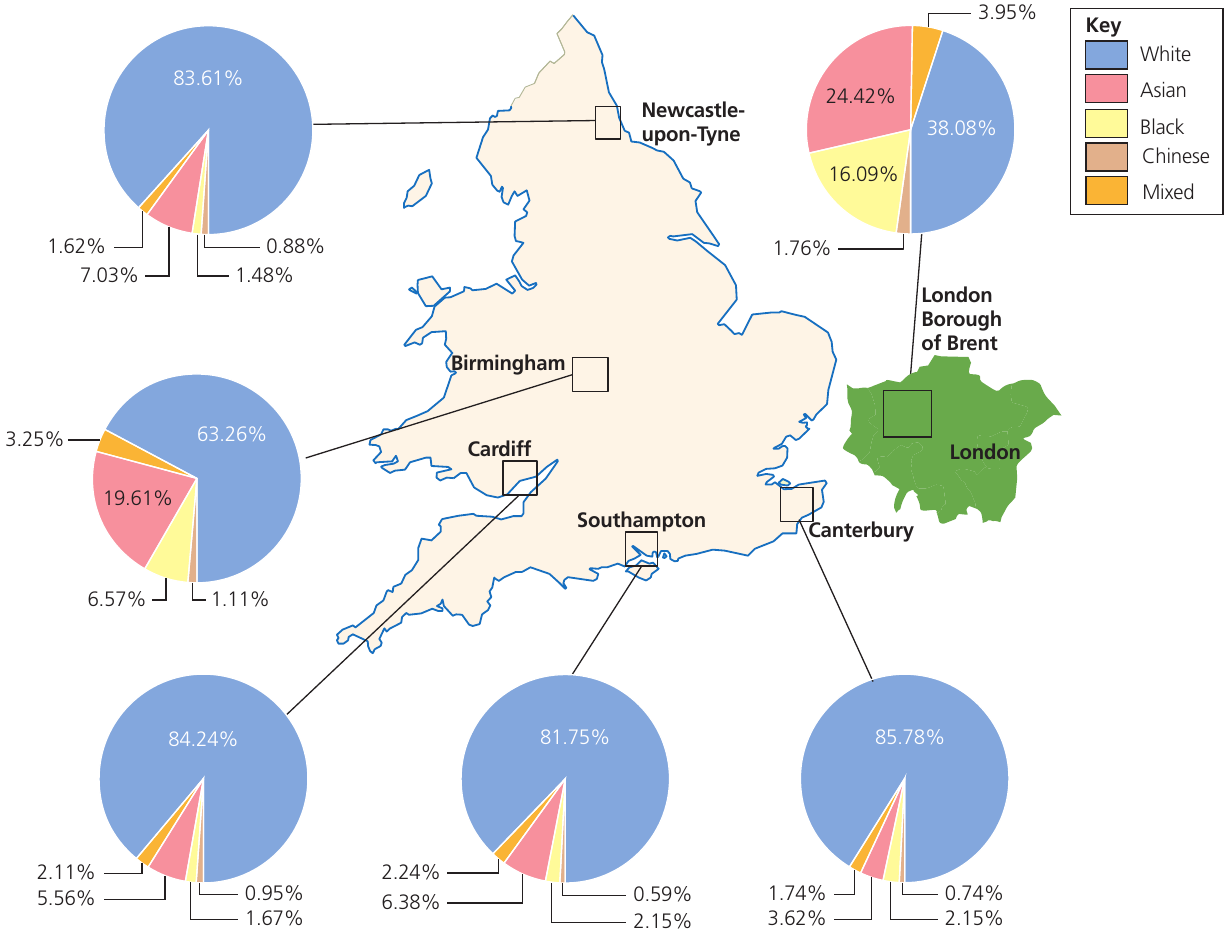
Why is there greater cultural diversity in cities?
Cultural diversity results largely from immigration, with migrants more likely to choose urban areas. There are several reasons for this pattern:
- Employment opportunities: Cities tend to offer a greater range of employment opportunities compared to rural areas
- Points of entry: Cities are often the first point of entry into the country for many immigrants, particularly port cities
- Established communities: Cities tend to house earlier immigrant groups with the same ethnicity, providing support networks
- Specialist facilities: Established cultural diversity means there are specialist shops and religious centres already located in cities
- Tolerance: Urban populations tend to be more tolerant of immigrants than rural communities
Cultural diversity in the UK
The UK has experienced several significant migrations which have shaped the cultural diversity of cities:
Note
Historical migrations:
- The port city of Liverpool attracted many Irish migrants in the nineteenth and twentieth centuries
- Large minority ethnic Indian communities developed in cities such as Leicester and Greater Manchester, where labour-intensive industries like clothing were traditionally located
Note
Recent migrations:
- The influx of Eastern European migrants has led to changes in the demographic make-up of many British cities
- In Southampton, more than 10 per cent of the population are now Polish
- Specialist Polish supermarkets and restaurants have opened to cater for this community
Benefits of cultural diversity
Note
Enriching Urban Life Through Diversity
Cultural diversity brings many advantages to urban society. The most commonly cited benefits include:
- Greater exposure to different foods
- Access to diverse music styles
- Opportunity to learn new languages
- Introduction to different religions and belief systems
Events such as the Notting Hill Carnival in London and Mela in Newcastle have become part of the British calendar. These celebrations serve to illustrate an acceptance of and interest in different cultures within UK society.
Issues associated with cultural diversity
Whilst cultural diversity enriches urban life, it can also create challenges for cities. Cultural diversity can put extra pressure on already stretched urban services.
Important
Service pressures:
- Where language differences exist, local authorities may need to provide English lessons or bilingual literature
- Hospitals may need to cater for specific requirements
- Schools may alter their curricula and holiday patterns to cater for different ethnic groups
- Variations in educational attainment have been noted, and it is the responsibility of local authorities to ensure that all children have the same opportunities
Social segregation based on ethnicity
Important
Segregation refers to spatially distinct communities leading 'parallel lives'.
In some European and North American cities, different ethnic communities have become isolated from wider society. They have maintained their own language and beliefs whilst limiting their interaction with others. Local schools can sometimes become dominated by a particular group, which can lead to suspicion and hostility as younger people from different backgrounds do not get to know each other.
The ghetto
In American cities, the term ghetto has been used to describe an area of a city where the population is almost exclusively made up of an ethnic or cultural minority. These areas are often located in the poorer parts of cities, which wealthier residents have left and where unemployment rates are high.
Geographic patterns in London
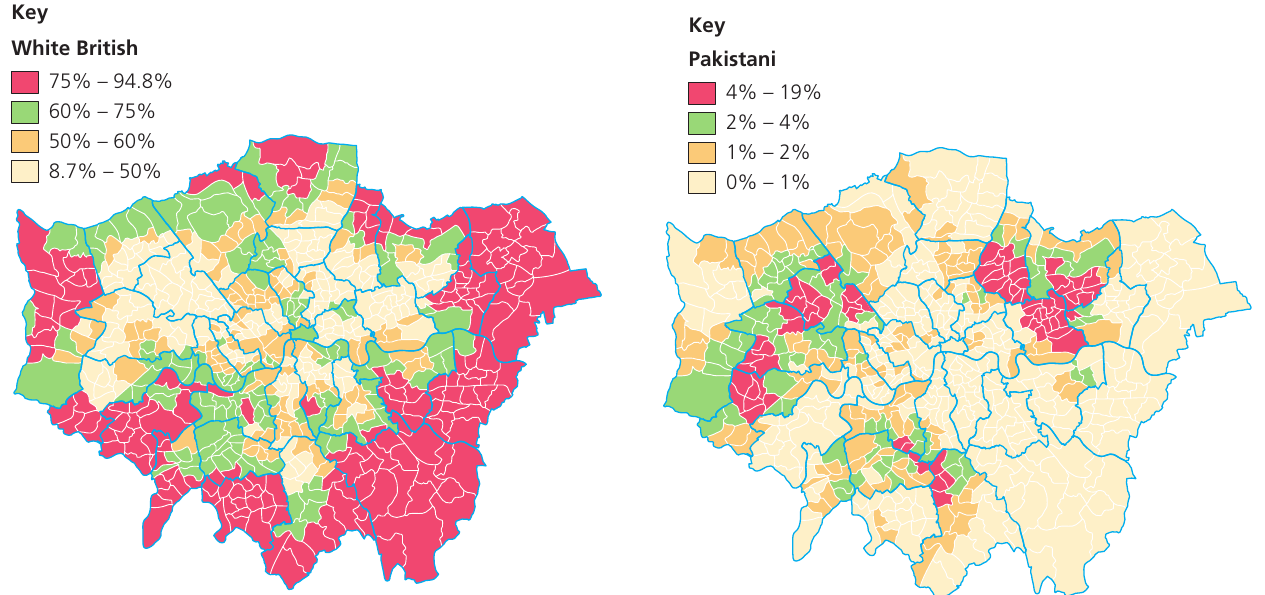
The place study on Brick Lane and Spitalfields in Chapter 8 highlights the large concentration of people of Bangladeshi descent in East London. There are also geographical patterns for other ethnic groups in the capital, as shown by the maps above. The distribution shows:
- White British populations display a concentric pattern around the edge of London
- Pakistani descent populations are concentrated in three main areas of the city
Why does ethnic segregation occur?
There are two main types of factors that contribute to ethnic segregation in cities:
Self-segregation factors
These are choices made by minority ethnic communities themselves:
- Support networks: Migrants seek the support and security of living near friends and relatives within a minority ethnic community
- Specialist facilities: Provision of specialist facilities such as places of worship and food shops
- Protection: Protection against racial abuse and attacks from the majority population
- Cultural maintenance: Maintenance of culture, language and traditions
External factors
These are pressures from outside the minority community:
- Cheap housing: Traditionally, migrants have been a source of cheap labour, forcing them into areas of cheap housing
- Discrimination: Minority ethnic groups have been discriminated against in access to local authority housing and have been less successful in securing mortgage loans
- Hostility: Hostility from the majority population can drive communities together
- "White flight": Movement of the majority population out of areas into which minority populations have moved, a process often referred to as "white flight"
Changes in segregation patterns
Note
Positive Trends in Integration
Despite rising tensions between ethnic groups in some cities, analysis of the 2011 census data revealed positive changes. Many large cities in the UK, including Leicester, Birmingham, Manchester and Bradford, recorded a decrease in segregation for most ethnic groups between 2001 and 2011.
Figure 9.24 shows the changes for Indian and Chinese groups across England and Wales. In London too, even the most diverse wards of Brent and Newham experienced a further decrease in segregation.
This suggests that whilst segregation remains a challenge, integration is gradually improving in many UK cities.
Policy responses: Interculturalism
Many countries have adopted a multicultural policy to protect and celebrate cultural diversity. However, some argue that at an urban level, this can encourage spatially and socially distinct communities leading 'parallel lives'.
To tackle the negative issues associated with ethnic segregation, a policy of interculturalism has been promoted by some authorities. This emphasises interaction and the exchange of ideas between different cultural groups.
Note
Intercultural spaces include:
- Libraries
- Schools
- Sports clubs
- Community centres
Areas of mutual interest are found and community engagement is conducted in these shared spaces.
UK legislation and policies
In the UK, there is legislation addressing:
- Anti-racism
- Employment rights and opportunities
- Measures to combat discrimination, prejudice and racism
Encouraging greater political involvement of different cultural groups can also encourage greater integration and provide a voice for those who may feel under-represented.
Summary
Key Points to Remember:
- Cultural diversity refers to the variety of cultural and ethnic groups within a society, and cities are hotspots for this diversity due to immigration and globalisation
- Cities attract migrants because they offer employment opportunities, contain established ethnic communities, have specialist facilities, and tend to be more tolerant
- Segregation can occur through both self-segregation (community choice for support and cultural maintenance) and external factors (discrimination, poverty, and "white flight")
- The 2011 census showed decreasing segregation in many UK cities, suggesting gradual improvement in integration
- Interculturalism promotes interaction between cultural groups through shared spaces like libraries, schools and community centres, helping to break down barriers between communities