Gentrified Areas (AQA A-Level Geography): Revision Notes
📚Revision Notes
Gentrified areas
What is gentrification?
Gentrification is the process where wealthier individuals purchase and renovate properties in more run-down urban areas. This transforms neighbourhoods by improving housing quality but often displaces existing lower-income residents.
Gentrification has become a significant force in regenerating British inner cities over recent decades. It differs from large-scale regeneration schemes because it happens gradually, street by street and house by house. Rather than being led by major organisations, gentrification is often driven by individuals or small groups of property developers who recognise opportunities in declining areas.
Estate agents and local authorities typically support this process because it can revitalise neglected neighbourhoods without requiring massive public investment.
Note
Unlike major urban regeneration projects that transform entire districts at once, gentrification is an organic, incremental process. This gradual transformation means changes may be less visible initially, but their cumulative effect can fundamentally alter a neighbourhood's character over time.
Why does gentrification occur?
Several factors make certain urban areas attractive targets for gentrification:
The rent gap
When properties fall into disrepair through lack of maintenance or investment, their market value drops significantly below their potential worth. This creates a financial opportunity for investors.
The rent gap describes the difference between a property's current low value and the higher price it could achieve after renovation.
Property developers and individuals who can afford renovation costs see these areas as profitable investments. They purchase cheap properties, improve them, and then sell at much higher prices or rent them to more affluent tenants.
Lower commuting costs
Living closer to city centres dramatically reduces the time and expense of commuting to work. Many people who work in urban areas find the cost savings and convenience of inner-city living appealing enough to move into previously less desirable neighbourhoods. This demand creates opportunities for property renovation and increases local house prices.
Note
Commuting costs include not just money spent on transport, but also the value of time lost to travel. For professionals with demanding careers, reclaiming 1-2 hours daily can significantly improve quality of life, making higher property prices in central areas worthwhile.
The 'pioneer' image
Certain groups, particularly artists, designers and creative professionals, are attracted to urban areas with distinctive character rather than suburban conformity. These 'pioneers' value the diverse cultural opportunities found in edgy neighbourhoods.
Well-known examples include:
- Hoxton and Shoreditch in London
- SoHo in New York City
These early residents help establish an area's reputation as culturally vibrant and trendy, which then attracts more affluent newcomers and further investment.
Government and local authority support
Both central government and local councils actively encourage gentrification as a tool for urban regeneration. They view it as improving local economies and environments whilst requiring less public funding than major redevelopment schemes.
Local authorities benefit from increased council tax revenue as property values rise, whilst the improved physical appearance of neighbourhoods enhances the area's overall reputation.
Changing household composition
The growth of single-person and two-person households without children has created a demographic group particularly suited to inner-city living. These smaller households:
- Need less space than families
- Value proximity to urban amenities and workplaces
- Have fewer concerns about schools and family-friendly facilities
- Often have higher disposable incomes relative to their housing needs
This shift in household structure has increased demand for inner-city properties, fuelling gentrification.
The impacts of gentrification
Gentrification creates both positive and negative consequences for urban communities. Understanding these competing effects is essential for evaluating its role in urban regeneration.
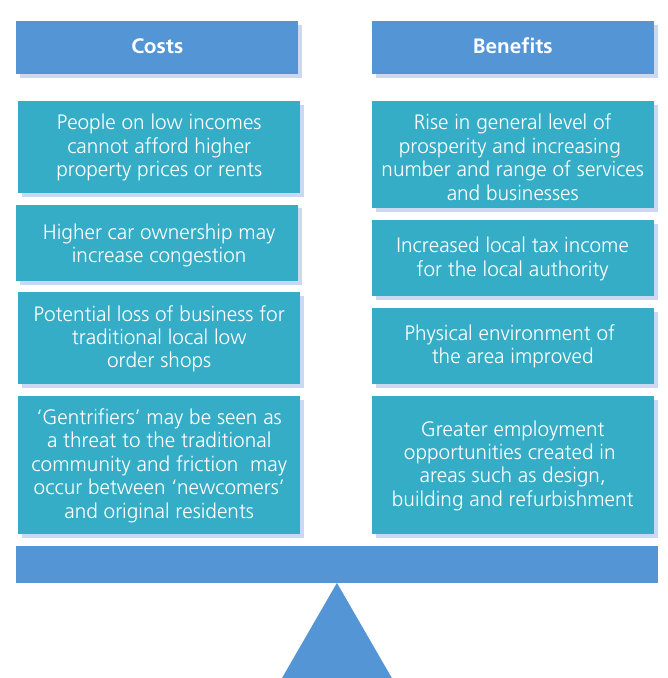
Costs of gentrification
Important
Affordability crisis for existing residents
Lower-income families who have lived in an area for years often cannot afford rising property prices and rents. This forces them to move away from their established communities, disrupting social networks and support systems.
Increased traffic congestion
Gentrification often brings residents with higher car ownership rates. More vehicles in previously low-car-ownership areas leads to increased congestion on local roads, which can reduce quality of life for all residents.
Loss of traditional local businesses
Small, independent shops that served original residents may struggle as rents increase and customer demographics change. Traditional 'low order' shops (corner shops, local services) are often replaced by boutiques, cafes and businesses targeting wealthier newcomers.
Note
The displacement of traditional businesses represents more than just economic change—it often symbolizes the loss of community identity. A local shop that served generations of families holds cultural and social value beyond its commercial function.
Social tension and community conflict
Friction frequently develops between long-standing residents and newcomers. Original inhabitants may feel threatened by changes to their community's character and the loss of familiar places and faces. These tensions have sparked anti-gentrification protests in many parts of London and other UK cities.
Benefits of gentrification
Note
Rising prosperity and improved services
As wealthier residents move in, the local economy strengthens. More businesses open, offering a wider range of services and products. This increased commercial activity benefits all residents by providing better shopping and leisure options.
Greater local authority revenue
Higher property values generate increased council tax income for local authorities. This additional revenue can fund improved public services, infrastructure maintenance and community facilities.
Enhanced physical environment
Renovated properties improve the visual appearance of streets and neighbourhoods. Neglected buildings are restored, gardens are maintained, and public spaces often receive attention. This environmental improvement can increase pride in the area amongst all residents.
Employment opportunities
Gentrification creates jobs in construction, design, property management and related sectors. Local workers may benefit from these employment opportunities, though questions remain about whether original residents actually secure these positions.
Important
While gentrification brings economic benefits, the crucial question remains: who actually benefits? Critics argue that the positive impacts often bypass existing low-income residents, who instead face displacement and loss of community ties.
Case study: Liverpool housing scheme
Example
Innovative Regeneration: Liverpool's £1 Homes
Liverpool City Council developed an innovative approach to regenerating inner-city estates whilst minimising displacement of existing low-income families.
The scheme:
In 2013, the council sold 20 derelict homes in Kensington, Granby and Picton for just £1 each. This radical approach aimed to revitalise run-down areas without forcing current residents out through rising property prices.
Conditions:
Buyers had to meet two important requirements:
- Demonstrate capability to renovate the property to a reasonable standard
- Sign an agreement to live in the property for five years without subletting
Results:
- Approximately 1,000 applications received for each house, showing significant demand
- The scheme expanded to include other houses and shops in the area
- The initiative aimed to improve the built environment whilst creating a thriving community
This approach represents an alternative model of regeneration that attempts to balance neighbourhood improvement with protecting existing residents from displacement.
Remember!
Summary
Key Points to Remember:
-
Gentrification involves wealthier individuals purchasing and renovating properties in run-down urban areas, transforming neighbourhoods gradually over time.
-
The rent gap between current low property values and potential renovated values creates the financial incentive driving gentrification.
-
Gentrification produces both benefits (improved environment, better services, higher tax revenue) and costs (displacement of low-income residents, loss of traditional businesses, social tensions).
-
Estate agents, local authorities and government bodies generally support gentrification as a regeneration tool, despite concerns about displacement.
-
Alternative approaches like Liverpool's £1 homes scheme show that urban regeneration can be designed to minimise negative impacts on existing communities.