Urban Change (AQA A-Level Geography): Revision Notes
📚Revision Notes
Urban change
De-industrialisation in UK cities
During the Industrial Revolution and much of the 19th and early 20th centuries, manufacturing was the backbone of urban growth in the UK. Cities developed strong identities linked to specific industries - Manchester became famous for textiles, Sheffield for iron and steel, and Glasgow for shipbuilding. These industries created thousands of jobs and drew people into urban areas.
However, from the 1980s onwards, older industrial cities began experiencing severe economic difficulties as manufacturing declined.
Important
De-industrialisation refers to the decline in manufacturing employment that occurred across UK cities in the second half of the twentieth century.
Causes of de-industrialisation
Three main factors drove the loss of manufacturing jobs:
-
Mechanisation: Most companies found they could produce goods more cheaply using automated machinery rather than employing large workforces. This meant fewer workers were needed to produce the same output.
-
Competition from abroad: Rapidly industrialising countries such as Taiwan, South Korea, India and China could manufacture goods more cheaply than UK factories. British manufacturers struggled to compete with these lower production costs.
-
Reduced demand: As new materials and technologies were developed, demand for traditional products (like coal and steel) fell. This meant less need for the industries producing these goods.
Note
These three causes - mechanisation, foreign competition, and reduced demand - often worked together, creating a compound effect that accelerated the decline of manufacturing in UK cities.
Manufacturing employment trends
The table below shows how dramatically manufacturing employment declined in the UK over four decades:
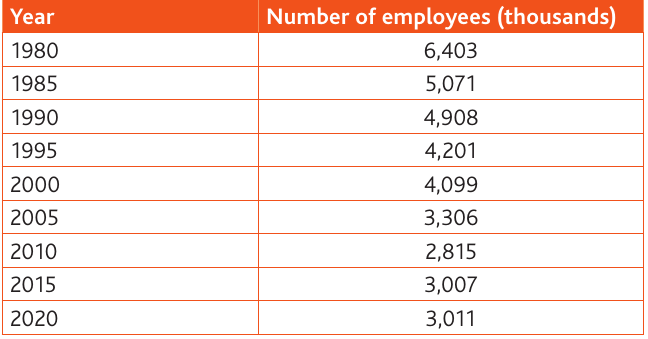
The data reveals a steep downward trend, with employment falling from 6.4 million workers in 1980 to just 2.8 million by 2010 - a reduction of more than half. Although there was a small recovery by 2020, manufacturing employment remained far below historical levels.
Variation between cities
The impact of de-industrialisation was not uniform across the UK. Cities in the traditional manufacturing heartlands of northern England, such as Manchester, Liverpool and Sheffield, experienced more severe job losses than cities with more varied economies. Those heavily dependent on a single industry were particularly vulnerable when that industry declined.
Variation within cities
Even within individual cities, the effects varied considerably:
-
Inner city areas were hit hardest. These neighbourhoods contained many older factories with outdated production methods, low productivity and highly unionised workforces. They also lacked suitable land for expanding existing manufacturing operations.
-
Outer urban and rural areas fared better. When companies did invest in new facilities, they typically chose edge-of-urban locations or more rural sites rather than inner city areas.
Decentralisation
The movement of industry away from inner cities formed part of a broader trend called decentralisation. This process also affected commercial and residential land use during the late 20th century, as businesses and people moved outwards from city centres to suburbs and beyond.
The rise of the service economy
As manufacturing declined, the service economy expanded to become the dominant sector in urban areas.
Important
The service economy encompasses a wide range of activities including tertiary and quaternary sectors.
Types of service activities
Service activities fall into two categories:
Tertiary activities involve providing services directly to people and businesses. Examples include:
- Financial services (banking, accountancy, insurance)
- Retailing
- Leisure and entertainment
- Transport
- Education
- Healthcare
Quaternary activities are knowledge-based services where ideas and expertise are the main output. Examples include:
- Advertising
- Computer programming
- Software design
- Research and development
- Consultancy
Note
The distinction between tertiary and quaternary activities is important: tertiary services focus on direct service provision, while quaternary activities emphasize knowledge creation and expertise.
Reasons for service sector growth
While population growth creates demand for services, several other factors explain why the service economy has expanded:
-
Support for remaining manufacturing: Financial services are still needed to support the manufacturing industries that continue operating in many cities today.
-
Technological advancement: As societies become more technologically sophisticated, they require a broader range of specialist services to function effectively.
-
Increasing wealth: As populations become wealthier, they demand more leisure activities and retail services.
Global economic shift
The transformation from manufacturing to services has been dramatic in cities worldwide. Major financial centres are now exclusively located in world cities, whilst corporate headquarters cluster in urban areas where they can access international markets, highly skilled workers and specialist business services.
Urban resurgence
The period of decline
Throughout the mid-20th century, many American cities experienced severe population decline as families moved to suburbs. Manufacturing and retail businesses closed, and traditional downtown areas - the main retail centres - fell into decline alongside neighbouring residential areas. The term 'dead heart syndrome' described this process of urban core decay.
Factors driving resurgence
From the 1990s onwards, urban areas began to revive:
-
Economic growth: A sustained period of national economic expansion generated prosperity and investment opportunities.
-
Regeneration schemes: Successful projects and more attractive urban design helped restore cities' appeal.
-
Population return: Young people increasingly chose to remain in cities even when starting families. Meanwhile, older people whose children had left home moved back to cities to access urban services more easily.
This population revival increased demand for services and created a more prosperous urban economy in many cities.
Note
However, concerns emerged that not everyone benefited from resurgence, leading to growing inequality between rich and poor populations. This uneven distribution of benefits remains a challenge for urban planners today.
Case study: The New York City High Line
Example
Case Study: Urban Regeneration - The New York City High Line
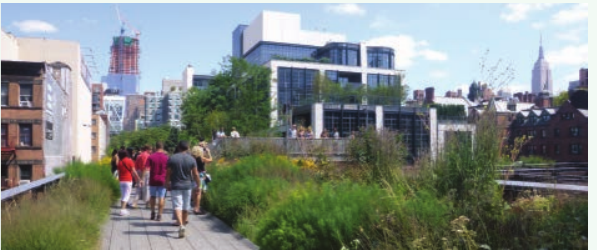
Urban resurgence is clearly visible in New York through the transformation of the High Line - a 1.5 mile section of elevated railway track originally built to transport goods to and from Manhattan's largest industrial district.
Background
The railway was abandoned in the 1980s as the Lower West Side underwent a period of manufacturing decline. For 25 years, the structure remained derelict.
Transformation
In the 2000s, the High Line was successfully redeveloped as an elevated park and walkway featuring:
- Trees, grasses and shrubs creating green space
- Porous pathways allowing water drainage between planks, reducing storm-water runoff into sewers
- Planting design inspired by the self-seeded landscape that naturally grew on the abandoned tracks over 25 years
Impact
The High Line has breathed new life into former industrial infrastructure, serving as a public green space that:
- Hosts artistic commissions and cultural events
- Attracts five million annual visitors
- Increases spending in local shops and cafés
- Encourages property development in neighbourhoods along its route
The project demonstrates how abandoned industrial sites can be transformed into valuable community assets.
Impacts of de-industrialisation on urban areas
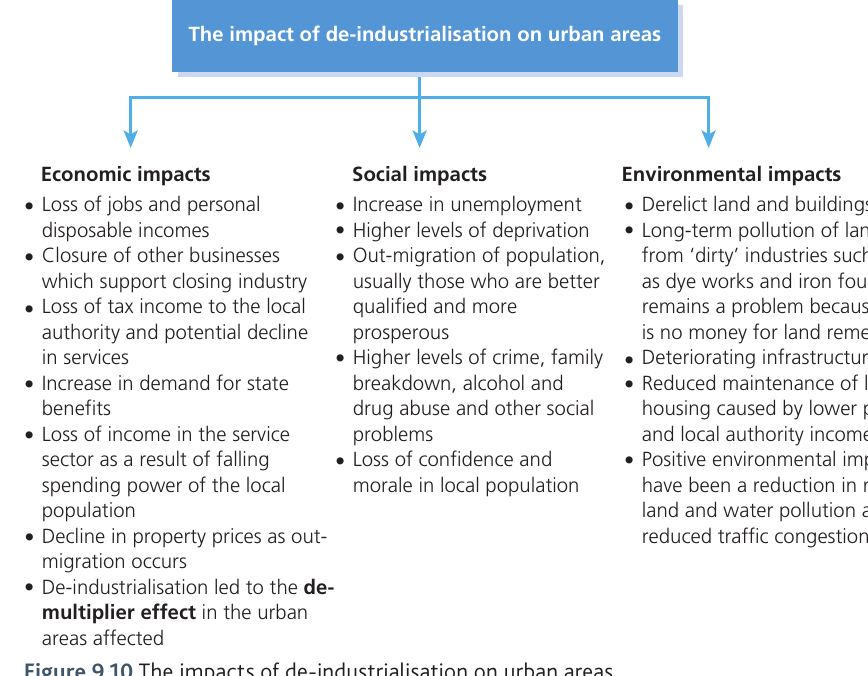
De-industrialisation has had wide-ranging consequences for cities. These impacts can be grouped into three main categories:
Economic impacts
The economic effects have been largely negative:
- Job losses: Workers lost employment and personal incomes declined
- Business closures: Supporting businesses (suppliers, service providers) also closed as the industries they served disappeared
- Reduced tax revenue: Local authorities collected less income from businesses and workers, limiting their ability to maintain services
- Increased benefit costs: More people required state financial support
- Declining service sector income: Reduced spending power meant service businesses earned less
- Property price falls: As out-migration occurred, property values declined
- De-multiplier effect: The downward economic spiral affected wider urban areas as one closure led to others
Important
The de-multiplier effect is particularly significant - it describes how the closure of one major factory can trigger a chain reaction. As that factory closes, suppliers lose business and close too. Workers lose income and spend less at local shops, causing more closures. This creates a downward spiral that affects the entire urban economy.
Social impacts
De-industrialisation created serious social problems:
- Rising unemployment: More people unable to find work
- Higher deprivation: Living standards fell for many residents
- Out-migration: Better-qualified and more prosperous residents often moved away seeking opportunities elsewhere
- Crime increase: Higher levels of crime, family breakdown, alcohol and drug abuse, and other social problems emerged
- Community decline: Loss of confidence and morale within local populations affected community cohesion
Environmental impacts
Environmental consequences were mixed:
Negative impacts:
- Derelict land and abandoned buildings scarred the urban landscape
- Long-term pollution from 'dirty' industries (dye works, iron foundries) remained problematic with no money available for clean-up
- Infrastructure deteriorated as reduced incomes for residents and local authorities meant less maintenance
- Housing quality declined
Positive impacts:
- Reduced noise pollution
- Cleaner water and air
- Less traffic congestion in formerly industrial areas
Summary
Key Points to Remember:
-
De-industrialisation is the decline in manufacturing employment that transformed UK cities from the 1980s, caused by mechanisation, foreign competition and reduced demand for traditional products.
-
The service economy (tertiary and quaternary activities) grew to replace manufacturing as the dominant urban economic sector, driven by population growth, technological change and increased demand for specialist services.
-
Urban resurgence began in the 1990s as cities recovered from 'dead heart syndrome' through economic growth, regeneration schemes and population return - though not everyone benefited equally.
-
De-industrialisation had three categories of impact: economic (job losses, business closures, reduced incomes), social (unemployment, out-migration, crime), and environmental (derelict land and pollution, but also reduced congestion and cleaner air).
-
Successful urban regeneration projects like New York's High Line demonstrate how abandoned industrial infrastructure can be transformed into valuable public spaces that attract visitors and stimulate local economies.