Global Systems and Governance (AQA A-Level Geography): Revision Notes
📚Revision Notes
Globalisation Critique
Introduction
For several decades, globalisation has been viewed as an unstoppable force that continues to expand and connect the world. Global trade, international tourism, and cooperation between nations have all grown steadily. However, this process has faced significant criticism and challenges in recent years, leading many to question whether globalisation truly benefits everyone equally.
Challenges of globalisation
Economic challenges
The belief that globalisation brings economic benefits to everyone has been seriously questioned. The 2008-2009 global financial crisis challenged the assumption that increased global connections automatically lead to prosperity. Many economies around the world are still recovering from this crisis, which demonstrated how problems in one part of the global economy can quickly spread to affect everyone.
Note
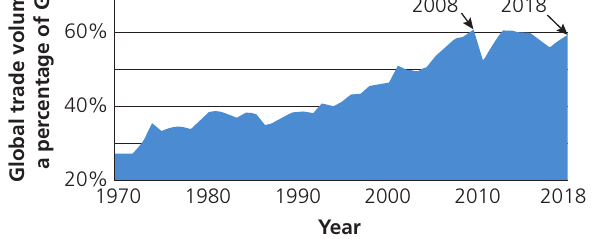
Evidence suggests that globalisation may have reached its maximum point or at least stopped growing. Global trade growth has slowed considerably in recent years, marking a significant shift from decades of continuous expansion.
The graph demonstrates that global trade as a percentage of GDP grew from around 25% in 1970 to approximately 61% in 2008, but then declined slightly to about 60% by 2018. This slowdown represents a significant shift from the previous trend of continuous expansion.
Another economic challenge comes from rising tensions between major economies. The ongoing geopolitical tensions between the USA and China have resulted in both nations imposing escalating tariffs on each other's goods. These trade barriers directly limit the growth of global trade and threaten the open market system that globalisation depends upon.
Social challenges
Globalisation creates significant social pressures in many communities. International economic migration, whilst offering benefits to some countries and workers, has also created tensions:
- Migration pressures: Growth in international migration can lead to racial tensions and cultural conflicts. For example, migrants from the Philippines working in the UAE may face discrimination, whilst destination countries may experience challenges in maintaining social cohesion
- Job displacement: The transfer of manufacturing jobs from highly developed economies (HDEs) to lower-cost countries causes unemployment and wage stagnation in the regions losing these jobs. Areas that were once thriving industrial centres experience deprivation and related social problems
- Sense of neglect: Communities experiencing economic decline due to deindustrialisation often feel ignored by national governments and international organisations. This creates a feeling of being left behind by the globalisation process
Political challenges
Many communities believe they have not benefited from global integration and that their lives have actually worsened. The recognition that globalisation has not been inclusive has fuelled the rise of populist political movements. These movements reject existing political establishments and favour 'nation-first' approaches over international cooperation.
Important
Populist movements are political campaigns that claim to represent ordinary people against established elites, often promoting nationalist policies and opposing globalisation.
Two significant political events in 2016 demonstrated this trend:
- The UK electorate voting to leave the European Union through the Brexit referendum
- The election of Donald Trump as US President on a 'Make America Great Again' platform promoting protectionist policies
Brexit and globalisation
When UK voters decided to reject continued membership of the EU, many analysts interpreted this as a rejection of greater integration and the globalisation process itself. The UK officially left the EU on 31 January 2020, entering a transition period that lasted until the end of that year.
Reasons for the Brexit vote
Example
Case Study: The Four Main Reasons Behind Brexit
The Brexit vote can be understood through four interconnected factors that motivated voters to choose leaving the EU:
1. Sovereignty: The 'Leave' campaign effectively used the message 'Take back control' to persuade voters that the UK had lost the power to make its own decisions independently. They argued that EU membership prevented the UK from negotiating its own trade deals or controlling its own legal affairs.
2. Immigration: Freedom of movement within the EU meant that nearly one million East European migrants had entered the UK since 2004. This created several concerns:
- Pressure on jobs, with some workers fearing increased competition for employment
- Strain on public services such as healthcare and education
- In some areas, discrimination and social tension developed
3. Inequality: The gap between wealthy and poor citizens widened significantly during the UK's EU membership. The Gini coefficient increased from 0.27 in 1973 (when Britain joined Europe) to 0.35 in 2016. Many communities felt 'left behind' as their regions experienced decline due to deindustrialisation. These communities blamed EU membership for their economic difficulties.
4. Pro-nationalistic feelings: A significant portion of the UK electorate preferred the concept of an independent Britain that could shape its own future in the world, free from supranational governance structures.
The Brexit debate
Many Leave supporters argue that Brexit is not an antiglobalisation vote but rather creates an opportunity for the UK to trade more globally without the constraints of being part of a customs union. However, others view it as a clear rejection of closer international integration.
'Make America great again' and globalisation
In November 2016, a similar populist movement brought Donald Trump to power in the United States. He was elected President with a promise to return jobs to American workers through more protectionist policies. The previous Obama administration had started to open the US to increased global trade, but Trump reversed this direction by promising to renegotiate free trade deals and restrict the movement of workers.
Examples of America-First policies
Trump's administration implemented several measures designed to prioritise American interests:
- Withdrawal from international agreements: The US withdrew from the Trans-Pacific Partnership (TPP) trade agreement and instigated withdrawal from the Paris Climate Agreement on climate change
- Import tariffs: The administration imposed tariffs on imported manufactured goods from China and other Asian countries, attempting to stimulate production in traditional manufacturing regions of the US
- Immigration restrictions: Rhetoric about building a wall between the USA and Mexico aimed to prevent migration from Central America
- Manufacturing incentives: US car manufacturers, such as Ford, were encouraged to build new factories within the USA rather than investing in production facilities in Mexico
Note
Despite losing the 2020 Presidential election, support for Trump remained strong among many Americans. However, since taking office in 2021, President Biden has signalled an intention to reverse many of Trump's policies as his administration adopts a more internationalist approach to global affairs.
Summary of arguments
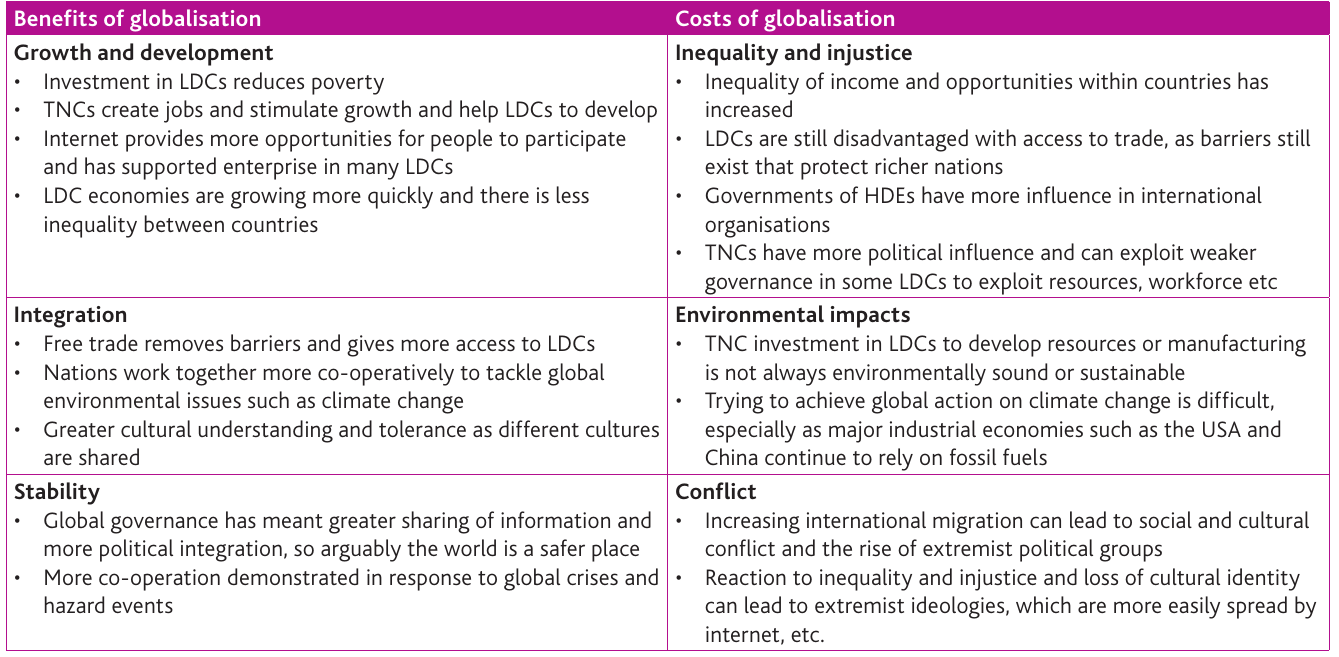
The debate around globalisation involves weighing its benefits against its costs. Understanding both perspectives is essential for evaluating the overall impact of global integration.
Key benefits of globalisation
Growth and development:
- Investment in Less Developed Countries (LDCs) reduces poverty levels
- Transnational corporations (TNCs) create jobs and stimulate economic growth, helping LDCs to develop their economies
- The internet provides increased opportunities for people to participate in economic activities and has supported enterprise growth in many LDCs
- Economies in developing countries are growing more rapidly, reducing inequality between nations
Integration:
- Free trade removes barriers and provides better access to markets for LDCs
- Nations become more willing to cooperate on global environmental challenges such as climate change
- Greater cultural understanding and tolerance develops as different cultures interact and share ideas
Stability:
- Global governance structures facilitate greater information sharing and political integration, potentially making the world safer
- Increased cooperation has been demonstrated in responses to global crises and hazard events
Key costs of globalisation
Inequality and injustice:
- Inequality of income and opportunities within individual countries has increased significantly
- LDCs remain disadvantaged in accessing trade opportunities, as barriers still exist that favour wealthy nations
- Governments of HDEs have more influence in international organisations, creating power imbalances
- TNCs wield considerable political influence and can exploit weaker governance systems in some LDCs to access resources or exploit workers
Environmental impacts:
- TNC investment in LDCs for resource development or manufacturing is not always environmentally sound or sustainable
- Achieving global action on climate change proves difficult, especially when major industrial economies such as the USA and China continue to rely heavily on fossil fuels
Conflict:
- Increasing international migration can lead to social and cultural conflict, contributing to the rise of extremist political groups
- Reactions to inequality, injustice, and loss of cultural identity can fuel extremist ideologies, which spread more easily through the internet and global communication networks
Remember!
Summary
Key Points to Remember:
-
Globalisation faces significant challenges: the 2008-2009 financial crisis questioned its benefits, and global trade growth has slowed since then, reaching approximately 61% of GDP in 2008 before declining slightly
-
Both Brexit and Trump's election in 2016 represented populist reactions to globalisation, with concerns about sovereignty, immigration, inequality, and national identity driving these political movements
-
Brexit occurred due to four main factors: desire for sovereignty, immigration pressures, widening inequality (Gini coefficient rose from 0.27 to 0.35), and pro-nationalistic feelings
-
The benefits of globalisation include economic growth in LDCs, greater integration through free trade and cooperation, and increased global stability through better governance
-
The costs include increased inequality within countries, environmental damage from unsustainable development, and social conflicts arising from migration and cultural tensions