Case Study: Antarctica - NGOs (AQA A-Level Geography): Revision Notes
📚Revision Notes
Case Study: Antarctica - NGOs
Introduction to NGOs in Antarctic governance
Environmental non-governmental organisations (NGOs) play a crucial and impactful role in the governance of Antarctica. They are particularly valuable because they represent groups that prioritise environmental protection as a top concern. Unlike nations with territorial or economic interests, NGOs can focus solely on conservation objectives.
Note
Several NGOs and international conservation organisations operate in the Antarctic region. Their ability to influence proceedings is strengthened because they have no sovereign national interests and can act independently, providing objective perspectives on conservation issues.
The role of NGOs and international conservation organisations in Antarctica
NGOs play multiple roles in shaping decisions about Antarctic development. They operate in four main capacities: guardians, technical advisers, partners, and visionaries.
Guardians
NGOs oversee and question the decision-making processes of Antarctic Treaty System (ATS) members and put forward alternative approaches. In this role, they act as watchdogs to ensure environmental considerations remain central to all decisions.
Example
Example: ASOC's Campaign Against Mining
Through strong involvement from Greenpeace, the Antarctic and Southern Ocean Coalition (ASOC) successfully campaigned to prevent the Minerals Convention from being adopted. They played an instrumental role in developing the Madrid Protocol instead, which banned all mineral resource activities in Antarctica.
Technical advisers
NGOs leverage their specialist knowledge to gain credibility and influence the decisions made by ATS members. Their scientific expertise and research capabilities make them valuable contributors to policy discussions.
For instance, ASOC's recommendation to adopt an 'ecosystem approach' to managing fisheries was incorporated into ATS conservation strategies. This demonstrates how NGO expertise can directly shape policy and improve environmental outcomes.
Partners
NGOs collaborate with ATS members and other organisations to identify and designate protected areas. This collaborative approach has led to significant conservation achievements in the Antarctic region.
NGO groups worked with the Commission for the Conservation of Antarctic Marine Living Resources (CCAMLR) to establish the Ross Sea Marine Protected Area, a process that spanned from 2012 until its approval in 2017.
Important
Ross Sea Marine Protected Area (MPA)
The Ross Sea MPA is the world's largest marine protected area, covering 1.55 million km² (with 1.12 million km² fully protected). It will remain protected for 35 years, demonstrating the impact of NGO-government collaboration on conservation outcomes.
Visionaries
NGOs develop comprehensive future conservation plans and large-scale strategies that look beyond immediate concerns to envision long-term protection frameworks. They push boundaries and propose ambitious goals that challenge conventional thinking.
For example, ASOC's objective is to create a network of MPAs, including the proposed Weddell Sea, Antarctic Peninsula and East Antarctica MPAs. This vision aims to create interconnected protected areas that preserve entire ecosystems.
Note
During negotiations over the Minerals Convention, Greenpeace's vision was to establish a 'World Park Antarctica' that would ensure the entire continent remains 'off limits' for any type of resource extraction or development. While not fully realized, this vision influenced the eventual adoption of the Madrid Protocol.
Key international conservation organisations
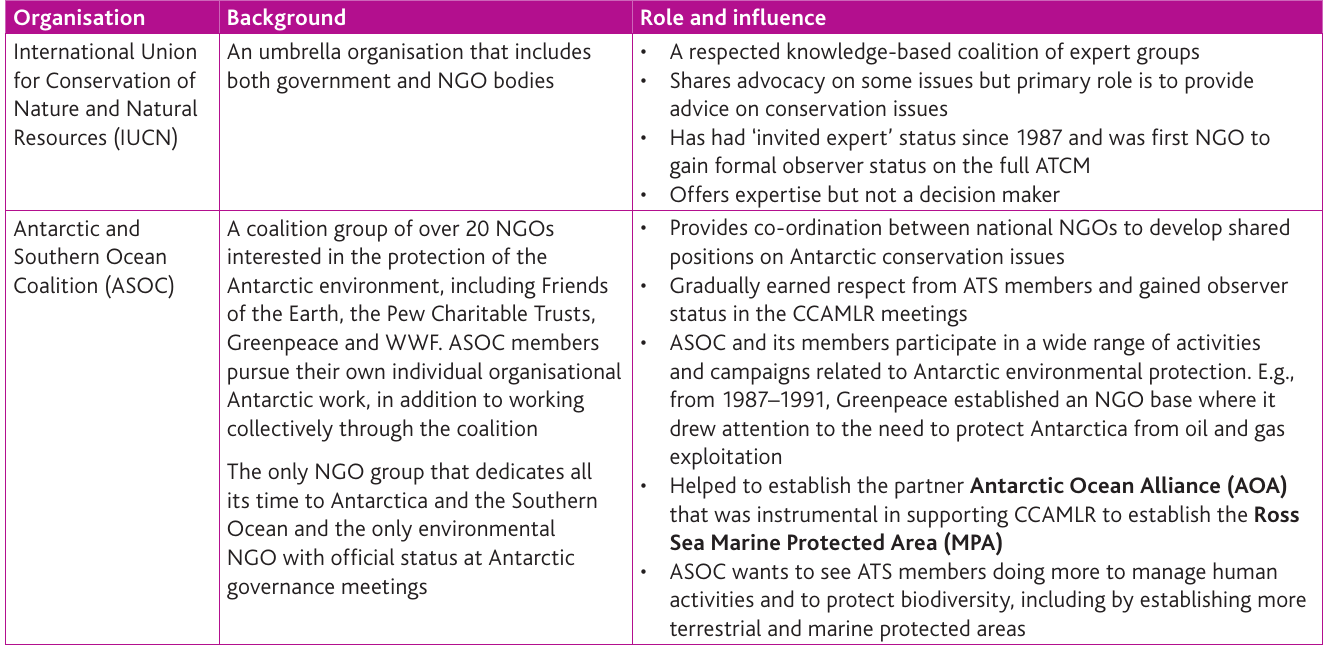
Two major organisations play particularly important roles in Antarctic conservation: the IUCN and ASOC. While they share the common goal of environmental protection, they operate differently and complement each other's work.
International Union for Conservation of Nature and Natural Resources (IUCN)
The IUCN is an umbrella organisation that brings together both government bodies and NGOs. Its key characteristics include:
- Acts as a respected knowledge-based group of expert specialists
- Provides advice on conservation matters, though shares advocacy on some issues
- Gained 'invited expert' status since 1987, becoming the first NGO to receive formal observer status at full Antarctic Treaty Consultative Meetings (ATCM)
- Provides expertise but does not make decisions itself
Note
The IUCN's unique structure, combining government and NGO members, gives it credibility with both conservation groups and national governments. This positioning allows it to bridge different perspectives and facilitate constructive dialogue.
Antarctic and Southern Ocean Coalition (ASOC)
ASOC is a coalition of more than 20 environmental NGOs working to protect Antarctica. Member organisations include:
- Friends of the Earth
- Pew Charitable Trusts
- Greenpeace
- WWF (World Wide Fund for Nature)
Key features of ASOC:
- The only NGO group that dedicates all its efforts to Antarctica and the Southern Ocean
- The only environmental NGO with official status at Antarctic governance meetings
- Members carry out their own individual organisational work while also collaborating through the coalition
- Progressively gained respect from ATS members and secured observer status at CCAMLR meetings
ASOC has participated extensively in Antarctic environmental protection activities and campaigns. Between 1987-1991, Greenpeace established an NGO base in Antarctica, highlighting the urgent need to protect the continent from oil and gas exploitation.
Note
ASOC's Collaborative Approach
ASOC helped create the partner Antarctic Ocean Alliance (AOA), which proved instrumental in supporting CCAMLR to establish the Ross Sea Marine Protected Area (MPA). This demonstrates how coalition-building and partnerships amplify NGO influence.
ASOC's campaign priorities
ASOC actively campaigns to bring critical issues to the attention of ATS members, ensuring that proposals are negotiated, agreed upon, and properly implemented. Their work focuses on translating scientific understanding into practical conservation measures.
Their monitoring activities include:
-
Marine and terrestrial protected areas: Creating systems to preserve biodiversity and build ecosystem resilience in response to a changing climate
-
Climate change integration: Incorporating climate change considerations into all relevant aspects of decision-making
-
Ecosystem-based management: Applying precautionary, ecosystem-based approaches to Southern Ocean fisheries, including krill fishing
-
Tourism regulation: Establishing appropriate controls for tourism activities
ASOC wants ATS members to take greater action in managing human activities and protecting biodiversity. This includes establishing more terrestrial and marine protected areas to safeguard Antarctic ecosystems for future generations.
Assessment of global governance of Antarctica and future consequences
The ATS is recognised as one of the most successful international agreements. Tensions over territorial claims have been suspended, and it has proven effective as a common governance measure. The involvement of UN and ATS member countries, with the underlying influence of NGOs, demonstrates how governance of a 'global common' area has operated effectively.
However, protecting Antarctica remains challenging, and several issues require resolution concerning its future governance:
Duration of agreements
The Environment Protocol that underpins the ATS system could be reviewed in 2048 and potentially modified. Similarly, the Ross Sea MPA could be reviewed in 2052. These agreements are not permanent, creating uncertainty about long-term protection.
Important
Temporary Nature of Protection
The fact that key agreements have review dates means that Antarctic protection is not guaranteed indefinitely. Future political and economic pressures could lead to modifications that weaken environmental safeguards.
Territorial claims
The ATS has not rejected any existing territorial claim, though it does prohibit the establishment of new claims. None of the seven 'claimant nations' have abandoned their claim. The USA and Russia also maintain the right to make claims in the future.
Note
This creates a delicate balance where claims are 'frozen' but not resolved. The system works because countries agree not to press their claims actively, but underlying tensions remain.
Impacts of human activity
The growing footprint from scientific activity, tourism and fishing requires better environmental protection measures to minimise damage. As access to Antarctica becomes easier and interest grows, managing these activities becomes increasingly complex.
Marine Protection Areas (MPAs)
To meet United Nations Environment Programme (UNEP) global biodiversity targets, attempts to establish additional MPAs are likely over the next 10 years. This may create disagreement between ATS parties wanting to extend marine protection and those, such as China and Russia, who want greater access to fisheries.
Example
Example: Weddell Sea MPA Proposal
In 2018, China and Russia, together with Norway, blocked a proposal for the Weddell Sea MPA plan. This demonstrates how economic interests in fishing can conflict with conservation goals, even within the ATS framework.
Climate change
Antarctica is an essential location for research that helps us understand and address climate change. In the short term, scientists can do little to prevent land glaciers melting and oceans warming, which complicates some issues such as implementing MPAs effectively.
Note
Climate change adds urgency to conservation efforts while simultaneously making some protection measures more challenging to implement. For example, changing ocean temperatures and ice patterns may require MPAs to be adaptive rather than fixed.
Geopolitics of Antarctica
Pro-conservation 'claimants', such as Australia, are concerned that China and Russia are attempting to increase their territorial claims. In 2009, China established its third research station at Dome Argus on the Antarctic plateau. They proposed a code of conduct there, which remains under discussion, with other parties concerned about potential limits on their own scientific activities.
However, similar efforts by Western powers to manage scientific research in other sensitive areas have been accepted. China has an astronomical observatory at Dome A, the best location globally for space observation. The area is also thought to contain uranium deposits.
Important
Growing Geopolitical Tensions
The governance of Antarctica continues to be effective but relies on political compromises. It cannot be assumed that Antarctica will remain protected indefinitely, especially if some of the more powerful members, such as China or the USA, adopt a more nationalist approach and begin to question whether Antarctica needs protection at all.
Summary
Key Points to Remember:
- NGOs play four key roles in Antarctic governance: guardians, technical advisers, partners, and visionaries
- ASOC is the only NGO group dedicated exclusively to Antarctica and has official observer status at governance meetings
- The Ross Sea MPA (1.55 million km²) is the world's largest marine protected area, established through NGO-government collaboration
- Future challenges include the potential review of the Environment Protocol (2048), territorial claim tensions, and increasing pressure from human activities
- Geopolitical tensions, particularly involving China and Russia, create uncertainty about the long-term effectiveness of Antarctic protection measures
- The success of Antarctic governance depends on continued political compromise and cooperation among nations with competing interests