Consequences of International Trade (AQA A-Level Geography): Revision Notes
📚Revision Notes
Consequences of International Trade
International trade and globalisation have transformed the world economy, creating both winners and losers. Understanding these consequences helps us appreciate why some groups support free trade whilst others resist it. These impacts span geographical, economic, political, social, cultural and environmental dimensions.
Main beneficiaries of globalisation
Four main groups have gained significantly from increased international trade and the globalisation process.
Emerging economies
Medium-income nations have experienced rapid development through globalisation. Countries like China, India, Brazil and South Korea have attracted substantial inward investment from transnational corporations. This investment has helped them industrialise quickly and emerge as major economic powers that now compete with traditional developed regions. Their economic growth has lifted millions out of poverty and created new middle classes with increased purchasing power.
Note
The rise of emerging economies represents one of the most significant economic shifts of the past few decades. These countries have transformed from primarily agricultural societies into major manufacturing and service economies, fundamentally altering the global balance of economic power.
Transnational corporations
Large companies operating across multiple countries have expanded dramatically through globalisation. Although TNCs typically have their headquarters in developed countries, they have established operations worldwide. Companies from emerging economies have also grown into global players. TNCs benefit from access to cheaper labour, raw materials and new markets. They can locate different parts of their production chains in the most cost-effective locations.
International organisations
Bodies such as the International Monetary Fund (IMF), World Bank and World Trade Organisation (WTO) have become more influential as global trade has expanded. These institutions help integrate economies and set rules for international commerce. Through their lending programmes and policy advice, they have consolidated their position and extended their control over global economic systems. Their decisions affect trade policies and economic development strategies worldwide.
Regional trading blocs
Groups of countries have formed free trade areas and customs unions to boost trade between members. These arrangements are expanding across Asia, Latin America and Africa. By negotiating as a bloc, member countries gain greater leverage in trade discussions with other regions and major economies. This collective approach helps developing countries access important markets more effectively. However, some critics argue this comes at the expense of individual nation states, which lose some economic sovereignty.
Economic consequences
Free trade creates significant economic impacts, with both advantages and disadvantages depending on your perspective and position in the economy.
Benefits of free trade
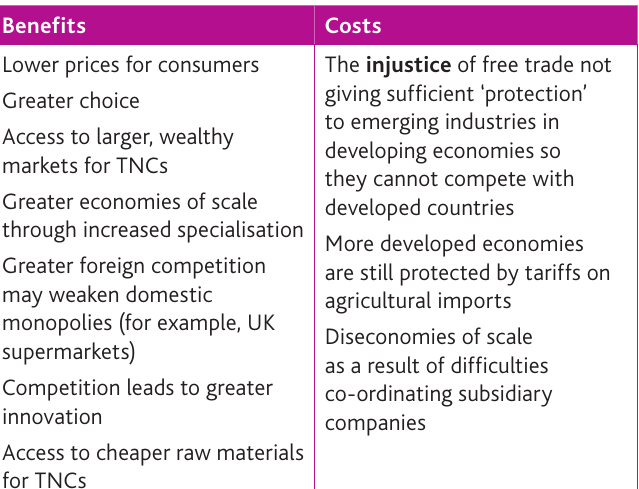
International trade without tariff barriers brings several economic advantages:
-
Lower consumer prices: Goods produced in countries with lower labour and production costs become cheaper for consumers worldwide. Competition between international producers helps keep prices down.
-
Greater consumer choice: Shoppers can access products from around the world, not just those made domestically. Supermarkets stock food from numerous countries year-round, giving unprecedented variety.
-
Access to wealthy markets: TNCs can sell to hundreds of millions of consumers by entering large markets like the European Union. This access drives business growth and creates economies of scale.
-
Economies of scale through specialisation: When countries focus on producing goods they make most efficiently, companies can increase output and reduce per-unit costs. This specialisation makes production more efficient.
-
Reduced domestic monopolies: Foreign competition prevents single companies from dominating national markets. This competition drives innovation and efficiency.
-
Increased innovation: Competition from international firms pushes companies to develop better products and processes. This benefits consumers through improved goods and services.
-
Access to cheaper raw materials: TNCs can source materials from wherever they are least expensive, reducing production costs.
Case study: Japanese car manufacturers in the UK
Example
Worked Example: Impact of Free Trade on Japanese Car Manufacturers
The experience of Japanese car companies demonstrates both benefits and costs of free trade. In the 1990s, Honda, Nissan and Toyota established manufacturing plants in the UK. They made this decision because it gave them tariff-free access to the entire EU market of over half a billion people, most of whom owned cars.
Positive outcomes:
- People in areas experiencing deindustrialisation, such as Sunderland, gained employment at Nissan's factory
- The absence of tariffs and economies of scale achieved by the manufacturers meant car prices fell in real terms
- Imports from Europe became cheaper without tariffs, benefiting UK consumers
Negative consequences:
- Traditional manufacturing workers saw wage stagnation, with real wages remaining flat despite increased productivity
- The combination of no tariffs and economies of scale reduced costs for manufacturers but these savings were not shared with workers
Costs and challenges of free trade
Despite its benefits, free trade creates problems for certain groups:
Important
Common Pitfalls of Free Trade:
-
Injustice to emerging industries: Developing countries struggle to protect their new industries from competition with established firms in developed nations. Without tariff protection, these infant industries cannot compete and may never develop.
-
Agricultural protection in developed economies: Rich countries often maintain tariffs and subsidies to protect their farmers, even whilst demanding free trade in other sectors. This creates an unfair playing field.
-
Diseconomies of scale: As TNCs expand globally, coordinating operations across numerous subsidiary companies becomes increasingly difficult. Communication challenges and management complexity can reduce efficiency.
Impact on consumers and workers
Globalisation has affected different groups in contrasting ways. Electronic goods like computers have become much cheaper as production moved to lower-cost locations. Major retail TNCs control food supply chains and negotiate lower prices with producers internationally. This enables consumers to purchase food relatively cheaply throughout the year from diverse sources. Fair trade has emerged as an alternative for consumers concerned about ethical production.
However, offshoring and outsourcing have devastated traditional manufacturing communities in developed countries. Jobs have been lost to lower-wage economies, and for those who remain employed, real wages have stagnated. This creates social problems and resentment in affected regions.
Political consequences
The uneven distribution of benefits from globalisation has triggered a political backlash in many countries. Not everyone has gained from increased international trade, and this is reflected in growing inequality within most nations.
Rise of national populism
In recent years, resistance to further integration and globalisation has strengthened, particularly in developed countries. This has manifested as 'national populism' - political movements that prioritise national interests over international cooperation.
Important
Key Political Shifts:
Two significant examples illustrate this trend:
-
Brexit: The UK electorate voted to leave the European Union in 2016, partly driven by concerns about sovereignty, immigration and the perceived negative impacts of free trade on British workers.
-
Donald Trump's election: Trump won the US presidency on a nationalist and protectionist platform, promising to bring manufacturing jobs back to America and renegotiate trade deals.
These political shifts reflect frustration among workers who have seen their communities decline due to deindustrialisation and feel left behind by globalisation. The benefits of cheaper consumer goods have not compensated for lost jobs and stagnant wages in their view.
Social and cultural impacts
Beyond economics and politics, international trade has transformed societies and cultures worldwide.
Greater cultural exchange
Globalisation has enabled unprecedented sharing of ideas, lifestyles and traditions across borders. People now have much greater access to foreign culture through film, music, food, clothing and other goods and services that were previously unavailable domestically. This cultural exchange can enrich societies and broaden perspectives.
Standardisation and cultural homogeny
The expansion of global trade has led to increased standardisation of many products and services. Some people worry this creates cultural homogeny, with local traditions and distinctive products being replaced by identical global brands. Shopping streets in different countries increasingly look the same, featuring the same multinational chains.
Glocalisation strategy
Important
Key Concept: Glocalisation
Glocalisation is a term used to describe products or services that are distributed globally but which are fashioned to appeal to consumers in a local market.
To address criticism about standardisation, some TNCs have adopted a glocalisation approach. This strategy involves thinking globally but acting locally to reduce threats of cultural dilution. Products and services achieve greater success when customised for local markets rather than being completely standardised.

McDonald's exemplifies this strategy effectively. Whilst the company operates globally, it adapts menus to suit local tastes and preferences. In India, it offers vegetarian options and avoids beef. In France, the menu includes more sophisticated items. This approach allows TNCs to maintain their global brand whilst respecting local cultural preferences.
Increased global awareness
People have become more aware of global news and events through improved communications and media. This can positively inform populations about important issues like climate change and environmental challenges. However, this connectivity also has a dark side - terrorist organisations can exploit global communications for propaganda purposes, spreading their messages and recruiting supporters internationally.
Environmental consequences
Environmentalists argue that globalisation prioritises economic benefits whilst largely ignoring environmental costs. The expansion of international trade has created numerous environmental problems:
Note
Environmental Impacts of Globalisation:
-
Increased transport emissions: Moving goods around the world requires ships, planes and lorries that burn fossil fuels, significantly increasing greenhouse gas emissions.
-
Depletion of non-renewable resources: Growing consumption driven by international trade accelerates the extraction of finite resources like oil, minerals and metals.
-
Relocation to countries with weaker standards: TNCs often outsource production to countries with less strict environmental regulations, allowing greater pollution that would not be permitted in developed nations.
-
Weak environmental controls: Many developing countries have limited capacity to enforce environmental protections, allowing pollution of air, land, rivers and seas.
-
Increased packaging waste: Global supply chains require extensive packaging to protect goods during long-distance transport, creating waste problems.
-
Reduced environmental spending: IMF-enforced spending cuts in developing countries often reduce government budgets for environmental protection and conservation.
-
Greater disease and invasive species risk: Increased movement of goods and people facilitates the spread of diseases and invasive species to new regions, disrupting ecosystems.
Impacts on developing economies
The relationship between transnational corporations and developing economies creates both opportunities and challenges. Understanding this balance is crucial for evaluating whether globalisation benefits or harms less developed countries.
Benefits of TNC investment
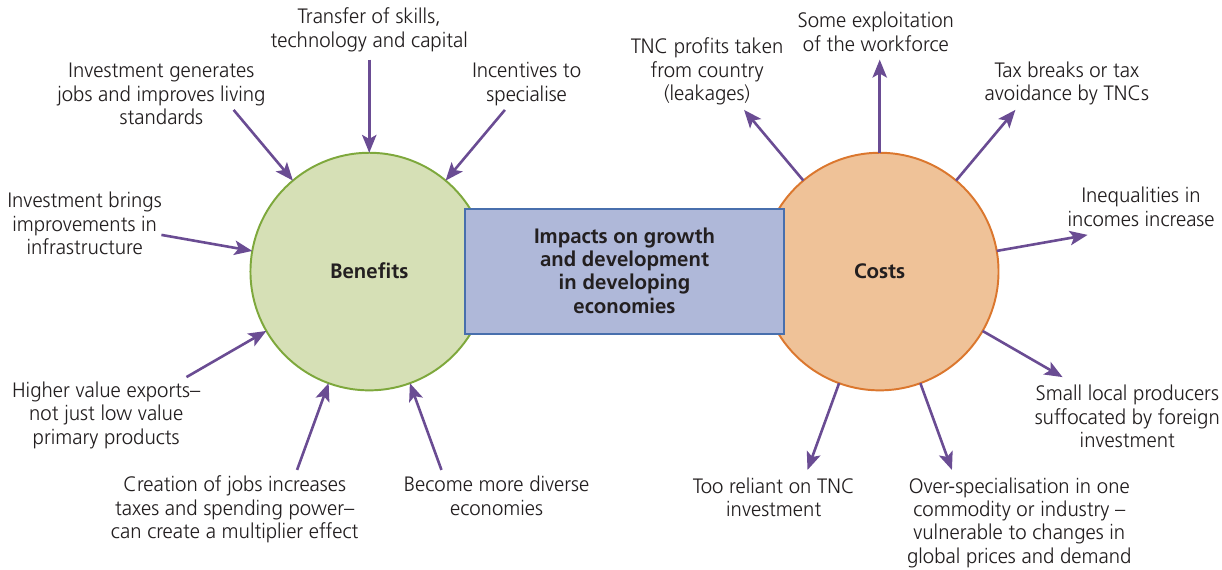
When transnational corporations invest in developing economies, they can generate significant positive impacts:
-
Job creation: TNCs establish factories, offices and other facilities that employ local workers, reducing unemployment and poverty.
-
Skills and technology transfer: Local employees gain valuable skills and knowledge from working for international companies. These capabilities can later benefit domestic firms and entrepreneurs.
-
Infrastructure improvements: TNCs often invest in infrastructure like roads, ports and utilities to support their operations. These improvements benefit the wider economy.
-
Higher value exports: Instead of exporting only low-value primary products like raw agricultural goods or minerals, countries can export manufactured goods with higher profit margins.
-
More diverse economies: TNC investment helps countries develop new industries, reducing dependence on a narrow economic base.
-
Multiplier effects: TNC spending creates jobs and income that circulates through the local economy. Workers spend wages at local businesses, creating further employment and economic activity.
-
Increased tax revenue: Profitable TNCs pay corporate taxes that governments can use for public services and development projects.
Costs and challenges of TNC investment
However, TNC presence in developing economies also creates problems:
Important
Critical Issues with TNC Investment:
-
Profit leakages: TNCs send most profits back to their home countries rather than reinvesting them locally. This removes capital that could fuel domestic development.
-
Workforce exploitation: TNCs may pay low wages, impose poor working conditions and provide minimal job security. Workers have little bargaining power.
-
Tax avoidance: Through creative accounting and exploitation of legal loopholes, many TNCs pay minimal taxes in developing countries despite earning substantial profits there.
-
Growing inequality: The benefits of TNC investment often flow to educated urban elites whilst rural populations and unskilled workers see little improvement. This widens the gap between rich and poor.
-
Displacement of local producers: Small local businesses struggle to compete with large, well-resourced TNCs and may be forced to close. This reduces economic diversity and local ownership.
-
Dependency on TNC investment: Countries become reliant on continued foreign investment. If TNCs relocate to cheaper locations, the economy suffers greatly.
-
Over-specialisation vulnerability: Focusing on particular commodities or industries to attract TNC investment makes economies vulnerable to changes in global prices and demand. If demand falls or prices collapse, the entire economy struggles.
Remember!
Summary
Key Points to Remember:
-
Globalisation has created clear winners and losers: Emerging economies, TNCs, international organisations and trading blocs have benefited most, whilst workers in developed countries have often lost jobs and seen wages stagnate.
-
Free trade brings lower prices and greater choice for consumers but can harm domestic producers: The same processes that make electronic goods and food cheaper also cause factory closures and unemployment in traditional manufacturing regions.
-
Political backlash against globalisation is growing: Rising inequality has fueled national populism, exemplified by Brexit and Trump's election, as people reject further integration.
-
Glocalisation helps TNCs adapt global products to local markets: Companies like McDonald's customise their offerings to suit local tastes and cultural preferences, reducing resistance to standardisation.
-
Environmental costs of globalisation are substantial: Increased transport emissions, resource depletion, pollution and waste are serious consequences that receive insufficient attention compared to economic benefits.
-
TNC investment in developing economies brings both opportunities and exploitation: Whilst TNCs create jobs and transfer skills, they also extract profits, avoid taxes and may exploit workers, making the net benefit questionable.