Differential Access to Markets (AQA A-Level Geography): Revision Notes
📚Revision Notes
Differential Access to Markets
What determines market access
A country's ability to participate in international trade depends on how easily it can access foreign markets. This access is shaped by various barriers and policies that either facilitate or restrict trade between nations.
Note
Understanding market access is fundamental to comprehending global trade inequalities. The barriers that exist between nations can either enable prosperity or perpetuate poverty, depending on which side of them a country finds itself.
Market access is influenced by several factors:
- Tariffs - taxes imposed on imported goods
- Quotas - limits on the quantity of goods that can be imported
- Trade regulations - rules governing how trade occurs
- Trading blocs - groups of countries that trade freely with each other
- Protectionism - policies that protect domestic industries from foreign competition
The level of development in a country significantly affects how much market access it can achieve. Differential access creates an unequal playing field in global trade, where some nations face far greater barriers than others.
Fair trade in less developed economies
Understanding fair trade
Important
Fair trade is a social movement aimed at helping producers in less developed economies (LDEs) secure improved trading conditions.
Fair trade emerged as a response to the inequalities in global trade systems. The movement primarily concentrates on agricultural commodities such as:
- Coffee
- Tea
- Cocoa
- Sugar
- Bananas
- Cotton
- Chocolate
How fair trade works
The fair trade system addresses a fundamental problem: producers in LDEs often receive unfair compensation from the organisations purchasing their products. This happens because individual suppliers:
- Have minimal influence in negotiations
- Depend heavily on the income from their goods
- Cannot afford to refuse low prices
Fair trade organisations support producers by:
- Paying higher prices for their products
- Helping them establish co-operatives that increase their bargaining power
- Enabling more direct trade relationships with buyers
- Improving social and environmental standards
Products certified with the International Fairtrade Certification mark signal to consumers that producers received fair compensation. However, it's crucial to understand that fair trade and free trade are distinct concepts with different goals.
Free trade versus fair trade
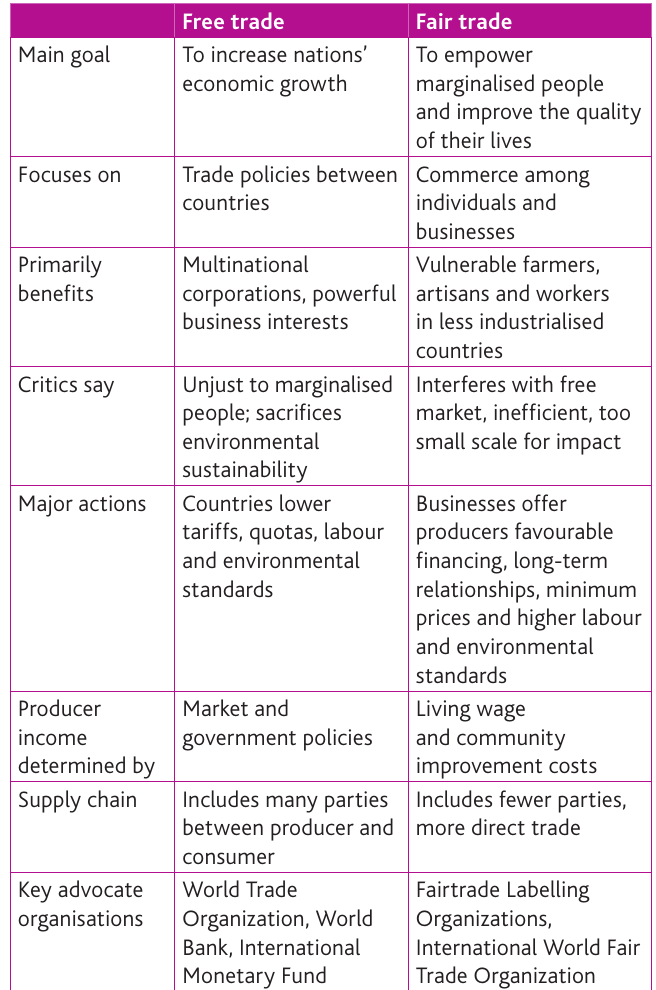
The table above highlights the fundamental differences between these two trade approaches:
Free trade focuses on economic efficiency and growth. It aims to increase national prosperity by removing barriers between countries. The system primarily benefits multinational corporations and powerful business interests. Critics argue that it can disadvantage marginalised people and harm environmental sustainability.
Fair trade emphasises empowerment and quality of life for vulnerable producers. It concentrates on commerce between individuals and smaller businesses rather than large corporations. The movement prioritises supporting farmers and artisans in less industrialised nations through direct trade relationships and guaranteed minimum prices.
Note
Key Distinctions:
The fundamental difference lies in their objectives: while free trade seeks to maximise economic output through market forces, fair trade prioritises equitable treatment and sustainable livelihoods for the most vulnerable participants in global commerce.
Key differences include:
- Income determination: Free trade relies on markets and government policies, whilst fair trade guarantees living wages and covers community improvement costs
- Supply chains: Free trade involves many intermediaries between producer and consumer, whereas fair trade creates more direct connections
- Standards: Fair trade requires higher labour and environmental standards, along with long-term relationships and stable minimum prices
Access associated with levels of economic development
Economic development significantly impacts how easily countries can access international markets. Wealthier nations enjoy considerable advantages that poorer countries cannot match.
Advantages for highly developed economies (HDEs)
More developed economies generally secure better market access because:
- They can afford to pay higher tariffs on their exported goods, making trade restrictions less prohibitive
- They can invest in foreign markets, for example by relocating production facilities to avoid tariffs altogether
- They form trading blocs and customs unions such as the EU, which allow free trade internally whilst imposing barriers on external countries
Note
The Wealth Cycle:
These capabilities create a self-reinforcing cycle of prosperity. HDEs use their wealth to overcome trade barriers, which then generates more wealth through increased trade. This positive feedback loop continuously widens the gap between developed and developing economies.
Disadvantages for less developed economies (LDEs)
In contrast, LDEs face substantial obstacles when trying to access foreign markets:
- High tariffs are unaffordable, making their exports less competitive
- Investment in foreign markets is difficult, limiting their ability to bypass trade barriers
- Entering trading agreements with wealthier nations is challenging, as they have less negotiating power
- They often export primary products subject to volatile prices, which worsens their already limited market access
Important
This creates a problematic situation where those who most need better market access face the greatest barriers. The inequality reinforces existing patterns of global economic disparity, making it increasingly difficult for developing nations to break out of poverty cycles.
Trading agreements
Trade agreements between countries or groups of countries can either improve or restrict market access depending on their structure and terms.
Benefits of trade agreements
Negotiating a trade agreement or joining a trading bloc can provide several advantages:
- Improved access to partner markets - trade agreements remove or reduce barriers to the markets of other countries within that bloc
- Lower prices for consumers - especially beneficial for lower income countries that can trade more freely, often with exchange rate advantages
- Increased leverage - being part of a trading group provides more influence when negotiating access to other markets
- Wider market opportunities - agreements between multiple trading groups can expand markets considerably, particularly benefiting LDEs
Free trade agreements may also eliminate protections for developing domestic industries before they become strong enough to compete internationally. On balance, participating in a trade agreement tends to be more beneficial than remaining isolated.
Drawbacks of trade agreements
However, trade agreements also present certain disadvantages:
- Restricted negotiating power - if a country joins a customs union, it cannot negotiate new deals independently beyond the members of that bloc
- Loss of industry protection - removing barriers may expose domestic industries to competition before they're ready
- Reinforced isolation - countries not included in agreements face even greater barriers to market access
The shift from multilateral SDT agreements to bilateral deals between individual poorer and richer countries has altered the landscape of international trade, with mixed results for developing nations.
Impacts on economic and societal well-being
Trade sanctions as an economic tool
Nations use trade sanctions as a political and economic instrument against countries they dispute with.
Example
Real-World Application: Iran Sanctions
In 2006, the UN Security Council imposed sanctions on Iran due to its refusal to suspend its nuclear programme. These sanctions severely restricted Iran's economic activity until an agreement led to their removal in 2016.
This case demonstrates how trade sanctions can be used as leverage to influence political decisions, but also shows the significant economic costs imposed on the sanctioned nation during the enforcement period.
Economic consequences of poor market access
Whether caused by sanctions or unequal development levels, restricted access to international markets creates devastating economic effects:
- Limited revenue from exports and business taxes means less money available for investment or development
- Poor market access deters foreign investment, as companies avoid countries with restricted trading opportunities
- Balance of payment problems increase, leading to rising debt and restricted economic growth
- Limited investment, growth and development result in widespread unemployment and poverty
- Restricted range and affordability of imported goods for consumers, limiting choice and access to products
Social consequences
The economic impacts translate into serious social problems:
- Unemployment and poverty affect large portions of the population
- Food or energy security may be threatened in the worst cases, as countries lack the ability to trade for essential goods
Important
These impacts demonstrate how differential access to markets affects not just national economies, but the daily lives and wellbeing of entire populations. The consequences extend far beyond economic statistics to affect fundamental human welfare and security.
Measures to combat differential access
Special and differential treatment agreements (SDTs)
Important
Special and differential treatment (SDT) agreements are arrangements that give less developed countries preferential access to markets in trade agreements.
The WTO (previously GATT) multilateral trading system has included these agreements for over sixty years. In 1971, the UN General Assembly created a category of 'Least Developed Countries' (LDCs) to identify developing countries requiring support measures to overcome their structural disadvantages.
Features of SDT agreements
These measures provide LDCs with preferential access through several mechanisms:
- Privileged access to the markets of their trading partners, particularly developed countries
- Greater rights to restrict imports compared to developed countries, protecting domestic industries
- Additional freedom to subsidise exports, helping their products compete internationally
The role of preferential access
Trade plays a vital role in promoting economic development. Preferential access has enabled many LDCs to:
- Diversify their economies beyond traditional sectors
- Achieve economic take-off, moving to higher levels of development
- Lift significant portions of their population out of poverty
However, SDTs are not without problems.
Challenges with SDT implementation
Note
Implementation Difficulties:
While SDT agreements sound beneficial in principle, their practical application has proven challenging. Several structural and political issues have limited their effectiveness in achieving their intended goals.
Several issues limit the effectiveness of these agreements:
- The WTO Doha Development round made minimal progress in strengthening SDT measures for developing countries
- Concerns from richer nations that non-reciprocal preferential trading creates unfair trade, particularly as emerging economies like China maintain 'developing country' status whilst being able to subsidise exports
- HDEs fear that cheap imports will flood their markets and undermine their own industrial base
- Difficulty in applying agreements fairly and the lack of reciprocity has deterred some developed countries from participating
- Replacement by bilateral agreements - many SDTs have been superseded by trade agreements between individual poorer and richer trading partners (for example, Mexico now benefits more from NAFTA/USMCA membership than from previous preferential access to Canadian and US markets)
Nature and role of transnational corporations (TNCs)
Defining transnational corporations
Important
Transnational corporations (TNCs) are companies that operate in at least two countries, with a headquarters based in one country but with business operations usually in a number of others.
TNCs take many different forms and operate across various economic sectors. They no longer originate solely from more developed countries - emerging economies now host major global companies as well. Some TNCs wield enormous power, with revenues exceeding the total GDP of many nations. This gives them considerable political influence, such as persuading governments to reduce taxes or establish special economic zones to attract investment.
Reasons for operating across borders
TNCs may establish operations in multiple countries for several strategic reasons:
- To escape trade tariffs - for example, Nissan's decision to manufacture cars in Sunderland was largely motivated by gaining barrier-free access to the EU market
- To find the lowest cost location for production - for instance, Hewlett-Packard chose Malaysia for its cost advantages
- To take advantage of foreign exchange rates that make exports cheaper - such as Dyson's operations in Malaysia
- To reach foreign markets more effectively - as demonstrated by McDonald's global expansion
- To exploit mineral or other resources available in foreign countries - for example, BP's operations in Azerbaijan
Note
Strategic Location Decisions:
Each of these motivations reflects a fundamental principle of TNC operations: maximising efficiency and profitability through strategic global positioning. By carefully selecting where to locate different aspects of their operations, TNCs can optimise their competitive advantage across multiple markets simultaneously.
Common characteristics of TNCs
Several features are typically shared by transnational organisations:
- Maximising global economies of scale by organising production to reduce costs
- Sourcing raw materials or components at the lowest possible cost
- Controlling supply chains efficiently
- Managing processing at each production stage
- Branding products and services to make them easily recognisable worldwide
Spatial organisation
Global integration
Transnational corporations operate as globally integrated enterprises by locating different functions across multiple countries. This allows them to gain an effective blend of cost efficiency, skilled labour, and favourable environmental conditions.
Headquarters location
Traditionally, company headquarters are situated in a major city within the home country. Most TNCs maintain subsidiary headquarters in each continent or region where their main operations are based.
Research and development
To remain competitive, TNCs invest significantly in research and development (R&D) activities. These tend to be concentrated in the country of origin and often locate near to:
- Centres of higher education, to access graduate labour markets
- University research facilities, to utilise advanced research infrastructure
- Manufacturing operations, though these are often in LDEs where land, labour and material costs are lower
Note
Global Division of Labour:
This spatial separation creates a global division of labour, with high-skill activities in developed countries and production in developing nations. This arrangement maximises efficiency but also raises questions about equity and development opportunities.
Offshoring and outsourcing
Important
Offshoring refers to locating manufacturing operations in LDEs where land, labour and material costs are lower. Outsourcing involves organising production or support services more cost effectively.
These practices are slightly different concepts but share similar causes and consequences. Both are strategies employed by TNCs to organise production or support services more efficiently and at lower cost.
Key characteristics
Both offshoring and outsourcing are:
- Largely one directional - moving from developed to developing countries
- Driven by cost considerations
- Used to maintain or improve competitiveness
- Affecting both manufacturing and service sectors
These practices significantly influence global patterns of employment, economic development, and the distribution of wealth between nations. They represent practical examples of how differential access to markets operates through corporate decision-making.
Summary
Remember! Key Takeaways:
-
Differential market access is determined by a country's ability to trade, which depends on barriers like tariffs, quotas and regulations, as well as its level of economic development
-
Fair trade and free trade are fundamentally different: free trade focuses on economic growth and benefits large corporations, whilst fair trade prioritises empowering marginalised producers in LDEs through better prices and direct relationships
-
Economic development creates unequal access: HDEs can afford tariffs, invest abroad and form trading blocs, whilst LDEs struggle with high costs and limited negotiating power
-
SDT agreements provide preferential access to LDCs but face implementation challenges, including concerns about reciprocity and the rise of bilateral agreements replacing multilateral approaches
-
TNCs operate globally to maximise efficiency by escaping tariffs, reducing costs, accessing markets and exploiting resources, using strategies like offshoring and outsourcing to locate different functions where they're most cost-effective