Flows of Capital, Labour, Products, Services and Information (AQA A-Level Geography): Revision Notes
📚Revision Notes
Flows of Capital, Labour, Products, Services and Information
Introduction to globalisation
Globalisation has evolved beyond simple economic connections to encompass multiple dimensions of international interaction. The process involves the movement and exchange of ideas, information, goods, services, capital and people across the world, creating increasingly uniform patterns of consumption and culture despite geographical distances.
Dimensions of globalisation
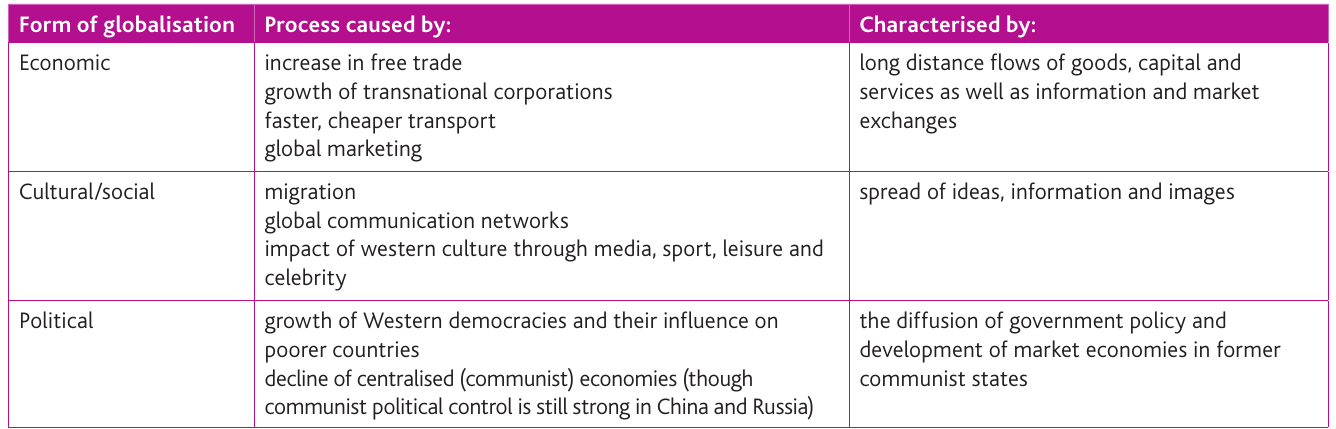
Globalisation operates through three interconnected forms, each driven by distinct processes and displaying unique characteristics:
Note
Globalisation manifests in three key dimensions that work together to create our interconnected world:
- Economic: Trade expansion and transnational corporations
- Cultural and Social: Movement of people and information
- Political: Spread of democratic systems and market economies
Economic globalisation centres on the expansion of international trade and the removal of barriers to commerce. The growth of transnational corporations (TNCs) has been pivotal, as these organisations coordinate production, distribution and sales across multiple countries. This form of globalisation is characterised by the long-distance movement of goods, capital and services, alongside the development of integrated global market exchanges.
Cultural and social globalisation manifests through the worldwide movement of people and the rapid spread of information via global communication networks. Western cultural influences, particularly through media, sport, leisure activities and celebrity culture, have diffused internationally. This dimension is marked by the sharing of ideas, information and cultural images across borders.
Political globalisation reflects the expansion of Western democratic systems and their influence on developing nations. The decline of centralised communist economies, though communist political control persists in countries like China and Russia, has led to the development of market-based economic systems in former communist states.
Factors of production
Understanding global flows requires knowledge of the fundamental resources needed for economic activity. Economists identify four essential factors of production:
Note
Land encompasses all natural resources provided by the Earth, including minerals, soils, water supplies and forests. These raw materials form the foundation of production systems.
Note
Labour refers to the human workforce available in any economy. The quantity, quality and cost of workers are crucial considerations for businesses producing goods and providing services. Labour quality depends on education, skills and training levels.
Note
Capital in economic terms describes physical resources that serve as man-made aids for production, such as buildings, factories, machinery and equipment. Capital flows involve the transfer of these physical resources between locations, though in practice this usually means the movement of investment finance used to acquire such capital.
Note
Enterprise represents the human capacity for establishing businesses and organising the production of goods or provision of services. Entrepreneurs take risks and make decisions about how to combine the other factors of production effectively.
The increased international movement of capital, labour and enterprise has been both a driver and a consequence of globalisation.
Flows of capital
Understanding international capital flows
Note
International capital flows include all money that moves between countries for purposes of investment (such as acquiring land and physical capital), trade or production.
In the late twentieth century, the deregulation of world financial markets transformed how capital moves globally. This process removed restrictions that had previously confined the activities of financial institutions, including banks, insurance companies and investment firms, within national boundaries. Deregulation allowed these institutions to operate internationally with greater freedom.
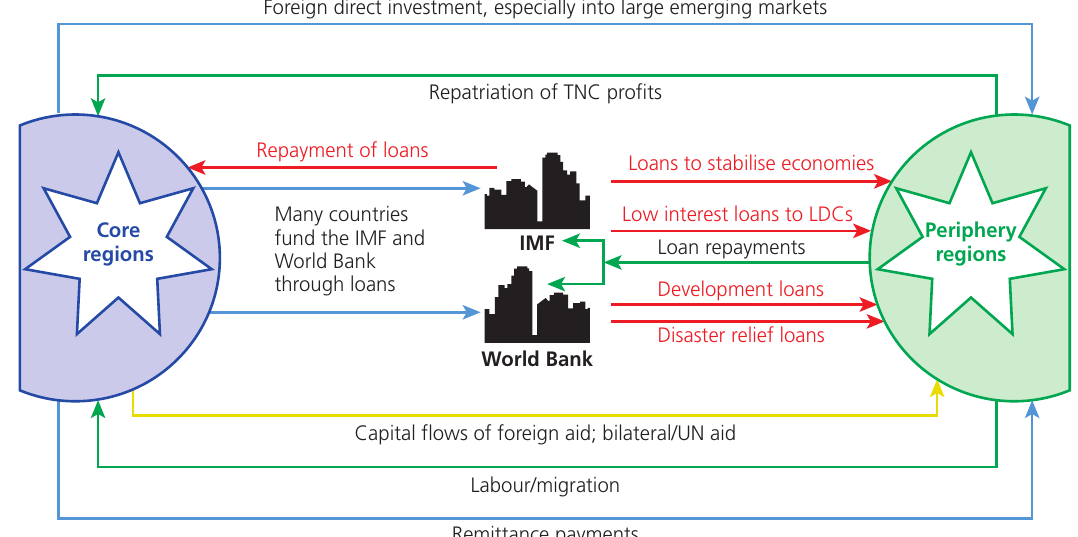
The diagram above illustrates the complex web of capital flows in the global economy. It distinguishes between 'core' regions (highly developed economies or HDEs) and 'periphery' regions (less developed economies or LDEs). This framework draws from dependency theory and world systems theory, which suggest that global economic power concentrates in blocks of highly developed nations.
However, the rapid growth of large and medium emerging economies, such as the BRIC nations (Brazil, Russia, India, China) and more recently MINT countries (Mexico, Indonesia, Nigeria, Turkey), has made the core-periphery distinction less clear-cut. A continuum of development now exists rather than a simple two-tier system.
Note
BRIC – An acronym used to identify a group of four countries – Brazil, Russia, India and China – whose economies have advanced rapidly since the 1990s. Sometimes South Africa is added to this list, making the acronym BRICS.
Note
MINT – An acronym referring to the more recently emerging economies of Mexico, Indonesia, Nigeria and Turkey.
Types of capital flows
Capital moves between regions through several key mechanisms:
Foreign Direct Investment (FDI): This represents investment made mainly by TNCs (though sometimes by governments) from their base country into the physical capital or assets of foreign enterprises. The investing company may establish this overseas investment in various ways, including setting up a subsidiary company, acquiring shares in an existing foreign company, or forming a joint venture with a local partner.
Repatriation of profits: TNCs investing in overseas production typically transfer any profits made from that investment back to their home country. This process represents an economic leakage, as income 'leaks' from the country that received the investment. The majority of these profit flows return to companies based in richer countries.
Important
Economic leakage refers to a loss of income from an economic system. It most commonly describes profits sent back to their base country by transnational corporations – also known as profit repatriation. This represents a significant challenge for developing economies receiving FDI, as the benefits of investment may be diminished by outward profit flows.
Note
Diaspora – A large group of people with a similar heritage or homeland who have moved and settled in places all over the world.
Aid: This provides an important source of financial support for poorer countries. Aid can take multiple forms and may be provided through the UN, with contributions from multiple richer countries (multilaterally), or directly from one government to another (bilaterally), usually with mutual cooperation conditions attached. Aid is also known as Official Development Assistance (ODA).
Migration: The majority of labour migration occurs from poorer to richer countries. This pattern can exacerbate disparities, as less developed nations lose their most skilled and talented workers. These individuals typically pay taxes and spend much of their earnings in their destination country, though they often send remittances back to their country of origin.
Note
Remittances are transfers of money made by foreign workers to family members in their home country. These flows have become a critical source of income for many developing economies.
Remittance flows – 'rivers of gold'
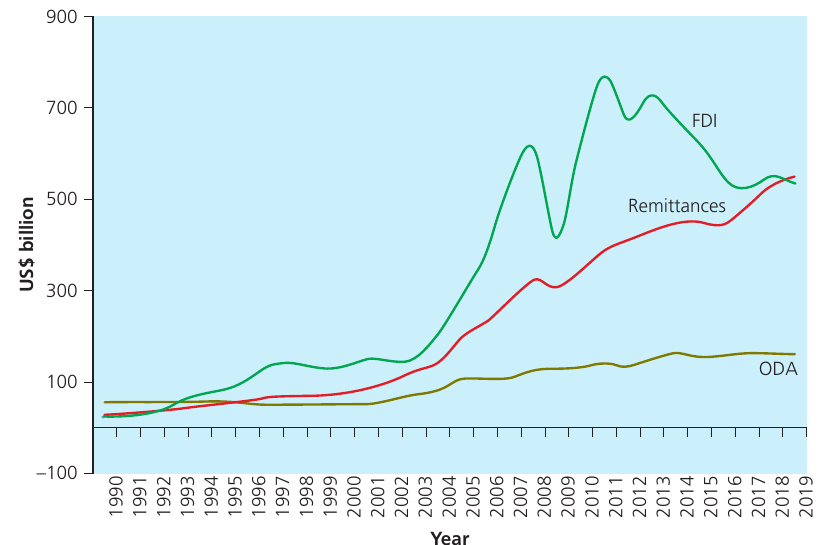
The money that workers send home to their families from abroad has become a critical component of many developing economies worldwide. Officially recorded remittances reached a record US $529 billion in 2018, more than three times the volume of Official Development Assistance. These flows are expected to grow in importance as a source of external financing in least developed countries (LDCs).
Sources and destinations
The net flows of remittance payments generally move from wealthy and resource-rich economies to developing economies. Among the main sources of remittances are the USA, Saudi Arabia, United Arab Emirates, UK, Canada, Russia and EU countries including Germany, France and Italy.
Example
Worked Example: Understanding Remittance Impact
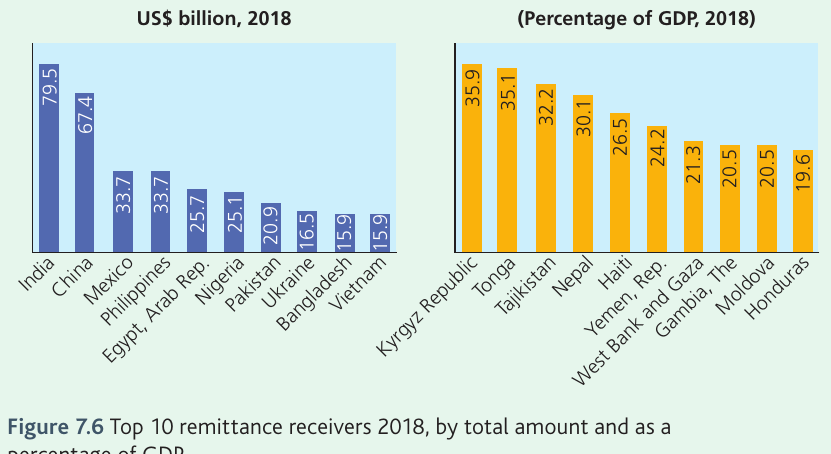
The data reveals interesting patterns when examining remittances both in absolute terms and as a percentage of GDP:
Absolute amounts (highest recipients):
- India: $79.5 billion
- China: $67.4 billion
As percentage of GDP (highest dependence):
- Kyrgyz Republic: 35.9% of GDP
- Tonga: 35.1% of GDP
- Tajikistan: 32.2% of GDP
This shows that while large economies receive more money in total, remittances form a much larger share of national income for smaller economies, making them critically important for these nations' economic stability.
Benefits and challenges of remittances
Remittances offer several advantages:
- They provide a more stable and steadily rising source of income compared to Foreign Direct Investment, which fluctuates significantly and experiences sharp declines during economic recessions
- They serve as an effective mechanism to alleviate poverty because funds go directly to families rather than through intermediary institutions
- They enable developing countries to receive substantial financial inflows without accumulating debt
However, the benefits are reduced by several factors:
Important
Transaction Costs Reduce Benefits
High charges imposed by banks, post offices and other transfer agencies for sending money significantly reduce the net benefit to recipient families. The global average cost for sending $200 in 2019 was around 7% of the amount sent, though it can reach between 15 and 18% for some transfers. These transaction costs substantially reduce the net benefit to recipient families and economies.
The UN recognises the importance of remittances for development. Reducing remittance costs to 3% by 2030 is a global target under the Sustainable Development Goals.
Another way to maximise the development impact of remittances is to encourage migrant workers to invest in their home countries more formally through diaspora bonds, which can be used to finance development projects.
Flows of labour
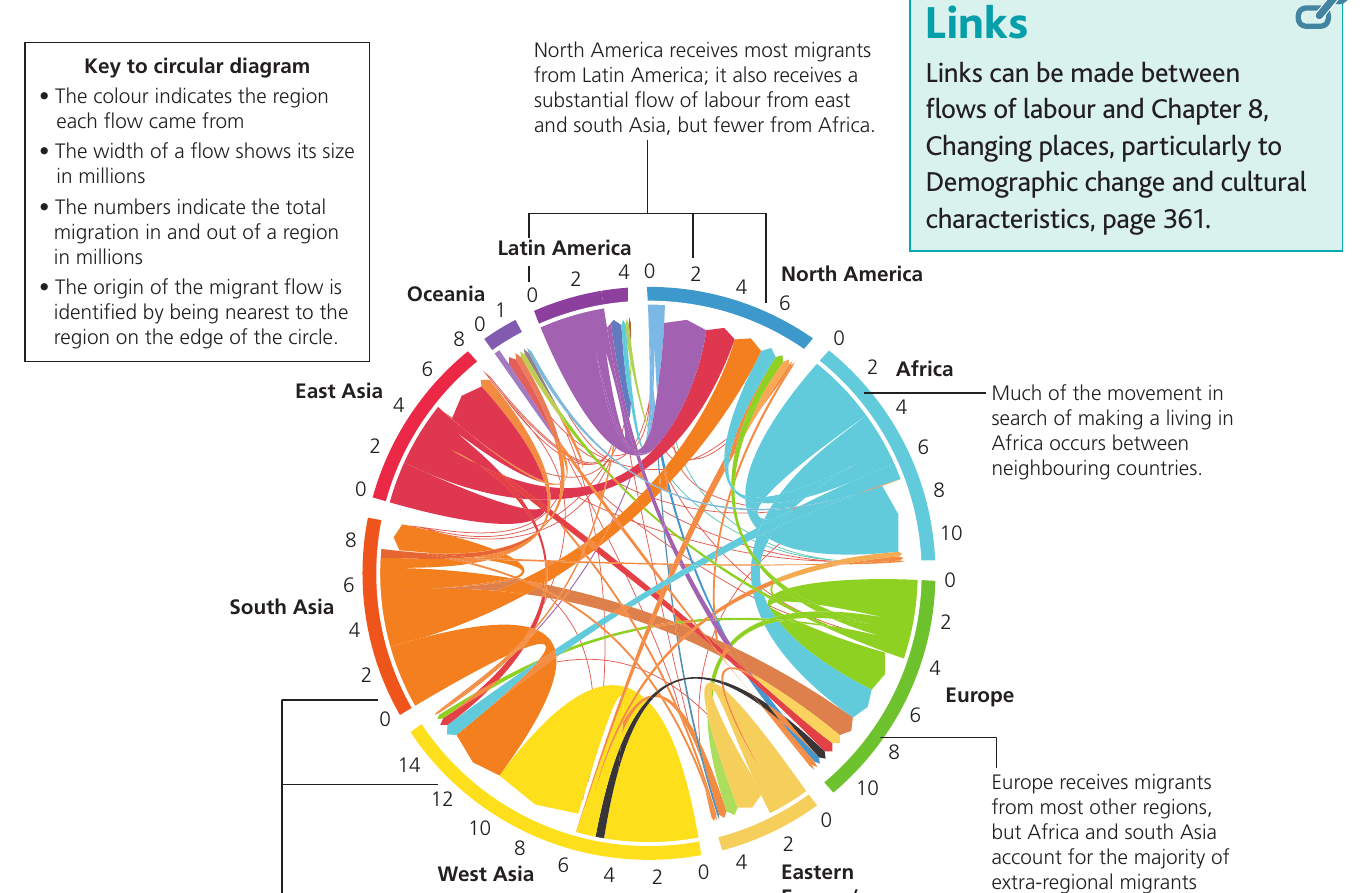
Labour markets do not allow people to move as freely around the world as financial markets allow money to move. People relocate less easily than capital because of immigration restrictions. Nevertheless, recent years have witnessed a phenomenal rise in the numbers of migrants crossing international borders, mainly to seek better employment opportunities. Much of this movement originates from developing countries in South Asia, Africa and Latin America, with destinations in the richer areas of North America and Europe. Another major destination for labour movement has been the oil-rich Gulf States of Kuwait, Qatar, Bahrain, Saudi Arabia and the United Arab Emirates, where construction booms have provided plentiful employment opportunities.
Key facts about labour movement
Note
Global Labour Flow Patterns
Several important patterns characterise global labour flows:
- Despite increases in cross-border movements, most migrants move over short distances within the same region or between neighbouring regions (especially in sub-Saharan Africa)
- North America, Europe and the Gulf countries in western Asia attract migrants from the furthest distances
- The bulk of economic migrants moving between continents are not the poorest but are those with some education and financial means
- The largest inter-regional flow of labour occurs in Asia. Between 2010 and 2015, around three million workers moved from south and west Asia to west Asia
- The second largest inter-regional flow moves from Latin America to North America
- Over the past 25 years, more people have migrated from Asia to North America and Europe, though both the Gulf states and the Tiger economies of South East Asia have become attractive destinations for those seeking employment
Much of the movement within Africa occurs between neighbouring countries. North America receives most migrants from Latin America and also attracts a substantial flow of labour from east and south Asia, but fewer from Africa. Europe receives migrants from most other regions, but Africa and south Asia account for the majority of extra-regional migrants. The black line on the diagram represents the number of migrants from the Middle East to Europe, including those from Syria up to mid-2015.
Flows of products
International trade in manufactured goods has increased significantly in recent years. This expansion has been stimulated by demand from affluent populations in developed countries, combined with low production costs due to cheap production and low wage economies in exporting regions, particularly in China and South East Asia.
Facilitating product flows
The international movement of products is facilitated, especially for developing countries, by:
Reduced transaction costs: Improvements in data flows and the ease with which capital can be transferred have reduced the costs of paying for transactions internationally.
Transport and time cost reductions: The process of containerisation has enabled more complex and long-distance flows of products. Air transport can also speed delivery and reduce costs for more valuable or perishable cargo.
Note
Containerisation – A system of standardised transport that uses large standard-size steel containers to transport goods. The containers can be transferred between ships, trains and lorries, enabling cheaper, efficient transport.
Trade barriers and blocs
The most obvious regulatory barriers to trade are tariffs, which the encouragement of the World Trade Organization (WTO) has generally reduced in global trade.
Note
Tariffs – A tax or duty placed on imported goods with the intention of making them more expensive to consumers so that they do not sell at a lower price than home-based goods – a strategy of protectionism.
Note
Protectionism – A deliberate policy by government to impose restrictions on trade in goods and services with other countries – usually done with the intention of protecting home-based industries from foreign competition.
Regional trading blocs provide tariff-free trade or other favourable trading conditions to fellow member nations within the bloc. These arrangements have facilitated increased trade flows between member countries.
Example
Worked Example: Growth in International Trade (2005-2017)
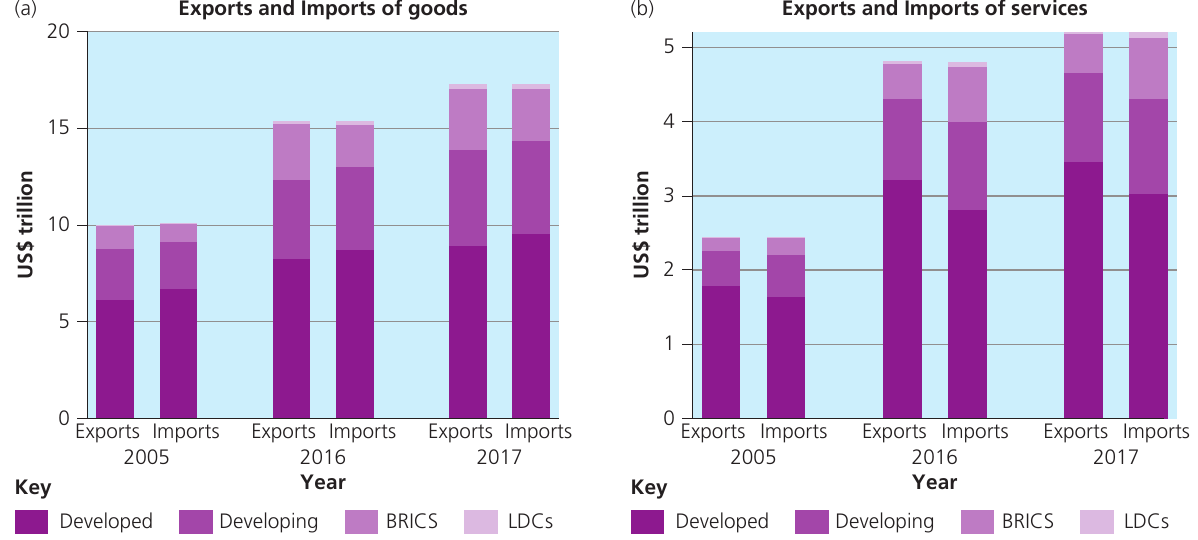
The charts illustrate the dramatic growth in international trade between 2005 and 2017:
Trade in goods:
- Nearly doubled over the period
- Reached approximately $20 trillion US
Trade in services:
- More than doubled over the period
- Reached about $5 trillion US
Key observations:
- Developed countries still account for the largest share of both exports and imports
- Developing countries and BRICS nations have increased their participation substantially
- Physical goods still dominate international commerce (4:1 ratio compared to services)
Flows of services
Services are economic activities that are traded without the production of material goods. Examples include financial services and insurance services. They can also be sub-divided into:
- High level services – services to businesses such as finance, investment and advertising
- Low level services – services to consumers such as banking, travel and tourism, customer call centres or communication services
Characteristics of service flows
Services such as banking, insurance and advertising depend on communication and the transfer of information. They can be footloose – able to locate anywhere – and advancing technology means they can still serve the needs of customers worldwide regardless of location.
High-level services are concentrated in cities in the more developed world, such as London, New York and Tokyo, which are the major centres of global finance. With the emergence of east Asian economies, Hong Kong, Singapore and Shanghai have also become major global financial centres.
Note
A growing number of transnational service conglomerates have emerged, seeking to extend their influence on a global scale. Examples include:
- HSBC Holdings in banking
- AXA (France) in insurance
- WPP Group (UK) in advertising
- TUI Group (Germany) in travel and tourism
Note
Conglomerates – A collection of different companies or organisations which all report to one parent company – most transnational corporations are conglomerates.
One trend has been the decentralisation of low level services from the developed to the developing world. Call centre operations, for example, have moved from the UK to India where labour costs are up to 20% lower than in the UK. Much of India's economic success can be attributed to its growing service sector, especially information technology and online customer services, which provide support for companies in high-income countries (also known as 'outsourcing').
Flows of information
Information flows are governed by the movement of people through migration and by the speed of data and communication transfers. Both are responsible for the transfer of cultural ideas, language, industrial technology, design and management support.
Digitisation and satellite technology have transformed these flows of information, which are now supported by:
Note
Technological Enablers of Information Flows
- Improvements to global telephone networks, making communication cheaper and easier
- Mobile telecommunication technology enabling connectivity in remote locations
- Email and the internet, which enable large amounts of information to be exchanged instantly across the globe
- Live media coverage available on a global scale because of satellite technology
Important
The importance of information flows should not be underestimated because of their contribution to the expansion of knowledge-intensive goods and services (also known as the quaternary sector of an economy). Such goods and services include those which have an intensive research and development component and use highly skilled and educated labour. They include high-tech products such as pharmaceuticals, computer technology and business services including international law, accounting and engineering. These industries need the exchange of ideas and flow of expertise to flourish.
Global marketing and production patterns
Global marketing
Marketing is the process of promoting, advertising and selling products or services. When a company becomes a global marketeer, it views the world as one single market and creates products that fit the various regional marketplaces. It will usually develop a recognisable brand and employ one marketing strategy to advertise the product to customers all over the world. The ultimate goal is to sell the same or similar product, the same way, everywhere. Having one marketing campaign on a global scale like this generates economies of scale for the organisation, which reduces their costs.
Note
Economies of scale – The cost advantages that result from the larger size, output or scale of an operation. Savings are made by spreading the costs or by rationalising operations.
Example
Worked Example: Coca-Cola's Global Marketing Strategy
Coca-Cola is an example of a company with a single product but minor elements are tweaked for different markets:
Product consistency:
- Uses the same formulas (one with sugar, the other with corn syrup) for all its markets
- Maintains consistent taste and quality worldwide
Local adaptations:
- The bottle design is recognisable in every country
- The size of bottles and cans conforms to each country's standard sizing
This demonstrates how global marketing can maintain brand consistency while adapting to local market requirements.
Patterns of production, distribution and consumption
Globalisation created a new international division of labour with two main recognisable groups:
- The highly skilled, highly paid, decision-making, research and managerial occupations which, on a global scale, are largely concentrated in more developed countries
- Lower-skilled manufacturing and assembly work, typically located in developing countries where labour costs are significantly lower
This division reflects how production processes have been fragmented and distributed across different countries to maximise efficiency and minimise costs. Components may be manufactured in several countries before final assembly occurs in another location, creating complex global supply chains. Distribution networks then move finished products to consumer markets worldwide, often using the containerisation systems discussed earlier.
Summary
Key Points to Remember:
-
Capital flows in multiple forms: FDI, profit repatriation, aid (ODA), and remittances all move money between countries, with remittances now exceeding $529 billion annually – more than three times the value of official development assistance.
-
Labour migration follows economic opportunities: The largest flows move from developing regions (South Asia, Africa, Latin America) to developed areas (North America, Europe) and resource-rich Gulf states, though most migration still occurs over short distances within regions.
-
Trade has been transformed by technology: Containerisation has revolutionised product flows by standardising transport and reducing costs, whilst the WTO and regional trading blocs have reduced tariff barriers to facilitate increased global trade.
-
Services and information are increasingly mobile: High-level services concentrate in global financial centres (London, New York, Tokyo, Hong Kong, Singapore), whilst low-level services have been outsourced to developing countries like India where labour costs are lower and technology enables remote service delivery.
-
Globalisation creates interdependence: The flows of capital, labour, products, services and information are interconnected – for example, remittances from labour migration provide capital flows, whilst information technology enables service outsourcing and supports knowledge-intensive industries that drive economic development.