Interactions of Governance between Different Scales (AQA A-Level Geography): Revision Notes
📚Revision Notes
Interactions of Governance between Different Scales
What is multiscalar governance?
Success in global governance requires clear communication and understanding of strategies at all scales, from global institutions right down to local communities. Governance is not simply about governments controlling society. It also involves mobilising organisations and individuals to follow guidelines, which may be set out in regulations or agreements. This requires informing people about issues and persuading them to follow an appropriate course of action.
Important
Multiscalar power is the ability to influence behaviour and attitudes through interactions at different scales, to encourage or prevent change. Multiscalar relationships operate in a complex way. They involve different tiers of government but other 'players' are involved in decision-making at each level, including non-governmental organisations (NGOs) and civil society groups as well as individual citizens, all of whom may influence, organise or mobilise each other to take action.
The multiscalar web of interactions
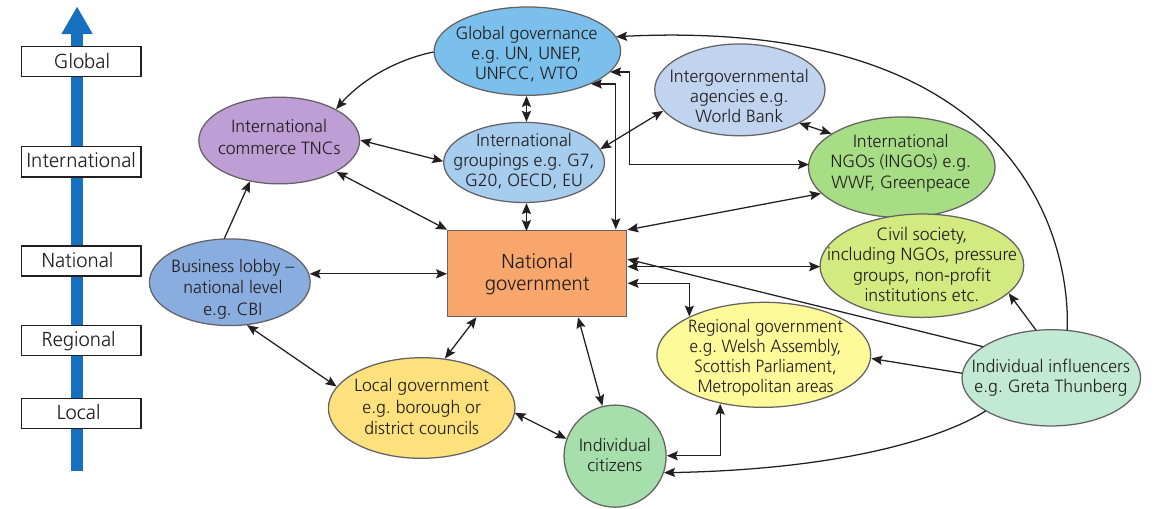
Governance operates through a complex network of actors and institutions working at different geographical scales. These scales include:
- Global level: UN agencies (UNEP, UNFCCC), World Trade Organisation (WTO)
- International level: International groupings (G7, G20, EU), intergovernmental agencies (World Bank), transnational corporations (TNCs)
- National level: Central governments, business lobby organisations
- Regional level: Welsh Assembly, Scottish Parliament, metropolitan areas
- Local level: Borough councils, district councils
Note
This diagram shows how different actors interact across scales. Importantly, influence does not just flow downwards from global to local. Individual citizens, local governments, and civil society groups can also influence national and even global governance through various channels.
Case study: Sustainable development and Agenda 21
The Earth Summit and Agenda 21
At the Earth Summit in Rio de Janeiro in 1992, leaders of the international community adopted Agenda 21, a UN non-binding resolution that was seen as a blueprint for sustainable development for the early part of the twenty-first century. In total, 178 national governments signed up to follow the resolution. The plan focused on social and economic issues, such as combating poverty and the conservation and management of resources.
How Agenda 21 worked across scales
Agenda 21 action plans were cascaded down from international agencies to different governance levels:
- Global level: UN agencies (such as UNEP) created the overall framework
- National level: National governments developed their own strategies
- Regional and local level: Regional and local government implemented practical actions to influence individual behaviour
This represented a 'top-down' approach, which encouraged a 'bottom-up' response, as the ideas were designed to filter down from the UN to encourage more sustainable lifestyles and behaviour.
Example
Worked Example: Local Implementation in the UK
Each local authority in the UK developed a Local Agenda 21 (LA21) strategy in line with UN objectives and actions. For example, the fact that most parts of the UK have various recycling options as part of their waste collection is a tangible outcome stemming from Agenda 21.
Strengthening NGO participation
A key feature of Agenda 21 was to strengthen the role of NGOs and civil societies in the decision-making process. This recognised that effective governance requires participation from actors beyond just government.
Note
Implementation of Agenda 21 attempted to engage governments and individuals at all levels, on the basis that good governance is essential for sustainable development. It has now been superseded by Agenda 2030, which is supported by the 17 Sustainable Development Goals (SDGs).
Case study: Climate change governance
The Paris Climate Agreement
At the UNFCCC Paris Climate Summit in December 2015, a landmark agreement to combat climate change was struck by world leaders. The Paris Agreement came into force in November 2016 and has been ratified by nearly all national governments. (Significantly, the USA withdrew from the Paris Agreement in November 2020, but this decision has been reversed by the new Biden administration.)
The Agreement's central aim is to keep global temperature rise this century to well below 2°C above pre-industrial levels and to pursue efforts to limit the temperature increase to 1.5°C in order to avert the worst effects of global warming.
Citizen-led pressure and civil society response
The perceived lack of action by many governments to impose measures that would address the climate 'emergency' gave rise to a series of citizen-led protests. Events were organised by environmental pressure (civil society) groups such as the newly formed Extinction Rebellion and NGOs such as Greenpeace.
Example
Example: Youth Climate Movement
From 2019, 'School Strike for Climate' protests, inspired by Sweden's then 16-year-old Greta Thunberg, were supported by 1.5 million schoolchildren and students. A new civil society group of mainly under 18s, the UK Student Climate Network (UKSCN), was formed to organise these strikes.
The UK's climate emergency declaration
In 2019, the UK government made a declaration of an 'Environment and Climate Emergency' as a result of pressure from citizens, civil society groups, NGOs and from local and regional governments. The declaration itself was largely symbolic with no legislation attached but it did acknowledge:
- The term climate 'emergency'; this has been used by activists in preference to climate change to signal that an urgent response is required
- That politicians, at all levels, should increasingly engage with climate and environment issues, which should be a central and integral part of government policies, rather than an afterthought
Note
This example demonstrates how local and individual action can influence national policy, showing the multiscalar nature of governance in practice.
The role of non-governmental organisations (NGOs)
Important
Non-governmental organisations (NGOs) are any non-profit, non-commercial organisation with a common interest working independently of government influence. NGOs can be organised on a local, national or international scale.
Important
Civil society is the 'third sector' of societal decision-making, distinct from government and business. It can include a wide array of non-profit organisations including NGOs, pressure groups, community groups, indigenous groups, charitable organisations, professional bodies and unions.
Why NGOs matter in multiscalar governance
Non-governmental organisations operate across boundaries and at all scales and are important participants in the interactions that influence global governance. They can mobilise strong support from individual citizens, giving them more authority to challenge the excesses of transnational corporations (TNCs) and national governments that threaten equality, justice or the environment and to influence governance.
With greater communication, including social media, to raise awareness of issues, NGOs have expanded their scope and have increasingly become 'international' organisations.
What NGOs do
In the twenty-first century NGOs have emerged as a global force to:
- Democratise decision-making (encouraging governments to consider 'bottom-up' approaches)
- Protect human rights
- Provide essential services such as food, water or medical help to the most needy
Types of NGOs
There is a distinction to be made between operational and advocacy (campaigning) NGOs. Both are funded by donations and subscriptions, but some also receive money from governments and others from businesses (though this may compromise their independence).
- Operational NGOs: those providing frontline support services to the needy (for example, Oxfam, Médecins sans Frontières); they tend to raise money for each project they undertake
- Advocacy NGOs: those who focus on campaigns to raise awareness to gain support for a cause (for example, Greenpeace); derive money from donations and, in some cases, from subscriptions
Different roles of NGOs
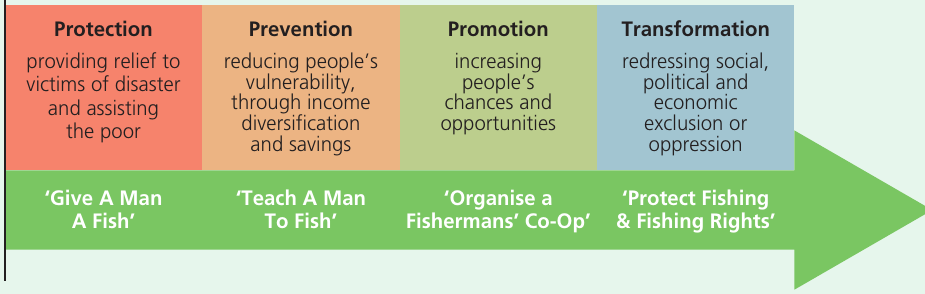
NGOs play different roles depending on their objectives and approach:
- Protection: Providing relief to victims of disaster and assisting the poor (e.g. "Give a man a fish")
- Prevention: Reducing people's vulnerability through income diversification and savings (e.g. "Teach a man to fish")
- Promotion: Increasing people's chances and opportunities (e.g. "Organise a fishermans' co-op")
- Transformation: Redressing social, political and economic exclusion or oppression (e.g. "Protect fishing and fishing rights")
Note
This progression shows how NGO work can move from simply providing immediate relief to tackling systemic issues. The movement from protection through prevention and promotion to transformation represents increasingly comprehensive approaches to addressing development challenges.
Growing importance of NGOs
NGOs work increasingly in partnerships with other stakeholders, such as governments, international organisations and other civil society groups. They are becoming increasingly important in supporting development and are often the only co-ordinated organisations to provide a voice for the poor.
The global commons
What are the global commons?
The 'global commons' refers to resource domains or areas that lie outside of the political reach of any one nation state. It is a term used to describe supra-national 'spaces' in which common shared resources can be found.
International law recognises four global commons:
- The high seas
- The atmosphere
- Antarctica
- Outer space
Note
Some commentators would argue that cyberspace has also emerged as a 'global common' domain which meets the definition of a 'global common' by being a resource that is shared by all but is not controlled by any single nation. This includes the development of the worldwide web, one of the main drivers of globalisation.
Rights and benefits of the global commons
International law relating to the global commons is guided by the common heritage of mankind principle. This principle affirms that the natural resources in defined territories or spaces are held in common by all nations. These resources are to be distributed equitably for the benefit of everyone, including for future generations; individual nations have no sovereign rights to exploit them.
Historically, access to these resources (with the exception of fishing and whaling on the high seas) has been difficult.
More recently however:
- Advances in science and technology have given easier access to a range of resources
- Greater scarcity of resources, especially minerals, fuels and food has put increasing pressure on the global commons to provide resources for a needy and developing world
Important
These changes mean that the concept of common heritage is being put under increasing pressure. The balance between providing resources for development and protecting these commons for future generations is one of the key governance challenges of the twenty-first century.
'The tragedy of the commons'
Important
This concept explains why shared 'common access resources' of any type are likely to be overexploited. If individuals act independently and according to their self-interest, this will be contrary to the interest of the whole group because the shared resource will become depleted.
This is exactly what has happened on a global scale to fish stocks, which have been overfished, leading to depletion, marine pollution and loss of sustainability.
The rights of all to the benefits of global commons can only be secured through sustainable development, which requires effective governance at a global level. Clear rules given by the UN will ensure that the commons are protected from over-exploitation and preserved for future generations.
Protecting the global commons
Each of the global commons is covered by a number of international laws or treaties of one kind or another:
- The high seas by the UN Convention on the Law of the Sea (UNCLOS)
- The atmosphere by the United Nations Framework Convention on Climate Change (UNFCCC), plus other international environmental agreements, including the Paris Climate Accord
- Antarctica by the Antarctic Treaty Systems (ATS)
- Outer space by the Outer Space Treaty (1967)
Summary
Key Points to Remember:
- Multiscalar power involves interactions between actors at different geographical scales (global, international, national, regional, local) to influence governance and decision-making
- Governance is not just top-down from governments; civil society groups, NGOs, and individual citizens can also influence policy at higher scales through various channels
- Agenda 21 demonstrated how global frameworks can cascade down through governance levels whilst also encouraging bottom-up participation
- Climate change governance shows how citizen-led protests and civil society pressure can influence national government declarations and policies
- NGOs operate across all scales and play crucial roles in democratising decision-making, protecting human rights, and providing essential services, with roles ranging from protection to transformation
- The global commons (high seas, atmosphere, Antarctica, outer space) require effective governance at a global level to prevent the 'tragedy of the commons' and ensure sustainable use for future generations