International Agencies (AQA A-Level Geography): Revision Notes
📚Revision Notes
International Agencies
Introduction to international agencies
A range of intergovernmental institutions and agencies play crucial roles in managing global governance. These organisations work internationally to address worldwide challenges and coordinate responses between nations. Most of these international agencies have connections to the United Nations system, which serves as the central framework for global cooperation.
United Nations (UN)
Overview and purpose
The UN is a global organisation established in 1945, comprising 193 member states. Its primary aims focus on promoting international peace, security, and cooperation between nations. The organisation's unique international standing and powers outlined in its founding charter make it the intergovernmental institution with the most significant political authority worldwide.
How the UN works
The UN operates according to principles set out in its charter. These principles guide the organisation's work and include:
Note
Core UN Principles:
- Taking action on critical issues facing humanity in the twenty-first century, including peace and security, climate change, sustainable development, human rights, poverty reduction, and many other global challenges
- Fostering cooperation by facilitating dialogue and negotiations between nations
- Acting as a mechanism for solving problems and finding areas of agreement between different countries
UN specialist bodies
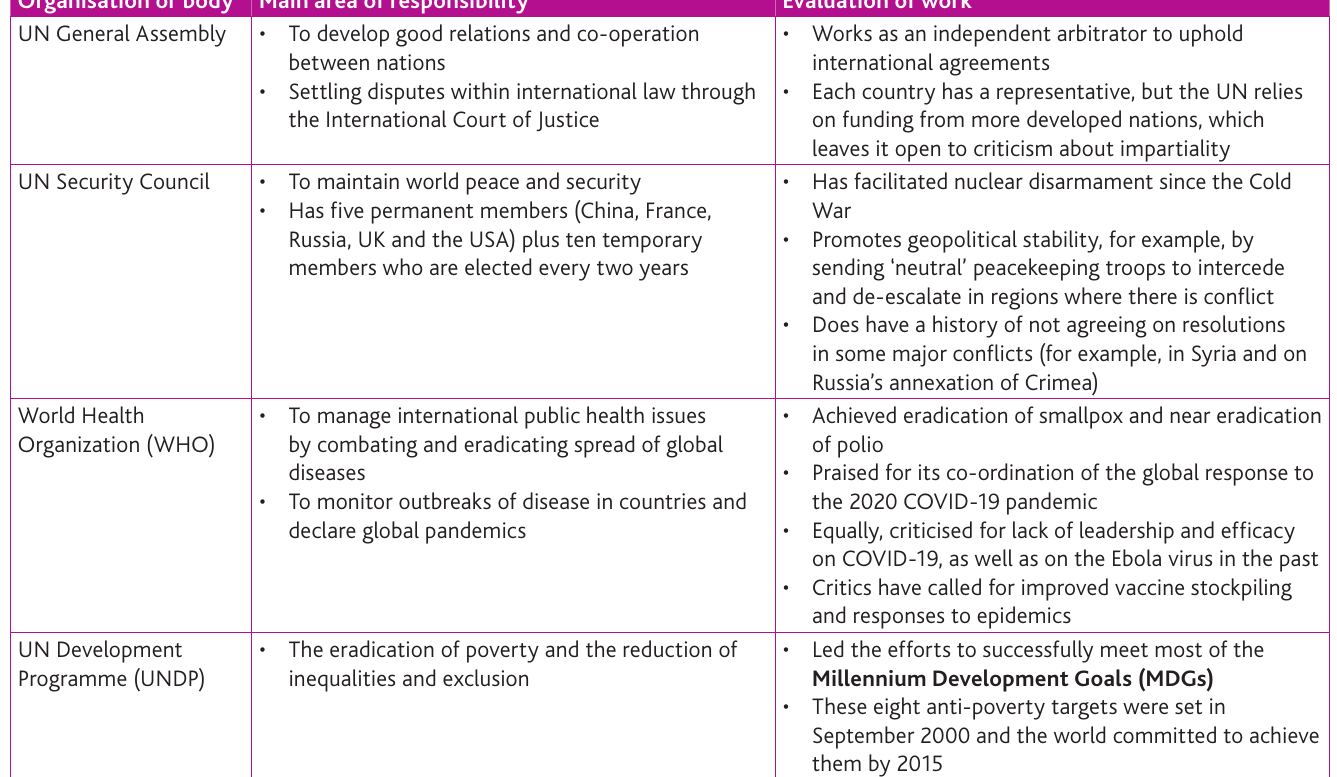
The UN includes numerous specialist bodies within its broader structure. These specialised agencies are governed by UN principles and focus on managing specific global issues that require coordinated international responses.
UN General Assembly
The General Assembly works to develop positive relations and cooperation between nations. It settles disputes within international law through the International Court of Justice. The General Assembly functions as an independent arbitrator to uphold international agreements. However, whilst each country has a representative voice, the UN depends on funding from more developed nations. This creates concerns about impartiality, as wealthier countries have greater influence.
UN Security Council
The Security Council's role centres on maintaining world peace and security. It has five permanent members (China, France, Russia, UK, and USA) alongside ten temporary members elected every two years. Since the Cold War, it has facilitated nuclear disarmament. The council promotes geopolitical stability, for example by deploying 'neutral' peacekeeping troops to intercede and de-escalate conflicts in regions experiencing violence. However, the council has a history of failing to agree on resolutions for some major conflicts, such as in Syria and regarding Russia's annexation of Crimea.
World Health Organization (WHO)
The WHO manages international public health issues by combating and eradicating the spread of global diseases. It monitors outbreaks of disease in countries and can declare global pandemics. The organisation successfully achieved the eradication of smallpox and is close to eradicating polio. It received praise for coordinating the global response to the 2020 COVID-19 pandemic. However, the WHO faces criticism for lacking leadership and effectiveness on COVID-19, as well as previous failures with the Ebola virus. Critics also call for improved vaccine stockpiling and responses to epidemics.
UN Development Programme (UNDP)
The UNDP focuses on the eradication of poverty and the reduction of inequalities and exclusion. It led efforts to successfully meet most of the Millennium Development Goals (MDGs). These eight anti-poverty targets were established in September 2000, with the global community committing to achieve them by 2015.
Agenda 2030 and Sustainable Development Goals
Following the largely successful achievement of the Millennium Development Goals, UN members gathered at the Sustainable Development Summit in September 2015. They agreed on Agenda 2030 for global sustainable development, which defined 17 Sustainable Development Goals (SDGs) covering the period 2015 to 2030.
Important
Definition: Sustainable Development
Development which meets the needs of the present without compromising the ability of future generations to meet their own needs.
The SDGs provide a comprehensive framework for addressing global challenges ranging from poverty and inequality to climate change and environmental protection. Annual reports and statistics track progress towards achieving these goals.
Criticisms of the UN
Despite its 75-year history of maintaining stability, reducing poverty, and organising global responses to inequality, injustice, climate change, and sustainable development, the UN faces several criticisms:
Note
Key Criticisms of the UN:
- Lack of agreement and inaction: Many security issues remain unresolved because member states cannot reach agreement or take subsequent action
- Limited enforcement power: The organisation has restricted ability to enforce compliance with regulations by national governments
- Funding and influence concerns: The UN's organisation and funding structure means that wealthier, more powerful nations can set the agenda according to their own interests, potentially undermining impartiality
The International Monetary Fund (IMF) and World Bank
Overview
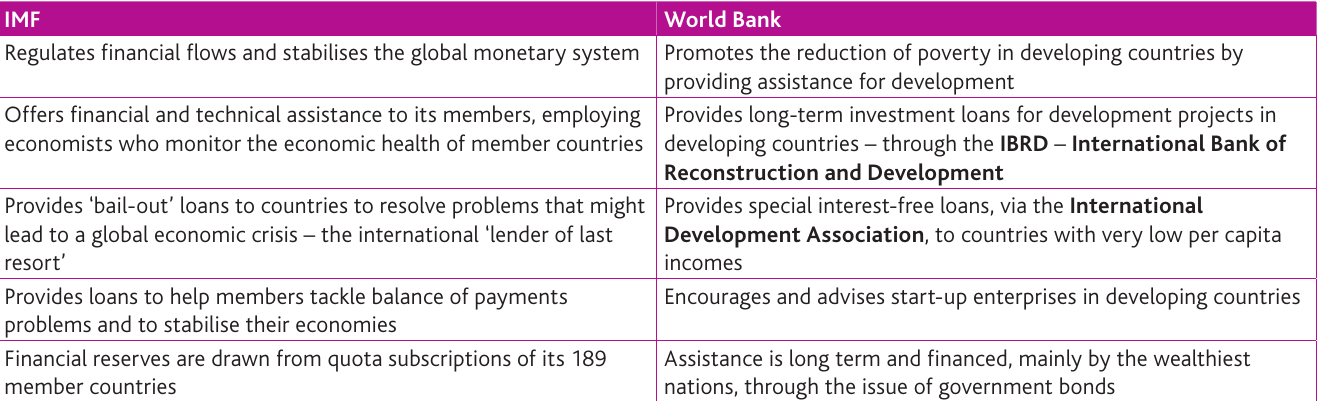
The intergovernmental finance institutions—the IMF and the World Bank—were both established in 1945 at the end of the Second World War. Their purpose was to stabilise the global economy and provide financial stability. These institutions play pivotal roles in regulating and acting as intermediaries in the flow of international capital. Whilst their roles differ significantly, they both underpin the interdependency that exists in global finance flows.
Functions of the IMF
The IMF regulates financial flows and stabilises the global monetary system. Key functions include:
- Offering financial and technical assistance to members, employing economists who monitor the economic health of member countries
- Providing 'bail-out' loans to countries facing problems that might lead to a global economic crisis—acting as the international 'lender of last resort'
- Providing loans to help members tackle balance of payments problems and stabilise their economies
- Drawing financial reserves from quota subscriptions of its 189 member countries
Functions of the World Bank
The World Bank promotes the reduction of poverty in developing countries by providing assistance for development. Key functions include:
- Providing long-term investment loans for development projects in developing countries through the IBRD (International Bank of Reconstruction and Development)
- Offering special interest-free loans via the International Development Association to countries with very low per capita incomes
- Encouraging and advising start-up enterprises in developing countries
- Financing assistance long-term, mainly through the issue of government bonds by the wealthiest nations
Criticisms of the IMF and World Bank
Both institutions face significant criticisms regarding their approach to their respective roles:
Note
IMF Criticisms:
- Influence based on wealth: Funding comes from members, with influence determined by their wealth. Developing countries criticise this because larger contributions give wealthier nations more powerful votes on decisions
- Severe spending cuts: As part of loan conditions, the IMF has imposed severe cuts on spending by governments in developing countries, adversely affecting education and welfare
- High interest rates: Rescue loans stabilise international trade, but the borrowing country eventually must repay the loan at high interest rates
- Capitalist conditions: Conditions attached to World Bank loans often insist on the reproduction of capitalist and free-trade market models in the loanee's economy, which do not always reduce poverty
Important
World Bank Criticism:
The Bank has been criticised for funding major 'top down' projects, such as large multi-purpose dams to provide hydro-electric power, which have not helped reduce poverty. The Bank now claims to support more sustainable 'bottom up' development projects.
Understanding the difference between these development approaches is crucial:
Note
Definition: Bottom up
When local people are consulted and supported in making decisions to undertake projects or developments that meet one or more of their specific needs.
Definition: Top down
When the decision to undertake projects or developments is made by a central authority such as government with little or no consultation with the local people whom it will affect.
The World Trade Organization (WTO)
Overview and history
The WTO came into existence in 1995 as the successor to the General Agreement on Tariffs and Trade (GATT), which was established following the Second World War. The WTO currently has 164 members and covers 98 per cent of world trade.
Functions of the WTO
The WTO facilitates international trade, providing stability and giving members confidence in the international trading system through:
Note
Core WTO Functions:
- Undertaking trade liberalisation: Encouraging the removal of barriers and protectionist policies adopted by some governments and trading blocs
- Resolving trade disputes: Acting as mediator between member governments when disagreements arise
- Providing a forum: Creating space for trade negotiation between members
- Administering trade agreements: Establishing ground rules that become the foundation for international commerce
The Doha Development Round
The WTO holds 'rounds' of talks to reach multilateral agreements aimed at advancing global free trade. The most recent was the Doha Development Round, which started in Doha, Qatar, and effectively came to an end in Nairobi in 2015. The Doha round focused on reforming trade in agricultural produce, especially between advanced and developing economies, with the aim of lifting less developed nations out of poverty.
The annual talks repeatedly stalled, with meetings in Geneva (2008), Bali (2013), and finally Nairobi (2015). Some progress was achieved in redressing inequalities in access for LDCs to HDE markets, but overall, reaching a multi-lateral trade agreement with 164 countries, each with economic and political self-interest, proved insurmountable.
Problems in reaching agreement
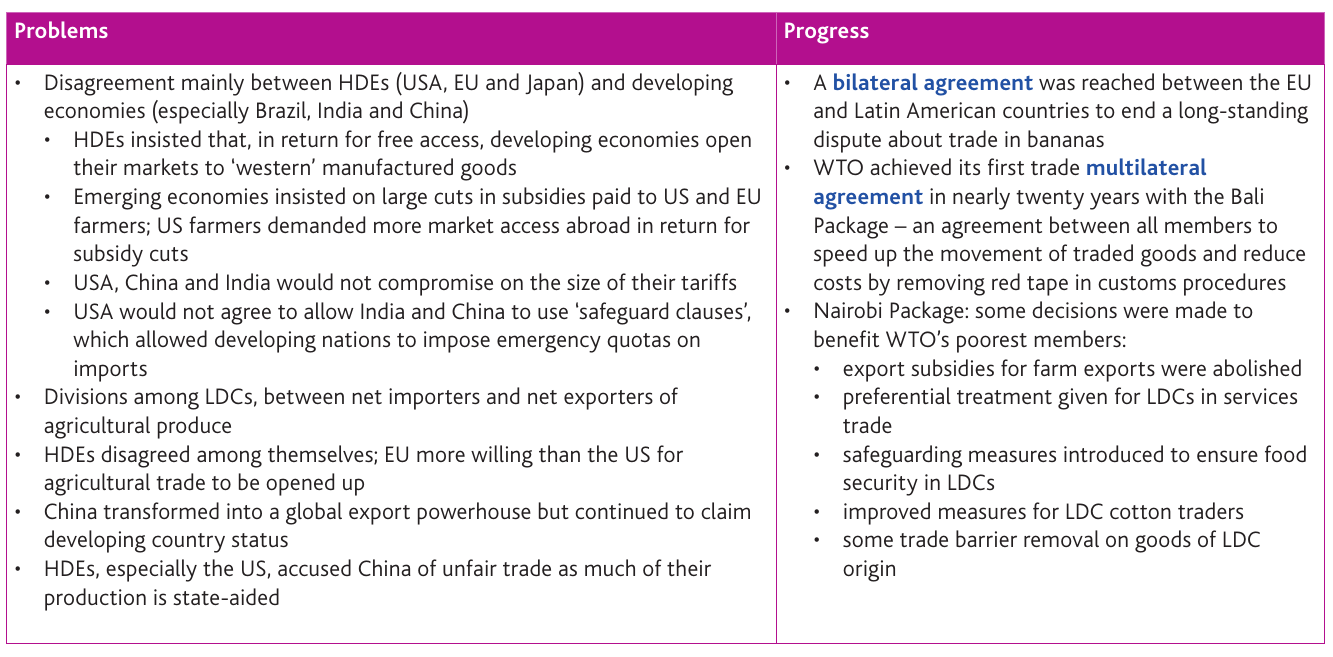
The Doha round faced numerous challenges:
Important
Major Obstacles in the Doha Round:
- Disagreement between HDEs and developing economies: Particularly between the USA, EU, Japan and emerging economies like Brazil, India, and China
- Market access disputes: HDEs insisted that developing economies open their markets to 'western' manufactured goods in return for free access. Emerging economies wanted subsidies paid to US and EU farmers to be reduced or stopped
- Tariff compromises: The USA, China, and India would not compromise on the size of their tariffs. The USA and EU agreed to allow India and China to use 'safeguard clauses', permitting developing nations to impose emergency quotas on imports
- Divisions among LDCs: Disagreements arose between net importers and net exporters of agricultural produce
- Regional disagreements: HDEs disagreed amongst themselves, with the EU more willing than the US to see agricultural trade opened up
- China's status: China transformed into a global export powerhouse but continued to claim developing country status
- Unfair trade accusations: HDEs, especially the US, accused China of unfair trade practices, as much of their production is state-aided
Progress achieved
Despite the difficulties, the Doha round achieved some positive outcomes:
Note
Achievements of the Doha Round:
- A bilateral agreement was reached between the EU and Latin American countries to end a long-standing dispute about trade in bananas
- The WTO achieved its first multilateral agreement in nearly twenty years with the Bali Package—an agreement between all members to speed up the movement of traded goods and reduce costs by removing red tape in customs procedures
- The Nairobi Package made decisions benefiting the WTO's poorest members, including abolishing export subsidies for farm exports, giving preferential treatment for LDCs in services trade, introducing safeguarding measures for food security in LDCs, improving measures for LDC cotton traders, and removing some trade barriers on goods of LDC origin
Regional and bilateral alternatives
Whilst the Doha round was ongoing, many countries pushed ahead with bilateral or regional deals. It seems that bilateral deals between governments or trading blocs offer a more effective way to establish free trade. Such agreements can be expanded and eventually made multi-lateral under WTO rules.
Interactions of governance between different scales
Success in global governance and in regulating the extremes resulting from unchecked globalisation can be achieved if there is clear communication and understanding of strategies at all scales, from global to local. Governance is not just about control—it is also concerned with mobilising organisations or individuals to follow guidelines, which may be set out in regulations or agreements. This involves informing people about issues and persuading them to follow an appropriate course of action.
Multiscalar power
Important
Understanding Multiscalar Power
Multiscalar power refers to the ability to influence behaviour and attitudes through interactions at different scales, with the aim of encouraging or preventing change. Multiscalar relationships operate in complex ways. They involve different tiers of government, but other 'players' are also involved in decision-making at each level.
Key actors in multiscalar governance include:
- Non-governmental organisations (NGOs)
- Civil society groups
- Individual citizens
All of these actors may influence, organise, or mobilise each other to take action. Understanding how these different scales interact is crucial for effective global governance.
Remember!
Summary
Key Points to Remember:
-
The UN is the most significant international organisation for global governance, founded in 1945 with 193 member states, working through specialist bodies to address peace, security, health, and development challenges.
-
The IMF and World Bank were both established in 1945 but serve different purposes: the IMF stabilises the global monetary system and provides bail-out loans, whilst the World Bank focuses on poverty reduction through long-term development loans.
-
The WTO facilitates international trade and has 164 members covering 98% of world trade, but faces challenges in reaching multilateral agreements as demonstrated by the difficult Doha Development Round (2001-2015).
-
All major international agencies face criticism—the UN for limited enforcement power, the IMF and World Bank for favouring wealthy nations and imposing harsh conditions, and the WTO for struggling to balance interests of developed and developing economies.
-
Effective global governance requires multiscalar power—the ability to influence behaviour at different scales from global to local, involving not just governments but also NGOs, civil society groups, and individual citizens.