Issues Associated with Interdependence (AQA A-Level Geography): Revision Notes
📚Revision Notes
Issues associated with interdependence
Introduction
Globalisation and interdependence create connections between countries that have both benefits and challenges. These connections involve flows of people, money, ideas and technology between nations. However, these flows are often unequal, creating disparities in power, wealth and development. Understanding these issues is essential for evaluating how globalisation affects different countries and groups of people.
Note
Interdependence manifests through four key flows between nations:
- People - migration and movement of workers
- Money - remittances, loans, investment and aid
- Ideas - concepts about governance, economics and culture
- Technology - information systems, manufacturing and knowledge transfer
Environmental interdependence context
Before examining the specific issues of interdependence, it's important to understand that countries are linked environmentally through shared resources.
Global commons are resources that all countries share, such as oceans and the atmosphere. All nations are environmentally interdependent because activities in one country can affect others through these shared resources. International agreements and legislation govern how countries use these commons.
Note
International Environmental Cooperation
Climate change concerns have led to increased international cooperation through organisations such as:
- UN Framework Convention on Climate Change (UNFCCC) - encourages nations to work towards climate change mitigation goals
- UN Environment Programme (UNEP) - promotes biodiversity protection and sustainable practices
However, some practices challenge this interdependence because their impacts cross borders. Examples include air pollution, acid rain deposition and deforestation. For instance, rainforest loss in the Amazon or South Asia may result from demands for hardwood or land clearing for commercial ranching. These activities in one region can have irreversible global consequences, including forest loss that affects climate patterns worldwide.
Unequal flows of people
Globalisation enables workers to move more freely around the world. The main pattern of migration involves people moving from developing countries towards highly developed economies (HDEs). This movement creates both opportunities and challenges for the countries involved.
Impacts of international migration
International labour migration between developing countries and HDEs produces varied effects that can promote stability and development or create inequalities and conflicts.
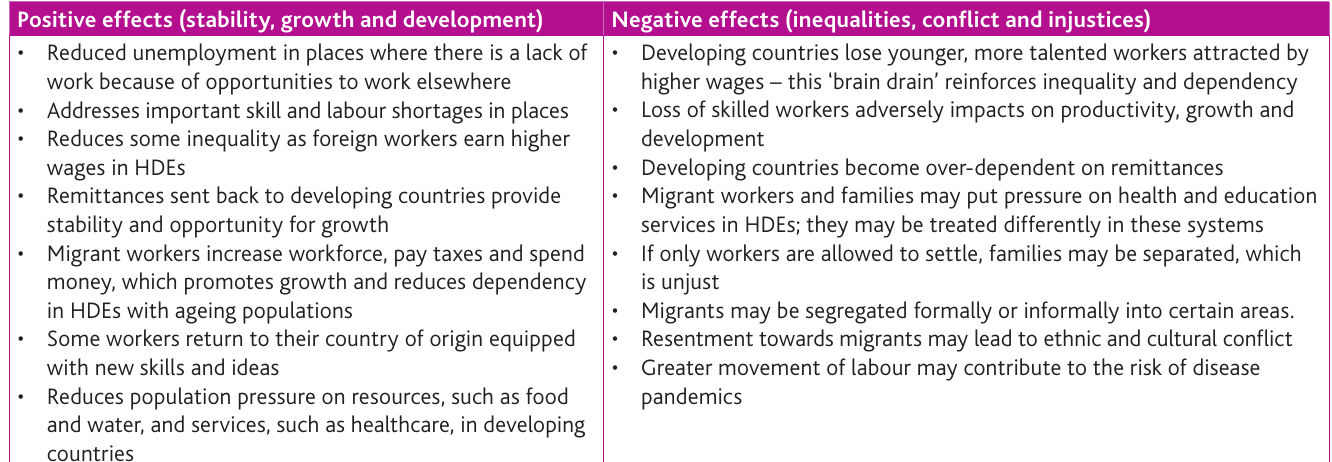
Positive impacts include:
- Reduced unemployment in origin countries where work opportunities are limited
- Addressing skill and labour shortages in destination countries
- Reduced inequality as migrant workers earn higher wages in HDEs compared to their home countries
- Remittances providing financial stability and development opportunities for origin countries
- Increased workforce in HDEs, contributing to economic growth and tax revenue
- Workers returning home with new skills and knowledge
- Reduced population pressure on resources like food, water and healthcare in origin countries
Negative impacts include:
- Brain drain - developing countries lose younger, more talented workers to wealthier nations, reinforcing inequality and dependency
- Loss of skilled workers adversely affecting productivity, growth and development in origin countries
- Over-dependence on remittances in developing countries, creating economic vulnerability
- Pressure on health and education services in HDEs where migrants settle
- Differential treatment of migrants compared to local populations
- Family separation when only workers are allowed to settle
- Segregation of migrants into certain areas, creating social divisions
- Resentment towards migrants potentially leading to ethnic and cultural conflict
- Greater movement of labour potentially contributing to disease pandemic risks
Important
Brain Drain
Brain drain refers to the emigration of highly trained or talented individuals from developing countries to developed nations, resulting in a loss of skilled workers that hampers development in the origin country. This creates a cycle where developing countries invest in education and training, only to lose their most capable workers to wealthier nations.
Unequal flows of money
Money flows between countries through various channels, each with beneficial and problematic aspects for people and places.
Remittances
Money sent home by migrants working overseas represents an important income source for developing economies. These financial transfers can:
- Provide stability and opportunities for growth in recipient countries
- Support families and communities
- Fund local development projects
However, countries can become over-dependent on remittances, creating economic vulnerability.
Loans
Developing countries borrow from institutions like the World Bank to fund projects such as:
- Improving transport connectivity
- Health and education programmes that increase standards, access and inclusion
- Engineering and construction projects for transport or energy infrastructure
Sound investment in infrastructure can benefit countries significantly. Most World Bank lending in 2020 supported emergency responses to the COVID-19 pandemic.
Important
Challenges with Loans
- Money must be repaid, requiring effective investment to generate returns
- Repayment becomes difficult if loans fund social rather than economic development projects
- Countries can accumulate unsustainable debt burdens that limit future development options
Foreign direct investment (FDI)
Investment from transnational corporations (TNCs) or governments in Europe, Japan and the US into developing countries has raised average incomes and reduced poverty. It's estimated that over one billion people in Asia have escaped poverty in the last 30 years.
Potential problems with FDI:
- Can create dependency, particularly when investment focuses on key projects
- Workers dependent on higher wages may face poor working conditions
- Benefits may not be distributed fairly
Growth of TNCs
Capital investment and taxes paid by successful global businesses to their host governments have stimulated economic growth.
Concerns about TNCs:
- May pressure host governments to reduce or relax taxes, social protections and environmental laws
- Can shift focus away from sustainable development
Loss of profits ('leakages')
The repatriation of profits by TNCs to their home countries undermines benefits gained from investment in developing countries. Limited 'trickle-down' effects from FDI into the developing economy may worsen global inequalities in wealth.
Foreign aid
Aid helps low-income countries during times of need, providing essential support.
Limitations:
- Can reduce incentives for governments to develop their own countries' resources and capabilities
- May create dependency on external support
Unequal flows of ideas
Ideas generally flow from wealthier HDEs to developing countries seeking to replicate the success of richer nations. Many of these ideas connect to global capitalism and can promote growth in less developed economies (LDEs) but also cause problems.
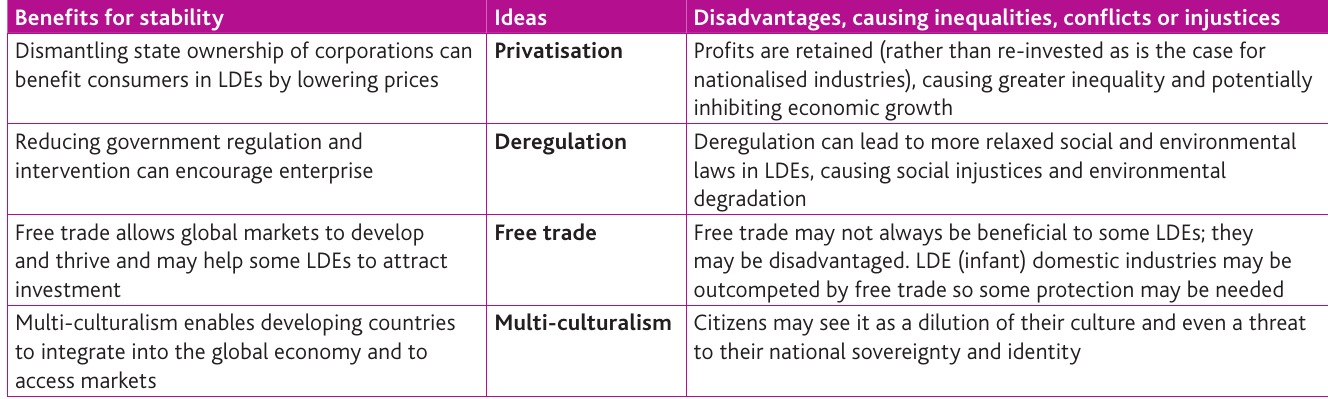
Privatisation
The idea: Dismantling state ownership of corporations can benefit consumers in LDEs by lowering prices.
Benefits for stability:
- Potentially lower consumer costs
- Increased efficiency through competition
Disadvantages:
- Profits are retained by private owners rather than being reinvested as would occur with nationalised industries
- Creates greater inequality and potentially inhibits economic growth
- Wealth concentrates in fewer hands
Deregulation
The idea: Reducing government regulation and intervention can encourage enterprise.
Benefits for stability:
- Encourages business development and entrepreneurship
- Reduces bureaucratic barriers
Disadvantages:
- Can lead to more relaxed social and environmental laws in LDEs
- May cause social injustices and environmental degradation
- Reduces protections for workers and communities
Free trade
The idea: Allowing global markets to develop and thrive may help some LDEs attract investment.
Benefits for stability:
- Opens access to international markets
- Attracts foreign investment
- Can stimulate economic growth
Disadvantages:
- May not always benefit some LDEs
- Infant domestic industries in LDEs may be outcompeted by established foreign companies
- Some protection may be needed to allow domestic industries to develop
Multi-culturalism
The idea: Multi-culturalism enables developing countries to integrate into the global economy and access markets.
Benefits for stability:
- Increases economic integration
- Expands market access opportunities
- Promotes international cooperation
Disadvantages:
- Citizens may view it as dilution of their culture and values
- Can threaten national sovereignty and identity
- May create social tensions
Unequal flows of technology
Information and data flows
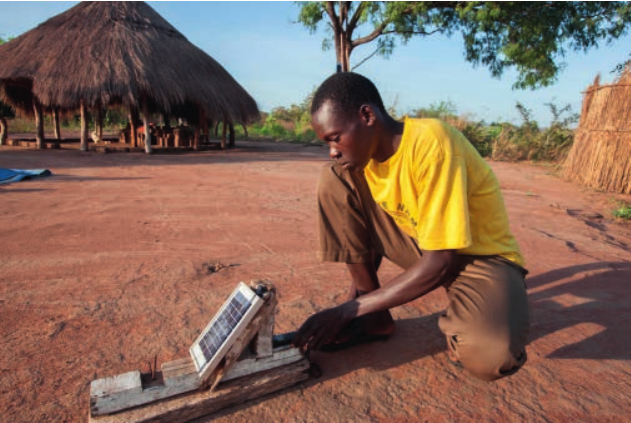
Access to mobile and internet services is transforming people's lives in less developed economies. The 'Village Phone' microfinance model pioneered in Bangladesh is now being used in Uganda, supported by the World Bank and using wireless technology.
Example
Case Study: Village Phone Technology
The Village Phone model demonstrates how technology can empower rural communities:
Step 1: Initial Investment
- Loans allow purchase of a smartphone, car battery or solar charger
Step 2: Infrastructure Connection
- Technology links to an improved network of mobile telephone masts
- Enables internet access even in remote rural areas
Step 3: Economic Benefits
- Improves quality of life for users
- Allows establishment of small businesses based on information provision
- Farmers can access real-time information on market prices, weather forecasts and agricultural advice
Result: Rural entrepreneurs can generate income while providing essential services to their communities.
Technology manufacture
Access to technology such as computers and smartphones in less developed countries is limited because technology is unaffordable to many.
Note
The Technology Paradox
Assembly of consumer technology products often occurs in developing countries, where workers receive relatively low wages compared with the selling price of goods. This seems unjust given that production happens in these countries, yet the populations cannot afford to purchase the products they manufacture.
Technology transfer
The transfer of labour-saving technologies from HDEs to developing countries can promote growth.
Important
Challenges of Technology Transfer
- Some technologies may put many people out of work
- Can lead to high unemployment and poverty
- Has particularly affected agricultural technologies and the textile industry in some developing countries, such as India
- The benefits of increased productivity may not offset the social costs of job displacement
Inequality issues
Evidence suggests that globalisation produces complex effects on inequality. It may be reducing global inequality through transfers of capital and income from richer to poorer economies. Paradoxically, it may simultaneously be increasing inequality within countries as wealthier members of societies cope better with changes in jobs and technology.
Inequalities between countries
As communication and transport increase economic integration, developing countries are closing the gap with their rich-world counterparts. The development continuum, with the exception of some of the least developed countries, has become more condensed.
The fastest growing economies continue to be in Asia, whilst countries in sub-Saharan Africa have a large gap to make up in living standards. However, some African nations are now growing more quickly than most developed countries.
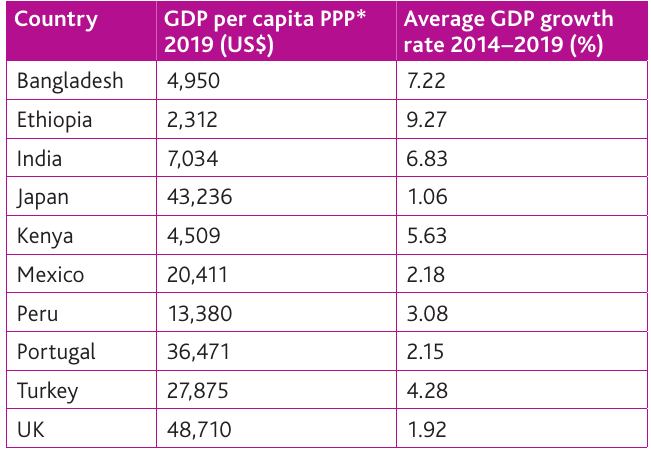
The table shows considerable differences in average income between a range of ten developed and developing economies in 2019. The data presents GDP per capita at purchasing power parity (PPP), which adjusts for the equivalent of what you can purchase in each country.
Example
Analyzing Economic Growth Patterns
Key patterns from the 2019 data:
Lowest Income, Highest Growth:
- Ethiopia had the lowest GDP per capita ($2,312) but the highest growth rate (9.27%)
Highest Income, Modest Growth:
- The UK had the highest GDP per capita ($48,710) but modest growth (1.92%)
Developing Countries Pattern:
- Bangladesh, Ethiopia, India show lower GDP per capita but faster growth rates
Developed Countries Pattern:
- Japan, UK, Portugal show high GDP per capita but slower growth rates
Conclusion: This supports the idea that developing countries tend to have faster economic growth rates, potentially allowing them to catch up with developed nations over time through a process of economic convergence.
Important
Purchasing Power Parity (PPP)
PPP is based on the equivalent of what you can purchase in each country. It adjusts GDP figures to account for different costs of living, providing a more accurate comparison of living standards between countries. For example, $1,000 may buy more goods and services in India than in the United States.
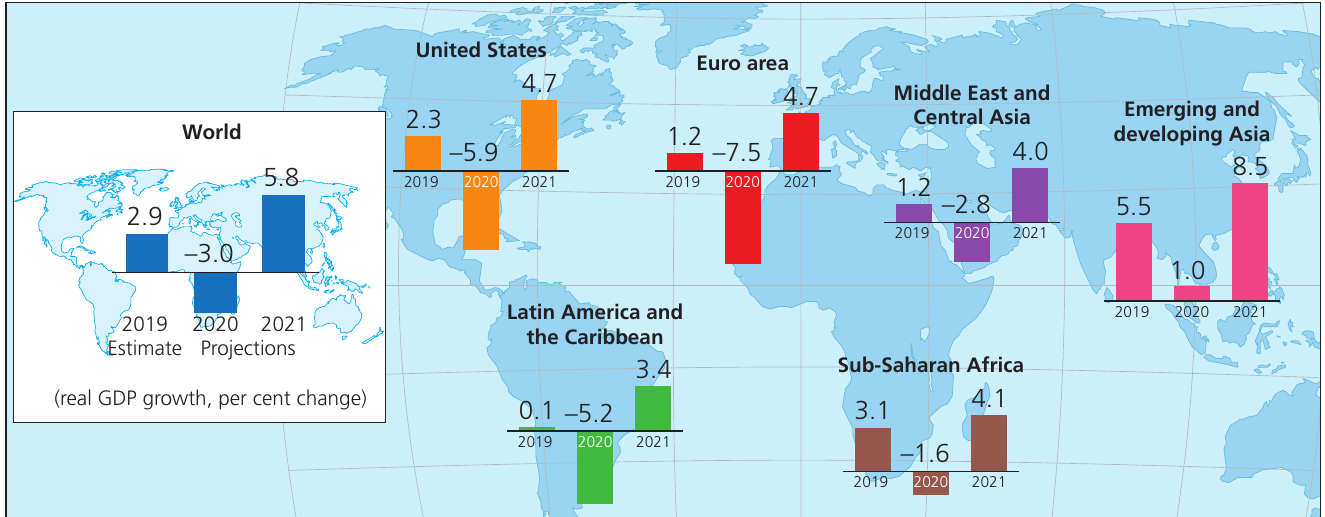
The world map shows projected GDP growth rates by region from 2019-2021, illustrating the effects of the COVID-19 pandemic in 2020. Key observations include:
- Sharp economic contraction in 2020 across all regions (negative growth rates)
- Projected recovery in 2021
- Emerging and developing Asia showing strongest recovery (8.5% projected growth in 2021)
- More modest recovery in developed regions like the United States (4.7% in 2021) and Euro area (4.7% in 2021)
- Sub-Saharan Africa showing positive growth throughout (4.1% in 2021)
Inequalities within countries
Important
The Gini Index
The Gini Index is the statistical measure usually used to indicate levels of inequality of income distribution within a country. The Gini Index aggregates the inequalities in people's incomes into a single measure, giving a coefficient score between zero and one. The higher the score within this range, the greater the income inequality.
Interpretation:
- Score closer to 0 = more equal income distribution
- Score closer to 1 = more unequal income distribution
The level of inequality varies widely around the world, but there is usually more income inequality in LDEs than in wealthier countries. For example, South Africa has one of the highest Gini Index scores at 0.63.
Trends in inequality:
- Over the past 25 years, income inequality has increased in most developing countries
- This suggests globalisation has had a negative effect on income distribution
- Inequality has also increased within highly developed economies
- Many countries, including the UK, Canada and even traditionally egalitarian Sweden, have seen rising income inequality
This indicates that whilst globalisation may be reducing inequality between countries, it is simultaneously increasing inequality within countries as wealthier individuals benefit more from economic changes.
Unequal power relations in global systems
In general, wealthier developed countries wield more power, which enables them to steer global systems to their own advantage. Several factors reinforce this imbalance of power.
Factors reinforcing power imbalance
Wealth and technology advantages:
- HDEs have more wealth and advanced technology
- In many cases, HDEs possess more military power for use on a global scale
- They provide aid, investment and transfers of technology and medical knowledge to assist developing countries
- Usually rely on geopolitical support in return
International cooperation among wealthy nations:
Wealthier countries have close relations with each other in groups that enhance their influence:
Important
G7 – The 'Group of Seven'
An intergovernmental organisation made up of the world's seven largest advanced IMF economies: Canada, France, Germany, Italy, Japan, the UK and the US. These nations coordinate economic policies and exert significant influence over global financial systems.
Important
G20
The G20 group is an international forum for the governments of 20 major economies. It includes the G7 countries and the EU as a single member. It was established in 1999 to give a voice to the major developing economies. This group includes China, providing greater representation than the G7 alone.
Important
OECD – Organisation of Economic Co-operation and Development
A group of 34 of the richest and most influential countries globally. The OECD promotes policies to improve economic and social well-being worldwide, but its membership is dominated by wealthy developed nations.
By co-operating in these intergovernmental economic groups, wealthy nations can synergise their efforts to be more influential in driving global economic and political systems.
Influence through global governance:
- Developed countries have more influence in global governance through intergovernmental organisations such as the UN, the IMF, the World Bank and the WTO
- These organisations have helped to improve stability and development globally
- However, they are led by the more powerful nations whose vested interests cause them to influence change to their own advantage
Limited power of developing countries:
- Developing countries have less influence and limited power to intervene
- They must depend on decisions made by wealthier countries
- This means less developed nations are constrained in how they can respond to geopolitical issues
- They may have to rely on geopolitical support from more powerful allies
Geopolitical events
Geopolitical issues arise for a variety of reasons but are usually rooted in political or economic conflicts between two countries or two groups of countries.
Common causes of geopolitical conflicts:
- Resource shortages
- Strategic territorial claims
- Exploration rights
- Supporting political allies or minority groups within countries
Example
Case Study: UN Security Council Influence
The US's permanent position on the UN Security Council may have shielded Israel from wider UN criticism for policies disadvantaging Palestinians. This demonstrates how permanent members can use their veto power to protect allied nations from international censure, regardless of the issue's merits.
The examples of Russia and China demonstrate how two states (both permanent members of the UN Security Council) are exerting their considerable political or economic power in global systems to influence geopolitical events to their advantage. Their positions on the Security Council give them significant leverage in international affairs.
Summary
Key Points to Remember:
-
Interdependence creates unequal flows of people, money, ideas and technology between developed and developing countries, producing both positive and negative impacts on stability, growth and inequality.
-
Migration has mixed effects - it can reduce unemployment and provide remittances to origin countries, but also causes brain drain, over-dependence and potential social conflicts.
-
Globalisation affects inequality in complex ways - it may reduce inequality between countries (as developing nations grow faster) whilst increasing inequality within countries (as wealthier individuals benefit more from economic changes).
-
Wealthier nations wield disproportionate power through greater wealth, advanced technology, military capabilities, and influence in international organisations like the G7, G20, OECD and UN, enabling them to steer global systems to their advantage.
-
The Gini Index measures income inequality within countries - higher scores indicate greater inequality, with many developing countries and even some developed nations experiencing rising inequality over the past 25 years.