Nature and Role of Transnational Corporations (TNCs (AQA A-Level Geography): Revision Notes
📚Revision Notes
Nature and Role of Transnational Corporations (TNCs)
What are transnational corporations?
Transnational corporations (TNCs) are businesses that have operations in at least two countries. They maintain their headquarters in one nation (typically their country of origin) whilst conducting business activities in multiple other countries. These companies take various forms and operate across different economic sectors. Importantly, TNCs are no longer limited to more developed countries. Many emerging economies now have major global companies, and some TNCs possess revenues larger than the total GDP of entire nations.
Important
A Transnational Corporation (TNC) is a company that operates in at least two countries, with headquarters in one country but business operations in several others. They can have considerable political influence.
TNCs have become powerful actors in the global economy. They can influence government policies in developing economies, for example by persuading governments to reduce taxes or establish special economic zones to encourage the TNC to invest in their country.
Why TNCs operate globally
TNCs choose to operate in multiple countries for several strategic reasons:
Avoiding trade barriers
Companies may establish operations abroad to escape trade tariffs and gain barrier-free access to important markets. For instance, Nissan's decision to produce cars in Sunderland was primarily driven by gaining access to the EU market without import duties.
Reducing production costs
TNCs seek out the lowest cost locations for their production operations. Hewlett-Packard's manufacturing in Malaysia exemplifies this strategy of finding locations where production costs are minimised.
Exploiting favourable exchange rates
Companies can benefit from foreign exchange rates that make exports cheaper. Dyson's operations in Malaysia take advantage of currency differences that reduce export costs.
Note
Exchange rate advantages can provide significant cost savings for TNCs, making their products more competitive in international markets. This is particularly important for companies exporting manufactured goods back to developed economies.
Accessing new markets
Operating internationally allows TNCs to reach foreign markets more effectively. McDonald's global expansion demonstrates how companies can serve customers directly in different regions rather than relying solely on exports.
Securing resources
TNCs may operate in foreign countries to exploit mineral or other natural resources. BP's operations in Azerbaijan illustrate how companies secure access to resources located in different parts of the world.
Common characteristics of TNCs
Whilst TNCs vary greatly in size and sector, certain features are thought to be common across most transnational organisations:
- Maximising economies of scale: TNCs organise production on a global level to reduce costs through large-scale operations
- Sourcing materials strategically: They obtain raw materials or components from wherever costs are lowest
- Controlling supply chains: TNCs oversee the processing at each stage of production
- Strategic branding: Products and services are branded to make them easily recognisable across different markets
Spatial organisation of TNCs
Headquarters location
Transnational corporations operate as globally integrated enterprises because they position different functions in various locations to achieve an effective blend of cost, skill and environment considerations.
Traditionally, company headquarters are located in a major city within the home country. Most TNCs maintain subsidiary headquarters in each continent or region where their main operations are based.
Research and development centres
To remain competitive, TNCs invest heavily in research and development (R&D) activities. These facilities tend to be located in the country of origin and are often positioned near centres of higher education. This strategic placement allows companies to:
- Access graduate labour markets with skilled workers
- Utilise university research facilities and expertise
- Benefit from knowledge exchange with academic institutions
Note
The clustering of R&D facilities near universities creates innovation hubs where TNCs can tap into cutting-edge research and recruit highly skilled graduates. This proximity also facilitates collaborative projects between industry and academia.
Manufacturing operations
Manufacturing operations are frequently located in less developed economies (LDEs) where labour and material costs are lower. This practice is known as offshoring.
Offshoring and outsourcing explained
Whilst these terms are sometimes confused, offshoring and outsourcing are distinct concepts with similar motivations and outcomes:
Offshoring
This involves relocating part of the organisation, such as manufacturing operations, to an overseas location. Companies do this to capitalise on lower costs or to access foreign markets more effectively. TNCs might also establish factories in higher wage economies (such as Toyota in the UK and US) specifically to access wealthier markets.
Outsourcing
This strategy involves subcontracting part of the business operation to another company, usually in a country where costs are lower. Rather than the TNC owning the facility, an external company performs the work.
Important
Key Distinction: Offshoring means relocating your own operations abroad, whilst outsourcing means contracting another company to do the work. A TNC can offshore without outsourcing (keeping operations in-house abroad) or outsource without offshoring (contracting to a domestic company).
Both practices largely involve moving jobs from costly economies in Europe and North America to lower wage economies. These strategies can contribute to growth, development and increasing skills and technology in LDEs. However, they also create negative effects, causing inequalities and injustices in both more developed economies (HDEs) and LDEs.
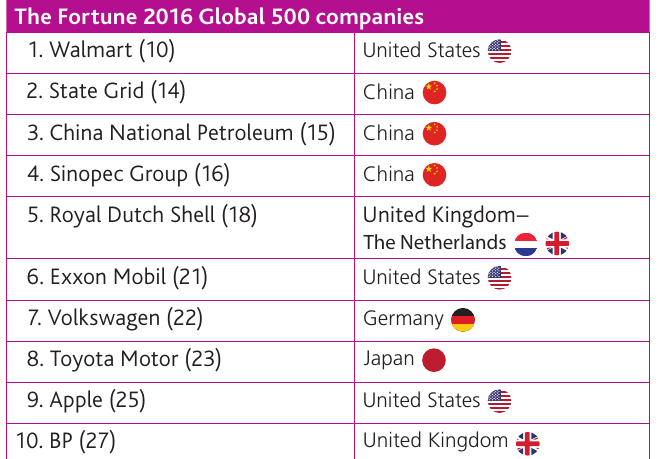
Production across different sectors
Primary sector production
Production operations of TNCs in the primary sector are based wherever unexploited resources exist. This tends to occur in developing economies, as reserves in more developed countries have largely been depleted. However, rising world prices combined with new technologies have enabled access to previously unviable reserves of raw materials in the home country. For example, hydraulic fracturing (known as 'fracking') has revitalised oil and gas industry bases in North America.
Secondary sector production
For TNCs operating in the secondary sector, production operations have predominantly been located in the manufacturing regions of developing countries, particularly in South East and South Asia.
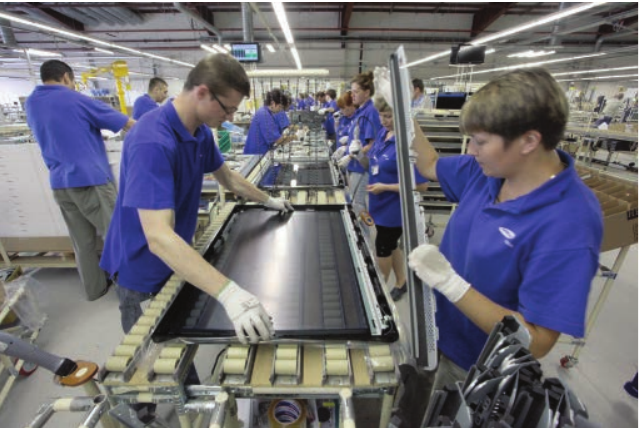
These areas attract TNCs because:
- Lower labour costs: Wages are significantly cheaper than in developed economies
- Educational investment: There is investment in education, making it easier to train workers with necessary skills
- Strong work ethic: Workers demonstrate willingness to work long hours with relatively few holidays in non-unionised labour environments
- Government incentives: Governments may offer tax-free breaks, special economic zones (SEZs) with low business rates, or less restrictive environmental regulations
Note
Special Economic Zones (SEZs) are designated areas where governments offer favourable business conditions such as reduced taxes, streamlined regulations, and improved infrastructure. These zones are specifically designed to attract foreign investment from TNCs.
The spatial organisation of production has enabled TNCs from emerging economies to locate production facilities where they gain access to large markets in developed regions. Kia Motors (South Korea), for instance, has established factories in Slovakia and the USA to access EU and USMCA markets respectively.
Tertiary sector operations
Service-based TNCs in the tertiary sector operate with greater flexibility. They locate operations either where relatively low labour costs are balanced with good education, or in proximity to their markets.
Language represents an important consideration for service TNCs. Lower level services, such as call centres, are commonly outsourced to India. This is because India has a high proportion of well-educated English-speaking workers who provide a lower cost alternative to workers in developed economies.
Linkages and integration strategies
How TNCs expand and gain control
One distinguishing feature of TNCs is their ability to expand and gain more control over their industry and markets. They achieve this by developing links with other companies and between countries. These connections can be created through investment and by establishing joint ventures with national or state-controlled companies.
TNCs can also expand through takeovers or mergers with other companies to integrate different parts of their business operations.
Note
Agglomeration occurs when companies in similar industries locate near each other to benefit from shared ideas and resources. This is sometimes called 'agglomeration economies'.
Note
The multiplier effect describes a situation where an initial injection of investment or capital into an economy creates additional income through increasing employment, wages, spending and tax revenues.
Vertical integration
Vertical integration is an arrangement where the supply chain of a company is owned entirely by that company, from raw material acquisition through to the finished product. This structure gives the TNC complete control over its supplies and stocks, reducing costs through economies of scale.
Example
Example: BP's Vertical Integration in Oil and Gas
BP demonstrates vertical integration across the entire oil and gas industry:
Upstream activities:
- Exploration and production rights in over 50 oil and gas fields worldwide
Mid-stream activities:
- Joint ownership of 11 oil pipelines (with other energy companies)
- Operation of its own shipping fleet
Downstream activities:
- Ownership of refineries in countries where end products are sold
- Nearly 19,000 retail service stations globally
This complete supply chain control allows BP to manage costs, ensure supply security, and maintain quality from extraction to final sale.
Horizontal integration
Horizontal integration is a strategy where a company diversifies its operations through expansion, merger or takeover to gain a broader capability at the same stage of production. This can be either complementary or competitive to its existing business.
For example, Kraft Foods' takeover of Cadbury in 2010 gave them a more diverse base in the grocery and confectionery market. Following a series of de-mergers, the newly formed Kraft Foods Group merged with Heinz in 2015 to form Kraft Heinz, again for the same purpose of diversification.
Trading and marketing patterns
Market focus and consumer demand
-
The majority of TNCs conduct trade in highly developed economies in North America, Europe and the Far East (Japan and Korea)
-
Emerging economies in South and East Asia, the Middle East and Latin America are creating rapidly increasing demand for consumer goods
-
TNC activities in emerging economies have evolved from a focus on production for export to becoming suppliers to internal markets to meet ever-growing consumption in those countries
-
TNCs employ global marketing strategies to capitalise on marketing economies and to give clear identity through branding of their products
Benefits and costs of TNCs
The operations of TNCs create both advantages and disadvantages for different stakeholders:
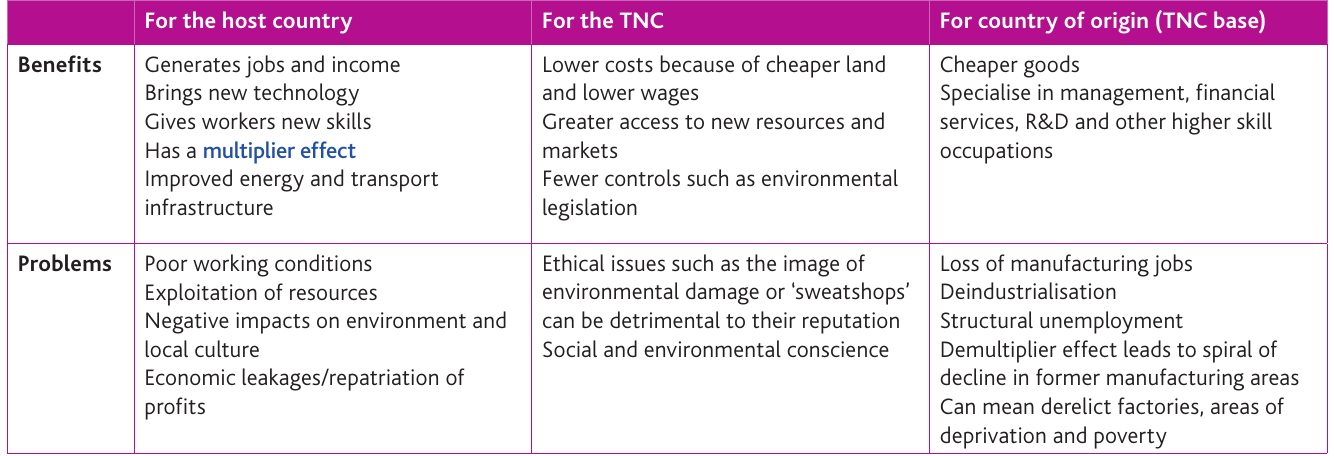
For host countries
Benefits:
- Generates jobs and income for local populations
- Brings new technology and skills
- Workers acquire new capabilities through training and experience
- Creates a multiplier effect that stimulates broader economic growth
- Improves energy and transport infrastructure to support operations
Problems:
- Poor working conditions may exist in factories (sometimes called 'sweatshops')
- Exploitation of natural resources without adequate compensation
- Negative impacts on environment and local culture
- Economic leakages occur when profits are repatriated to the country of origin rather than being reinvested locally
Important
Economic Leakage is a critical issue for host countries. When TNCs send profits back to their home country rather than reinvesting locally, the host country loses potential economic benefits. This can significantly reduce the positive impact of foreign investment on local development.
For the TNC
Benefits:
- Lower operational costs due to cheaper land and lower wages
- Greater access to new resources and markets
- Fewer controls such as environmental legislation in some host countries
Problems:
- Ethical issues arise regarding environmental damage and poor working conditions in 'sweatshops'
- These issues can damage the company's reputation
- Social and environmental conscience considerations
For country of origin (TNC base)
Benefits:
- Access to cheaper goods for consumers
- Specialisation in management, financial services, R&D and other higher skill occupations
Problems:
- Loss of manufacturing jobs leads to deindustrialisation
- Structural unemployment affects former manufacturing workers
- Demultiplier effect creates a spiral of decline in former manufacturing areas
- Can result in derelict factories, areas of deprivation and poverty
Case study: Apple Inc.
Background and products
Apple Inc. is a US transnational electronic technology corporation with its company headquarters at Apple Park in Cupertino, northern California.

Apple produces a range of familiar high-tech products and services marketed globally either under its universal 'i' brand or as 'Apple'. These products include iPhones, iPads and more recently Apple Watch, Apple TV and its most powerful device, the MacPro. In 2018, it launched a new smart speaker called HomePod.
The company began business in 1976, during the early days of personal computer manufacture. In 1982, it took over the smaller MacIntosh organisation and launched a new brand of desktop computer that later became AppleMac computers. Apple computers earned a growing reputation for quality and attracted a growing niche market of brand-loyal customers. Since 2000, it has experienced phenomenal growth as an organisation due to its development of mobile and Wi-Fi devices.
Apple's position in 2019
In 2019, Apple was the world's:
- Largest IT company by revenue
- Third-largest mobile phone manufacturer
- Number one global brand by value (US$234 billion)
The company has 137,000 full-time employees and over 510 retail stores in 22 countries.
Factors behind Apple's success
Apple's remarkable growth can be attributed to several factors:
- Stylish and well-designed products that appeal to consumers
- Effective marketing and branding that generates a growing number of customers with strong brand loyalty
- Innovative products that are regularly updated to maintain consumer interest
- Focus on mobile devices that fit their market's needs and lifestyle preferences
- Online sales strategy that sells products and services together with ancillary products such as music and TV programmes
- Diversification into new technologies and platforms as they evolve
Note
Apple's success demonstrates the importance of combining multiple strategies: innovation, branding, market positioning, and diversification. The company has built an ecosystem where products work seamlessly together, encouraging customers to purchase multiple Apple devices and services.
Spatial organisation and linkages
Apple operates as a truly global company with a distinctive geography. Their main products are designed in Silicon Valley, California, manufactured in mainland China by Foxconn (a Taiwan-based company), and sold all over the world. The different components used in their products are sourced from multiple locations to optimise cost and quality at each stage of the supply chain.
Example
Example: Apple's Global Supply Chain
Apple's spatial organisation demonstrates both vertical and horizontal integration:
Design & Development: Silicon Valley, California (high-skilled innovation hub)
Component Sourcing: Multiple global suppliers
- Screens from various manufacturers in Asia
- Processors designed by Apple, manufactured by partners
- Other components from specialized suppliers worldwide
Manufacturing: Foxconn factories in mainland China (low labour costs, skilled workforce)
Distribution & Sales: Global network of retail stores, online platforms, and authorized retailers in over 175 countries
This structure allows Apple to leverage advantages in different locations whilst maintaining control over design, quality, and brand identity.
Summary
Key Points to Remember:
-
TNCs are powerful global actors that operate across multiple countries, with some having revenues larger than entire nations' GDPs
-
TNCs operate globally for strategic reasons including avoiding trade tariffs, reducing costs, accessing markets, and securing resources
-
Offshoring and outsourcing are different strategies: offshoring relocates company operations abroad, whilst outsourcing contracts work to external companies
-
Vertical integration gives complete supply chain control from raw materials to finished products, whilst horizontal integration diversifies operations at the same production stage
-
TNCs create both benefits and costs for host countries, the companies themselves, and their countries of origin, affecting employment, development, and economic structures