Patterns of Production, Distribution and Consumption (AQA A-Level Geography): Revision Notes
📚Revision Notes
Patterns of production, distribution and consumption
Flows of information and services
Globalisation has transformed how goods, services, and information move around the world. Unlike physical products, many services can now be delivered anywhere through digital networks and telecommunications.
Service industries and their global locations
Banking, insurance, and advertising industries rely heavily on the ability to communicate and share information. Modern technology allows these businesses to operate from virtually any location whilst still serving customers worldwide.
Advanced service industries tend to cluster in major urban centres within developed nations. Cities such as London, New York, Singapore, and Tokyo function as the primary hubs for global finance. These locations have become command centres for international economic activity.
Note
The financial services landscape is evolving. East Asian cities including Hong Kong, Singapore, and Shanghai have emerged as significant global financial centres, competing with traditional Western hubs.
An increasing number of multinational service corporations have developed, seeking to expand their reach on a worldwide scale. Examples include:
- HSBC Holdings in banking
- AXA (France) in insurance
- WPP Group (UK) in advertising
- TUI Group (Germany) in travel and tourism
The decentralisation of services
A notable trend involves relocating lower-level service operations from developed to developing nations. Call centre functions, for instance, have shifted from the UK to India, where labour costs can be up to 20 per cent lower.
India's economic growth has been significantly driven by its expanding service sector. The country has particularly excelled in information technology and online customer services, providing support for companies based in high-income countries. This practice is commonly referred to as outsourcing.
Information flows and digitisation
The movement of information is shaped by human migration patterns and the pace at which data and communications can be transmitted. Both factors play crucial roles in transferring cultural ideas, languages, industrial technology, design concepts, and management expertise.
Digital technology and satellite systems have revolutionised these information flows. Modern information movement is now supported by:
- Enhanced global telephone networks that make communication cheaper and more accessible
- Mobile telecommunication technology allowing connectivity on the move
- Email and internet services enabling instant exchange of large volumes of information across the globe
- Live media coverage made possible through satellite technology
Knowledge-intensive goods and services
Important
Knowledge-intensive goods and services (also called the quaternary sector) are products and services that contain a substantial research and development (R&D) element and require highly skilled and educated workers to produce.
These industries have grown substantially due to improved information flows. They require the continuous exchange of ideas and specialist knowledge to thrive.
Examples of knowledge-intensive products and services include:
- Pharmaceuticals requiring extensive research
- Computer technology and software development
- Business services such as international law
- Accounting and financial consulting
- Engineering design and consultancy
Important
Conglomerates are collections of different companies or organisations that all report to one parent company. Most transnational corporations operate as conglomerates.
Important
Economies of scale refer to the cost advantages that result from larger size, output, or scale of operation. Savings are made by spreading costs or by streamlining operations.
Global marketing strategies
Understanding global marketing
Marketing involves promoting, advertising, and selling products or services. When a company becomes a global marketeer, it views the entire world as one unified market rather than separate regional markets.
Global marketing strategies involve:
- Creating products suitable for various regional marketplaces
- Developing a recognisable brand that consumers worldwide can identify
- Employing a single marketing strategy to advertise products to customers across the globe
The primary objective is to sell the same or very similar products using consistent methods everywhere. Implementing one marketing campaign on a global scale generates economies of scale for the organisation, thereby reducing overall costs.
Case study: Coca-Cola's global approach
Example
Case Study: Coca-Cola's Global Marketing Success
Coca-Cola exemplifies successful global marketing through its unified approach:
Product consistency: The company maintains a single product with only minor adjustments for different markets. It uses the same formulas (one with sugar, another with corn syrup) across all markets.
Brand recognition: The bottle design remains recognisable worldwide, though bottle and can sizes conform to each country's standard measurements.
Market reach: This approach allows Coca-Cola to reach even the poorest parts of countries like Senegal in Africa, demonstrating the power of a unified global brand strategy.
The international division of labour
Globalisation has created a new international division of labour, with two distinct and recognisable groups of workers:
Highly skilled workers in developed countries
The first group consists of highly skilled, well-paid professionals in decision-making, research, and managerial roles. These occupations remain largely concentrated in more developed countries. They involve:
- Strategic planning and corporate decision-making
- Research and development activities
- Management and coordination of global operations
Lower-skilled workers in emerging economies
The second group comprises lower-skilled, poorly paid assembly workers. These positions have increasingly relocated to newly industrialising countries where labour costs are significantly lower. This shift reflects the decentralisation of manufacturing production.
The rise of newly industrialised countries
Many nations previously classified as less economically developed have transformed into newly industrialised countries (NICs). These countries have successfully:
- Developed their own industrial and commercial bases
- Created markets for their own goods and services
- Produced transnational corporations that have extended their global influence
Note
The transformation began with the four Asian 'tiger' economies:
- Hong Kong
- Singapore
- South Korea
- Taiwan
These were subsequently followed by the BRIC economies (the most rapidly growing and prominent emerging economies):
- Brazil
- Russia
- India
- China
Economic development has spread to regions surrounding these new economic cores, particularly throughout South East Asia.
Changing patterns of production
The global shift in manufacturing
Over the past 40 years, manufacturing has become decentralised, relocating from the highly developed economies (HDEs) of Western Europe, North America, and Japan. Through foreign direct investment by transnational corporations (TNCs), many emerging economies have successfully developed competitive manufacturing industries.
Manufacturing operations can transfer relatively easily across borders. This global shift in production patterns from HDEs to lower-wage economies has been driven by several factors:
- Significantly lower land and labour costs in emerging economies
- Government incentives in the form of tax breaks or special economic zones encouraging TNCs to invest and relocate their production operations abroad
- The transfer of technology by TNCs, enabling countries in the developing world to increase their productivity without needing to raise wages to HDE levels
Additional factors influencing production locations
Note
Other considerations also affect where large manufacturing companies choose to establish operations:
- The availability of a skilled and educated workforce
- The opportunity to construct new facilities equipped with the latest and most productive technology
- Access to large markets without tariff barriers (made possible through trade agreements)
- The availability of infrastructure including power supply, roads, and ports (though many TNCs are willing to invest in these assets if other conditions are favourable)
Current manufacturing leaders
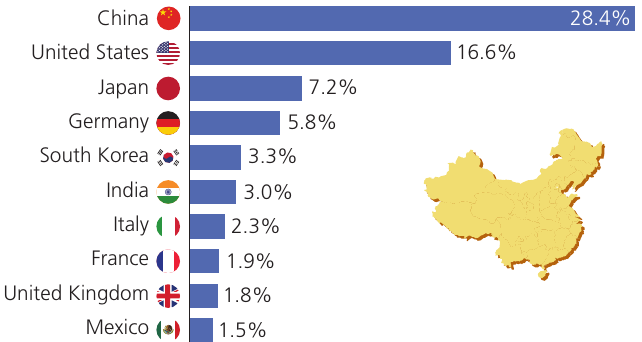
China has emerged as the dominant manufacturing nation, accounting for 28.4 per cent of global manufacturing output in 2018. The United States remains the second-largest manufacturer at 16.6 per cent, followed by Japan at 7.2 per cent and Germany at 5.8 per cent. Other significant manufacturing countries include South Korea, India, Italy, France, the United Kingdom, and Mexico.
Deindustrialisation in developed economies
Understanding deindustrialisation
One of the primary consequences of this global shift has been deindustrialisation in wealthier HDEs. This process involves a substantial decline and loss of employment in the manufacturing sector. Contributing factors include:
- Outdated production methods that cannot compete with modern facilities elsewhere
- Lack of investment in updating manufacturing infrastructure
- The movement of production to lower-cost locations

Important
Employment in UK manufacturing has fallen by nearly 60 per cent since the late 1970s. This decline has now stabilised, with numbers employed remaining steady and even increasing slightly in recent years. Productivity in the UK has been rising, largely because of advances in manufacturing technology.
Government responses to deindustrialisation
Governments in HDEs have implemented various strategies attempting to reverse this decline:
Attracting foreign investment: Encouraging foreign TNCs to invest in deindustrialised regions by offering incentives such as tax breaks
Upgrading technology and skills: Supporting investment in skills development and technology to modernise the manufacturing industry
Protectionist measures: Adopting policies such as import tariffs to protect domestic production (though this can prove counterproductive by making home industries uncompetitive globally)
Political reactions to the global shift
Note
The global shift in production has triggered political reactions against globalisation. The growth of populist and nationalist movements in developed economies is partially attributed to declining living standards in areas suffering from deindustrialisation. In 2016, this reaction arguably became a key driver behind the Brexit vote in the UK and the US presidential election that brought Donald Trump to power.
Distribution and consumption patterns
Current consumption patterns
Product consumption still occurs predominantly in the wealthier countries of the developed world. Goods manufactured in emerging NIC economies are largely exported and sold to countries in Europe, North America, and Japan.
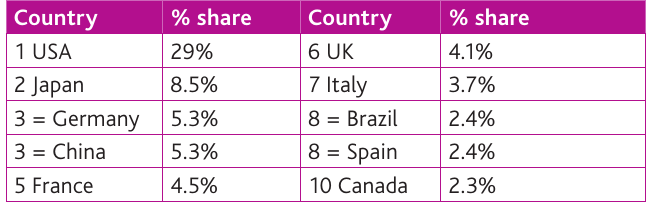
The USA dominates as the largest consumer market, accounting for 29 per cent of global consumption. Other major consumer markets include Japan (8.5%), Germany (5.3%), China (5.3%), France (4.5%), the UK (4.1%), and Italy (3.7%).
Emerging consumer markets
However, consumption patterns are evolving. As emerging NICs develop economically, their populations are becoming more affluent and beginning to demand similar consumer products to those being exported from their own countries.
Example
Example: Dyson's Asian Market Expansion
Dyson, a UK-based manufacturer of household electronic goods, relocated its manufacturing operations to Malaysia in 2002 and moved its headquarters to Singapore in 2019.
Traditional market: The company still sells the majority of its products in the UK and other parts of Europe.
Growth market: However, 75 per cent of its significant growth in 2017 came from its Asian market, with only one-fifth originating from Europe.
Future trends in distribution and consumption
Different patterns for distribution and consumption are likely to emerge in the future, with a market transition from west to east as the centre of gravity of economic activity shifts. Forecasts suggest:
- The USA, western Europe, Japan, and China will continue to be the best destinations for exporters
- As Asia becomes more competitive, a growing share of the region's exports will be directed to other countries within Asia
- China's 'Belt and Road Initiative' will open up access and diversify its exports to emerging markets
- Finance corporations from HDEs have the potential to benefit from the expansion in financial services in the Asia-Pacific region, but will face increasing competition from Chinese, Singaporean, and Korean banks and insurance companies
Communications technologies driving globalisation
A number of factors have combined to influence the breadth and depth of links between nations over the past 30 years.
In this digital age, there are few barriers preventing the sharing of information and flow of data globally. Links between countries have grown significantly as a result of:
Computer technology development: The advancement of computing power has enabled complex data processing and storage, facilitating global business operations
The internet: This technology enables speedy 24/7 global communication at the click of a button. There are currently 4.5 billion internet users worldwide, creating an interconnected global community
Mobile phones: These devices are particularly important in less developed economies, as people and markets can be connected more easily. There are nearly seven billion mobile phone subscribers worldwide, providing connectivity even in remote areas
Note
These technologies have removed traditional barriers to communication and commerce, accelerating the pace of globalisation and enabling the patterns of production, distribution, and consumption discussed throughout this note.
Remember!
Summary
Key Points to Remember:
-
Globalisation has created an international division of labour, with highly skilled jobs concentrated in developed countries and lower-skilled manufacturing jobs relocating to emerging economies
-
The global shift in manufacturing has been driven by lower costs, government incentives, and technology transfer, leading to China becoming the world's largest manufacturer
-
Deindustrialisation in developed economies has resulted in significant job losses, though productivity has often increased through technological advances
-
Consumption patterns are changing as emerging economies develop, with Asian markets becoming increasingly important for global companies
-
Communications technologies, particularly the internet and mobile phones, have been fundamental in enabling global patterns of production, distribution, and consumption by removing barriers to information sharing