Agricultural Productivity (AQA A-Level Geography): Revision Notes
📚Revision Notes
Agricultural Productivity
What is agricultural productivity?
Agricultural productivity measures how efficiently the farming industry converts available inputs into outputs. It is a crucial indicator of the economic performance of agriculture and plays a vital role in determining farm incomes. Understanding productivity helps us assess whether improvements are being made year-on-year and identifies opportunities for producing more with less.
Note
Productivity is commonly measured through yield - the amount of product generated per unit. For example:
- Kilograms of grain per hectare of land
- Kilograms of meat per animal
- Litres of milk per cow
However, examining productivity requires looking at longer-term trends rather than year-to-year fluctuations. Short-term changes often result from factors beyond farmers' control, such as weather conditions, animal diseases, policy changes, and broader economic conditions.
Understanding total factor productivity (TFP)
Important
Total factor productivity (TFP) is the ratio of agricultural outputs (gross crop and livestock output) to inputs (land, labour, fertiliser, machinery and livestock). In ecological terms, this represents the energy efficiency ratio of agricultural systems.
TFP provides the most comprehensive measure of agricultural productivity. It shows how effectively the agricultural industry uses all its available inputs to generate outputs. As farmers use inputs more efficiently, adopt improved cultivation practices, or implement better livestock rearing methods, their TFP increases - even when using the same or fewer inputs.
TFP represents the core measure economists use to understand agricultural efficiency because it accounts for the relationship between everything that goes into farming and everything that comes out.
How agricultural productivity improves
Improvements in crop production
TFP for crops increases through several key mechanisms:
Note
Key crop improvements:
- Higher-yielding crop varieties: Agricultural scientists develop disease-resistant and drought-tolerant varieties that produce more output per plant
- Flood-tolerant varieties: Crops bred to survive waterlogged conditions, expanding where farming is possible
- Efficient cultivation and harvesting: Better timing and methods for planting, tending, and collecting crops reduce losses and increase yields
- Precision technology: Modern tools indicate exactly when and where to apply water and fertiliser, reducing waste and optimising plant growth
Improvements in livestock production
For livestock, TFP growth comes from:
Note
Key livestock improvements:
- Selective breeding: Developing animals with favourable genetic qualities that produce more meat, milk, or other products
- Improved behaviour traits: Breeding animals that are easier to manage and more productive
- Better animal care: Enhanced disease management and welfare practices reduce losses and improve output
- High-quality feeds: Nutritionally optimised feed contributes directly to greater productivity per animal
Historical trends in agricultural productivity growth
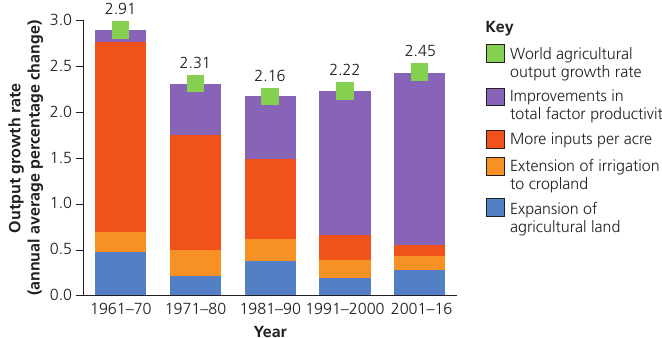
Over the past 55 years, agricultural productivity has grown steadily worldwide. Developing countries have experienced average annual increases of 2.5-3%, whilst more developed countries have seen growth rates of 2-2.5% per year.
This productivity growth stems from three main factors:
Extensification
Extensification refers to expanding the total area of land used for agriculture. This has been particularly important in lower-income developing countries where cultivable land in developed countries is already mostly in use. To a more limited extent, additional irrigation has brought previously unproductive land into agricultural production.
Intensification
Intensification involves applying more economic inputs to farming. This includes:
- Additional machinery
- Chemical fertilisers
- Pesticides and herbicides
- Higher-yielding seeds
These inputs have significantly increased productivity. Intensification was central to the 'industrialisation' of agriculture in developed countries and to Green Revolution technology in developing nations.
Total factor productivity improvements
More efficient and precise use of inputs - particularly through scientific research and development - has become the dominant driver of productivity growth over the last 20-30 years. Farmers and scientists have become better at extracting more output from each unit of input through innovation and improved practices.
Note
The chart above illustrates how these three factors have contributed to agricultural output growth across five periods from 1961 to 2016. Notice how the contribution from total factor productivity (purple) has grown increasingly important over time, whilst expansion of agricultural land (blue) plays a smaller role in recent decades.
Physical environmental constraints
Climate and soils as limiting factors
Physical environmental factors play a crucial role in determining agricultural productivity. Climate and soils are known as 'limiting factors' in agricultural production because specific crop types can only survive and be economically productive in certain climatic conditions and suitable soil types.
The climate and soils of a region are closely related, as the natural vegetation (determined largely by climate) influences soil development over time.
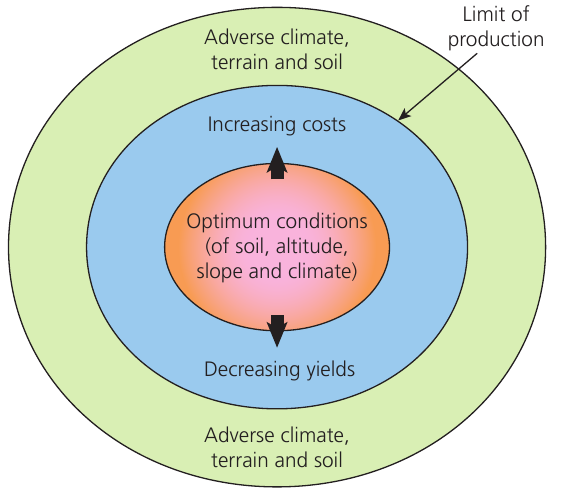
McCarty and Lindberg's Optima and Limits Model
This model explains the relationship between environmental conditions and agricultural productivity:
Important
Understanding the Optima and Limits Model:
The model shows that:
-
Each crop type has optimum growing conditions: These ideal combinations of climate, soil quality, altitude, and slope allow maximum productivity. In the centre of the model, conditions are perfect for a particular crop.
-
Physical limits exist beyond which crops cannot viably grow: As you move away from optimal conditions, there are boundaries where specific crops simply cannot be cultivated successfully.
-
Moving away from optimal conditions increases costs and decreases yields: The middle zone shows that as environmental conditions become less ideal, farmers must invest more inputs (such as fertilisers and irrigation) to compensate, whilst yields simultaneously decline.
-
Crops are grown within their environmental limits: Although not always in optimum conditions, successful crops must remain within tolerable ranges of temperature, rainfall, soil quality, and terrain.
Adapting to environmental constraints
Agricultural scientists have responded to these physical limitations by:
- Hybridising and modifying crops: Creating new varieties more tolerant of wider ranges of climatic and soil conditions
- Extending spatial limits: New varieties expand the geographical areas where particular crops can be grown
- Developing region-specific breeds: Some varieties are designed to grow optimally in specific conditions
For livestock, resilience is generally greater than for crops. However, certain climatic and soil conditions suit some animals better than others, and specific breeds perform optimally in particular regions.
Remember!
Summary
Key Points to Remember:
-
Agricultural productivity measures how efficiently farms convert inputs into outputs, serving as a key economic indicator for the farming sector.
-
Total factor productivity (TFP) is the primary measure, calculated as the ratio of outputs (crops and livestock) to inputs (land, labour, fertiliser, machinery, livestock). It represents farming's energy efficiency.
-
Three factors have driven 55 years of productivity growth: extensification (expanding farmland), intensification (more inputs per hectare), and TFP improvements (better use of inputs through science and innovation).
-
Climate and soils are limiting factors that determine where crops can grow. McCarty and Lindberg's model shows that each crop has optimal conditions at the centre, with increasing costs and decreasing yields as you move towards the limits of production.
-
Modern agriculture uses science to overcome limits: Through hybridisation and selective breeding, scientists have developed crop varieties and livestock breeds that are more productive and can thrive in wider ranges of environmental conditions.