Agricultural Systems (AQA A-Level Geography): Revision Notes
📚Revision Notes
Agricultural Systems
Understanding farms as systems
Farms can be studied using a systems approach, where they function as open systems. This means they have inputs that enter the system, processes that transform these inputs, and outputs that leave the system. Understanding agriculture in this way helps us analyse how different factors work together to produce food and other agricultural products.
Note
As a farming area develops and becomes more established, the role of physical environmental factors (like climate and soil) tends to become less critical. Instead, human-controlled inputs such as technology, investment, and management practices become increasingly important in determining agricultural success.
Components of the farming system
The farming system consists of four main components that work together: inputs, processes, outputs, and potential losses or hazards.
Inputs
Farms require various inputs that can be grouped into four main categories:
Physical inputs come from the natural environment and include:
- Temperature and precipitation patterns
- Wind conditions
- Length of the growing season
- Soil type and quality
- Altitude of the farmland
- Aspect (direction the land faces)
- Slope or gradient of the land
Cultural inputs relate to human society and traditions:
- Patterns of land ownership
- Inheritance customs
- Farm size
- Local dietary preferences
- Gender roles and issues in farming
Economic inputs involve money and resources:
- Labour (farm workers)
- Storage facilities and other infrastructure
- Processing plants
- Farm machinery and equipment
- Fertilisers and pesticides
- Transport systems
- Access to markets
- Type of government support
- Investment available
- Seeds and breeding stock
Note
The farmer themselves is a crucial input, bringing unique qualities that can make the difference between a successful and struggling farm operation. These personal factors include age and experience, knowledge and technical skills, openness to new ideas and innovation, and ambition and entrepreneurial spirit.
Processes
Processes are the activities carried out on the farm to convert inputs into outputs. These include:
For crop production:
- Ploughing the land
- Sowing seeds
- Weeding
- Applying fertiliser and pesticides
- Harvesting and threshing
For livestock production:
- Calving or lambing (helping animals give birth)
- Feeding animals
- Milking
- Providing winter care
- Storing feed
Outputs
Farms produce various outputs depending on their type:
Cereal crops such as wheat, barley, oats, rice, and maize
Vegetable crops including potatoes, cabbages, and carrots
Market garden crops like lettuce, beans, and tomatoes
Fodder crops grown primarily to feed livestock, such as grasses, silage, hay, and clover
Animal products including beef, pork, lamb, milk, cheese, hide, and eggs
Fruit production
Losses and hazards
Farming systems face various challenges that can reduce productivity:
Losses occur through:
- Soil erosion
- Leaching of soil nutrients (nutrients washed away by water)
- Poorly stored crops that spoil or are damaged
Hazards that threaten farm production include:
- Drought
- Hail storms
- Fire
- Crop diseases
- Floods
- Pests and predators
Types of farming systems
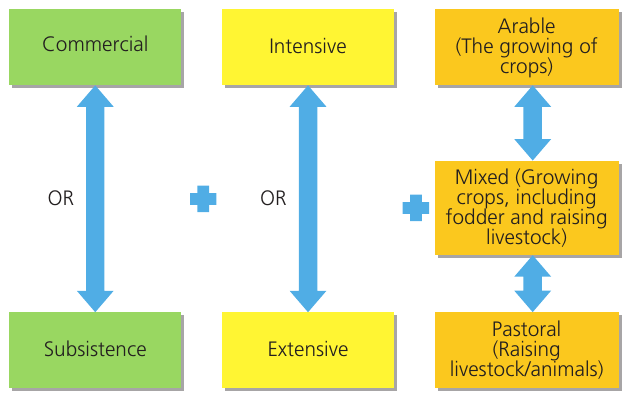
Farming systems can be classified in three main ways, which can be combined to describe any particular farm operation.
Commercial versus subsistence farming
Important
Commercial farming is agricultural production where most of the output is sold on the market. The income generated provides a livelihood for farm workers and can be reinvested into the farm to improve productivity and expand operations.
Important
Subsistence farming focuses on producing food primarily for consumption by the landowner and farm workers themselves. While a small surplus might be sold to purchase other necessities or invest in the farm, the main purpose is self-sufficiency rather than profit.
Intensive versus extensive farming
Important
Intensive farming involves using high levels of inputs per unit area of land. The intensity can take different forms depending on whether it is capital or labour driven.
Capital intensive farming means substantial financial investment in:
- Soil improvement
- Machinery and equipment
- Buildings and infrastructure
- Pest control systems
- High-quality seeds or breeding animals
Few workers are employed, but output per hectare is high.
Example
Example: Capital Intensive Farming in the Netherlands
Tomato production in the Netherlands demonstrates capital intensive farming at its finest. Advanced greenhouse technology and automation create high yields from small areas. The operation requires substantial investment in climate-controlled greenhouses, automated watering and feeding systems, and sophisticated pest management, but employs relatively few workers. The result is exceptional productivity per hectare despite the small land area involved.
Labour intensive farming uses large numbers of farm workers, resulting in high output per hectare but lower output per worker.
Example
Example: Labour Intensive Farming in the Ganges Valley
Rice cultivation in the Ganges Valley exemplifies the labour intensive approach. Many workers carefully tend crops on small plots of land, with activities including transplanting rice seedlings by hand, manual weeding, and careful water management. While this produces high yields per hectare, each worker's individual output is lower than in mechanised systems. The high population density in the region provides the necessary workforce for this intensive cultivation method.
Important
Extensive farming spreads agricultural activity over large areas with relatively fewer capital or labour inputs per unit of land. While total output may be high due to the large area farmed, output per unit area is lower than in intensive systems.
Extensive farming can still involve significant capital investment or rely on large land areas to compensate for minimal inputs.
Example
Example: Extensive Farming on the Canadian Prairies
Mechanised wheat farming on the Canadian Prairies demonstrates capital intensive extensive farming. Expensive machinery works vast areas with relatively few workers per hectare. Although the investment in equipment is substantial, the capital input per unit area remains low because the machinery covers such enormous expanses. The focus is on efficiency across large scales rather than maximising output from small areas.
Example
Example: Extensive Sheep Ranching in Australia
Sheep ranching in Australia illustrates extensive farming with minimal inputs. Animals graze over enormous ranges with little human intervention. The land area is vast, but inputs of labour, capital, and other resources per hectare are very low. Productivity per hectare is modest, but the total output is significant due to the sheer scale of operations.
Arable, mixed, and pastoral farming
Arable farming focuses exclusively on growing crops rather than raising animals.
Mixed farming combines crop production (including fodder crops for animal feed) with livestock raising. This system allows farmers to diversify their income sources and use crop by-products to feed animals.
Pastoral farming concentrates on raising livestock and animals rather than crop production.
Note
These three classification systems can be combined in various ways. For instance, a farm might be commercial, intensive, and mixed, whilst another could be subsistence, extensive, and pastoral. This flexibility in classification helps us understand the enormous diversity in global farming systems.
Organic versus conventional farming
Another important distinction exists between farms that use artificial chemicals and those that do not.
Organic farming of crops or livestock avoids artificial chemical additives entirely. Other farming systems use artificial inputs to boost productivity, such as chemical fertilisers for crops or hormone treatments for livestock.
Agricultural productivity
Understanding and improving agricultural productivity is essential for feeding growing populations and ensuring economic viability of farms.
What is agricultural productivity?
Productivity serves as a key indicator of how well the agricultural sector is performing economically. It shows how efficiently farms convert available inputs into outputs. This measure allows economists and policymakers to compare performance across different farms, regions, or time periods.
Agricultural productivity is commonly measured as yield:
- Kilograms of grain per hectare for crops
- Kilograms of meat per animal for livestock
- Litres of milk per cow for dairy
However, focusing on single outputs doesn't capture the full picture of farm efficiency.
Total factor productivity (TFP)
Important
Total factor productivity (TFP) calculates the ratio between all agricultural outputs (including both crop and livestock production) and all inputs (land, labour, fertiliser, machinery, and livestock). In environmental terms, this represents the energy efficiency ratio of the farming system.
Note
TFP provides a more comprehensive measure than simple yield because it accounts for all resources used to achieve production levels. As farmers increase outputs relative to inputs, productivity improves. This can happen by using inputs more effectively or precisely, or by adopting improved cultivation and livestock practices whilst maintaining or even reducing input levels.
When examining productivity trends, it's important to consider longer-term patterns rather than year-to-year fluctuations.
Important
Short-term changes often result from factors beyond farmers' control, such as:
- Weather variations
- Animal disease outbreaks
- Policy interventions
- General economic conditions
These temporary fluctuations don't necessarily reflect actual changes in farming efficiency or productivity improvements.
Factors influencing agricultural productivity
Over the past 55 years, agricultural productivity has grown at an average rate of between 2.5-3 per cent annually in developing countries and 2-2.5 per cent per year in more developed countries. Several factors have driven these improvements:
Extensification - bringing more land into agricultural production. This has been especially important in lower-income developing countries where much cultivable land was previously unused. In developed countries, most suitable land is already farmed, though additional irrigation has occasionally enabled expansion into previously unproductive areas.
Intensification - applying more economic inputs such as machinery, fertilisers, pesticides, and higher-yielding seeds. This approach has significantly increased productivity in both developed countries (associated with industrialisation of agriculture) and developing countries (linked to Green Revolution technologies).
Better TFP - more efficient and precise use of inputs, based on scientific research and development. This has become the dominant factor in raising productivity over the past 20 to 30 years.
Improving crop productivity
For crops, TFP improves through:
Better crop varieties:
- Higher-yielding varieties
- Disease-resistant strains
- Drought or flood-tolerant varieties
Improved cultivation practices:
- More efficient and timely cultivation methods
- Better timing of harvesting
Advanced technologies:
- Precision agriculture using technologies that indicate exactly when and how much water or fertiliser to apply
- GPS-guided machinery for optimal field coverage
Example
Example: Precision Agriculture Technology
Modern precision agriculture uses GPS and sensor technology to optimise resource application. Soil sensors measure moisture and nutrient levels across a field, allowing farmers to apply water and fertiliser only where needed and in exact amounts. GPS-guided tractors ensure complete coverage without overlap, reducing waste. This approach can increase yields while reducing input costs, improving TFP significantly.
Improving livestock productivity
For livestock raising, productivity increases through:
Selective breeding:
- Breeding animals for favourable genetic qualities
- Selecting for desired behaviours
- Improving meat quality, milk production, or other outputs
Better animal care:
- Improved disease management practices
- Better veterinary care
- Enhanced housing and welfare conditions
Optimised feeding:
- High-quality feed formulations
- Nutritionally balanced diets
- Feed supplements that boost productivity
Note
These improvements mean that farmers can now produce more food using the same or even fewer resources than in the past, making agriculture more sustainable and economically viable. This is particularly important as global population continues to grow and available agricultural land remains limited.
Remember!
Summary
Key Points to Remember:
-
Farms operate as open systems with inputs (physical, cultural, economic, and farmer-related), processes, outputs, and potential losses or hazards
-
Farming systems are classified in three ways: commercial vs subsistence, intensive vs extensive, and arable vs mixed vs pastoral - these can be combined to describe any farm
-
Intensive farming uses high inputs per unit area and can be either capital intensive (high investment, few workers) or labour intensive (many workers)
-
Agricultural productivity measures how efficiently farms convert inputs to outputs, with Total Factor Productivity (TFP) being the most comprehensive measure
-
Productivity improvements come from extensification (more land), intensification (more inputs), or better TFP (more efficient use of inputs through scientific advances)