Development Processes (AQA A-Level Geography): Revision Notes
📚Revision Notes
Development Processes
Introduction
The physical environment plays a crucial role in determining where human populations settle and how they are distributed across the globe. Understanding development processes helps explain how populations have grown and changed over time, as well as the challenges this creates.
How physical environment affects population distribution
Several key factors in the physical environment influence where people choose to live and how densely populated different areas become.
Soil fertility
Areas with highly fertile soils tend to support higher population densities. Fertile soils enable successful agriculture and food production, which allows communities to thrive.
Note
Intensive farming in densely populated areas can create environmental challenges including:
- Water pollution
- Eutrophication (excess nutrients in water bodies)
- Increased greenhouse gas emissions
Important
Not all fertile soils are ideal for settlement. Rich volcanic or alluvial soils may be prone to natural hazards such as volcanic eruptions and flooding. These risks can negatively impact population numbers despite the soil quality.
Water supply
Access to water resources is fundamental for human survival. Water is essential for:
- Human hydration
- Irrigation for food production
- Hygiene and sanitation
- Industrial processes
The distribution of water resources significantly influences population patterns.
Example
Worked Example: Water's Impact on Population Distribution in Egypt
Egypt provides a clear demonstration of how water availability shapes population patterns:
- Total population: Approximately 102 million people
- Land area used: Only 4% of the country's total land area
- Population concentration: 95% of the population lives within 12 miles of the River Nile
This dramatic example shows how water availability can concentrate populations even in otherwise inhospitable environments.
Similar population concentrations are visible along major water sources in:
- The Ganges Valley in India
- Eastern China
- South East Asia
- Northern Europe
Note
Areas with water scarcity tend to have sparse populations. These include:
- Desert regions
- Continental interiors
- Extreme cold temperature zones (Siberia, Canadian Shield)
Geology and other resource distributions
The presence of valuable resources influences where populations concentrate. Historically, areas rich in fossil fuels or minerals have attracted industrial development and consequently dense populations. Examples include:
- The Ruhr Valley in Europe
- Parts of the USA
- Increasingly, China and India
Note
Even when resources become depleted, these areas often maintain large populations as new tertiary (service-based) industries develop to support the established communities.
Population parameters
Distribution, density, numbers and change
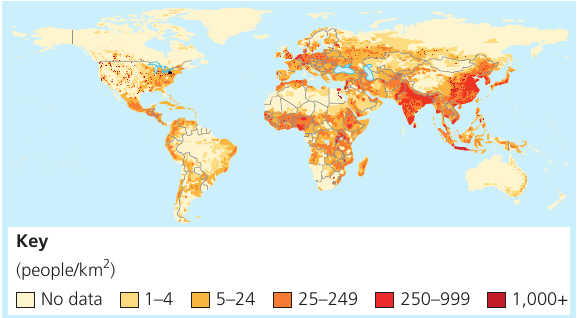
Physical environment factors clearly influence how populations are distributed across space. On a national scale, countries often show uneven population distribution patterns. Urban areas typically have much higher population densities than surrounding rural regions.
Important
Key Definitions to Remember
Population density – The average number of people living in a specified area, usually expressed as the number of people per km².
Population distribution – The pattern of where people live. This can be considered at all scales from local to global, in an area or country.
Understanding population numbers
Population numbers are recorded through census data, which most countries collect every five or ten years. Because populations are constantly changing, the size between census periods is estimated using:
- Birth rates
- Death rates
- Net migration (immigration minus emigration)
Note
Two Perspectives on Population Change
Population change is a dynamic phenomenon that must be considered from both:
- Temporal perspective – how populations change over time
- Spatial perspective – how populations are distributed across space
Population change can be measured by growth rates (or decline rates), but many other aspects of change can be observed beyond simple numbers.
Role of development processes
Development has traditionally been understood as humanity's ability to acquire and utilise resources available in the physical environment. Over time, people have migrated to areas with fertile soils and abundant resources, where populations have grown and thrived.
Historical development surges
Major development surges have occurred following specific triggers throughout history:
Note
The Neolithic Agrarian Revolution (approximately 12,000 years ago in Mesopotamia)
- Marked the transition from hunter-gatherer societies to settled agriculture
- Enabled specific areas to support larger human populations
- Represented humanity's first major transformation in resource utilisation
Note
The Industrial Revolution (eighteenth and nineteenth centuries in Europe)
- Sparked major technological developments
- Enabled the Earth as a whole to support significantly larger populations
- Created areas of industrial concentration with dense populations
- Fundamentally changed humanity's relationship with the environment
Disease control and population growth
Important
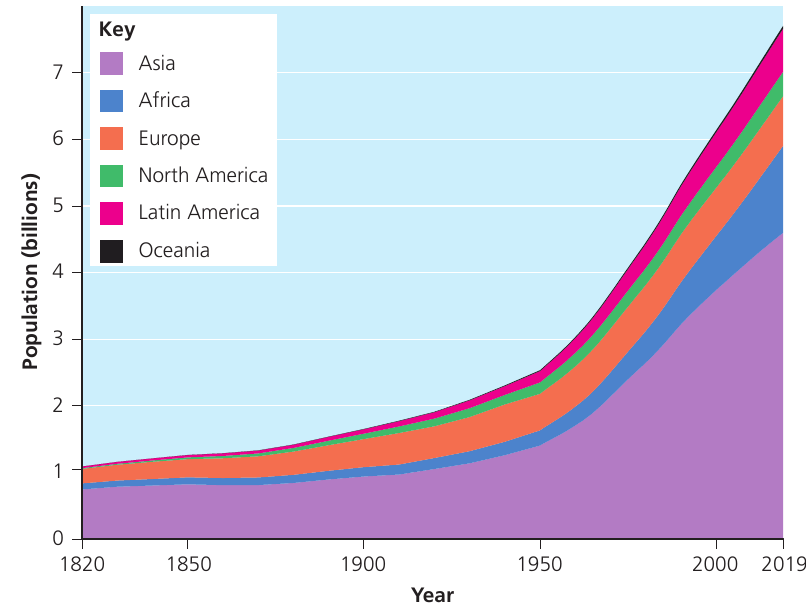
An important factor in population expansion has been humanity's increasing ability to control infectious diseases. By reducing disease-related deaths and keeping death rates low, populations have grown rapidly. The global population increased from approximately 1 billion in 1800 to 7.7 billion by 2019.
Environmental impact of development
Rapid population growth combined with development processes has created largely negative environmental impacts. The extent of these impacts depends on:
- Where individuals live on the planet
- Individual lifestyles and consumption patterns
- Available resources and services
These environmental challenges are explored in greater depth through concepts of ecological footprints and global sustainability concerns.
Global patterns of population numbers, densities and changes
Current global statistics
At the time of writing, the world's total population is approximately 7.8 billion. According to a UN report published in 2019, the global population is expected to:
- Increase by nearly two billion in the next 30 years
- Reach 9.7 billion by 2050
Asia remains by far the most populated continent, with around 60 per cent of the world's population. The two most populated countries are:
- China – currently the most populous
- India – expected to surpass China as the world's most populous country by the end of the 2020s
Population density patterns
Global patterns of population density show clear concentrations in:
- Coastal areas
- Major river basins
- Areas of industrialisation and urbanisation
These are the most densely populated regions worldwide, as shown in the population density map.
Regional variations in population change
The world's population continues to increase, but the rate of population change varies significantly across different regions.
Note
Regions with High Projected Growth:
- Sub-Saharan Africa – projected to double by 2050
- North Africa and West Asia – 46% increase expected
Regions with Moderate Projected Growth:
- Australia/New Zealand – 28% increase
- Central and Southern Asia – 25% increase
- Latin America and the Caribbean – 18% increase
Regions with Low Projected Growth:
- Eastern and South East Asia – 3% increase
- Europe and Northern America – 2% increase
Note
These variations reflect different stages of demographic development and varying levels of economic development across regions. Regions experiencing lower population growth rates typically have lower birth rates and more developed economies, whilst rapidly growing regions often have higher birth rates and younger populations.
Remember!
Summary
Key Points to Remember:
-
Physical environment factors (soil fertility, water supply, geology) fundamentally influence where populations concentrate and how densely areas are populated.
-
Population density and population distribution are key concepts for understanding human settlement patterns at all scales from local to global.
-
Major historical development surges, particularly the Neolithic Agrarian Revolution and Industrial Revolution, enabled dramatic population growth by increasing the Earth's carrying capacity.
-
The global population is projected to reach 9.7 billion by 2050, but growth rates vary dramatically by region, with sub-Saharan Africa expected to double whilst Europe and Northern America will grow by only 2%.
-
Development and population growth have created significant environmental challenges, with impacts depending on individual lifestyles, consumption patterns, and available resources.