Implications of Migration (AQA A-Level Geography): Revision Notes
📚Revision Notes
Implications of Migration
Migration is a significant geographical phenomenon that affects both the countries people leave (origin) and the countries they move to (destination). When large numbers of people migrate, this creates a range of demographic, social, economic, political, environmental and health impacts that can be both positive and negative. Understanding these implications is crucial for analysing population dynamics and their consequences in our interconnected world.
Note
Two Sides of Every Migration Story
When studying migration impacts, always consider both perspectives - the origin country and the destination country. What represents a loss for one country often becomes a gain for another, creating complex patterns of winners and losers in the global migration system.
Economic implications
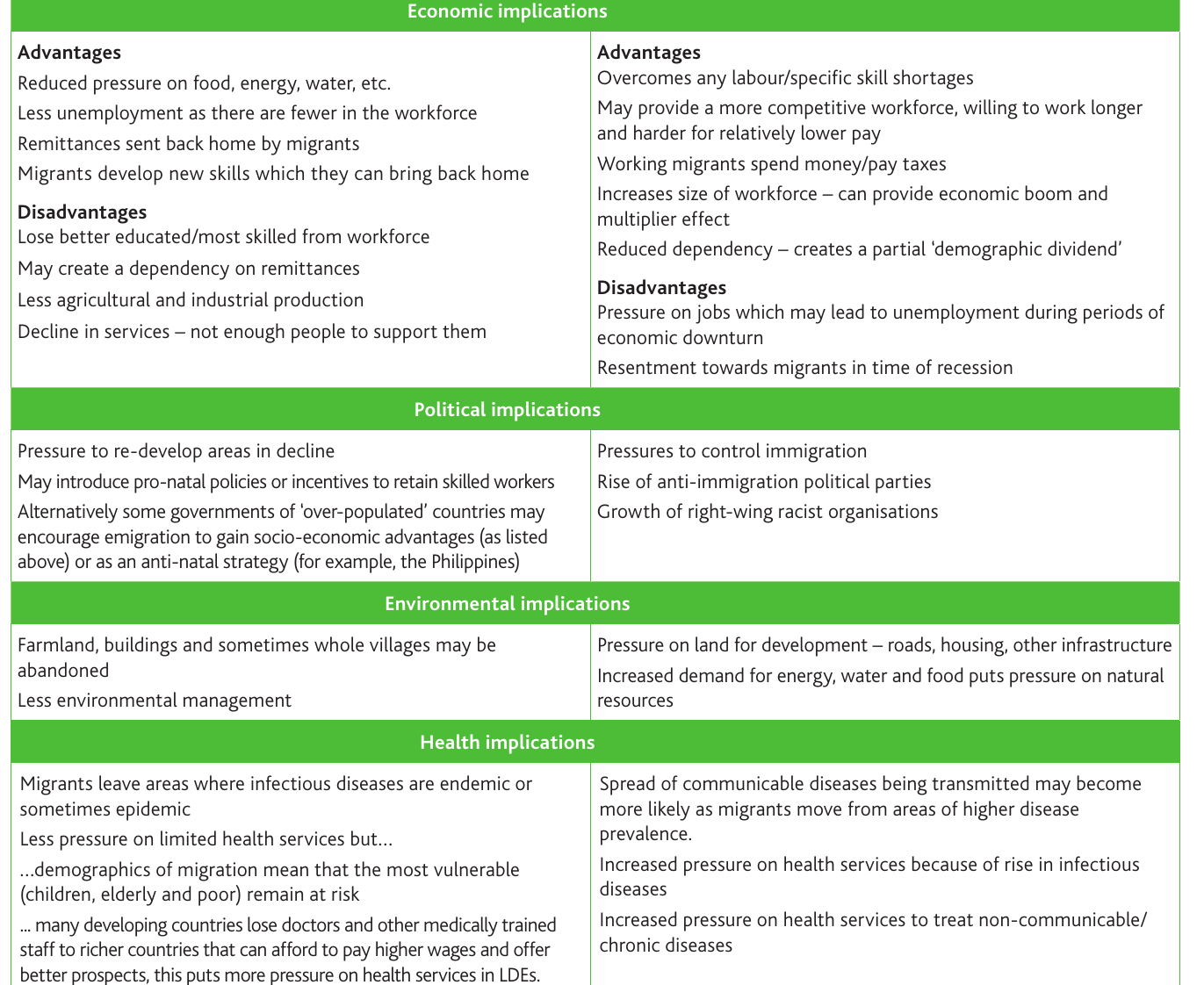
International migration reflects the interdependence between different countries within the global system. Workers in less developed economies (LDEs) often seek better opportunities abroad, typically in highly developed economies (HDEs). This creates an unequal flow of labour across international borders.
Globalisation has intensified economic migration in recent years, with workers moving across longer distances for various reasons:
- Skilled workers are increasingly required to work abroad, particularly when employed by transnational corporations (TNCs)
- Countries with ageing populations actively encourage immigration of skilled workers to address workforce shortages
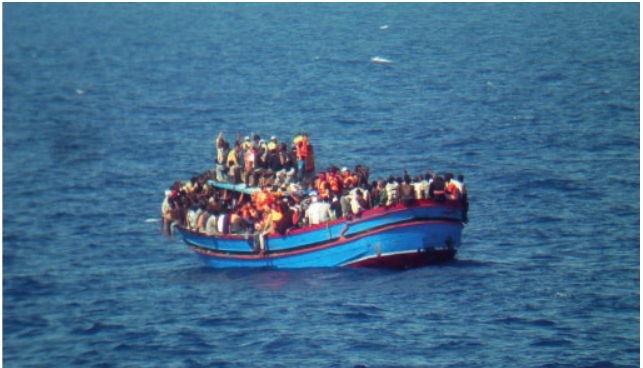
- Economic migrants who cross borders illegally often have detailed knowledge of migration routes and are willing to accept significant risks, including paying substantial sums to organised traffickers
The impact on HDEs and LDEs differs significantly. Economically developed countries often benefit from migration at the expense of LDEs, who lose their most talented young people. This phenomenon is known as brain drain - the emigration of highly skilled and educated workers from their home countries.
Important
Brain Drain: A Critical Challenge for LDEs
Brain drain occurs when qualified professionals such as doctors, nurses and teachers leave LDEs to work in HDEs where they can earn higher wages and access better career prospects. This creates a cycle where origin countries lose the very people needed to drive development, whilst destination countries gain skilled workers without bearing the cost of their education and training.
Through migration, HDEs gain additional skills and labour, whilst migrants' spending on goods and services, combined with tax payments, helps support and potentially boost the destination economy. However, this comes at a cost to origin countries, where increased dependency and service closures may occur due to lack of support.
Remittances (money sent back by migrants to their families in origin countries) can partially offset these negative effects. However, they often reinforce economic inequalities between HDEs and LDEs rather than reducing them. Origin countries may become dependent on these remittances, whilst losing productive capacity in agriculture and industry.
Destination countries benefit from overcoming labour and skill shortages. Migrants often provide a competitive workforce, willing to work longer hours for relatively lower pay. This increases the size of the workforce and can create an economic boom with a multiplier effect. The resulting reduction in dependency creates what economists call a partial demographic dividend - an economic benefit arising from changes in population structure.
Demographic implications
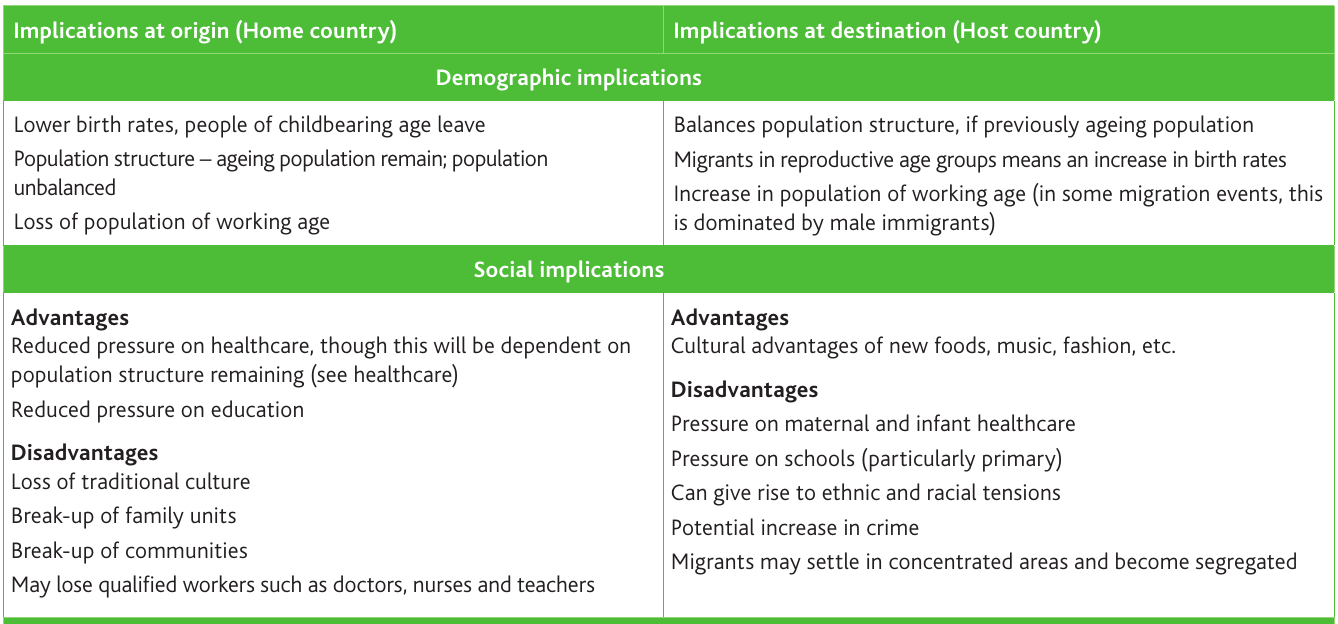
Migration has powerful and immediate effects on population size and structure in both origin and destination areas. Unlike natural population change (births and deaths), which occurs gradually over time, migration can transform a population's characteristics very quickly.
Population structure refers to the composition of a population by age and gender. Any significant migration event will alter this structure, as the movement of people changes population size whilst the age and gender characteristics of migrants impact the demographic makeup of both areas.
Note
Migration vs Natural Change: Speed of Impact
A key distinction exists between migration and natural population change. While births and deaths create gradual demographic shifts over decades, migration can instantly transform population structure. A single large migration flow can reshape a country's age and gender composition within months or years, not generations.
Voluntary migration is typically selective by age and gender. Young adults of working age are most likely to migrate, so the movement of substantial numbers creates noticeable impacts on population structure at both origin and destination. This pattern occurs at all scales, from rural-urban migration within developing countries to international migration between nations.
Specific structural impacts
When working-age adults leave origin countries, several demographic changes occur:
- The proportion of economically active people decreases, with only ageing populations and the unbalanced (too young or too old) remaining
- Loss of people of childbearing age leads to lower birth rates
- The working-age population shrinks, creating labour shortages
Conversely, destination countries experience opposite effects:
- Population structure becomes more balanced if it was previously skewed towards older age groups
- Migrants in reproductive age groups cause an increase in birth rates
- The working-age population expands (particularly in migration flows dominated by males)
Example
Worked Example: UAE Population Structure
The United Arab Emirates provides a striking demonstration of migration's demographic impact. The country's population pyramid reveals a dramatic concentration of males in working age groups from 25 to 59 years old. This distinctive pattern reflects large-scale immigration of male workers recruited to support the UAE's rapid economic development in construction, oil industries, and service sectors. The pyramid shows far more males than females in these age groups - a clear indicator that this is not natural population growth but rather the result of targeted labour migration policies.
Social implications
At origin (home countries)
The departure of migrants creates mixed social outcomes in origin areas. On the positive side, reduced population decreases pressure on healthcare services, though this depends on the remaining population structure. Educational facilities also face less demand.
However, significant disadvantages emerge. Traditional cultures may be eroded as young people leave, taking their knowledge and practices with them. Family units break up as members separate, and entire communities can fragment. The loss of qualified professionals - particularly doctors, nurses and teachers - severely impacts local services. These skilled workers are precisely the people who keep essential social infrastructure functioning.
At destination (host countries)
Destination countries gain cultural advantages as migrants bring new foods, music, fashion and perspectives. This cultural diversity can enrich society significantly.
Nevertheless, challenges also arise. Maternal and infant healthcare services face increased pressure as migrants in reproductive age groups have children. Primary schools experience rising demand as these children enter education. The potential for ethnic and racial tensions increases, particularly if migrants settle in concentrated areas and become segregated from the existing population. Some research suggests possible links between migration and increased crime rates, though this relationship is complex and contested.
Note
Cultural Impact: A Double-Edged Sword
Migration creates fascinating cultural dynamics in both origin and destination areas. While origin countries may lose traditional knowledge and practices as young people emigrate, destination countries gain the benefit of cultural enrichment and diversity. This exchange reshapes societies on both sides, creating new hybrid cultures whilst potentially weakening traditional ones.
Political implications
Origin country responses
Countries experiencing significant emigration may attempt to reverse population decline through various strategies. Governments might introduce pro-natal policies or create incentives to retain skilled workers. Alternatively, some governments of densely populated countries actively encourage emigration to gain socio-economic advantages, such as reduced pressure on resources and infrastructure, or as a deliberate anti-natal strategy (as seen in the Philippines).
Destination country responses
Host countries face mounting pressure to control immigration as numbers increase. This often leads to the rise of anti-immigration political parties and the growth of right-wing, sometimes racist, organisations. Immigration control becomes a politically contentious issue, with debates about border security, asylum seekers and refugee acceptance dominating political discourse.
Important
Political Tensions and Immigration
The political implications of migration are increasingly significant in many HDEs. Growing anti-immigration sentiment can lead to electoral success for populist parties, changes in immigration policy, and social division. Governments face the challenge of balancing economic needs for migrant workers against public concerns about cultural change, service pressure, and job competition.
Environmental implications
Impact on origin areas
Emigration can lead to the abandonment of farmland, buildings and sometimes entire villages, particularly in rural areas experiencing depopulation. This reduces environmental management as fewer people remain to maintain the land and infrastructure.
Impact on destination areas
Destination regions face increased pressure on land for development, including roads, housing and other infrastructure. Growing populations demand more energy, water and food, creating pressure on natural resources. The expansion of urban areas to accommodate migrants often results in environmental degradation and loss of green spaces.
Health implications
Disease transmission
Health disparities between migrants' places of origin and destination can significantly influence migration patterns. These differences may be among the original push and pull factors triggering movement. Migration flows can facilitate the transmission of certain diseases globally, particularly to countries receiving migrants.
This became especially evident during the COVID-19 pandemic, when disease incidence rates were carefully monitored by the WHO and national governments. Consequently, many borders closed during the crisis, especially for travellers from high-incidence areas. Most permanent legal migration was suspended whilst the pandemic persisted, though evidence suggests illegal migration attempts actually increased during this period.
Important
Avoiding Oversimplification
It is crucial to recognise that linking increased infectious disease to immigration may be misleading. Rising disease prevalence might be only one factor among many, or even incorrectly attributed to migration when other causes are primarily responsible. Migration and disease transmission have complex relationships that require careful analysis.
Impact on healthcare services in HDEs
A 2019 Health Foundation statement concluded that evidence demonstrates migration's positive contribution to healthcare in the UK. Data reveals that migrants make disproportionately low demands on health services, primarily because they tend to be younger and healthier than the general population. Language barriers and lack of knowledge about accessing healthcare systems also contribute to lower usage rates.
As taxpayers, immigrants contribute financially to public service costs. Significantly, migrants form an essential component of the healthcare workforce itself. Approximately 13 per cent of NHS staff are non-British, whilst 28 per cent of doctors working in the NHS trained in other countries.
Note
NHS Dependency on International Recruitment
Considerable staffing shortages are predicted in coming years. The UK will likely continue depending on recruiting healthcare and social care staff from overseas to address these shortages. For instance, projections suggest the NHS will need to recruit 5,000 international nurses annually from 2023-24 onwards. This creates a critical dependency on migration for maintaining healthcare services.
Impact on healthcare services in LDEs
Conversely, consider the negative impacts on health services in many LDEs. These countries frequently lose many of their most talented clinicians to more developed nations. The departure of doctors and other medically trained staff to countries offering higher wages and better career prospects places enormous additional pressure on already stretched health services in developing countries. This exacerbates existing healthcare challenges and leaves vulnerable populations - particularly children, elderly people and the poor - at greater risk.
Summary
Key Points to Remember:
-
Migration creates impacts at both origin and destination: Always consider both perspectives when analysing migration effects - what the home country loses, the host country often gains, and vice versa.
-
Brain drain severely affects LDEs: The loss of skilled workers like doctors, teachers and nurses creates serious problems for origin countries whilst benefiting destination countries economically.
-
Demographic changes are immediate: Unlike natural population change, migration instantly alters population size and structure, particularly affecting working-age populations.
-
Social implications are mixed: Host countries gain cultural diversity but face pressure on healthcare and education services, plus potential ethnic tensions. Origin countries reduce service pressure but lose traditional culture and family structures.
-
Health impacts work both ways: HDEs benefit significantly from migrant healthcare workers, but this creates severe staffing shortages in LDEs, whilst disease transmission concerns affect destination countries.
-
All six categories matter: Remember to consider demographic, social, economic, environmental, political and health implications when analysing any migration scenario.