Patterns of Food Production and Consumption (AQA A-Level Geography): Revision Notes
📚Revision Notes
Patterns of Food Production and Consumption
Understanding global food patterns
Food production and consumption vary significantly across the world. These patterns are shaped by both environmental factors and human capabilities. Understanding these differences is essential for addressing global food security challenges.
Food production
What determines food production?
Food production around the world is influenced by two main factors:
Environmental capacity refers to the natural conditions that affect farming:
- Physical environment features (terrain, altitude)
- Climate patterns (temperature, rainfall)
- Water availability for irrigation
- Soil fertility and quality
Human capacity encompasses the resources and knowledge people can apply:
- Population size (available workforce)
- Skills and education levels
- Technology and innovation
- Capital investment in agricultural infrastructure
Important
Both environmental and human capacity work together to determine how much food a region can produce. Areas with poor environmental conditions can still achieve high production through investment in technology and infrastructure.
Historical changes in food production
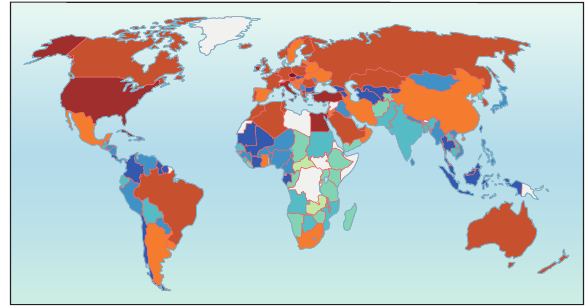
In the early 1960s, global food supplies were very limited and unevenly distributed. The average person worldwide had access to only 2,300 kilocalories per day. However, the situation was starkly different between regions:
- High-income countries: 3,030 kcal per person per day
- Low-income developing countries: below 2,000 kcal per person per day
- Result: More than half the population in low-income countries experienced chronic under-nutrition
Note
By 2015, despite the global population increasing two and a half times, food production had dramatically improved. The world could produce enough food to provide every person with more than 2,940 kilocalories per day. This would have been sufficient to ensure everyone had an adequate and balanced diet.
Despite this progress, the UN's Millennium Development Goal of halving poverty and hunger by 2015 was not fully achieved. In 2018, 820 million people still experienced under-nutrition, representing a decline from 15% to 10.5% over a 15-year period.
Factors driving increased production
Several key developments have contributed to the growth in global food production:
The green revolution introduced a package of agricultural technologies that transformed farming:
- Development of new high-yielding crop varieties
- Expanded irrigation systems
- Increased use of fertilisers to improve soil nutrients
- Application of pesticides to protect crops
- These technologies increased yields for millions of farmers
- However, there were some negative social and environmental impacts
Note
The green revolution's impact was particularly significant in Asia, where countries like India and the Philippines saw dramatic increases in rice production. This technological package helped avert predicted famines in the 1970s and 1980s.
Globalised trade has improved food distribution:
- Addresses seasonality issues by moving produce between hemispheres
- Promotes specialisation where production is most efficient
- Allows regions to focus on crops suited to their conditions
Investment in agriculture from various sources:
- Transnational corporations (TNCs) bringing capital and technology
- Government programmes supporting farmers
- Non-governmental organisations (NGOs) working to increase productivity
- Focus particularly on low-income countries
Food consumption
Measuring food consumption
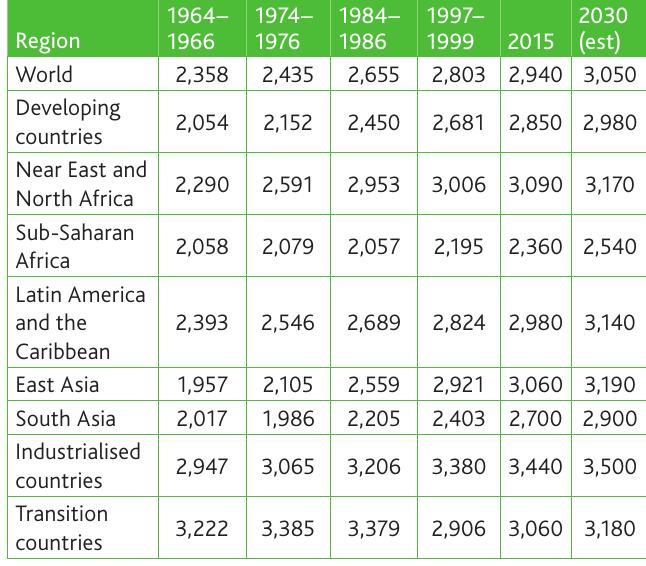
Food consumption is measured in kilocalories (kcal) per capita per day. This provides a standardised way to compare food availability across different countries and regions.
Note
Analysis by the United Nations Food and Agriculture Organization (FAO)
The FAO reveals that dietary energy availability has been steadily increasing worldwide. Between the mid-1960s and 2015:
- Global average increased by nearly 600 kcal per capita per day
- Developing countries saw an increase of 800 kcal per capita per day
This demonstrates significant progress in raising food consumption per person over the past 50 years, though problems of undernourishment and hunger persist in some regions.
Understanding undernourishment
Important
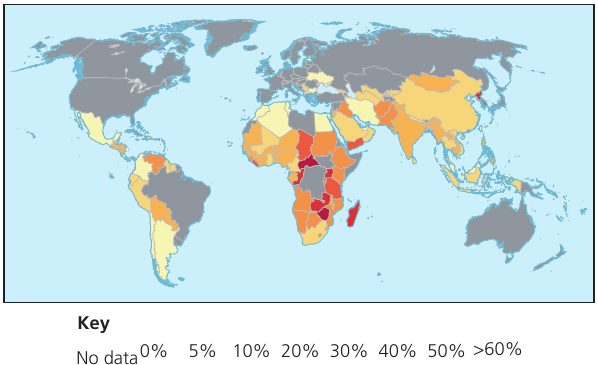
Undernourishment, or hunger, occurs when dietary intake falls below the minimum daily energy requirement. These requirements vary by gender, age, and physical activity levels, but generally range between 1,700 and 2,000 kcal per day.
The global pattern of undernourishment is highly uneven. Regions suffering most from undernourishment include:
- Sub-Saharan Africa
- South, central and eastern Asia
- Latin America
Recent trends in food consumption
Over the past twenty-five years, food consumption has been growing faster than world population growth. This has been driven by:
- Rising incomes in industrialising countries
- Changes in consumer preferences in higher income countries
These factors have influenced the following changes in food consumption patterns:
In emerging economies:
- Increased consumption of higher value meat products
- Growing demand for dairy products
- Reflects rising prosperity and changing dietary preferences
In developed economies:
- Lower red meat consumption
- Motivated by health concerns
- Environmental considerations influencing dietary choices
Note
These contrasting trends reflect different stages of economic development. As countries industrialise and incomes rise, populations tend to diversify their diets and consume more protein-rich foods. However, in the most developed nations, concerns about health and sustainability are beginning to shift consumption patterns back towards plant-based diets.
Regional variations in consumption
Production and consumption of main agricultural products have been growing at higher rates in low-income countries compared to higher-income countries. This reflects:
- Higher population growth rates in developing regions
- Increasing wealth and purchasing power
- Greater responsiveness of demand to income growth in poorer countries
In contrast, demand growth has been slower in the richer world because:
- High per capita consumption levels already reached
- Slow or negative population growth
- Market saturation for many commodities
Countries demonstrate different patterns: China and Brazil have high growth rates in food demand, whilst North America and Europe have lower growth rates, with some countries experiencing declining production.
Agricultural systems
Farming as a system
Important
Agriculture can be studied as a systematic process where farms operate as open systems. These systems have:
- Inputs: physical, cultural, economic, and behavioural factors
- Processes: farming activities
- Outputs: products
As an area develops economically, the physical factors typically become less important relative to the human inputs. More advanced agricultural systems rely heavily on technology, capital, and management expertise rather than just natural conditions.
Types of farming systems
Agricultural systems can be categorised in different ways. Three important classifications are:
Example
Commercial Farming
Commercial farming is organised to generate income:
- The majority of produce is sold rather than consumed
- Income provides a livelihood for the farmer and farm workers
- Profits can be reinvested back into the farm
- Focus on market demand and profitability
Example
Subsistence Farming
Subsistence farming is oriented towards self-sufficiency:
- The majority of produce is consumed by the landowner and farm workers
- Only a small surplus may be sold to purchase other living requirements
- Limited investment back into the farm
- Priority is feeding the family rather than generating profit
Example
Intensive Farming
Intensive farming requires high levels of input:
- High level of inputs per unit area of land
- These inputs can vary in nature
- May involve intensive use of labour, capital, technology, or other resources
- Can apply to both commercial and subsistence systems
Summary
Key Points to Remember:
-
Food production is determined by both environmental capacity (climate, water, soil) and human capacity (population, skills, technology, investment).
-
Global food production has dramatically increased since the 1960s, with average calories per person rising from 2,300 to over 2,940 kcal per day by 2015, though 820 million people still faced undernourishment in 2018.
-
The green revolution, globalised trade, and investment by TNCs, governments, and NGOs have been key drivers of increased food production.
-
Food consumption patterns are changing globally, with emerging economies increasing meat and dairy consumption whilst developed countries are reducing red meat consumption for health and environmental reasons.
-
Agricultural systems can be classified as commercial (producing for sale), subsistence (producing for own consumption), or intensive (high inputs per unit area), each with different characteristics and purposes.