Perspectives on Population Growth (AQA A-Level Geography): Revision Notes
📚Revision Notes
Perspectives on Population Growth
Understanding different perspectives on population growth is crucial for analysing the relationship between human populations and environmental resources. Scholars have debated whether population expansion leads inevitably to crisis or whether human ingenuity can overcome resource limitations. These contrasting views shape policy decisions and influence how societies respond to demographic changes.
Note
The theoretical debate between pessimistic and optimistic views of population growth has profound implications for policy-making. Understanding both perspectives enables critical evaluation of proposed solutions to demographic challenges.
Malthusian theory
Thomas Malthus, an English clergyman, published An Essay on the Principle of Population in 1798 during a period when global population was beginning its unprecedented exponential growth. His observations about the relationship between humans and resources led him to make predictions about humanity's future that remain influential today.
Core principle: exponential vs linear growth
Malthus identified a fundamental imbalance in growth rates. He argued that human populations have the capacity to grow much more rapidly than our ability to produce sufficient food. Specifically, he observed that:
- Population grows geometrically (exponentially): Numbers double repeatedly over time:
- Food production grows arithmetically (linearly): Agricultural output expands by adding fixed amounts each time period:
Important
The Malthusian Crisis
This creates an unsustainable situation where population growth will inevitably outpace food supply. The mathematical difference between exponential and linear growth means that no matter how much food production increases, population will eventually exceed it.
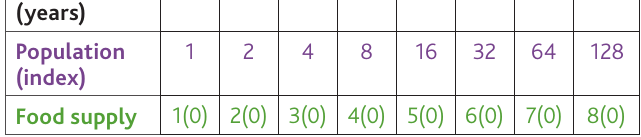
The table above demonstrates how dramatically these different growth patterns diverge over time. Within just 200 years, population could increase 128-fold whilst food supply might only increase 8-fold.
Carrying capacity and population crashes
Note
Carrying capacity refers to the maximum population size that an environment can sustainably support given available resources.
Malthus believed this carrying capacity represents a fixed environmental limit. When population exceeds this threshold, the imbalance triggers a crisis. The diagram below illustrates how populations repeatedly crash back to sustainable levels.
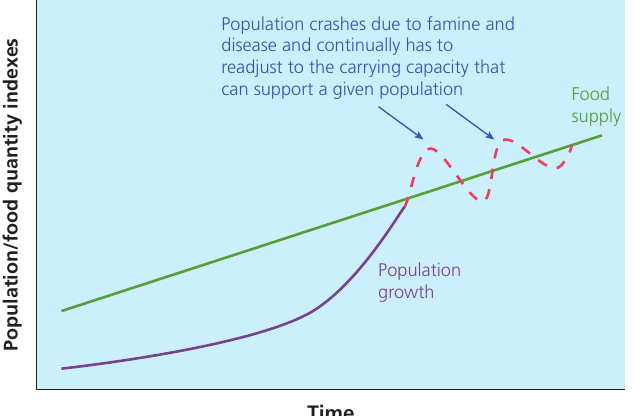
When numbers surpass the carrying capacity, populations experience dramatic declines through starvation and illness. This creates a cyclical pattern where populations grow, exceed limits, crash, and must continually readjust to what resources can support. Malthus predicted that without intervention, "life would end in misery" - a scenario that became known as Malthusian catastrophe.
Checks on population growth
Malthus identified mechanisms that maintain balance between population and resources, categorising them as positive or negative checks:
Positive checks reduce population through increased mortality:
- War and conflict
- Famine and starvation
- Disease epidemics
- Infanticide and abortion
These represent negative feedback mechanisms where population excess triggers events that reduce numbers back toward equilibrium.
Negative checks prevent population growth through reduced fertility:
- Moral restraint
- Celibacy
- Delayed marriage
- Sexual abstinence
Note
Malthus advocated for negative checks, particularly moral restraint, as the preferred solution. However, his theory was formulated before modern contraception became available, limiting the practical options he could consider.
Malthus's pessimistic outlook
Malthus held fundamentally pessimistic views about population-resource balance. He believed environmental constraints impose ultimate limits on human population size - a deterministic philosophy where the environment determines what is possible. Without controlling population growth, he predicted humanity faced inevitable misery and suffering.
Neo-Malthusian perspectives
Although Malthus developed his ideas over two centuries ago, they experienced a significant revival during the 1960s when global population entered its most rapid growth phase. Scholars supporting these renewed concerns became known as neo-Malthusians.
Key figures and organisations
Paul Ehrlich became the most prominent neo-Malthusian voice. In 1968, he published the controversial book The Population Bomb, which made stark predictions about humanity's immediate future. Ehrlich forecast mass starvation affecting millions by the 1970s and advocated for coercive population control measures alongside reduced consumption.
The Club of Rome, a global think tank established in 1968, also championed neo-Malthusian concerns. This organisation continues to view their warnings as relevant and urgent today.
Predicted problems from population growth
Neo-Malthusians identified numerous serious consequences from continued population expansion:
- At least 600 million people facing undernourishment
- Increased disease occurrence and spread
- Global warming and climate change acceleration
- Rapid urbanisation creating unsustainable cities
- Overfishing depleting marine resources
- Loss of biodiversity and ecosystem collapse
- Environmental degradation
- Rising pollution levels
- Resource depletion
Evidence supporting neo-Malthusian views
Contemporary events appear to validate some neo-Malthusian warnings:
Note
Real-World Evidence of Malthusian Predictions
Several recent events demonstrate the ongoing relevance of neo-Malthusian concerns about population-resource imbalances and environmental limits.
-
Frequent droughts and famines: Over 100,000 people died during droughts in the Sahel region (2010) and East Africa (2011). Climate change may increase the frequency of such catastrophic events.
-
Resource conflicts: Wars and tensions over access to food, water, and energy resources demonstrate how scarcity drives conflict.
-
Climate change impacts: The negative feedback effect of climate change on population has materialised, with altered rainfall and drought patterns devastating crop production in vulnerable regions.
-
Agricultural challenges: Despite technological advances, soils become depleted and the carbon cycle disrupted, leading to instability in food production. Fossil fuel dependence increases our capacity to produce food but simultaneously creates rising global temperatures and greenhouse gas emissions.
Alternative perspectives: Cornucopian views
Not everyone accepts the pessimistic Malthusian outlook. Alternative, more optimistic perspectives suggest that human ingenuity and technological advancement enable us to overcome environmental constraints. These views are often described as cornucopian, referencing the mythical "horn of plenty" symbolising abundance.
Ester Boserup's theory
Ester Boserup, a Danish economist, recognised that environments have limits restricting production. However, unlike the determinism claimed by Malthusians, she proposed a possibilistic philosophy. This suggests that human ingenuity and creativity allow us to expand carrying capacity and extend it upwards in line with population growth.
Important
Boserup's Revolutionary Insight
In 1965, Boserup made a crucial observation: population growth often stimulates innovation and technological advancement rather than causing collapse. These innovations increase resource availability substantially, enabling the carrying capacity to sustain much larger populations than Malthus imagined possible.
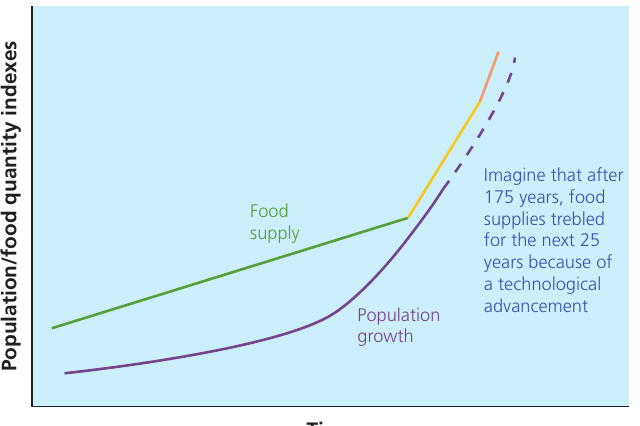
Boserup's perspective reverses the Malthusian logic. When crisis threatens survival in an area, humans discover solutions that ultimately avert catastrophe. This demonstrates that "necessity is the mother of invention" - pressure drives progress.
Historical examples supporting Boserup
Agricultural history provides compelling evidence for Boserup's optimistic outlook:
Example
Examples of Innovation Under Pressure
-
Intensification of farming in Europe: Following food shortages after the Second World War, European agriculture adopted intensive techniques dramatically increasing yields per hectare.
-
The Green Revolution: Beginning in Mexico and spreading throughout South and South East Asia, high-yielding crop varieties transformed food production in developing regions.
-
Recent biotechnological developments: Genetic modification (GM) technology creates crops with enhanced productivity, pest resistance, and nutritional content, further expanding agricultural potential.
These innovations demonstrate humanity's capacity to increase food supply when population pressure demands it.
Julian Simon's arguments
Julian Simon, an American economist and contemporary of Ehrlich, argued forcefully against neo-Malthusian pessimism. His book The Ultimate Resource (1981) presented a fundamentally different interpretation of population and resource trends.
Simon maintained that every measure of human material welfare shows improvement globally, despite rapid population growth. He used facts and evidence to demonstrate that:
- Air quality in wealthy countries has become safer to breathe
- Water cleanliness has improved rather than deteriorated
- Cropland condition has enhanced rather than worsened
- Food production increases have consistently matched or exceeded population increases historically
- Raw materials have become less scarce rather than more scarce
- Relative costs of accessing resources have decreased
Note
For Simon, the Earth was not running short of resources - even with more people demanding them. He argued that the only genuine resource Earth possesses is people themselves. Human ingenuity, creativity and problem-solving represent the "ultimate resource" enabling continuous improvement.
Evidence supporting cornucopian views
Several trends support the optimistic cornucopian perspective:
-
Increased food production: Agricultural output through intensification and technology (including the Green Revolution and GM crops) has grown faster than population in many regions.
-
Technological transitions: Shifts from non-renewable to renewable energy sources, alongside improvements in repair, reuse and recycling, demonstrate adaptive capacity.
-
Innovation in response to scarcity: As certain resources become depleted, alternatives emerge and are adopted.
-
Pollution mitigation: Increased awareness has led to damage reduction and environmental protection measures.
-
Demographic transition: Population growth naturally slows with economic and social development, happening "naturally" without coercive control measures.
-
Appropriate technology adoption: Technologies designed for sustainability offer pathways to support larger populations responsibly.
Comparing the perspectives
The fundamental debate between neo-Malthusian and cornucopian worldviews extends across multiple dimensions, reflecting deeply different assumptions about human nature, environmental limits, and technological potential.
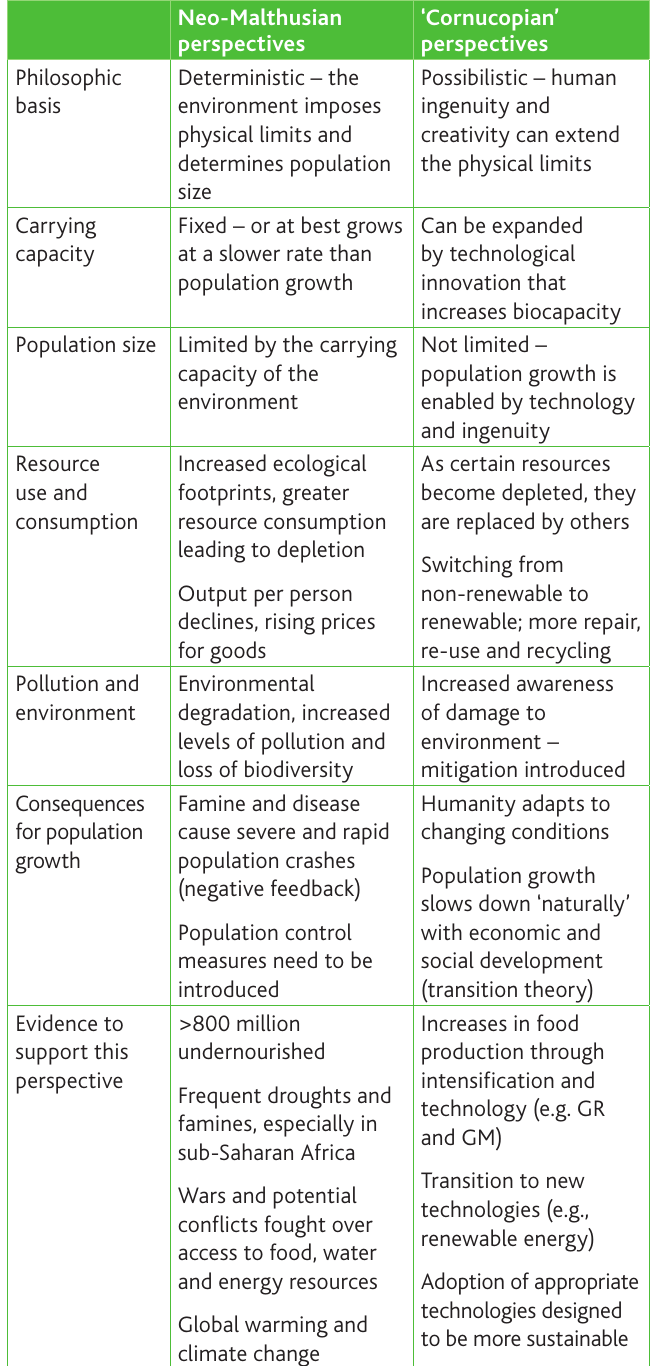
The table above systematically compares neo-Malthusian and cornucopian worldviews across multiple dimensions:
Philosophical foundations
Neo-Malthusian perspectives adopt a deterministic approach - the environment imposes physical limits that determine maximum population size. These constraints cannot be overcome.
Cornucopian perspectives embrace a possibilistic approach - human ingenuity and creativity allow us to extend physical limits. Technology expands what is environmentally possible.
Views on carrying capacity
Neo-Malthusians argue carrying capacity is fixed or grows very slowly relative to population growth. Environmental biocapacity sets firm boundaries.
Cornucopians contend that carrying capacity can be expanded through technological innovation that increases biocapacity and productive capacity.
Population size implications
Neo-Malthusians believe population size is limited by environmental carrying capacity. Exceeding this threshold brings catastrophe.
Cornucopians argue population growth itself is not the limiting factor - instead, it enables technological advancement and human ingenuity that increase our capacity to support larger numbers.
Resource use and consumption patterns
Neo-Malthusians highlight increased ecological footprints, greater resource consumption leading to depletion, rising prices, and declining output per person as populations grow.
Cornucopians acknowledge that certain resources become depleted but emphasise that alternatives replace them. Switching from non-renewable to renewable resources, combined with improved repair, reuse and recycling, maintains or increases availability.
Environmental concerns
Neo-Malthusians warn of environmental degradation, increased pollution levels, and loss of biodiversity as population pressures mount.
Cornucopians point to increased awareness of environmental damage and the introduction of mitigation measures and sustainable technologies as population grows.
Consequences of population growth
Neo-Malthusians predict severe consequences: famine and disease causing rapid population crashes through negative feedback. They advocate population control measures to prevent catastrophe.
Cornucopians observe that humanity adapts to changing conditions. Population growth slows naturally with economic and social development through demographic transition theory, without requiring coercive intervention.
Supporting evidence
Both perspectives can point to evidence supporting their interpretations:
Note
Neo-Malthusian evidence:
- Undernourishment affecting over 800 million people
- Frequent droughts and famines, particularly in sub-Saharan Africa
- Wars and conflicts over access to food, water and energy
- Global warming and climate change impacts on agriculture
Cornucopian evidence:
- Increases in food production through intensification and technology
- Transition to renewable energy sources
- Adoption of appropriate sustainable technologies
- Natural demographic transition reducing birth rates
- Overall improvements in human welfare measures globally
Understanding both viewpoints
Both neo-Malthusian and cornucopian perspectives offer valuable insights for understanding population-environment relationships. Students of human geography should research evidence for both sides and formulate informed viewpoints based on critical analysis rather than accepting either perspective uncritically.
Important
The Ongoing Debate
The debate ultimately centres on whether environmental limits are fixed or expandable, and whether human ingenuity can indefinitely overcome resource constraints. Historical evidence provides support for both positions, suggesting the answer may vary by context, timescale, and specific resources under consideration.
Summary
Key Points to Remember:
-
Malthus predicted population disaster: He argued that population grows exponentially (doubling repeatedly) whilst food production grows linearly (adding fixed amounts), inevitably leading to crisis when population exceeds carrying capacity.
-
Two types of population checks exist: Positive checks reduce population through death (war, famine, disease), whilst negative checks prevent growth through restraint (celibacy, delayed marriage, moral restraint).
-
Neo-Malthusians revived concerns in the 1960s: Figures like Paul Ehrlich and organisations like the Club of Rome warned of imminent catastrophe from overpopulation, predicting mass starvation and environmental collapse.
-
Cornucopians offer an optimistic alternative: Boserup and Simon argued that human ingenuity and technological innovation can expand carrying capacity, with population pressure actually stimulating the innovations needed to support larger numbers.
-
Evidence exists supporting both perspectives: Famines and resource conflicts support neo-Malthusian warnings, whilst agricultural innovations and improved living standards support cornucopian optimism - the debate remains unresolved and context-dependent.