Strategies to Ensure Food Security (AQA A-Level Geography): Revision Notes
📚Revision Notes
Strategies to Ensure Food Security
Understanding food security
Food security exists when all people have reliable access to sufficient, safe and nutritious food at all times. This is a complex challenge that requires multiple components working together effectively. The global population is projected to reach nearly 10 billion by 2050, making food security increasingly urgent.
Important
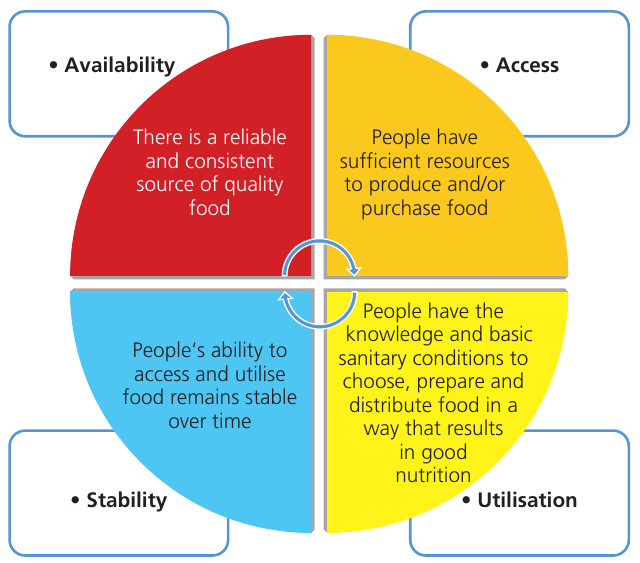
The Four Pillars of Food Security
Food availability - A reliable and consistent supply of quality food must exist in sufficient quantities.
Food access - People need adequate resources to obtain appropriate foods for a nutritious diet.
Food utilisation - Individuals must have knowledge of basic nutrition and care, along with access to clean water and sanitation, to use food properly.
Food stability - The availability, access and utilisation components must remain sustainable for future generations.
All four pillars must be present and functioning for true food security to exist.
Debates about food security
There are several important discussion points that influence food security strategies:
Note
Key Debates Shaping Food Security Policy
-
Is there enough food globally? Some argue sufficient food exists worldwide but it's not distributed where needed. Others believe current production cannot meet projected 2050 demands.
-
Does globalisation help or hinder? International trade can improve food distribution, but it may also contribute to poverty and food insecurity in rural communities.
-
Who gets priority? National food security is vital, but should countries prioritise domestic needs over participating in global trade?
-
Is quantity enough? Households may have adequate food overall, but individual members (particularly women and children) might not receive sufficient nutrition.
These debates shape the strategies adopted to ensure food security.
Strategic approaches to food security
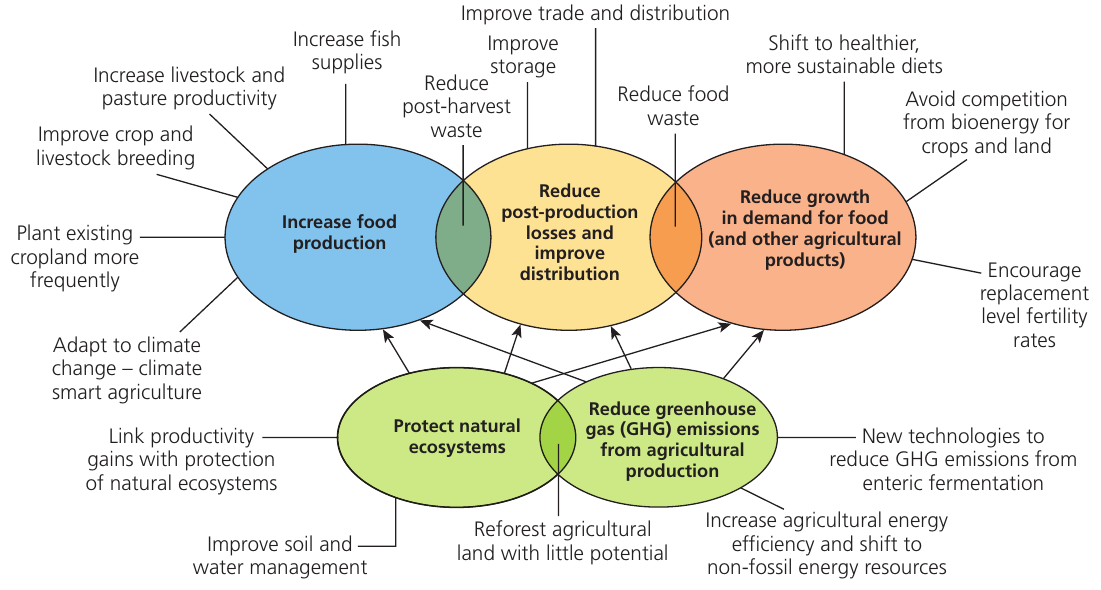
Three main approaches address food security challenges, and an integrated strategy combining elements of all three is typically most effective:
Production strategies focus on increasing food output to meet growing demand through supply management.
Distribution strategies recognise that sufficient food already exists to feed the predicted 2050 population, but it's unevenly distributed. These approaches reduce losses throughout the supply chain and improve food mobility through better trade or aid.
Demand strategies address overconsumption in wealthier nations, where high-calorie foods (particularly meat) require more resources to produce. These approaches aim to reduce demand for resource-intensive foods and support more equitable distribution.
Note
To achieve food security sustainably, these strategies must incorporate protection of natural ecosystems and reduction of greenhouse gas emissions from agriculture.
Strategy 1: Increasing food production
The Global Agriculture and Food Security Program
The Global Agriculture and Food Security Program (GAFSP) is an intermediary fund hosted by the World Bank that works to strengthen resilient and sustainable agricultural systems in low-income countries. GAFSP believes the world needs to produce approximately 56 per cent more food by 2050 to feed everyone.
The programme receives donations from wealthy governments and the Gates Foundation, then allocates funding where it's most needed and likely to make the greatest impact. By investing in smallholder farmers and their communities, GAFSP helps progress towards UN Sustainable Development Goals, particularly SDG2 (Zero Hunger).
By 2018, GAFSP had allocated $1.7 billion to projects tackling hunger and malnutrition across 45 countries, reaching and supporting over 13 million smallholders.
Increasing livestock and pasture productivity
Food production can increase without expanding agricultural land through several measures:
- Improving pasture fertilisation to produce higher quality feed
- Providing better veterinary care to keep animals healthy
- Raising improved breeds through selective breeding programmes
- Using rotational grazing systems to increase yields sustainably
These approaches allow farmers to produce more meat, milk and other livestock products from existing land.
Improving crop breeding
Biotechnology offers significant potential for increasing food production:
- Hybridisation can develop high-yielding variety (HYV) seeds suited to specific environmental conditions
- These seeds can be advanced and extended further, particularly in sub-Saharan Africa where potential is greatest
- New advances in molecular biology make it cheaper and faster to genetically code plants and purify crop strains
Note
Genetic Modification and Food Security
Genetic modification (GM) may offer solutions to hunger in Africa, though it faces opposition from environmental protesters in Europe. The technology could provide additional yield gains by creating plants resistant to pests, diseases, and environmental stresses.
Planting existing cropland more frequently
Double cropping and intensive cropping systems can boost production by reducing fallow periods. This puts pressure on land fertility, but with careful management through crop rotation and research to determine optimal intensity, some of the production gap can be closed without expanding agricultural area.
Increasing fish supplies
Fish provides essential protein and nutrition, particularly in populations lacking these dietary elements. Aquaculture (fish-farming) offers important potential for increasing food supply, especially in less developed economies.
The creation and stocking of fish-breeding pools with fast-breeding species such as tilapia can increase food and nutrition supply sustainably. Productivity improvements come from:
- Selective breeding to improve growth rates
- Better feeds and disease control
- Water recirculation and pollution controls
Important
The Blue Revolution Faces Challenges
However, the Blue Revolution in aquaculture faces significant challenges:
- It competes with agriculture for land
- Places high demands on freshwater supplies (which may already be limited)
- In most cases, wild fish must be caught to provide feed for farmed fish, which raises sustainability concerns
Strategy 2: Reducing post-production losses
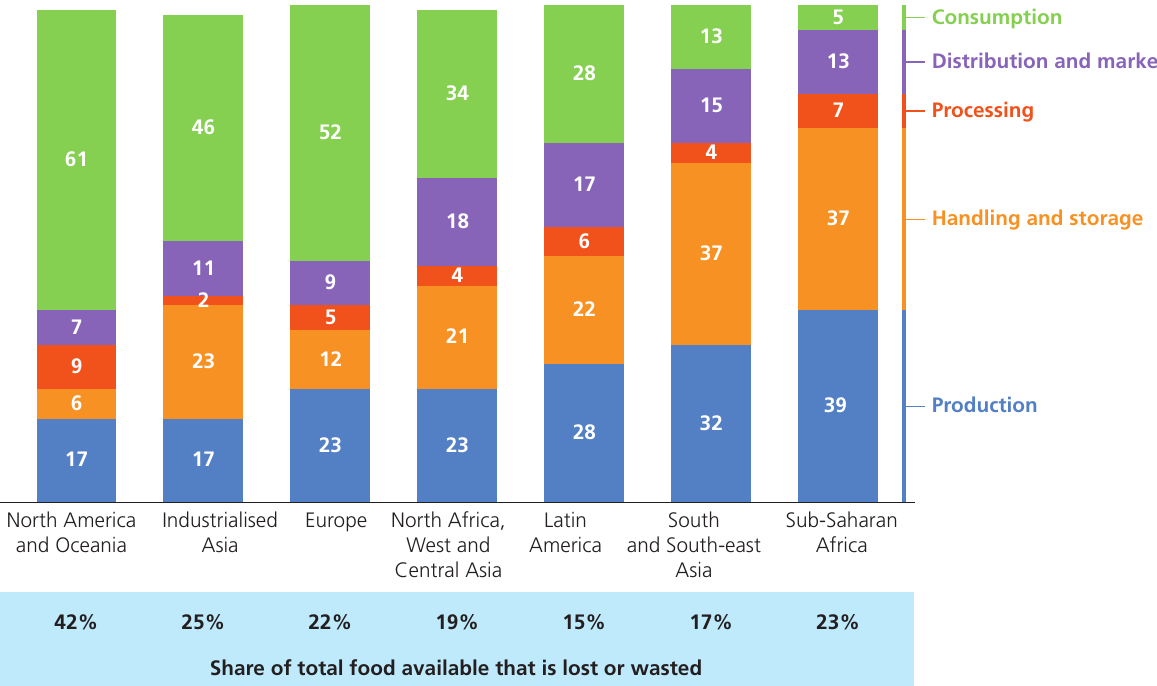
According to the Food and Agriculture Organization, global food production has increased faster than population growth. However, approximately 25 per cent of food produced for human consumption goes uneaten, with loss or waste occurring throughout the supply chain from field to fork.
Note
Regional Patterns of Food Loss and Waste
The chart reveals important patterns:
- Developing regions experience greater losses during production, handling and storage stages
- Developed regions show higher waste at the consumption stage
- Reducing losses during production and post-harvest practices increases food supply
- Reducing consumer waste effectively reduces demand
Addressing both types of loss would help increase and balance food security globally.
Improving post-harvest practices
After crops ripen, several functions are performed including harvesting, drying, threshing, storage, transportation and marketing. Inefficient practices at any stage may allow crops to become exposed to contamination by micro-organisms, chemicals or excessive moisture. Temperature extremes, mechanical damage or ineffective storage can compromise food safety and contribute greatly to losses.
Training and guidance for farmers in developing countries can reduce crop susceptibility to contamination. Key areas include:
- Controlling moisture content and avoiding direct crop contact with exposed soil during drying
- Understanding weather conditions to harvest at optimum times (avoiding rain that dampens crops and encourages mould growth)
- Drying crops by reducing moisture content below levels required for mould growth
- Taking precautions to avoid damaging grain during threshing
- Killing insect pests by placing grain in solar ovens for 1-5 hours before storage
Important
Contamination After Harvest: The Aflatoxin Problem
Contamination can also occur after harvest. For example, in Uganda, the most serious food-related health risk is aflatoxin contamination. Aflatoxins are naturally occurring, highly carcinogenic poisons produced by a fungus particularly prominent in maize.
The toxin develops when produce contacts soil during harvesting, threshing and drying. This problem has become so widespread in East Africa that aflatoxin poisoning is now epidemic.
Storage improvements
Poor storage conditions can lead to pest infestation and accelerated fungal growth. Farmers are advised to:
- Avoid stockpiling harvested crops directly in baskets or polypropylene bags on floors of their homes (or risk theft)
- Use improved low-humidity storage methods and new technologies such as hermetic (airtight) storage units or metallic silos
- Protect crops from insects, rodents, birds, rain and temperature fluctuations
The FAO has built more than 45,000 small metal storage silos (each large enough for a single farmer's use) in 16 different developing countries. These greatly reduce post-harvest losses.
Redistributing food
Some perfectly good food never gets eaten. A farmer might not afford to harvest an entire field, or a grocer may order too much and cannot sell it all. One way to reduce loss and waste is redistributing food by giving it to food banks or NGOs for distribution to communities in need.
Note
However, this approach is difficult to organise and achieve effectively beyond a local level, especially with fresh food. International redistribution (other than in emergencies) can lead to problems with 'food dumping' in poorer countries, which undermines local farmers' livelihoods.
Reducing food waste close to the fork
Several consumer-focused measures can reduce food waste:
Improve food labelling - Confusion around 'use-by', 'sell-by', 'best-before' and other date labels leads people to throw out food that's still perfectly good. For food safety purposes, the focus should be on 'use-by' dates. One UK survey found that one-fifth of food thrown out by households was perfectly good but being discarded because of confusing date labels.
Launch consumer awareness campaigns - Campaigns revealing how much food people actually waste may address consumer consciencefulness. Providing constructive solutions for cutting down on waste (such as storage tips for fruit and vegetables) could help local government officials play a part in reducing waste.
Set food loss and waste reduction targets - Time-bound targets inspire action by raising awareness, focusing attention and mobilising resources. The European Union has announced a target of reducing food loss and waste by 50 per cent by 2050.
Strategy 3: Reducing growth in demand
Shifting to healthier, more sustainable diets
As societies in emerging economies become more affluent, demand for meat products has increased enormously. In many countries such as China, consumption of beef, lamb and goat is projected to nearly double by 2050 at current growth rates.
Meat requires far more resources to produce than plant proteins. It's very land-intensive, requiring at least 10 times more land per gram of edible protein than common plant proteins such as peas and beans. More land is therefore required to grow fodder for livestock.
Note
The Case for Plant-Based Diets
If greater numbers of people ate less meat and consumed more plant-based food as part of their diet, this would free up more land for crop production for direct human consumption. However, this may require:
- Better marketing of plant-based food
- Improvement of meat substitute products
- Implementing policies to disincentivise meat consumption
There would undoubtedly be resistance from pastoral farmers, especially in wealthier countries. Much farmland, particularly steeper or marginal land, is only suitable for pasture and cannot be used for crops, so needs to be put to its most effective use.
Encouraging replacement level fertility rates
One of the most obvious strategies to ensure food security is controlling population growth. Most of the world's nations are close to or below replacement level fertility of approximately two children per woman. This level stabilises population growth and will reduce pressure on food supplies in the longer term.
Sub-Saharan Africa is an exception globally, with fertility rates of above four children per woman of childbearing age in many countries. This rate is falling but may need to fall more rapidly to ensure food security by 2050.
Note
Coercive policies are difficult to implement in poor regions with high infant and child mortality. Better measures to encourage lower fertility include:
- Family planning initiatives
- Increasing awareness and provision of contraceptive methods
- Compulsory education for girls to provide better career prospects
Many demographers and economists argue that the only way to secure lower fertility rates in poor areas is through economic development that contributes to improved healthcare.
Supporting sustainable agriculture: soil management
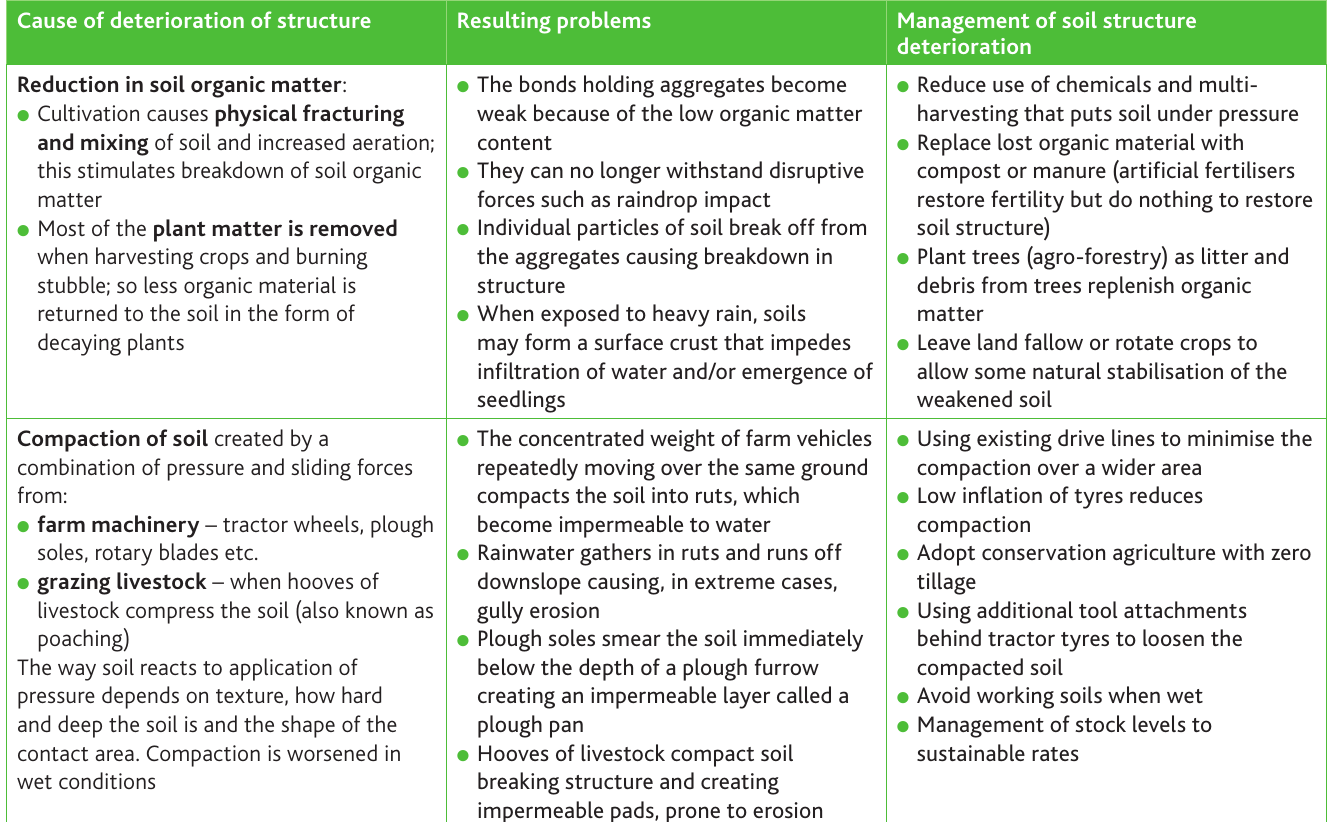
Sustainable food production requires careful management of soil resources. Soil structure can deteriorate through two main processes, each with specific problems and solutions.
Reduction in soil organic matter
Causes:
- Cultivation causes physical fracturing and mixing of soil, increasing aeration which stimulates breakdown of organic matter
- Harvesting crops removes plant matter, so organic material isn't returned to soil as decaying plants
Resulting problems:
- Bonds holding soil aggregates become weak due to low organic matter content
- Soil can no longer withstand disruptive forces such as raindrop impact
- Individual particles break off from aggregates, causing structural breakdown
- Heavy rain may form surface crusts that impede water infiltration and seedling emergence
Important
Management Solutions for Organic Matter Loss
- Reduce chemical use and multi-harvesting that puts soil under pressure
- Replace lost organic material with compost or manure (though artificial fertilisers restore fertility but don't restore soil structure)
- Plant trees through agroforestry so litter and debris add organic matter
- Leave land fallow or rotate crops to allow natural stabilisation of weakened soil
Compaction of soil
Causes:
- Farm machinery (tractor wheels, plough soles, rotary blades) creates pressure and sliding forces
- Grazing livestock compress soil through their hooves (known as poaching)
- Worsened in wet conditions
Resulting problems:
- Concentrated weight of farm vehicles repeatedly moving over the same ground compacts soil into ruts which become impermeable
- Rainwater gathers in ruts and runs off downslope, causing extreme gully erosion
- Plough soles smear soil immediately below plough furrow depth, creating an impermeable layer called a plough pan
- Livestock hooves compact soil, breaking structure and creating impermeable pads prone to erosion
Important
Management Solutions for Soil Compaction
- Use existing drive lines to minimise compaction over wider areas
- Use low-inflation tyres to reduce compaction
- Adopt conservation agriculture with zero tillage approaches
- Use additional tool attachments behind tractor tyres to loosen compacted soil
- Avoid working soils when wet
- Manage stock levels at sustainable rates
Remember!
Summary
Key Points to Remember:
-
Food security requires four pillars working together: availability of food, access to food, proper utilisation of food, and stability over time. All four components must be present and sustainable.
-
Three complementary strategies address food security: Increasing production meets growing demand; reducing post-production losses improves distribution; and managing demand through diet shifts and population control reduces pressure on resources.
-
Post-production losses vary by development level: Developing regions lose more food during production and storage, while developed regions waste more at consumption. Addressing both patterns is essential.
-
Sustainable intensification is possible: Food production can increase without expanding agricultural land through improved breeding, better practices, intensive cropping and aquaculture development.
-
Soil management underpins sustainable agriculture: Maintaining soil structure by preserving organic matter and preventing compaction ensures long-term productivity and food security.