The Population, Resources and Pollution Model (AQA A-Level Geography): Revision Notes
📚Revision Notes
The Population, Resources and Pollution Model
Introduction to the PRP model
The Population, Resources and Pollution (PRP) model represents a fundamental ecological relationship that applies to all organisms, including humans. This model provides valuable insight into how human populations interact with their environment and demonstrates the interconnected nature of population dynamics, resource consumption and environmental degradation.
Note
The model is particularly useful because it:
- Illustrates the complex relationships between human activities and environmental impacts
- Adopts a systems approach, showing how changes in one component affect others
- Promotes systems thinking, which is essential for understanding sustainable development
- Helps identify potential solutions to resource depletion and pollution problems
- Uses the concepts of positive and negative feedback to explain population dynamics
Understanding carrying capacity
Important
Carrying capacity is the maximum population size that an environment can sustainably support over time, given the available resources such as food, water, habitat and other necessities.
Environmental resistance and limiting factors
As populations grow, they encounter environmental resistance – the combined effect of limiting factors that slow population growth. These limiting factors include:
- Availability of food and water
- Space and habitat constraints
- Competition for resources
- Predation and disease
- Waste accumulation
Environmental resistance increases as population size grows, creating natural checks on unlimited population expansion.
The sigmoid growth curve
Population growth typically follows an S-shaped (sigmoid) curve rather than increasing indefinitely. This pattern occurs because:
- Initially, populations grow exponentially when resources are abundant
- As population size increases, growth rates begin to slow
- Environmental resistance increases as more limiting factors come into effect
- Eventually, the population stabilises at the carrying capacity
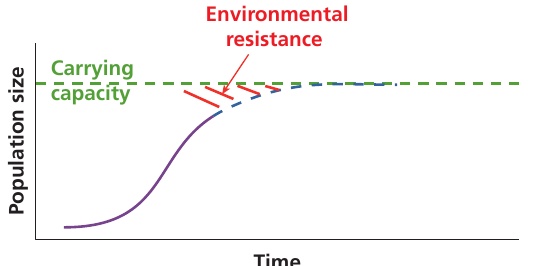
This logistic growth pattern is characteristic of species with relatively few predators, such as primates. The population eventually reaches an equilibrium where birth rates and death rates balance, maintaining a stable population size at the carrying capacity.
The population, resources and pollution model explained
The PRP model demonstrates how human populations are connected to their environment through resource use and pollution generation. The model operates as a cycle with four main components:
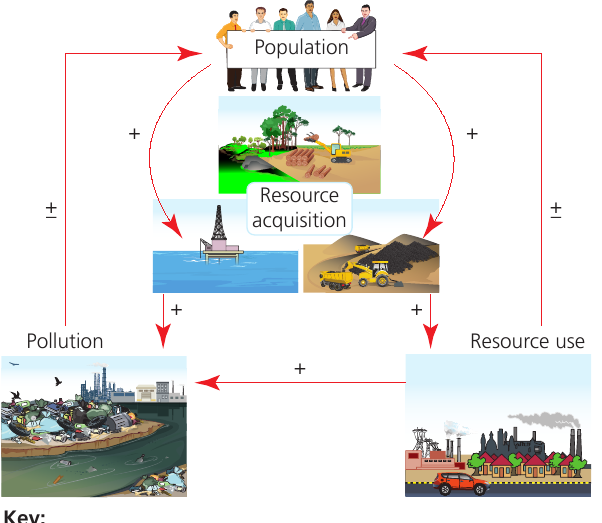
How the model works
1. Population growth
Human population size affects the demand for resources. As populations increase, so does the need for food, water, energy and materials.
2. Resource acquisition
Resources are extracted from the environment through various activities:
- Agriculture and forestry for food and materials
- Mining for minerals and metals
- Offshore drilling for oil and gas
- Water extraction for consumption and industry
This acquisition process alters existing ecosystems and can damage wildlife habitats. It can also lead to deforestation and soil erosion, which pollutes nearby streams and lakes.
3. Resource use
Extracted resources are processed and consumed:
- Coal generates electricity in power stations
- Iron ore is crafted into finished products like cars
- Water is used for drinking, agriculture and industry
The conversion of raw materials into energy or finished products generates pollution.
4. Pollution
The use of resources produces pollutants that contaminate specific ecosystems:
- Land pollution from waste and chemicals
- Water pollution in aquatic and marine environments
- Air pollution from industrial emissions and transport
Note
Many pollutants cross ecosystem boundaries. For example, acid rain is an atmospheric pollutant that, when it falls, contaminates forests, rivers and lakes.
Feedback mechanisms in the PRP model
The PRP model operates through feedback loops that either amplify or stabilise changes in the system.
Important
Positive feedback enhances or amplifies changes, moving a system away from its equilibrium state and making it more unstable.
Important
Negative feedback is an opposing force that counters any change, regulating the system towards a more stable equilibrium.
Negative feedback and population regulation
Negative feedback loops act as the 'default' mechanism for controlling biological systems, including population growth. They maintain homeostasis and prevent unlimited population expansion.
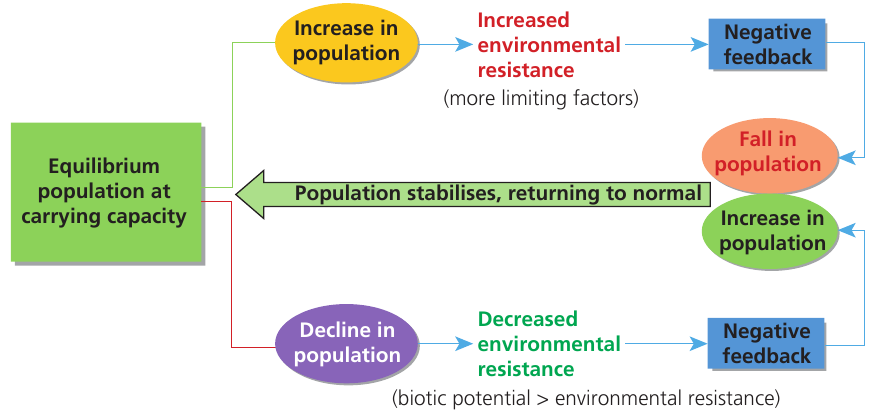
How negative feedback regulates population:
When population increases above carrying capacity:
- Environmental resistance increases due to more limiting factors
- This creates negative feedback that reduces population growth
- Eventually, the population falls as mortality rates increase
- The population returns to equilibrium at carrying capacity
When population declines below carrying capacity:
- Environmental resistance decreases
- Biotic potential (reproductive capacity) exceeds environmental resistance
- This creates conditions for population growth
- The population increases until reaching equilibrium again
This homeostatic regulation ensures mortality rates change depending on whether the population is above or below carrying capacity, maintaining long-term stability.
The role of negative feedback in the PRP model
According to the PRP model, continued population growth will eventually trigger negative feedback mechanisms. When population nears or exceeds carrying capacity:
- Extreme pollution occurs, including climate change impacts
- Resources become insufficient to support the population
- Death rates overtake birth rates
- Population size declines, returning to a stable equilibrium
This process is known as homeostatic regulation and represents a self-correcting mechanism in ecological systems.
Positive feedback in the PRP model
The positive feedback loops within the PRP model indicate that resource acquisition and use, combined with population growth, can enhance survival and enable further population expansion.
The positive feedback spiral:
One way to understand positive feedback is through the relationship between agriculture and population growth. These two factors can be viewed as existing in a positive feedback spiral, where each drives the other with increasing intensity:
- Population growth stimulates demand for more food
- This prompts increased agricultural yields and production through technology (such as high-yield variety crops)
- Greater food production supports more people
- This enables further population growth
- The cycle repeats with increasing intensity
Important
However, positive feedback mechanisms create serious problems:
- Devastating cycles of resource depletion and environmental destruction
- Disruption of natural ecosystem balance, reducing productivity and biocapacity
- Food, water and energy insecurity
- Soil degradation from overgrazing, over-cultivation or chemical pollution
- Eventual decline in food production
- Increased mortality rates with devastating effects on population size
The climate change feedback example
Example
Example: Positive Feedback Through Chemical Fertilisers
Chemical fertilisers (produced using the Haber process) have increased our capacity to produce and distribute food. However, this creates a positive feedback problem:
- Fossil fuel use in fertiliser production increases greenhouse gas emissions
- This contributes to global temperature rise
- Resulting shifts in rainfall and drought patterns may devastate crop production in many areas
- The negative feedback effect of climate change on population has already been observed in regions like the sub-Saharan Africa Sahel (2010) and East Africa (2011)
- Over 100,000 people died during these droughts, which are likely to become more frequent
Implications and challenges of population growth
Population growth, combined with resource consumption and pollution generation, creates numerous interconnected challenges across multiple domains.
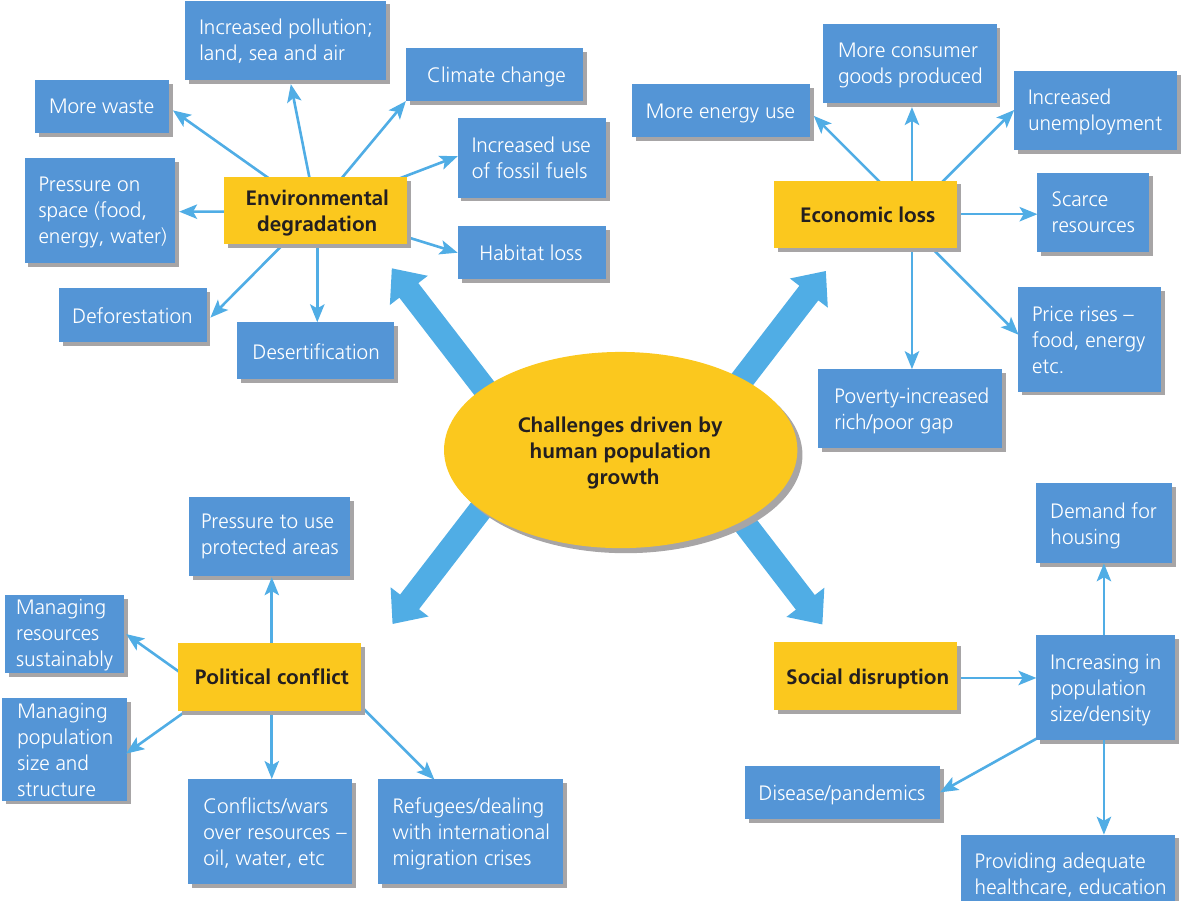
Environmental degradation
Population-driven environmental challenges include:
- Climate change from increased greenhouse gas emissions
- Increased pollution of land, sea and air
- More land use for settlement, industry and transport infrastructure
- Degradation of natural ecosystems through overexploitation
- Increased threat of species extinction due to habitat loss
- Over-cultivation and overgrazing, reducing soil quality
- Depletion of fish stocks beyond recovery levels
- Deforestation for agriculture and development
- Habitat loss for wildlife species
- Pressure on protected areas as human activities encroach
Economic impacts
The economic consequences of population growth include:
- Economic loss from environmental degradation
- Scarce resources leading to price increases
- Poverty and widening rich-poor gaps
- Unemployment as populations exceed job availability
- Price rises in food, energy and other essentials
- Increased demand for consumer goods
Social disruption
Social challenges arising from population pressures:
- Disease and pandemics spreading more easily in dense populations
- Demand for housing exceeding supply
- Increasing population size and density creating overcrowding
- Inadequate healthcare and education provision
- Pressure on social services and infrastructure
Political conflict
Political tensions develop from:
- Conflicts and wars over resources such as oil and water
- Refugee crises and international migration issues
- Challenges in managing resources sustainably
- Difficulties managing population size and structure
- Pressure to use protected areas for development
Contrasting perspectives on population growth
The relationship between carrying capacity and ecological footprint is complex, leading to different interpretations of future population prospects.
The pessimistic view: Malthus and neo-Malthusians
Thomas Malthus, an English clergyman, published An Essay on the Principle of Population in 1798. He was one of the first scholars to examine the relationship between humans and resources systematically.
Important
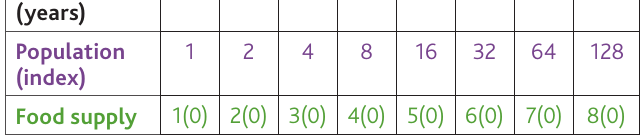
Malthusian theory proposes that population grows geometrically (exponentially) while food production increases only arithmetically (linearly), inevitably leading to population crises.
Malthus's key principle:
"The power of population is infinitely greater than the power in the earth to produce subsistence for man."
In other words, food production cannot increase as rapidly as human reproduction.
Example
Example: How Malthusian Theory Works
- Food production can only increase arithmetically:
- Population grows geometrically:
- At any one time, there is a fixed carrying capacity that can only support a given population
- Eventually, population will exceed the carrying capacity
- This results in a population 'crash' caused by famine and catastrophe
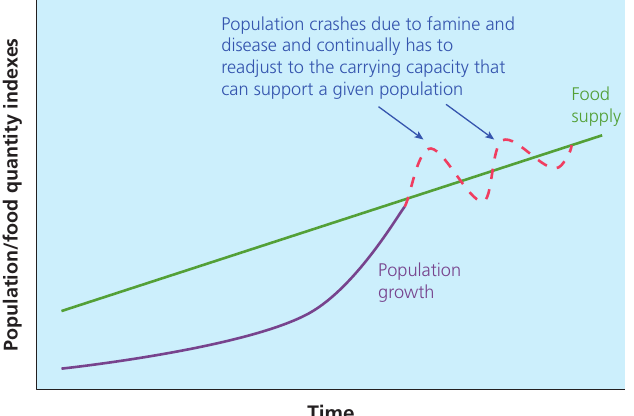
Malthus's views are pessimistic. He believed there is an ultimate limit to human population growth determined by the environment's ability to provide resources. Neo-Malthusians share this concern that continued population growth combined with resource depletion will lead to environmental and humanitarian crises.
The optimistic view
More positive perspectives on future population growth consider:
Evidence of demographic transition:
- Population growth rates on a global scale are slowing
- The view of 'transition' theorists suggests that population growth curves are forming as a sigmoid (S-shaped) curve
- As population size increases, the rate of increase declines due to more environmental resistance
- This adjustment leads to an equilibrium population size fixed by carrying capacity
Technological advances:
- Advances in technology have enabled increases in food productivity
- Access to more resources than previously thought possible
- Many technologies have increased carrying capacity
- However, these technologies have also increased humanity's ecological footprint
Note
Potential solutions:
- Green technologies, such as renewable energy transition, could increase carrying capacity without increasing resource demand
- Increasing education and awareness can influence lifestyles, reducing ecological footprints
- Biotechnologies and appropriate technologies could increase carrying capacity in specific areas and globally
- Control measures for resource depletion and population growth
- Encouraging less demand for resources will reduce pollution levels
Important considerations
Understanding breaching carrying capacity is crucial because negative implications are not related to population size alone. While controlling population growth may alleviate some pressure on productive biocapacity, the consumption issue requires more critical attention, particularly in countries with growing per capita ecological footprints.
The negative environmental implications of enlarging ecological footprints include:
- Climate change and exacerbation of global warming
- More land used for settlement, industry and transport
- Degradation of natural ecosystems
- Increased threat of species extinction
- Over-cultivation and overgrazing reducing land and soil quality
- Depletion of fish stocks beyond recovery
Remember!
Summary
Key Points to Remember:
- The PRP model demonstrates the cyclical relationship between population, resource extraction, resource use and pollution in a systems framework
- Carrying capacity is the maximum population size an environment can sustainably support, with populations naturally regulated through negative feedback mechanisms
- Negative feedback stabilises populations by increasing mortality when carrying capacity is exceeded, while positive feedback amplifies changes and can lead to instability
- Population growth creates interconnected environmental, economic, social and political challenges that require integrated solutions
- Malthusian theory presents a pessimistic view where geometric population growth inevitably exceeds arithmetic food supply growth, leading to crises and population crashes