Resource Security - Energy (AQA A-Level Geography): Revision Notes
📚Revision Notes
Case Study: Oil and Natural Gas Production - Niger Delta, Nigeria
Introduction
Nigeria's Niger Delta region is a crucial example of how oil and natural gas production can create both opportunities and challenges for a developing nation. This case study examines the complex relationship between resource extraction, economic development, and environmental and social impacts.
Note
This case study demonstrates the resource curse phenomenon, where abundant natural resources can paradoxically lead to economic instability, environmental degradation, and social conflict rather than prosperity for local populations.
Background to Nigerian oil production
Nigeria holds a prominent position in the global energy market. As Africa's largest oil producer and exporter, the country has been a member of OPEC (Organization of the Petroleum Exporting Countries) since 1971. With a rapidly growing population exceeding 190 million people, Nigeria faces the challenge of balancing resource development with the needs of its citizens.
The country also possesses Africa's largest natural gas reserves, though Algeria produces more gas currently. Nigeria has limited infrastructure to fully develop this sector, but natural gas is found alongside oil deposits and is often 'flared' (burned off) during oil extraction operations.
As one of the four MINT economies (Mexico, Indonesia, Nigeria, Turkey) experiencing rapid economic growth in the early twenty-first century, Nigeria relies heavily on its hydrocarbon industries. These resources form the backbone of the economy, with the petroleum sector accounting for 93% of the country's export earnings in 2018 according to the IMF.
Important
Nigeria's economy is critically dependent on oil exports, with 93% of export earnings derived from hydrocarbons. This extreme dependence makes the country vulnerable to global oil price fluctuations and creates significant challenges for economic diversification.
Location and resource development
Discovery and early development
The oil industry centres on the delta region of the River Niger. Oil was first discovered in this area in 1956 by Shell-BP, who held sole exploration rights at the time. Shell subsequently made additional discoveries in shallow coastal waters near Warri during the 1960s.
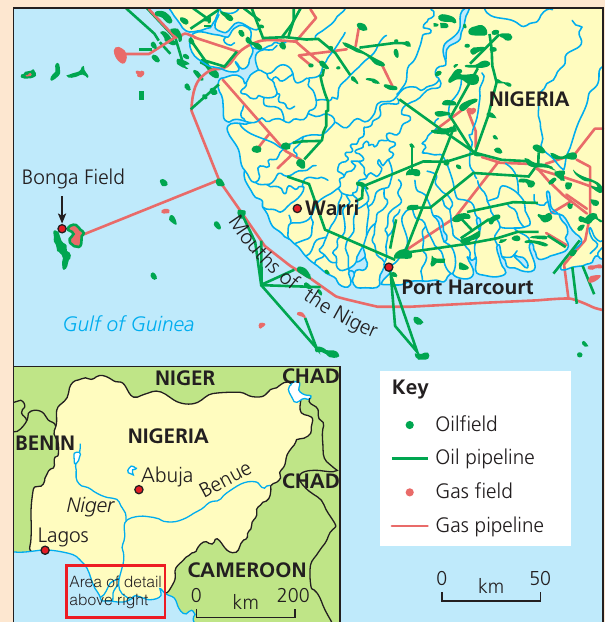
Exploration rights for both onshore and offshore areas were later granted to other international companies such as Exxon. In 1977, the government established the Nigerian National Petroleum Company (NNPC), a state-owned organisation that both regulates and participates in the industry.
Note
Key Term: NNPC
The Nigerian National Petroleum Company (NNPC) is a state-owned company established in 1977 that regulates and participates in Nigeria's oil industry through joint venture partnerships with foreign TNCs. This structure allows Nigeria to maintain national ownership while benefiting from foreign expertise and investment.
Joint ventures and production
Today, Nigeria maintains control over its oil resources whilst relying on the expertise and investment of Transnational Corporations (TNCs). The NNPC has established Nigerian-based subsidiaries which operate as 'joint ventures' with major TNCs including:
- Royal Dutch Shell
- Chevron-Texaco
- ExxonMobil
For example, the Shell Petroleum Development Company operates as a joint venture partner with the NNPC.
These partnerships allow Nigeria to develop the infrastructure needed to extract oil for export or domestic use whilst maintaining national ownership. The extensive network of pipelines distributes petroleum products across the region and to export terminals.
Production levels and challenges:
- Current production: approximately 2 million barrels per day (mbpd)
- Production capacity: potentially up to 3 mbpd
- Production has been disrupted for many years by local militant groups
- Nigerian crude oil is considered some of the best quality and least expensive to refine globally
Trade patterns and exports
Nigeria operates four oil refineries, with the two main facilities located at Port Harcourt and Warri. However, these refineries only operate at approximately 30% capacity. Consequently, most extracted oil is exported as crude by TNCs and refined overseas.
Export destinations
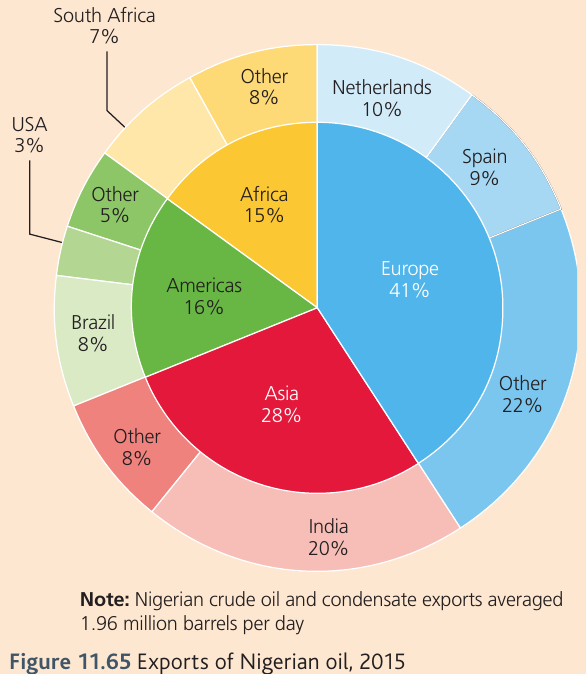
In 2015, Nigerian crude oil and condensate exports were distributed globally:
By region:
- Europe: 41% (largest market)
- Asia: 28%
- Americas: 16%
- Africa: 15%
Major individual importers:
- India: 20% (largest single importer)
- Netherlands: 10%
- Spain: 9%
- Brazil: 8%
- South Africa: 7%
- USA: 3%
Note
Changing Trade Patterns
Until 2012, the United States was Nigeria's largest market. As America increased its own domestic production, it became only the tenth-largest importer. Nigeria's largest regional markets are now in Asia and Europe, with India emerging as the single largest importer of Nigerian oil.
The average export volume was 1.96 million barrels per day in 2015.
Nigeria's energy mix
Despite being a major oil producer, only a small proportion of Nigeria's extracted oil supplies the domestic market. However, this contribution to the nation's energy consumption has increased from 9.23% in 2012 to 16% in 2017.
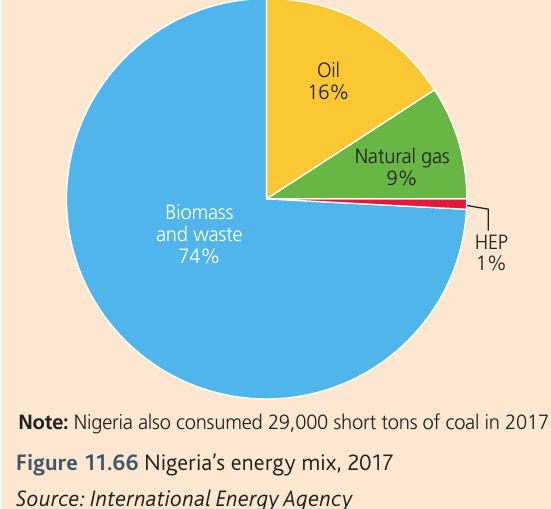
Domestic energy consumption breakdown (2017)
Nigeria's energy mix reveals a stark contrast between export production and domestic consumption:
- Biomass and waste: 74% (dominant energy source)
- Oil: 16%
- Natural gas: 9%
- Hydroelectric Power (HEP): 1%
Additionally, Nigeria consumed 29,000 short tons of coal in 2017.
Important
The Energy Paradox
Despite being Africa's largest oil producer and exporter, 74% of Nigeria's domestic energy comes from biomass and waste. This paradox reflects the country's failure to translate oil wealth into widespread energy infrastructure development for its own population.
Rural energy dependence
A significant factor in the energy mix is that 64% of the population live in rural areas. These communities rely on traditional biomass, particularly fuelwood, as their main energy supply. This dependence on biomass has several implications:
- Limited access to modern energy infrastructure
- Environmental pressure from deforestation
- Time and labour spent collecting fuel
- Health impacts from indoor air pollution
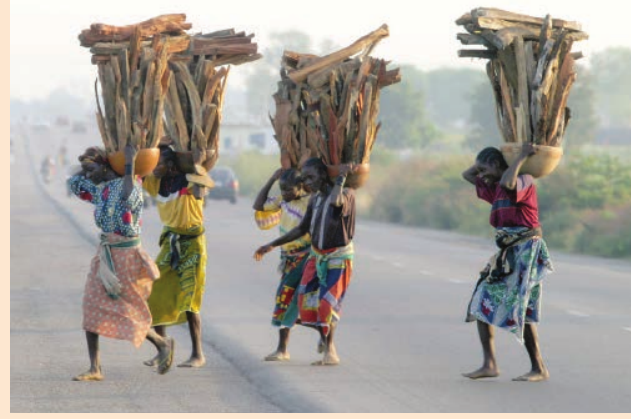
The reliance on fuelwood reflects the limited development of electricity infrastructure in rural regions, despite Nigeria's substantial natural gas reserves that could support power generation.
Implications for resource security and human welfare
Ethnic and regional tensions
The Niger Delta region experiences considerable ethnic and religious tensions. Approximately 34 million people from over 40 different ethnic groups live in the 'South-South' region of the Delta. Major groups include the Ijaw, Ogoni, and Igbo tribes, though several majority groups exist throughout different parts of the Delta.
Environmental devastation associated with the oil industry, combined with the unequal distribution of oil wealth, has intensified these tensions considerably.
Conflicts and militant activity
Tensions have led to the formation of militia groups that have disrupted oil production significantly. Locals feel largely excluded from the benefits of oil wealth and have responded by attacking infrastructure and staff.
Forms of disruption:
- Bunkering: Oil theft from pipelines
- Pipeline sabotage causing damage and production losses
- Pollution and forced shutdown of production
- Piracy in the Gulf of Guinea
Note
Key Term: Bunkering
Bunkering refers to the illegal theft of oil from pipelines, which depletes reserves, causes environmental damage, and results in significant revenue losses. This practice has become widespread in the Niger Delta as local communities seek to benefit directly from oil resources they feel entitled to.
Government military action against these groups has been largely unsuccessful, particularly as the army remains stretched fighting Boko Haram, an Islamic extremist insurgent group in northern Nigeria.
Major militant organisations
Movement for the Emancipation of the Niger Delta (MEND):
- Emerged as the most organised and visibly armed militia group
- Following a government amnesty, MEND declared a ceasefire in May 2014
Niger Delta Avengers (NDA):
- Formed in 2016 as a smaller group
- Pursue similar goals to MEND: removing oil companies from the region and giving local people more control
- Continue to target oil pipelines and other infrastructure
- Have caused significant production and revenue losses for the government
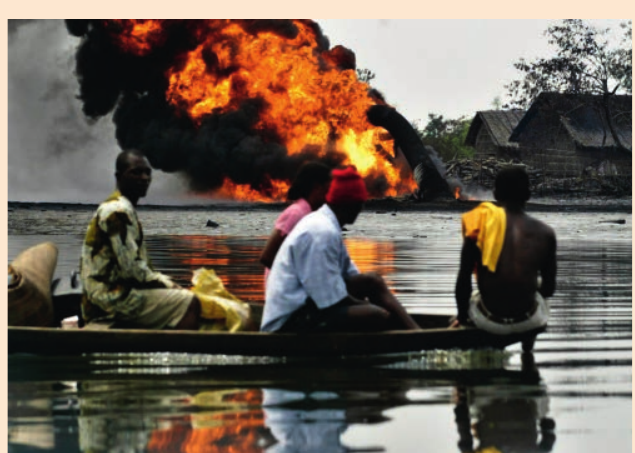
Important
Competing Perspectives on Environmental Damage
The conflict involves fundamentally different views on responsibility for environmental destruction:
Oil companies claim:
- Militant activity causes pollution
- Illegal gas flaring by militants damages the environment
- Security concerns prevent proper infrastructure maintenance
- Many leaks result from corrosion, not company negligence
Local communities argue:
- Companies engage in illegal 'flaring' (burning off gas)
- Pipeline infrastructure is poorly maintained by operators
- Environmental destruction stems directly from extraction operations
- Communities receive minimal benefit from oil wealth despite bearing environmental costs
A sustainable resolution requires widespread environmental cleanup, compensation for damage to communities, fair distribution of oil earnings to Delta residents, and addressing the root causes of conflict.
Environmental and social impacts
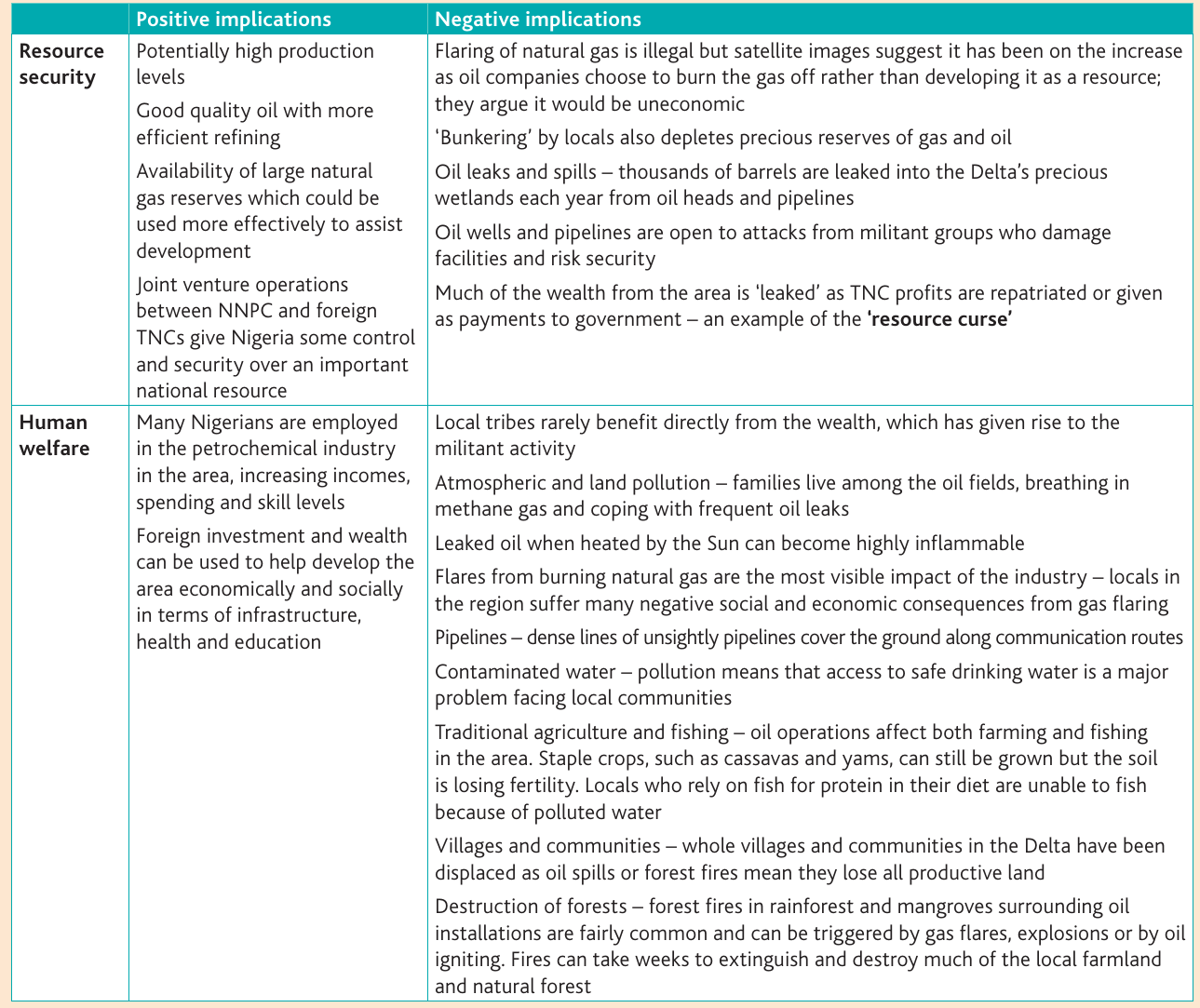
The oil industry's impacts on the Niger Delta demonstrate both the potential benefits and severe costs of resource extraction in a developing region.
Resource security implications
Positive aspects:
- High production levels (potentially up to 3 million barrels per day)
- Good quality crude oil that is more efficient to refine
- Availability of large natural gas reserves for development
- Joint venture operations between NNPC and foreign TNCs provide some national control over resources
- Infrastructure for gas transport (pipelines) and liquefied natural gas (LNG) via tanker
Negative aspects:
- Illegal gas flaring wastes energy and contributes to global warming
- Bunkering by locals depletes precious gas and oil reserves
- Oil leaks and spills mean thousands of barrels leak into the Delta's wetlands annually
- Oil wells and pipelines remain vulnerable to attacks from militant groups
- Much wealth from the area is 'leaked' through TNC profits being repatriated or given as government payments (an example of the 'resource curse')
Important
The Resource Curse
The resource curse refers to the paradox where countries with abundant natural resources often experience less economic growth and worse development outcomes than countries with fewer natural resources. This occurs due to factors like corruption, conflict, economic mismanagement, and the failure to invest resource revenues in broader economic development.
Human welfare implications
Positive aspects:
- Many Nigerians gain employment in the petrochemical industry, increasing incomes, spending power, and skill levels
- Foreign investment and wealth can help develop the area economically and socially through infrastructure, health, and education improvements
Negative aspects:
- Local tribes rarely benefit directly from the wealth, fuelling militant activity
- Atmospheric and land pollution: Families live among oil fields, breathing methane gas and coping with frequent oil leaks
- Fire hazards: Leaked oil becomes highly flammable when heated by the sun
- Gas flaring impact: Flares from burning natural gas represent the most visible environmental impact, causing numerous negative social and economic consequences for locals
- Pipeline dangers: Dense networks of unsightly pipelines cross the landscape along communication routes
- Water contamination: Pollution means access to safe drinking water is a major problem for local communities
- Agricultural destruction: Oil operations have devastated traditional agriculture and fishing. Staple crops like cassavas and yams can still grow, but soil is losing fertility. Communities who relied on fish for protein cannot fish due to polluted water
- Displacement: Entire villages and communities have been displaced as oil spills or forest fires have destroyed productive land
- Forest destruction: Forest fires in rainforest and mangroves surrounding oil installations occur frequently, triggered by gas flares, explosions, or oil igniting. Fires can take weeks to extinguish and destroy extensive farmland and natural forest
Important
Devastation of Traditional Livelihoods
The environmental damage has destroyed the traditional economic base of Niger Delta communities:
- Agriculture and fishing, which sustained communities for generations, are no longer viable in many areas
- Contaminated water prevents fishing and reduces crop yields
- Forest fires destroy farmland and natural resources
- Communities receive little compensation despite losing their means of subsistence
- This destruction of livelihoods is a primary driver of militant activity and social conflict
Attempts to manage the resource
Nigeria generates approximately $36 billion annually from oil, yet Niger Delta residents remain impoverished. Access challenges persist even in the dry season:
- Less than 20% of the region is accessible by good roads
- Hospitals and schools are seriously underfunded
The government can use oil revenue to address some issues, but wealth distribution in Nigeria remains highly inequitable. Economic growth is driving rural-urban migration as people move to cities where there is greater demand for electricity for industrial and domestic use.
Government and industry actions
Several measures have been implemented or proposed to address the environmental and social challenges:
Gas flaring regulation:
- The Nigerian government made flaring illegal in 2010, as it wastes energy and contributes to global warming
- Shell committed to ending flaring in 2008
- Environmental groups accuse Shell of failing to honour this commitment
Compensation:
- Shell has paid compensation to the Nigerian government for spill damage
NNPC reform:
- The government plans to transform the NNPC into a more profit-driven company
- This may involve seeking more private financing and reinvestment in infrastructure
Note
Enforcement Challenges
While gas flaring was made illegal in 2010, enforcement remains weak. The gap between policy and practice reflects broader governance challenges in Nigeria, where laws and regulations often exist on paper but lack effective implementation due to corruption, limited state capacity, and the political influence of oil companies.
Infrastructure development projects
Nigeria's electricity sector:
- Remains small compared to other countries with similar population size and living standards
- Enormous potential exists for electricity generation using natural gas and renewable sources such as HEP, solar power, and biomass
West African Gas Pipeline:
- Investment in infrastructure has established this pipeline
- Owned by a subsidiary of Chevron
- Transports natural gas to other West African states including Togo, Benin, and Ghana
Trans-Saharan Gas Pipeline:
- Nigeria continues to discuss a planned pipeline to carry natural gas from its oilfields to Algeria's Beni Saf gas export terminal
- Would enable Nigeria to supply gas to Europe
- Represents potential for diversifying export markets and revenue streams
Note
Future Development Potential
The proposed Trans-Saharan Gas Pipeline could transform Nigeria's position in the global energy market by opening direct access to European markets. However, the project faces significant challenges including security concerns, high construction costs, and political instability in the Sahel region. If completed, it would represent one of Africa's most ambitious infrastructure projects.
Summary
Summary
Key Points to Remember:
-
Nigeria is Africa's largest oil producer and has been an OPEC member since 1971, with the petroleum sector accounting for 93% of export earnings
-
The Niger Delta oil industry operates through joint ventures between the state-owned NNPC (established 1977) and major TNCs like Shell, Chevron, and ExxonMobil, producing approximately 2 million barrels per day
-
Despite oil wealth, 74% of domestic energy comes from biomass, as 64% of the population live in rural areas with limited access to modern energy infrastructure - demonstrating the energy paradox
-
Militant groups like MEND and NDA have disrupted production through attacks on infrastructure, oil theft (bunkering), and pipeline sabotage, costing the government billions in lost revenue
-
Environmental and social impacts are severe, including gas flaring, oil spills contaminating water and destroying agriculture, displacement of communities, and the destruction of forests and wetlands
-
Local people receive minimal benefit from oil wealth despite bearing the environmental and social costs - a clear example of the resource curse
-
Management attempts include making gas flaring illegal (2010), compensation payments, NNPC reform plans, and infrastructure projects like the West African Gas Pipeline, though enforcement remains weak