Case Study: Athabasca Tar Sand Development, Canada (AQA A-Level Geography): Revision Notes
📚Revision Notes
Case Study: Athabasca Tar Sand Development, Canada
Background to tar sand development
As traditional sources of crude oil become depleted worldwide, unconventional sources like tar sands (also called oil sands) are playing an increasingly important role in meeting global energy demands.
Canada's tar sands represent one of the world's largest petroleum reserves. The deposits are located in three major areas within the province of Alberta, which contains approximately 140,000 km² of pristine boreal forest.
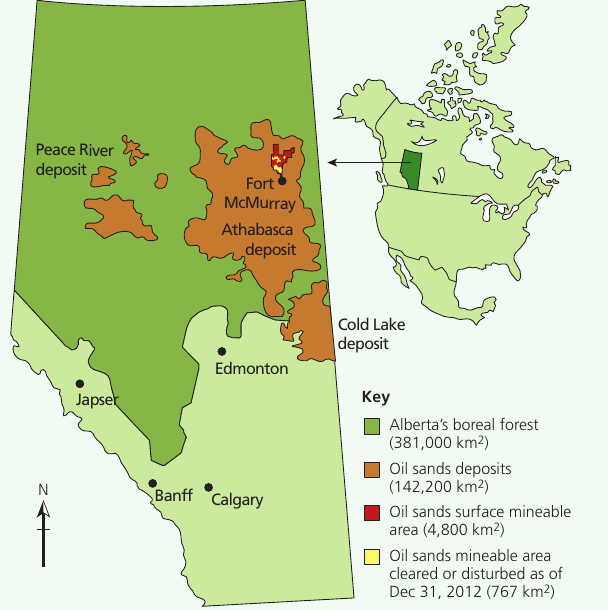
The deposits contain an estimated 175 billion barrels of recoverable crude bitumen reserves, making them comparable in size to Saudi Arabia's conventional oil reserves.
Important
Bitumen is a thick, tar-like substance that must be processed and upgraded to convert it into useable crude oil. Unlike conventional crude oil that flows relatively easily, bitumen is so viscous that it cannot flow without being heated or diluted.
Key facts about the deposits
- The Athabasca River deposit is the largest and most economically viable of the three major deposits
- Only 20% of the oil sands lie close enough to the surface for open-pit mining
- The remaining 80% are buried more than 75 metres underground and require thermal 'in-situ' extraction methods
- The tar sands have been mined commercially since the 1960s
- Recent technological advances combined with rising oil prices have made extraction increasingly profitable
Note
The shift from conventional oil to unconventional sources like tar sands represents a fundamental change in global energy production. While conventional oil can be extracted relatively easily by drilling wells, tar sands require intensive industrial operations that fundamentally reshape entire landscapes.
Current production levels
Production has grown dramatically in the twenty-first century:
- Current output: 2.5 million barrels per day
- Planned production target: 5 million barrels per day
- Approximately 20 mining projects are currently in operation
- Projects are owned and operated by major transnational oil corporations including Chevron-Texaco, Shell and Total
- Most oil is exported to the United States, where it provides roughly 7% of daily consumption
Extraction methods
The tar sands are composed of approximately 85% sand and clay, 5% water, and 10% crude bitumen. Extracting and processing this mixture into useable oil requires intensive industrial operations.
Open-pit mining
Most current production uses large-scale open-pit mining techniques.
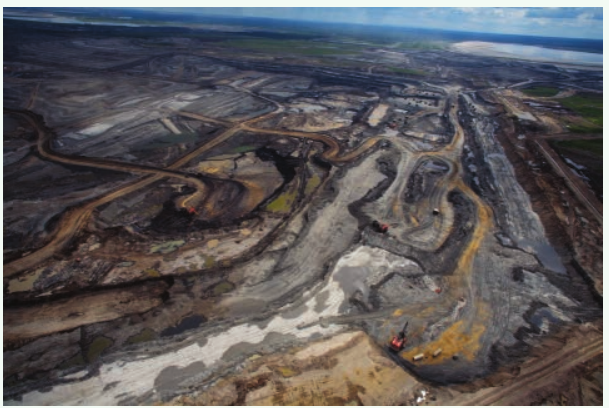
The extraction process involves:
- Strip-mining the sands layer by layer from the surface
- Some mines extend 150 km² in area and 90 metres in depth
- Before mining begins, boreal forest must be cleared, rivers and streams diverted, and wetlands drained
- The overburden (soil, rocks and clay) is stripped away and stockpiled for potential use in future reclamation
- Approximately 4 tonnes of material must be removed to produce each barrel of bitumen
- This process leaves massive scars across the landscape and destroys natural habitats and ecosystems
Important
Canadian geographers have termed these operations 'scar sands' due to their devastating visual and environmental impact. The scale of landscape destruction is so extensive that the mining operations are visible from space, appearing as massive dark wounds in the otherwise continuous green expanse of boreal forest.
In-situ extraction methods
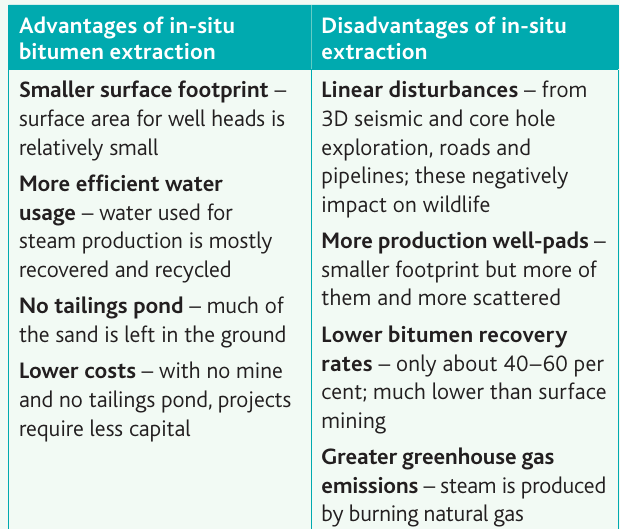
Thermal in-situ techniques are used where deposits lie too deep for surface mining. These methods involve:
- Injecting high-pressure steam into wells to soften and liquify the bitumen
- Pumping the liquified bitumen to the surface
- Leaving most of the sand and solids in the ground
Note
In-situ development could potentially affect an area 30 times larger than current open-pit mining operations, though the surface footprint is smaller. While this method appears less visually destructive, it fragments vast areas of forest with roads, pipelines, and well pads, creating significant ecological impacts.
Upgrading and refining
Producing useable oil from tar sands is a complex, multi-stage process:
-
Separation: A hot-water based process separates the bitumen from the sand, requiring enormous quantities of both water and energy
-
Upgrading: The separated bitumen undergoes intensive processing to upgrade it into synthetic crude oil
-
Dilution: Raw bitumen is diluted with lighter petroleum products (such as naphtha) so it can flow through pipelines
-
Transportation: The diluted bitumen travels through extensive pipeline networks, primarily to refineries in the Midwest United States
-
Refining: Final refining processes convert the synthetic crude into petrol, diesel and other petroleum products
Note
Each stage of this process requires significant energy inputs, primarily from natural gas. This energy intensity is a major reason why tar sands production generates such high greenhouse gas emissions compared to conventional oil extraction.
Environmental impacts
The scale and intensity of tar sands development creates numerous serious environmental consequences. To justify the investment, proponents argue it represents the largest industrial project in human history, but critics maintain it may also be the most environmentally destructive.
Extraction impacts
The strip-mining process causes immediate, severe landscape damage:
- Massive areas of boreal forest are clear-cut
- Rivers and streams are diverted from their natural courses
- Wetlands are drained
- The landscape is left with enormous scars visible from space
- Natural habitats and ecosystems are completely destroyed
Note
The transformation from pristine boreal forest to industrial mining site is total and immediate. Unlike some forms of resource extraction where environmental damage accumulates gradually, open-pit tar sands mining destroys entire ecosystems in a matter of months as operations expand across the landscape.
Climate change
Tar sands production is a major contributor to greenhouse gas emissions and climate change.
The mining and upgrading procedures release at least three times the CO₂ emissions of conventional oil production. This makes tar sands one of the single largest industrial contributors to climate change in North America.
Important
When considering the complete process (from extraction through to end-product use), the transition from conventional oil to tar sands actually increases total greenhouse gas emissions rather than reducing them. This contradicts the argument that tar sands help meet energy needs while transitioning to cleaner energy sources.
Local climate impacts:
The effects of climate change are already visible within the Athabasca basin itself. The Athabasca Glacier in Jasper National Park is rapidly melting and retreating. This glacier feeds the Athabasca River, which serves as the primary water source for tar sands operations. The outlet stream from the glacial lake is also used for separating extracted bitumen and for open-pit mining operations.
The greenhouse gases from tar sands processing are literally melting the glacier that feeds the water supply for the operations.
Loss of forests and wildlife habitat
Canada's boreal forest is globally significant as a complex ecosystem representing 25% of the world's intact forests. It provides 1.3 billion acres of wild habitat for numerous species including wolves, grizzly bears, lynx, nesting migratory birds and thousands of plant varieties.
Important
The tar sands are causing the second-fastest rate of deforestation on the planet after the Amazon rainforest.
Current and projected forest loss:
- At least 5,000 km² of forest has already been cleared, drained and stripped for open-pit mining
- The remaining 135,000 km² could be fragmented by seismic lines, roads, pipelines and well pads for in-situ drilling
- This fragmentation negatively affects wildlife populations, particularly species like woodland caribou that avoid linear features in the landscape
Water abstraction and pollution
Water usage in tar sands operations is enormous and unsustainable.
Water consumption:
- As much as 5 barrels of water are required to extract, separate and upgrade each barrel of oil produced
- The Athabasca River serves as the primary water source
- Current operations are permitted to withdraw 350 million m³ per year
- This is equivalent to the water consumption of a city with 2 million people
Initially, operators believed the river had sufficient natural flows to meet these demands. However, it has become clear this assumption was incorrect, particularly during winter when flows are naturally lower. Some operations now rely on groundwater aquifers, which lowers the water table across the region and threatens surface freshwater ecosystems.
Water pollution and tailings ponds:
Important
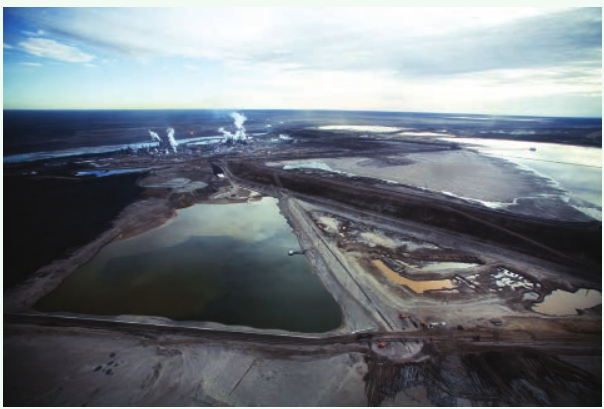
Tailings are the waste materials produced during extraction, consisting of sand, clay, unrecovered bitumen, and various toxic chemicals. These toxic waste products cannot be safely returned to natural water systems and must be stored indefinitely in massive containment structures.
Tar sands operations produce approximately 6 barrels of tailings for each barrel of bitumen extracted. These liquid tailings are a toxic mixture containing:
- Unrecovered bitumen
- Sand and clay particles
- Naphthenic acids
- Trace metals including heavy metals
Operators store this tailings waste in massive on-site containment structures called tailings ponds. The water is too toxic to be returned to the river.
Scale of tailings ponds:
- These reservoirs cover approximately 100 km²
- They are thought to contain around 720 billion litres of toxic tailings
- They are misleadingly referred to as 'ponds' despite their enormous size
Note
Growing evidence suggests that toxic chemicals from these ponds are leaching into groundwater and entering the nearby Athabasca River, threatening both aquatic ecosystems and the sustainability of fish populations. The Athabasca River feeds into the Peace-Athabasca Delta, which is a World Heritage Site and one of North America's most important waterfowl nesting and staging areas.
Air quality
Air pollution from tar sands operations affects both local communities and the wider region.
Important
CACs (Criteria Air Contaminants) are common pollutants released by heavy industry that affect human health and environmental quality. Exposure to these pollutants is linked to respiratory diseases, cardiovascular problems, and reduced life expectancy in nearby communities.
Tar sands operations release substantial quantities of CACs including:
- Lead
- Particulate matter (PM)
- Carbon monoxide
- Nitrogen oxide
- Sulphur dioxide
All of these pollutants are emitted in large volumes by tar sands operations. They negatively affect human health in local communities and contribute to acid rain across a wider region.
Cumulative impacts and reclamation
The environmental damage extends well beyond the immediate mining area.
Pipeline infrastructure transports tar sands products across the entire North American continent to refineries and to supertanker ports on all three major oceans and the Gulf of Mexico. This creates additional environmental risks along transportation routes.
Reclamation challenges:
- Very little of the area directly affected by mining has been successfully reclaimed
- Tailings ponds are expected to cover even larger areas in future
- The United Nations Environment Programme (UNEP) has identified Alberta's tar sand mines as one of 100 global 'hotspots' of environmental degradation
- According to Environment Canada, development presents 'staggering challenges for forest conservation and reclamation'
- Despite these concerns, oil sands projects continue to receive approval for expansion
Note
The lack of successful reclamation after decades of operation raises serious questions about whether meaningful restoration of these landscapes is even possible. The complexity of recreating functioning boreal forest ecosystems, combined with the presence of permanent toxic tailings ponds, suggests that much of the affected area may never return to its pre-mining ecological state.
Remember!
Summary
Key Points to Remember:
-
Massive scale: Alberta's tar sands contain 175 billion barrels of recoverable bitumen across 142,200 km² of deposits, making them one of the world's largest petroleum reserves.
-
Destructive extraction: Open-pit mining strips away entire landscapes, whilst in-situ methods fragment vast areas of boreal forest. Approximately 4 tonnes of material must be removed for each barrel of oil produced.
-
Climate impact: Tar sands production releases at least three times the CO₂ emissions of conventional oil production, making it one of North America's largest industrial contributors to climate change.
-
Water crisis: Operations use 5 barrels of water per barrel of oil produced and generate toxic tailings ponds covering 100 km² containing 720 billion litres of contaminated wastewater that cannot be returned to natural waterways.
-
Environmental hotspot: The UN has designated the development as one of 100 global environmental degradation hotspots, with minimal successful reclamation despite decades of operation.