Demand (AQA A-Level Geography): Revision Notes
📚Revision Notes
Demand
Components of energy demand
Primary energy sources serve various purposes across the economy. Energy consumption data is typically organised into four main categories:
- Industrial - manufacturing, processing, and production activities
- Transportation - movement of goods and people
- Residential - household energy use (heating, lighting, appliances)
- Commercial and public services - offices, shops, schools, hospitals
Note
Understanding these four sectors is essential for analyzing energy demand patterns. Each sector has distinct characteristics and varies in importance depending on a country's economic structure and development level.
Global energy consumption patterns
At the global scale, industrial activities account for the majority of energy consumption. Worldwide data from 2015 shows that industrial use dominates energy demand, representing over half of all energy consumed. This reflects the significant energy requirements of manufacturing and production processes across the global economy.
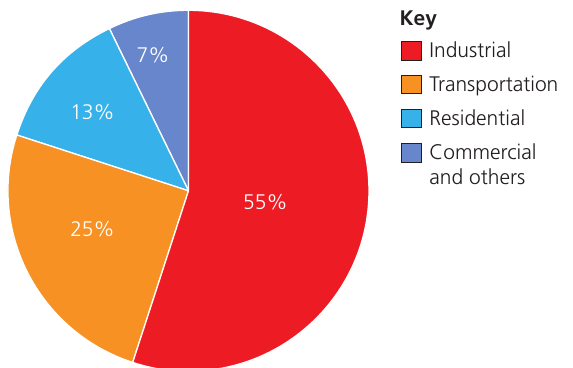
The global breakdown demonstrates that:
- Industrial purposes consume the largest share at 55%
- Transportation accounts for approximately one quarter of energy use
- Residential consumption represents a smaller but significant portion
- Commercial and other uses make up the remaining share
Note
Why does industrial use dominate globally?
The high proportion of industrial energy consumption reflects the energy-intensive nature of manufacturing, processing, and production activities. These processes require substantial amounts of energy for:
- Operating machinery and equipment
- Heating and cooling in production facilities
- Chemical processes and material transformation
- Transport of raw materials and finished goods
Regional variations in energy demand
Energy consumption patterns vary considerably between regions and countries. These differences reflect the economic structure, development level, and lifestyle patterns of different nations.
Developed countries
In more developed countries like the USA and European Union nations, the energy consumption pattern differs from the global average. These economies show:
- Higher transportation energy use - reflecting widespread car ownership and extensive transport networks
- Greater residential consumption - due to higher living standards and more energy-intensive lifestyles
- Significant commercial sector demand - from service-based economies
- Lower industrial share - as manufacturing has declined or moved overseas
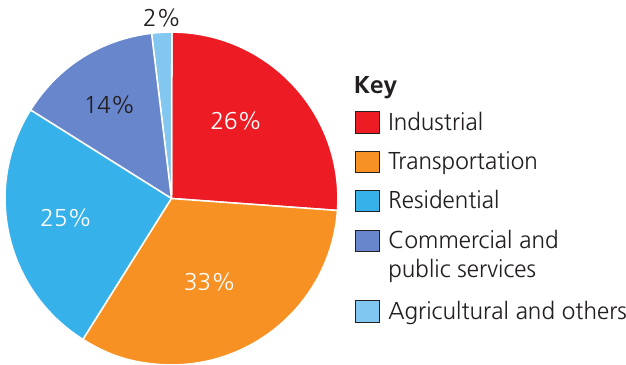
In the USA, transportation is the dominant energy consumer, accounting for 42% of total energy use. This reflects the country's car-dependent culture and vast distances requiring significant fuel consumption.
Developing and emerging economies
Countries at different stages of development show distinct patterns. The contrast between China, India, and the USA illustrates how economic structure shapes energy demand.
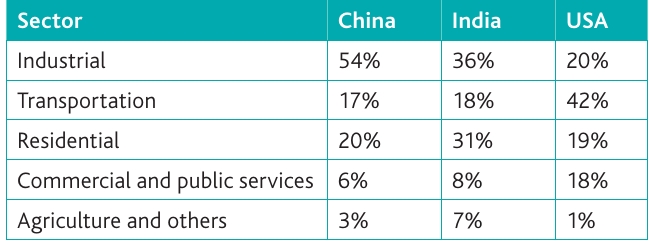
China demonstrates a heavily industrial energy profile:
- Industrial sector dominates at 54% of total energy consumption
- This reflects China's position as the "workshop of the world"
- Manufacturing and production activities drive energy demand
- Transportation (17%) and residential (20%) sectors are relatively smaller
India shows a more balanced distribution:
- Residential use is more significant at 31%
- This reflects lower industrial development and higher domestic energy needs
- Industrial sector accounts for 36% of consumption
- Agricultural activities represent a notable 7%, higher than in more developed nations
USA exhibits a developed economy pattern:
- Transportation leads at 42%, the highest among the three countries
- Industrial use is much lower at just 20%
- Commercial and public services consume 18%, reflecting a service-based economy
- This pattern is typical of post-industrial societies
Important
Key Relationship: Economic Structure and Energy Demand
The components of energy demand reflect the economic structure and development stage of a country:
- Industrial economies (like China) show high industrial energy use due to manufacturing dominance
- Developed economies (like the USA) consume more energy for transportation and services as they transition to post-industrial, service-based economies
- Developing economies (like India) often show higher residential and agricultural energy use relative to their industrial sector
Energy supply and physical geography
The availability of different energy resources depends on various physical factors. These limiting factors differ depending on the type of energy resource:
- Fossil fuels and geothermal energy - availability is determined by geological conditions
- Renewable sources (wind and solar) - climate conditions are the major constraint
- Location and accessibility - physical geography affects the practicality of resource exploitation
Note
Physical geography acts as a fundamental control on energy resource availability. No amount of technology or investment can create fossil fuel deposits where geology is unsuitable, or generate solar energy in persistently cloudy regions. Understanding these physical constraints is essential for energy planning and policy.
Geology
Physical geological factors play a crucial role in determining where fossil fuel resources can be found.
Coal
Coal is a sedimentary rock that began forming approximately 360 million years ago. The formation process occurred in specific environmental conditions:
Formation environment:
- Swamp conditions at the edges of sedimentary basins
- Locations such as lagoons or lakes where plant material accumulated
- Plant debris built up over long periods
The coalification process: Plant material underwent transformation through several stages:
Example
Worked Example: The Coalification Process
Understanding how coal forms helps explain its distribution and quality variations:
Step 1: Burial
- Plant debris was covered by layers of mud and sand
- This created the conditions necessary for preservation
Step 2: Anaerobic conditions
- Decomposition slowed due to lack of oxygen
- Organic material was preserved rather than completely decaying
Step 3: Pressure and heat
- Accumulating sediment weight compressed the organic material
- Temperature increased with depth of burial
Step 4: Chemical transformation
- Moisture and volatile materials were reduced over time
- The organic structure was altered by heat and pressure
Step 5: Carbon concentration
- Carbon content increased, improving coal quality
- Higher quality coal forms with greater heat and pressure over longer periods
Important
Coalification is the process through which dead vegetation is subjected to increasing heat and pressure over millions of years. This reduces moisture and volatile materials whilst increasing carbon content, producing higher quality coal.
The quality of coal produced depends on:
- The intensity of heat and pressure applied during formation
- The duration of the coalification process
- Higher temperatures and pressures over longer periods create better quality coal with higher carbon content
Summary
Key Points to Remember:
- Energy demand is divided into four main sectors: industrial, transportation, residential, and commercial
- Globally, industrial use dominates energy consumption at 55%, but this varies significantly by region
- Developed countries like the USA show higher transportation energy use (42%), whilst developing nations like China are more industrially focused (54%)
- Physical geography determines energy resource availability - geology controls fossil fuel deposits whilst climate affects renewable energy potential
- Coal forms through coalification, where plant material is buried and subjected to heat and pressure over millions of years in anaerobic conditions