Demand Management Strategies: Consumption (AQA A-Level Geography): Revision Notes
📚Revision Notes
Demand management strategies: Consumption
Introduction to demand management
Demand management strategies aim to decrease energy consumption rather than increase supply. These approaches have become increasingly important as countries work towards meeting international climate commitments such as the Paris Agreement. The focus is on using energy more efficiently and reducing overall consumption through various methods.
Note
Unlike supply-side strategies that focus on increasing energy production, demand management tackles the problem from the consumption end - helping individuals, businesses, and governments use energy more wisely and efficiently.
Energy conservation efforts are primarily driven by three key factors:
- Government incentives – financial support to encourage households and businesses to adopt energy-saving measures (such as subsidising loft and cavity wall insulation)
- Media campaigns and awareness programmes – these may be government-led or organised by energy-saving organisations like the Carbon Trust to educate people about energy efficiency
- Pricing strategies – higher fuel costs naturally encourage energy saving, whilst off-peak electricity pricing can reduce pressure on power generation during peak demand periods
Household energy saving
Energy performance certificates
The EU Directive on the Energy Performance of Buildings forms part of government strategy for addressing climate change. This directive requires an Energy Performance Certificate (EPC) to be issued whenever a property is constructed, rented out or sold.
The EPC displays the energy efficiency rating of a dwelling on an A–G rating scale, similar to those used for refrigerators and other electrical appliances. Properties rated 'A' are the most efficient, whilst those rated 'G' are the least efficient. The UK government has indicated it will continue to operate an EPC style scheme after Brexit is completed.
Important
An Energy Performance Certificate is legally required whenever a property is built, sold, or rented. This ensures potential buyers or tenants can make informed decisions about the energy efficiency and running costs of a property.
To achieve good ratings, homeowners need to consider several improvements:
- Improving thermal efficiency of walls, windows and roofs
- Draught-proofing of floors, doors and windows
- Installing a high efficiency condensing boiler
- Connecting to a heat network (also known as a district heating system)
- Using new building materials to reduce heat loss (thermal blocks)
- Using low carbon technologies such as solar panels, biomass boilers or wind turbines
- Installing energy efficient appliances and lighting
- Improved daylighting through fitting larger windows (passive solar heating)
- Using environmentally friendly or recycled building materials
Heat networks
Heat networks (also known as district heating systems) are an important part of the UK government's plan to reduce carbon emissions by providing a supply of low carbon heat to homes, offices and public buildings. They exploit larger-scale, often lower cost, renewable and recovered heat sources that otherwise would be wasted.
Heat energy is released from a central source through a distribution system of insulated pipes to a number of domestic and/or non-domestic buildings. The heat source might be a facility that provides a dedicated supply to the heat network, such as a combined heat and power plant, or heat recovered from industry or energy from waste plants.
Note
Think of heat networks as the heating equivalent of the electricity grid - instead of each building generating its own heat individually, a central source distributes heat efficiently to multiple buildings through insulated pipes. This is particularly effective in dense urban areas or large developments.
There are currently about 17,000 heating networks in operation in the UK, covering half a million premises. It is estimated that around 18 per cent of UK heat will need to come from heat networks by 2050 if the UK is to meet its carbon targets cost effectively.
Combined heat and power (CHP) systems
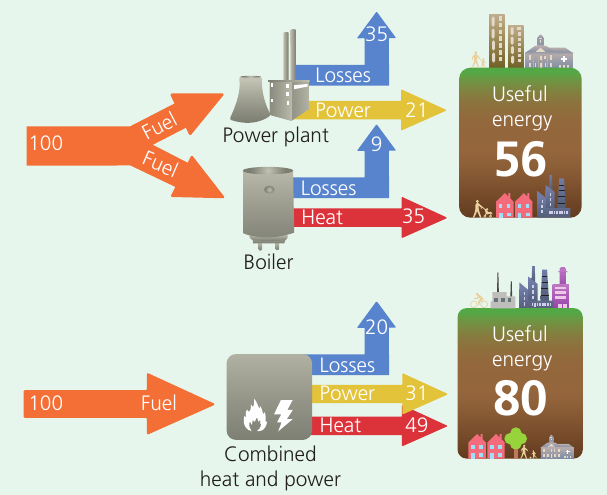
Combined Heat and Power (CHP) generates electricity whilst also capturing usable heat that is produced in the process. Conventional electricity generation from coal- and gas-fired power stations generates heat but, because of their remote location, up to two-thirds of the overall energy is lost. Energy is also 'lost' in transmission costs from generation to consumption.
CHP enables consumers to generate their own power locally using renewable or non-renewable fuels. It captures the waste heat from generation so it can be used for space or water heating, thus reducing energy consumption and carbon emissions. It can be used in homes, businesses or public buildings.
Important
Key Efficiency Comparison:
The diagram above demonstrates the efficiency advantages of CHP systems. In a conventional setup with separate power plant and boiler, only 56 units of useful energy are obtained from 100 units of fuel input, with 44 units lost through various processes. In contrast, a combined heat and power system delivers 80 units of useful energy from the same 100 units of fuel, with only 20 units lost. This represents a significant improvement in energy efficiency.
Example
Real-World Application: Center Parcs Woburn Forest
Center Parcs' most recent site at Woburn Forest uses two CHP generators, which saves the company $200,000 and 900 tonnes of carbon emissions per year. This demonstrates how CHP systems provide both economic and environmental benefits in commercial settings.
Industrial and commercial energy saving
The Energy Saving Trust and the Carbon Trust are non-profit organisations whose respective aims are to help the business community save energy and move towards a low carbon economy. They advise companies about creating climate change strategies and provide smaller businesses with free energy audits and no-interest loans for energy efficient equipment.
Many industrial processes generate heat, which is a source of energy that can be wasted unless it is captured. The Carbon Trust encourages industrial energy consumers to install heat recovery systems which collect and re-use heat arising from any process. Heat recovery can help to reduce the overall energy consumption of the process itself, or provide useful heat for other purposes. This should not be confused with combined heat and power systems, which are also beneficial in reducing energy consumption in industrial, commercial and domestic settings.
Note
Heat recovery systems work by capturing waste heat from industrial processes (such as manufacturing, cooling systems, or exhaust gases) and redirecting it to where it can be useful - like heating water, warming buildings, or pre-heating materials. This "waste not, want not" approach can significantly reduce overall energy bills and carbon footprints.
The energy savings strategies offered are similar to those in residential premises.
Sustainable transport strategies
Energy conservation can be achieved in transport use through technology, design and incentives to alter lifestyle and the type of transport used.
Technology
Engine design improvements enable more efficient fuel usage. For example, fuel injection delivers better performance with lower emissions. Stop/start ignition control reduces fuel wastage and cuts emissions when vehicles are stationary.
Electric vehicles (EVs) represent an important technological development. Various types are now available:
- Battery electric vehicles (BEVs) – fully electric, powered entirely by batteries
- Plug-in hybrid electric vehicles (PHEVs) – combine electric battery with traditional fuel engine
- Hybrid electric vehicles (HEVs) – use both electric and petrol/diesel power
Note
These become more sustainable options as the proportion of energy generated by renewable sources increases in the electricity grid. As the grid becomes "greener", the environmental benefits of electric vehicles multiply - they're only as clean as the electricity that powers them.
Methods and design
Several design and fuel approaches can reduce transport energy consumption:
- Aerodynamic designs reduce fuel consumption by minimising air resistance
- Using more renewable fuels such as bioethanol
- Using cleaner, more efficient fuels, for example LPG (liquified petroleum gas) or low sulphur alternatives
Schemes and campaigns to discourage car travel or reduce congestion
Governments can implement various policies and schemes to reduce transport energy consumption:
- Government policy and legislation – such as road tax based on emissions levels
- Congestion charges – fees for driving in busy city centres (for example, London Congestion Charge Zone)
- Toll roads – charging for road use (for example, M6 Toll)
- Park and ride schemes – in cities, combined with high car park charges in city centres
- Campaigns and incentives to encourage car sharing – reducing the number of vehicles on roads
- Campaigns to encourage taking public transport, cycling or walking – promoting alternative modes of transport
- Planning homes, services and workplaces in close proximity – reducing the need for travelling
Important
These schemes work on the principle of making car use less convenient or more expensive, while simultaneously making alternative transport options more attractive. The combination of "stick" (charges and restrictions) and "carrot" (better public transport and infrastructure) approaches tends to be most effective.
Environmental impacts
The environmental impacts of using energy resources occur at three distinct stages: during production (exploitation), transportation (trade), and consumption of the fuels to produce energy.
In developing countries, particularly in rural areas, people largely rely on biomass such as fuelwood to meet their energy needs for cooking. The scarcity of fuel supplies has led to the widespread removal of woodland for firewood. This results in less interception of rainfall, reduced infiltration, faster run-off and greater soil erosion by water and wind, often leading to desertification.
Note
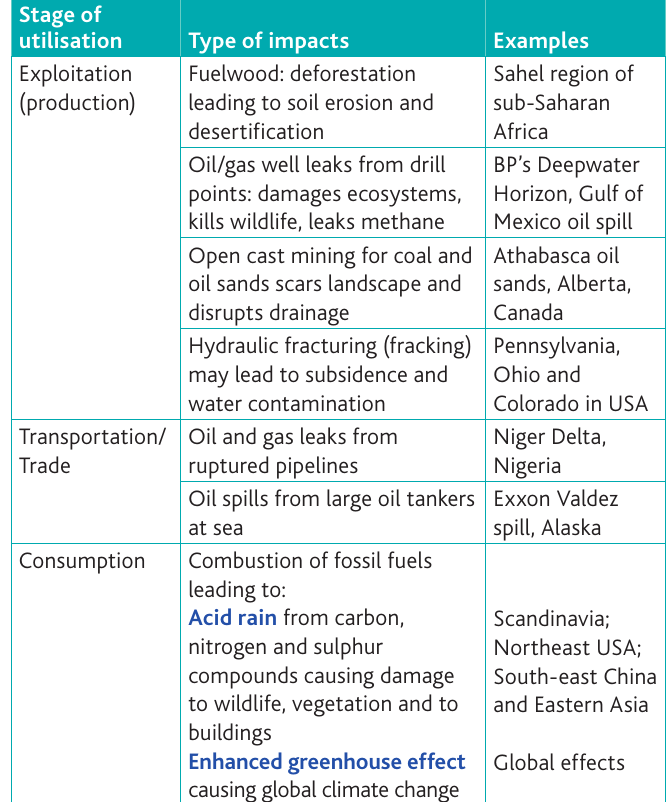
The table above summarises the key environmental impacts at each stage:
- During exploitation (production) – impacts include deforestation, oil and gas well leaks, open cast mining, and hydraulic fracturing
- During transportation – oil and gas leaks from ruptured pipelines and oil spills from tankers cause significant damage
- During consumption – the combustion of fossil fuels leads to acid rain affecting ecosystems and buildings, as well as enhanced greenhouse effect causing global climate change
Key terms
Acid rain – Rain that has been made acidic by certain pollutants in the air.
Enhanced greenhouse effect – The atmosphere absorbs long-wave radiation from the Earth and is warmed. The effect is increasing because of the release of gases such as carbon dioxide into the atmosphere by human activity.
Remember!
Summary
Key Points to Remember:
- Demand management strategies focus on reducing energy consumption through government incentives, awareness campaigns, and pricing strategies
- Energy Performance Certificates (EPCs) rate buildings from A to G, encouraging homeowners to improve thermal efficiency, install efficient appliances, and use renewable technologies
- Combined Heat and Power (CHP) systems dramatically improve energy efficiency by capturing waste heat, achieving 80 units of useful energy compared to just 56 units from conventional separate systems
- Transport energy conservation involves technology (electric vehicles), design (aerodynamics, cleaner fuels), and behavioural changes (congestion charges, park and ride schemes, public transport promotion)
- Environmental impacts of energy use occur at three stages: exploitation (deforestation, drilling damage), transportation (oil spills, pipeline leaks), and consumption (acid rain, enhanced greenhouse effect)