Production, Consumption and Trade (AQA A-Level Geography): Revision Notes
📚Revision Notes
Production, Consumption and Trade
Introduction: The global energy gap
Energy drives economic and social development around the world. However, there is a significant energy gap between wealthy and poorer nations.
Important
The energy gap refers to the marked difference in energy access and consumption between rich and poor nations of the world.
The scale of global energy inequality is striking:
- Nearly one billion people living in low-income countries have no access to electricity or modern energy supplies. These communities rely almost entirely on fuelwood or other biomass for their energy needs.
- Developed countries consume approximately 70% of the total supply of fossil fuels (coal, oil, and gas), despite having a much smaller share of the global population.
Globally, we remain heavily dependent on fossil fuels, which make up around 80% of the total energy mix. Whilst this proportion will decrease gradually in future decades, several significant changes in global energy patterns are already taking place.
Patterns of energy production
Overview of fossil fuel production
The main energy resources produced globally are fossil fuels: coal, oil, and natural gas.
Note
The Three Major Fossil Fuels:
Each fossil fuel has distinct characteristics that determine its use and value:
- Coal: Most abundant but highly polluting
- Oil: Highly flexible for transport, heating, and power generation
- Natural Gas: Cleanest burning fossil fuel with growing demand
Coal is relatively abundant worldwide, though its popularity as an energy source is declining because it is highly polluting. Carbon capture and storage technologies, along with cleaner coal-burning methods, may help reduce these environmental concerns in future.
Oil and gas are less evenly distributed globally than coal. However, they are highly valued because of their flexibility. They can be used for transport, heating, and power generation. The development of unconventional reserves (such as shale gas and oil sands) is extending the longevity of both gas and oil supplies.
As technology advances, demand will largely determine future production levels of oil, gas, and coal. The geographical distribution of these resources will also influence their use as primary energy sources.
Global distribution of production
Energy production is unevenly distributed worldwide. The areas of highest production are concentrated in:
- North America
- The Middle East
- Throughout Asia
Some countries are considered energy rich because they have large reserves of fossil fuels. Energy-rich nations possess both the wealth and technology needed to exploit these reserves. Many are also large consumers of their own energy resources. For example, China and the USA have substantial fossil fuel reserves but also consume heavily to support their economies.
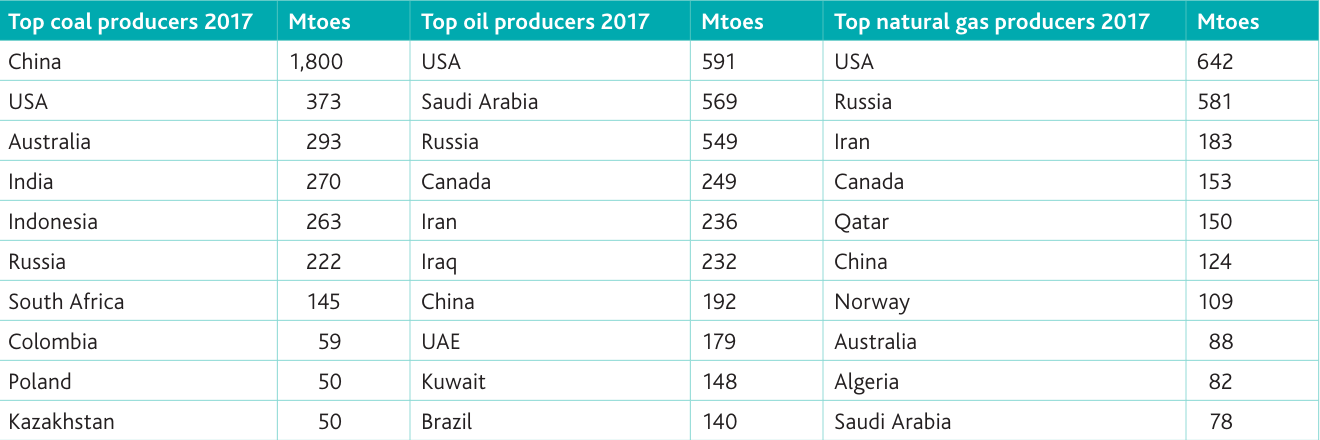
In richer countries that have reached peak production, two major trends have emerged:
-
Exploration and production in developing countries: Less developed nations, particularly in Asia, Latin America, and parts of Africa, have seen increased activity. Governments have granted exploration rights to transnational corporations (TNCs), whose investment and expertise have helped develop resources. Examples include Indonesia, Chad, Angola, and South Sudan.
-
Development of unconventional reserves: Rising oil and gas prices, combined with technological advances, have made it economically viable to develop unconventional resources. These include shale rock (particularly in North America), oil sands in Canada, and heavy oils in Venezuela.
Coal production
Coal production is distributed across the globe due to its relatively common availability.
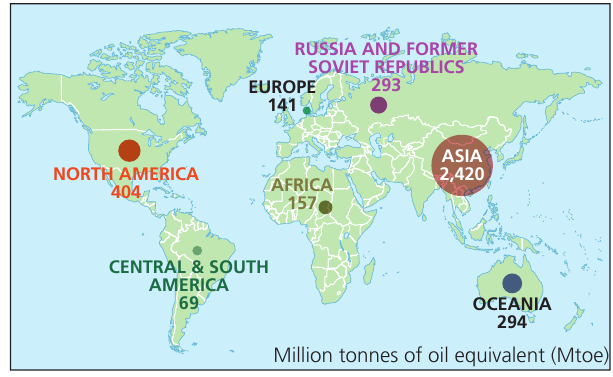
Key characteristics of global coal production:
- Sometimes called the 'fuel of the past' because it is the most polluting of the fossil fuels
- Despite environmental concerns, coal still accounts for approximately 25% of the global energy mix
- There has been a shift away from deep mining towards open-cast mining methods
- Geographically, global coal production is dominated by five countries: China, USA, Australia, India, and Indonesia. These nations together account for nearly 80% of world coal production.
Note
The primary use of coal is thermal electricity generation. Production levels are often determined by a country's need for coal-based energy generation. The largest producers tend to consume much of their own coal for power generation, especially the USA, China, and India.
Oil production
Oil production is concentrated in three main areas globally: the Middle East, North America, and Russia. These regions together account for over 70% of the world's oil production.
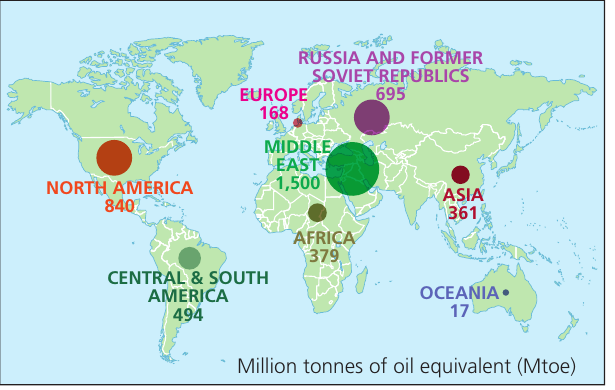
Key patterns in oil production:
- Middle East countries contribute over 25% of total world production due to their large reserves
- Exploiting unconventional shale (tight) oil reserves through fracking has enabled the USA to become the top oil producer
- Less conventional reserves, such as oil sands in Canada and heavy oil in Venezuela, have made these countries important producers
Important
Geological factors significantly influence the global pattern of oil supply:
- Extraction tends to be more economically viable in Middle Eastern countries, which have large oilfields. For example, Saudi Arabia benefits from relatively easy access to substantial reserves compared to smaller reserves found in the North Sea.
- Physical environment also affects production. Oil extraction in the harsh cold climates found in Alaska presents greater challenges, where oil deposits are deep below preserved permafrost layers. Conversely, the Middle East has a more politically volatile environment than other oil-producing regions, which can disrupt production.
Natural gas production
Natural gas has become an increasingly important energy resource over the last 50 years. It now contributes about 22% of the global energy mix. In 2019, world natural gas production hit a new record of almost 4,000 billion cubic metres (bcm).
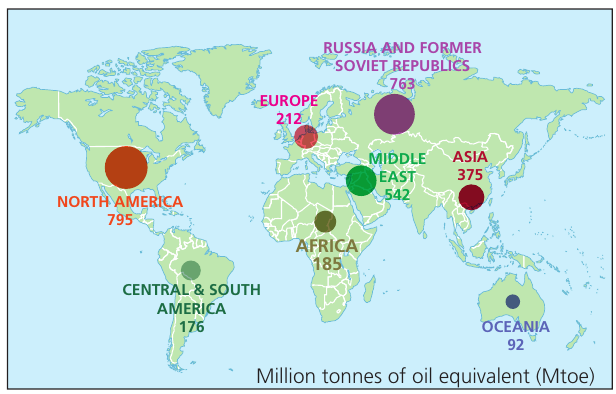
Characteristics of natural gas production:
- Natural gas deposits are generally found in the same locations as oil reserves, so global distribution of reserves is similar
- However, gas production is usually determined by the availability of infrastructure to store and transport it
- The USA is the largest producer (increasingly producing shale gas) and Russia possesses the largest natural gas reserves
- Production is dominated by the USA and Russia. The top five gas producers represent over half of the world's natural gas production.
Nuclear energy
The primary energy source for nuclear fission is the chemical element uranium. Mining uranium depends on the quality and quantity of discovered ores. Larger concentrations of higher-grade ores tend to occur in continental shield areas of the Earth.
The five largest producers of uranium in 2017 were:
- Kazakhstan (38% of global production)
- Canada (16%)
- Australia (10%)
- Namibia (7%)
- Niger (6%)
Note
Electricity is produced from uranium using nuclear fission. Wealthier countries are the largest producers of nuclear energy because they can afford the substantial investment required. Nuclear power allows them to diversify their energy mix and secure a domestic energy supply.
The USA produces the most nuclear energy globally. France, lacking substantial fossil fuel reserves, relies heavily on nuclear energy to produce 75% of its electricity.
Renewable energy
Renewable energy sources include solar, wind, hydroelectric power (HEP), biofuels, and geothermal energy. Together, they account for approximately 18% of world energy production (and more than 26% of electricity generation). They are the fastest growing sources of energy production.
Key features of renewable energy production:
- Renewable energy sources can be established in many countries, so the distribution of production is scattered globally
- Approximately 40% of the world's renewable energy is produced in low-income countries from solid biofuels (mainly fuelwood) and other forms of biomass
- Significant developments in solar and wind energy have occurred due to supportive policies by national governments in developed countries, which have raised the importance of renewable energy production, especially for electricity generation
Note
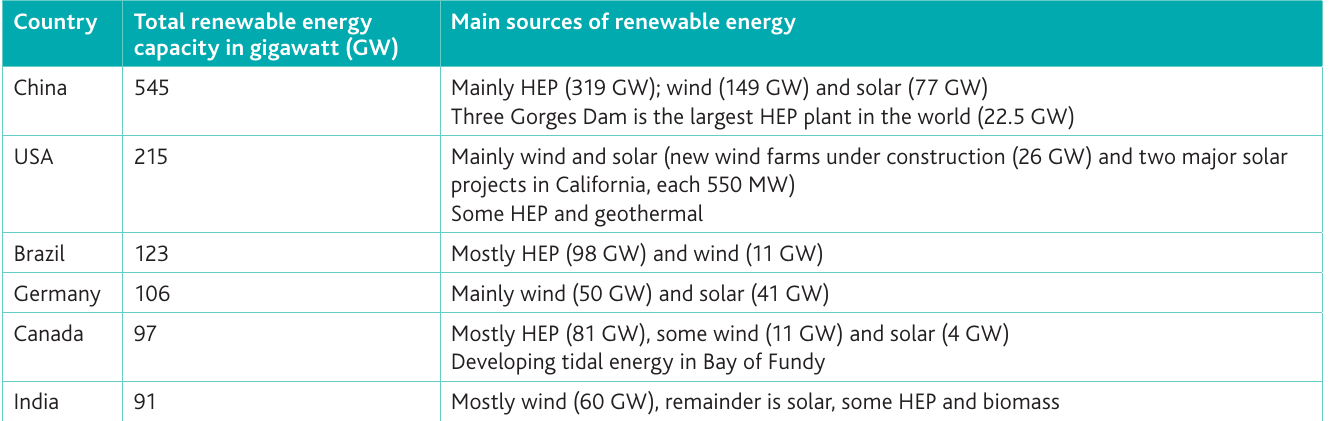
The table shows that China leads global renewable energy capacity with 545 GW, followed by the USA (215 GW), Brazil (123 GW), Germany (106 GW), Canada (97 GW), and India (91 GW). Each country has a different mix of renewable sources based on their geographical advantages and policy priorities.
Patterns of energy consumption
Global trends in energy consumption
Global energy use is increasing by approximately 2.5% per year, whilst population growth is only about 1.1% per year. This means the increase in energy consumption is not solely due to population growth.
Important
The amount of energy used per person globally is increasing on average by about 10%, but this varies significantly between different countries. This disparity reveals that energy consumption patterns are driven by factors beyond simple population growth.
Factors affecting energy consumption
Different factors drive energy consumption in developed countries compared to developing and emerging economies.
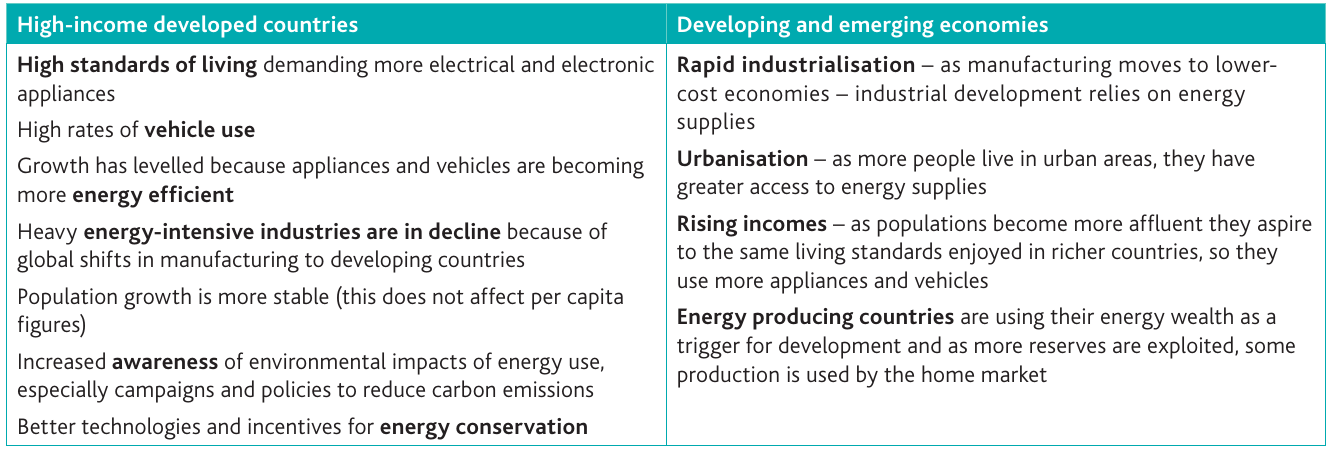
In high-income developed countries:
- High standards of living mean people demand more electrical and electronic appliances
- High rates of vehicle use for personal transport
- Growth has levelled because appliances and vehicles are becoming more energy efficient
- Heavy energy-intensive industries are in decline due to global shifts in manufacturing to developing countries
- Population growth is more stable (which does not significantly affect per capita figures)
- Increased awareness of environmental impacts of energy use, especially campaigns and policies to reduce carbon emissions
- Better technologies and incentives for energy conservation
In developing and emerging economies:
- Rapid industrialisation occurs as manufacturing moves to lower-cost economies, and industrial development relies heavily on energy supplies
- Urbanisation means more people live in urban areas with greater access to energy supplies
- Rising incomes mean populations become more affluent and aspire to the same living standards enjoyed in richer countries, leading to increased use of appliances and vehicles
- Energy-producing countries use their energy wealth as a trigger for development. As more reserves are exploited, some production is consumed domestically.
Recent consumption trends
Global energy consumption grew by 3% in 2018 to 14.5 gigatonnes of oil equivalent (Gtoes). This growth was stimulated by sustained economic growth and rising demand in China, the world's largest energy consumer since 2009.
Energy consumption in China is mainly driven by:
- Power generation
- Strong industrial demand
- Increasing fuel consumption by private transport
Energy consumption in the United States reached a record high of 2.3 Gtoes in 2018, representing a 3.5% increase from 2017. This increase was partially driven by weather conditions (hot summer and cold winter requiring more heating and cooling).
In contrast, energy consumption decreased in the European Union (-1%) and particularly in Germany (-3.5%). This decline was due to:
- Decreasing consumption in the power sector
- A milder winter
- Energy efficiency improvements
Future projections
The US Energy Information Administration (EIA) projects that global energy consumption will grow by nearly 50% between 2018 and 2050. Most of this growth will come from regions such as Asia, where strong economic growth is driving demand.
Note
The majority of that demand will continue to be met by non-renewable energy sources. However, with electricity generation expected to increase by 79% over that period, renewable energy will be the fastest growing energy source. Renewable energy is projected to nearly double its contribution to the global energy mix by 2050.
Consumption of fossil fuels
Coal consumption:
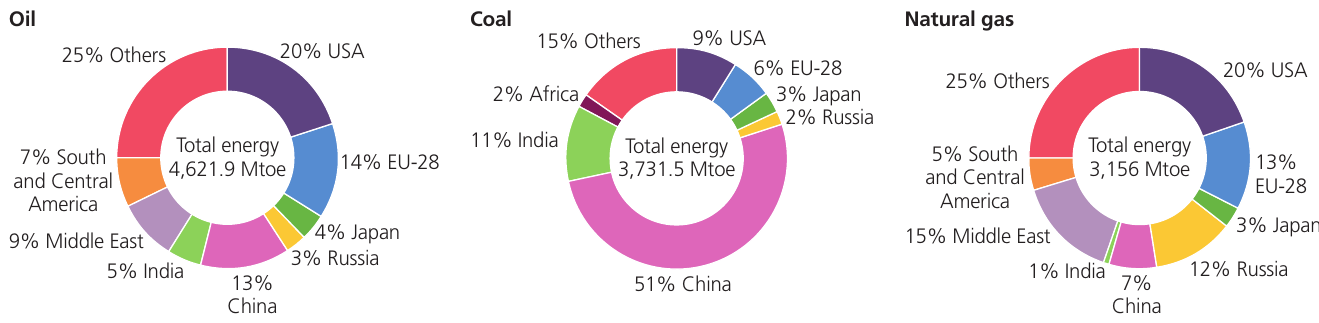
China dominates coal consumption, followed by India and the USA. These three countries account for over 70% of global coal consumption. As well as being the leading producer, China is by far the largest consumer of coal.
Oil consumption:
The USA is the largest oil consumer, followed by the EU, China, and the Middle East. Oil's share of global primary energy consumption has declined as it has been displaced by natural gas and nuclear power for electricity production. However, oil still accounts for over 90% of energy consumed in the transport sector.
Natural gas consumption:
The consumption of gas has tripled over the past 40 years and now accounts for over 20% of global energy consumption. This dramatic increase in gas consumption is a result of:
- Large discoveries in many countries
- Development of long gas pipeline connections to transport gas over large distances
- Development of liquefied natural gas (LNG) plants and carriers to transport it by sea
The largest consumers of natural gas, in rank order, are the USA, the Middle East, the EU, and Russia. Together, they account for 60% of world consumption.
Note
Why natural gas consumption is growing:
- Environmental concerns: gas is less polluting than coal and emits only half the carbon dioxide
- Development of combined cycle technology for more efficient electricity generation
Global trade in energy
Countries initially try to achieve energy security using their own domestic sources. However, many countries consume much more energy than they can produce, so they must import resources (for example, Japan and Spain). Conversely, some countries produce more energy than they need domestically. For low-income countries, this provides a valuable source of foreign exchange earnings.
Trade in fossil fuels
By far, the most traded energy resources are fossil fuels. They are needed by many countries for electricity generation and transport.
Important
Why oil is the most traded energy resource:
Oil is the most heavily traded fossil fuel because of the geographical mismatch between major areas of production and areas of highest consumption. The fuel must travel vast distances to reach its consumers.
These distances create many challenges:
- Environmental risks of long-distance pipelines
- Environmental hazards such as oil spills at sea
- Political instability in producing regions can disrupt supplies
Key exporters and importers of oil:
Major net exporters of oil include:
- Saudi Arabia
- Russia
- Iraq
- Canada
- United Arab Emirates
The largest net importers are:
- China
- USA
- India
- South Korea
- Japan
Note
Even though they are major producers themselves, China and the USA still rely heavily on oil imports to meet domestic demand.
The USA was historically the largest net importer of oil. However, it became a net exporter in 2019 due to substantial increases in shale oil production. If shale production continues to expand, it is expected that the USA will become a major net exporter by the late 2020s.
Trade in natural gas:
Transport and storage difficulties mean that natural gas is traded less extensively than oil. International trade is hindered by the need to build pipelines, which require huge investment. However, conversion to liquefied natural gas (LNG) enables gas to be carried by sea.
Proximity to large consuming economies makes pipeline construction economically viable:
- Russia is the largest exporter of natural gas. It supplies Europe to the west and China, Japan, and South Korea to the east through pipeline networks.
- Norway and Algeria are also major exporters to Europe
- Canada exports gas to the USA
The main importers of gas are China, Japan, Germany, Italy, and South Korea.
Trade in coal:
Coal is a low-value, bulky fuel, which makes it less economically viable for transportation over long distances. As a result, most coal is used in the country where it is produced. About one-fifth of global coal production enters the world market.
The major exporters are Indonesia and Australia, as they have production levels that exceed their domestic needs. China, India, Japan, South Korea, and Europe are the main importers.
Trade in renewable energy
Renewable energy resources are not usually traded because they are provided in situ (on site) within the country of production. For example, solar panels, wind turbines, and hydroelectric dams generate electricity where they are located.
However, electricity produced from renewable sources can be exported through interconnected electricity grids between neighbouring countries.
Geopolitical issues in energy
Important
Geopolitics is the study of international relations, as influenced by geographical factors.
Geopolitics involves understanding the relationships between a country (or group of countries) and the rest of the world. Each nation (or group of nations, such as the EU) has a sphere of influence over other nations in terms of trade, economic aid, and military intervention.
Historical context
From the 1990s onwards, the political alliances of countries that were based on Cold War divisions started to dissolve. However, some remain rooted in the old East/West divide.
The geopolitics of energy has created its own alliances. For example, OPEC is an economic alliance of countries with a surplus of oil that they are able to export to developed countries which need it more. OPEC still has a major influence on global oil trade as the organisation is responsible for about 50% of crude oil exports worldwide.
Trade and management: Co-operation and conflict
Good political relationships concerning energy resources will lead to co-operation between countries to secure energy supplies for the future. However, there are also potential threats and conflicts regarding the future security of energy supplies.
Saudi Arabia and Western relations:
Saudi Arabia currently has strong links with the USA and other Western countries. However, this relationship could change if there is:
- A leadership transition in Saudi Arabia
- Economic reform that shifts political allegiances
- The perceived threat of terrorism affecting stability in the region
Arab Spring and Middle East stability:
The Arab Spring uprisings that occurred in the Middle East and North Africa (MENA) region since 2010 have led to differing outcomes for individual oil-producing states. For example, Libya has experienced significant disruption, which is likely to affect future oil supplies from the country.
Iran and international sanctions:
Note
Iran is a major oil and gas supplier. However, its relationship with the Western world, particularly with the USA, has been extremely difficult for many years.
Timeline of Iranian relations:
- 2006: Sanctions were imposed on Iran because of concerns that the country was developing military nuclear capability
- Iran continued to trade with China and Russia during the sanctions period, but its economy was hit hard by the restrictions
- 2015: An international agreement was signed that lifted the sanctions, enabling Iran to trade oil with Europe and North America
- 2019: Iran's growing military influence, particularly against US allies in the region, caused President Trump to re-impose sanctions on trade between the US and Iran
Russia-Ukraine tensions:
Trade relations between Russia and Europe are threatened because of Russia's support for separatists in eastern Ukraine and its annexation of Crimea from Ukraine.
Note
Ukraine's government has allied itself with Europe, leading to further escalation of the conflict. The conflict in Ukraine (as well as Russia's involvement in the Syrian conflict) has led to the EU placing more sanctions on Russia. However, this puts Europe's gas supply at risk, as Russia is a major supplier to European countries.
Summary
Key Points to Remember:
-
The energy gap describes how wealthy nations consume approximately 70% of fossil fuels whilst nearly one billion people in low-income countries lack access to modern energy supplies.
-
Fossil fuel production is geographically concentrated: coal production is dominated by China, USA, and Australia; oil production is centred in the Middle East, North America, and Russia; natural gas production is led by the USA and Russia.
-
Energy consumption patterns differ between developed and developing countries. Developed countries are seeing slower growth or decline due to efficiency improvements, whilst emerging economies like China and India are experiencing rapid consumption growth driven by industrialisation and urbanisation.
-
Oil is the most traded energy resource due to the geographical mismatch between production and consumption areas. Major exporters include Saudi Arabia, Russia, and Iraq, whilst China, USA, India, and Japan are major importers.
-
Geopolitical tensions significantly affect energy security and trade, including ongoing conflicts such as Iran-US relations, Russia-Ukraine tensions affecting European gas supplies, and the influence of OPEC on global oil markets.