The Future of Mineral Ores (AQA A-Level Geography): Revision Notes
📚Revision Notes
The Future of Mineral Ores
Why mineral security matters
The future security of mineral supplies is a growing concern globally. New sources of minerals are needed to meet rising demand, particularly for critical minerals.
Important
Critical minerals are elements that are essential for new and green technologies, such as renewable energy systems and electronic devices.
If future shortages of these minerals occur, they could cause serious problems for technological development and economic growth. To prevent this, new approaches to finding, extracting and managing mineral resources must be developed.
Technological developments
Exploration techniques
Finding new mineral deposits is key to ensuring future supply. Several advanced techniques are being developed to explore for minerals more cost-effectively:
Remote sensing
Remote sensing is an approach that collects information about mineral deposits from a distance, without direct physical contact. The most common methods include:
- Aerial surveys using aircraft
- Satellite surveys from space
- These enable large areas to be surveyed quickly to identify topography and geological features
- Infrared imaging can indicate possible mineral content in surface rocks
Note
Remote sensing technologies have revolutionised mineral exploration by allowing geologists to survey vast areas quickly and cost-effectively, reducing the need for expensive ground-based surveys in the initial exploration phase.
Magnetometry
Magnetometry is a technique that detects magnetic properties in rocks. It is particularly useful for identifying magnetic rock content, such as iron ore deposits. By measuring variations in the Earth's magnetic field, geologists can locate areas with high concentrations of magnetic minerals.
Gravimetry
This method measures the density of rocks beneath the surface. It works by detecting tiny variations in gravitational pull caused by different rock types. Gravimetry is especially useful for distinguishing magmatic igneous deposits, which are usually denser than sedimentary and placer deposits.
Seismic surveys
Seismic surveys use echoes of surface vibrations to provide information about:
- The depth of rock layers
- The angle of rock strata
- The thickness of different geological formations
Seismic surveys are increasingly used in underwater exploration to map the ocean floor and identify potential mineral deposits beneath the seabed.
Deep sea exploration
Exploration of the deep ocean is expanding, using combinations of all these techniques. The deep sea represents a largely untapped frontier for mineral resources, though extraction presents significant technical and environmental challenges.
Extraction and exploitation methods
Mechanisation
Greater efficiency comes from advances in mining equipment technology. Key improvements include:
- Larger excavators that can extract material more rapidly
- More cost-effective equipment that reduces operational expenses
- Automated systems that can work continuously with less human intervention
Electronic technologies
The introduction of modern computing and communications systems has transformed mining operations:
- Computer technology enables precise control of mining processes
- Remote-control interfaces allow operators to manage equipment from safe distances
- Satellite communications maintain contact with remote mining sites
- Robotics technology can undertake dangerous tasks
- These innovations have led to greater safety for workers
- Productivity has increased significantly in mining, mineral processing, smelting and refining operations
Note
The combination of mechanisation and electronic technologies has not only improved productivity but also dramatically reduced workplace accidents in mining operations, making the industry safer for workers while maintaining economic viability.
Exploiting low-grade ores
Technological developments have made it economically viable to mine ores with declining grades and more complex mineralogy. Previously, these low-grade deposits were not worth extracting because costs exceeded the value of recoverable metals.
Alternative methods have been developed to extract metals from low-grade ores:
Example
Worked Example: Copper Extraction from Low-Grade Ores
Method 1: Copper from leachate water
- Copper in leachate water from spoil heaps can be concentrated through evaporation
- The concentrated solution is then separated by electrolysis
- This recovers copper that would otherwise be wasted
Method 2: Copper from low-grade sulphide ores
- Bacteria are used to extract copper from low-grade copper sulphide spoil heaps
- The bacteria oxidise the sulphur, producing an acid solution
- This acid leaches out the copper from the ore
- The copper can then be purified from the solution
These biological and chemical extraction methods make it possible to exploit resources that were previously considered waste material, effectively expanding exploitable reserves without discovering new deposits.
Economic considerations
Supply factors
Although mineral resources exist in abundance worldwide, reserves of exploitable minerals are limited. Several factors restrict how much can be extracted:
- High extraction costs may make mining economically unviable
- Lack of suitable technology may prevent extraction, even where minerals are present
- Prices for staple ores like iron, copper and nickel have been volatile
- Generally, prices remain low, which discourages extensive exploration in the near future
- However, increased recycling will help compensate for any falls in supply of primary ores
Important
Key distinction: While mineral resources (total amount in the ground) are abundant, exploitable reserves (economically viable to extract with current technology and prices) are much more limited. This distinction is crucial for understanding future mineral security.
Demand factors
Future demand for mineral ores will depend on balancing various economic, social and environmental factors. The table below shows the main forces affecting demand:
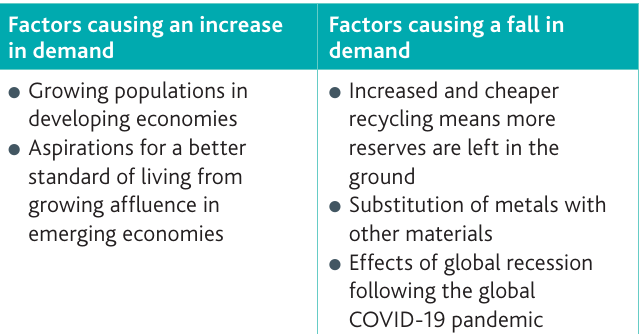
Factors increasing demand:
- Growing populations in developing economies require more resources
- Rising affluence in emerging economies drives aspirations for better standards of living
- Better living standards mean greater consumption of products containing metals
Factors decreasing demand:
- Increased and cheaper recycling means more reserves remain untapped in the ground
- Substitution of metals with other materials reduces the need for certain ores
- Effects of global recession following the COVID-19 pandemic have reduced economic activity and thus demand for raw materials
Note
The balance between these opposing forces will determine whether demand for mineral ores continues to grow or begins to decline. Understanding this dynamic is essential for predicting future mineral security and planning for sustainable resource management.
Environmental and political dimensions
Environmental concerns and political decisions about mineral extraction will become increasingly interconnected in future.
Pressures on the environment
- Exploration and development of new mines puts pressure on natural environments
- Mining operations can cause habitat destruction, pollution and landscape damage
- Protection for the environment can only come from governmental controls at all levels, from local to global
Mitigation and regulation
Environmental Impact Assessments (EIAs) may reduce some of the worst devastation caused by mineral exploitation. However, not all regions and countries will impose such restrictions on mining operators. Environmental protection often conflicts with economic development priorities.
Growth in emerging economies
Ore production will continue to grow in emerging economies. Investments in mining have increased significantly in:
- Latin America
- Africa
- Parts of Asia
These trends may escalate further over the next ten to twenty years.
Economic benefits for developing nations:
Developing nations see economic gains from foreign direct investment in mining as an opportunity to:
- Provide wealth and employment
- Create jobs in the mining sector
- Improve social and physical infrastructure
- Fund schools, hospitals and transport networks
Important
In many cases, these economic benefits may obscure concerns over environmental impacts. The pressure to develop economically can override environmental protection measures, creating a tension between short-term economic gains and long-term environmental sustainability.
Unexplored deposits and protected areas
Globally, some sites with large mineral deposits will remain unexplored. These include:
- Legally protected areas where mining is prohibited
- Regions that are too expensive to develop due to hostile environments or infrastructure difficulties
Note
Protected and Unexplored Mineral-Rich Regions:
Antarctica:
- Protected from all forms of commercial mineral exploitation
- The Madrid Protocol on Environmental Protection to the Antarctic Treaty prohibits mining activities
Arctic regions:
- Including Alaska, Greenland and Siberia
- Remain largely unexplored due to extreme conditions and high costs
Deep seas:
- The right to exploit deep ocean floor deposits in international waters is regulated by the International Seabed Authority
- Few companies have been willing to invest in the expensive technologies required
- However, the first mining permits have recently been granted to Papua New Guinea for mining operations at a depth of 1,500 metres
These protected and difficult-to-access areas represent significant untapped mineral resources, but environmental and economic barriers will likely keep them unexploited for the foreseeable future.
Summary
Key Points to Remember:
-
Critical minerals essential for green technologies are increasingly important, requiring new exploration and extraction methods to ensure future supply security.
-
Advanced exploration techniques (remote sensing, magnetometry, gravimetry, seismic surveys) enable more cost-effective discovery of mineral deposits, including in deep sea environments.
-
Technological innovations in mechanisation and electronics have improved mining efficiency and safety, while new methods enable extraction from previously uneconomic low-grade ores.
-
Future demand will be shaped by competing factors: growing populations and affluence in developing economies versus increased recycling, material substitution and economic recession effects.
-
Environmental protection and economic development are increasingly in tension, with international regulations protecting some areas (Antarctica, deep oceans) while emerging economies expand mining operations for economic benefits.