Geopolitics (AQA A-Level Geography): Revision Notes
📚Revision Notes
Geopolitics
Introduction to water geopolitics
Water is a resource that gives countries significant strategic advantages. Nations that can access and control water sources gain geopolitical power, making water a highly valuable commodity in international relations. Unlike energy resources, water cannot easily be traded globally because it is heavy and expensive to transport. This means countries must secure their water supplies locally or regionally, which can lead to competition and disputes.
Important
Hydropolitics refers to negotiations that focus on resolving disputes caused by the shared use of water resources between different users and countries.
As freshwater becomes increasingly scarce, tensions among different users intensify at local, national, and international levels. Water is less easily traded than energy resources, which makes securing reliable access potentially a greater source of international disagreement. The shared nature of many water sources means there are often no alternatives available to the countries that depend on them.
Transboundary water resources
Many of the world's most important water sources cross international borders, creating complex situations where multiple countries depend on the same supply.
Key statistics highlight the scale of shared water resources:
- 276 river basins are transboundary, meaning they are shared by two or more countries
- 200 transboundary aquifers (underground water sources) have been identified where extraction by one country can affect supplies in neighbouring nations
- 148 countries have territory within at least one transboundary river basin. Of these, 39 countries have more than 90% of their territory within transboundary basins, making them heavily dependent on water sources shared with neighbours
Note
The sheer scale of transboundary water resources means that international cooperation is not optional but essential. Nearly every continent faces the challenge of managing shared water supplies, and the potential for conflict exists wherever formal agreements are absent.
Without formal agreements, any activities within a shared river basin can create international tensions. When one country makes changes to water flows, builds infrastructure, or extracts water, it can significantly impact downstream countries that rely on the same source.
Causes of water tensions
Several factors can trigger disputes over shared water resources:
- Pollution: When water supplies are contaminated by upstream countries, it reduces the quality and usability of water for downstream nations
- Diversion: Redirecting water flows to serve one country's needs can leave insufficient supplies for others
- Over-abstraction: Extracting excessive amounts of water upstream means less reaches neighbouring countries
- Unilateral development projects: Building major infrastructure such as dams without regional consultation and agreement heightens regional instability
Important
The most serious tensions arise when countries act unilaterally without consulting neighbouring nations that depend on the same water source. This lack of consultation can transform technical water management decisions into major diplomatic crises.
China's control of the Tibetan Plateau
A significant example of geopolitical water control involves China's position as the source of ten major Asian river systems. China controls the Tibetan Plateau, often called the 'Water Tower of Asia', which provides the headwaters for rivers including the Indus, Ganges, and Mekong.
Example
Example: China's Hydroelectric Development
China's demand for energy to support rapid industrialisation has led to the construction of multiple hydroelectric power (HEP) dams in the headwaters of these major rivers. Crucially, these projects have been built without formal agreements with downstream countries, which are known as riparians (those with access rights to the river banks).
This unilateral development creates uncertainty and concern for countries downstream that depend on predictable water flows, demonstrating how water infrastructure decisions in one country can have far-reaching geopolitical implications across an entire region.
Water conflict hotspots
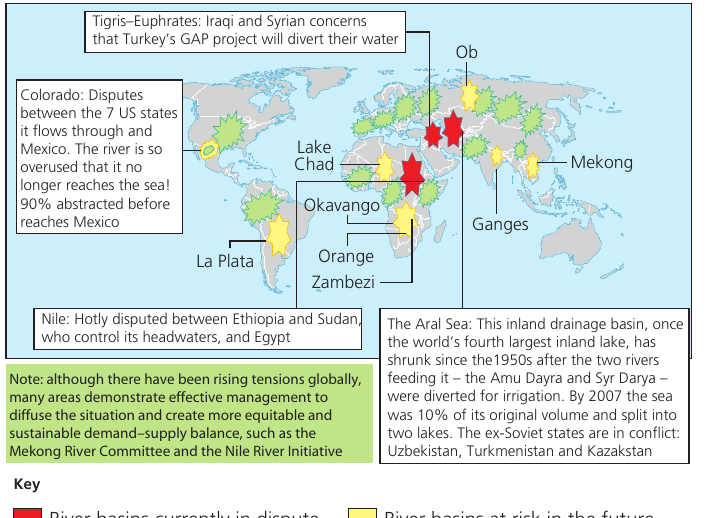
As demand for water reaches the limits of supply in certain regions, disputes may arise between nations that share freshwater reserves. The United Nations recognises the potential for up to 60 conflict 'hotspots' around the world. These are areas where five or more countries might become caught up in disputes unless proper agreements on sharing rivers, reservoirs, and aquifers are established.
Note
The map above shows both current disputes (marked in red) and areas at risk of future conflicts (marked in yellow). The global distribution of these hotspots demonstrates that water geopolitics is not limited to any single region but represents a worldwide challenge requiring international cooperation.
Major conflict zones include:
- Colorado River: Disputes between seven US states flowing through to Mexico, with concerns about abstraction before water reaches Mexico
- Tigris-Euphrates: Iraq and Syrian concerns that Turkey's GAP (Southeastern Anatolia Project) will divert their water supply
- Nile River: Hotly disputed between Ethiopia (which controls the headwaters), Sudan, and Egypt
- Mekong River: Tensions over development affecting multiple Southeast Asian countries
- Ganges: Shared between multiple South Asian nations
- Lake Chad: Shrinking water body creating disputes in Central Africa
- Aral Sea: This inland drainage basin has shrunk dramatically since the 1950s after two rivers feeding it were diverted. By 2007, it was just 10% of its original volume and split into two lakes. The former Soviet states of Uzbekistan, Turkmenistan, and Kazakhstan continue to dispute control
Positive examples do exist, such as the Mekong River Committee and the Nile River Initiative, which demonstrate that cooperation is possible even in water-stressed regions.
Improving transboundary cooperation
The Berlin Rules on Water Resources (2004)
The Berlin Rules provide an international legal framework customarily applied to sharing freshwater resources. These Rules require nations to take appropriate steps to sustain and manage water resources whilst minimising environmental harm.
Countries are encouraged to view water management as an opportunity for regional economic development to be strengthened, rather than seeing it as an inevitable source of conflict. This represents a shift in thinking from competition to collaboration.
Currently, there are approximately 450 transboundary agreements that exist regarding international water sharing. Legal agreements on water sharing have been negotiated and maintained even as conflicts have persisted over other issues between the same countries. This demonstrates that water cooperation can continue even when diplomatic relations are strained in other areas.
Case study: Mekong River Agreement (1995)
Example
Worked Example: The Mekong River Commission
Cambodia, Laos, Thailand, and Vietnam signed the Mekong Agreement in 1995 to form the Mekong River Commission. These countries agreed to jointly manage the shared water resources and promote sustainable development of the lower Mekong Basin.
The Challenge: In 2016, Laos began construction of the Don Sahong Dam, a HEP project, located just two miles north of the Cambodian border. This dam threatened fishing industries downstream in Cambodia, Thailand, and Vietnam.
The Resolution: The downstream countries demanded consultation in the planning process, demonstrating the Commission's role in facilitating dialogue. The dam began operating in 2020 and connected its power grid to Cambodia to export reliable electricity supplies, showing how cooperation can lead to mutually beneficial outcomes.
Success Factor: The Mekong River Commission has been successful in facilitating agreement between India and Pakistan on managing the Indus. The Commission divided six tributaries equally between the two nations. This agreement has survived two wars between India and Pakistan, showing its strength. However, there have been ongoing disputes about the Indus waters, particularly regarding technical features of dams being built by India, though Pakistan has challenged these through the Commission rather than through military conflict.
Case study: Indus River Commission
Example
Worked Example: Long-term Cooperation Despite Conflict
The Indus River Commission represents successful long-term cooperation in a region marked by other conflicts. The agreement between India and Pakistan has endured despite two wars, demonstrating that water agreements can persist even when diplomatic relations break down in other areas.
The Framework: The Commission divided the six tributaries of the Indus equally, giving each country fair access to the water resources.
Dispute Resolution in Action: Whilst disputes have arisen over technical aspects of dam construction by India, Pakistan has used the Commission's dispute resolution mechanisms rather than escalating to armed conflict. This shows the value of having established frameworks for resolving disagreements peacefully.
Case study: Nile Basin Initiative (1999-2015)
Example
Worked Example: Overcoming Major Disagreements
The Nile Basin Initiative (NBI) was formed in 1999 to manage the Nile River Basin and achieve sustainable socio-economic development in the region. The initiative promotes equitable use of common water resources across the countries that share the Nile.
The Challenge: In 2010, disagreement emerged between five upstream nations that wanted a greater share of the Nile waters and the downstream countries of Sudan and Egypt, which opposed changes to existing allocations. Egypt particularly objected to the construction of Ethiopia's Great Renaissance Dam in the headwaters of the Blue Nile, fearing it would reduce water flowing downstream.
The Outcome: The disagreement was eventually resolved in 2015, demonstrating that even serious disputes can be addressed through negotiation and compromise. This case shows both the difficulties of managing shared resources and the possibility of finding solutions through international dialogue.
The need for international institutions
These examples demonstrate the importance of institutions such as the United Nations in developing processes for engagement between countries. International frameworks help nations seek cooperative solutions to shared water resource challenges rather than allowing disputes to escalate into conflicts.
Remember!
Summary
Key Takeaways:
-
Hydropolitics involves negotiations over shared water resources, becoming more critical as water scarcity intensifies globally
-
276 river basins and 200 aquifers cross international borders, affecting 148 countries and creating potential for disputes when managed unilaterally
-
The UN recognises up to 60 conflict hotspots where disputes over water sharing could emerge unless proper agreements are established
-
The Berlin Rules (2004) provide an international framework encouraging countries to view water management as an opportunity for regional cooperation rather than inevitable conflict
-
Successful agreements like the Mekong River Commission, Indus River Commission, and Nile Basin Initiative show that transboundary cooperation is achievable, with approximately 450 agreements currently in place worldwide
-
Water cooperation agreements have proven resilient, surviving wars and diplomatic crises, demonstrating that shared water resources can unite nations even when other issues divide them