Global Availability and Demand (AQA A-Level Geography): Revision Notes
📚Revision Notes
Global Availability and Demand
Introduction to global water patterns
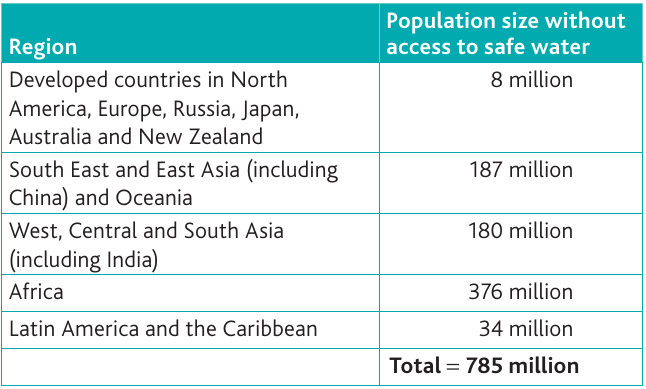
Despite Earth containing enough freshwater to support seven billion people, distribution remains uneven. Significant quantities are wasted, polluted, or managed in unsustainable ways. Currently, 785 million people worldwide lack access to safe water supplies.
Note
The challenge of water security stems not from an absolute shortage of water on the planet, but from how water resources are distributed geographically and how effectively they are managed by human societies.
Understanding water availability
Water availability varies dramatically across different regions of the world. This variation depends on both natural (physical) factors and human management systems.
Regional patterns of water resources
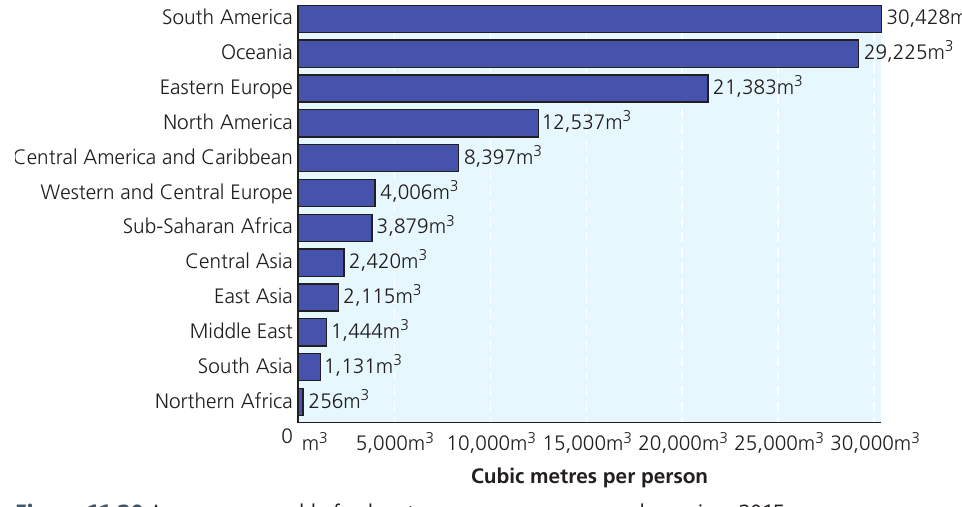
Different parts of the world have vastly different amounts of renewable freshwater available per person. South America leads globally with 30,428 cubic metres per person annually, whilst Northern Africa has just 256 cubic metres per person - over 100 times less.
Note
Understanding the Scale of Inequality
The difference between the highest and lowest water availability regions is staggering - South America has more than 100 times the water per person compared to Northern Africa. This dramatic variation highlights how geography and climate create fundamental inequalities in water access.
Key regional patterns include:
- Highest availability: South America (30,428 m³/person), Oceania (29,225 m³/person), Eastern Europe (21,383 m³/person)
- Moderate availability: North America (12,537 m³/person), Central America and Caribbean (8,397 m³/person)
- Low availability: Middle East (1,444 m³/person), South Asia (1,131 m³/person), Northern Africa (256 m³/person)
Factors affecting water availability
Water availability is shaped by both natural and human influences working together.
Physical factors largely determine natural water supply:
- Latitude and climate: Regions receiving regular, plentiful rainfall benefit from good run-off and storage in aquifers, lakes, and rivers
- Wind direction and proximity to coasts: These influence rainfall patterns and determine which areas receive adequate precipitation to support their populations
- Evaporation rates: Low evaporation rates help maintain water stores in cooler climates
Human factors determine how effectively natural water supplies are accessed and distributed:
- Treatment facilities: Infrastructure to purify water and make it safe for consumption
- Distribution systems: Pipelines and wells that deliver water to populations
- Urban-rural divide: Around 82 per cent of people lacking improved water access live in rural areas, whilst only 18 per cent live in urban areas
- Management practices: Even areas with natural surplus can face shortages if water is overused or poorly managed
Important
The urban-rural divide is crucial to understanding water access inequality. Despite urban areas receiving more attention, the vast majority of people without safe water access (82%) actually live in rural areas where infrastructure development faces greater challenges.
Areas of water surplus
Important
Water surplus occurs when regions have more than adequate water supplies to meet the needs of their population. These areas receive sufficient rainfall and manage their water resources effectively.
Countries and regions with water surplus share certain characteristics:
Environmental characteristics:
- Climates providing regular, plentiful rainfall
- Good natural run-off systems
- Large bodies of surface freshwater (lakes, rivers)
- Low evaporation rates maintaining water stores
- Substantial aquifer recharge
Management characteristics:
- Effective water treatment systems protecting against pollution
- Premium water quality maintained through proper management
- Agreements for sharing water resources with neighbouring countries where transboundary rivers exist
- Efficient management strategies for long-term sustainability
Usage characteristics:
- Low population density relative to water availability
- Efficient water usage reducing wastage
- Lower per capita water consumption
Geographic distribution of surplus areas
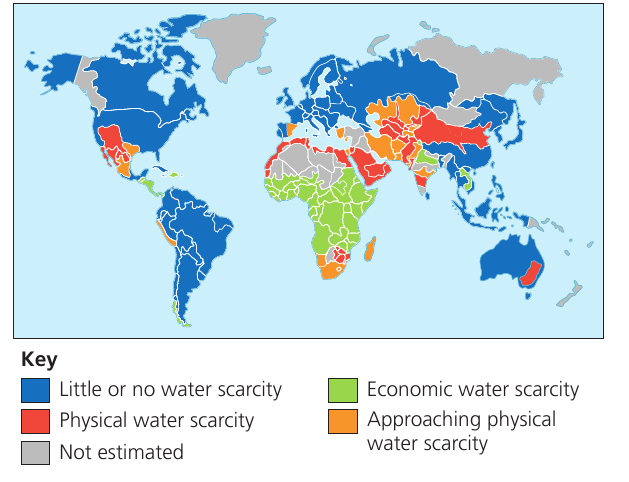
Water surplus regions are primarily located in temperate or tropical zones, including:
- Much of South America
- North America (though with regional variations)
- Northern Europe including Russia
- South East Asia
- Australasia
Note
Rainfall Doesn't Tell the Whole Story
It's important to note that water surplus doesn't always correlate directly with rainfall levels. For example, both Russia and the USA contain areas with low rainfall, yet both nations maintain an overall water surplus. This demonstrates their capacity to manage water resources effectively, though on smaller scales both countries do have regions experiencing water deficit.
Areas of water scarcity
Water scarcity represents both a natural phenomenon and a human-created problem, currently affecting every continent. In 2019, the World Resources Institute identified that approximately 1.8 billion people (25 per cent of the global population) live in areas experiencing physical water scarcity.
Measuring water scarcity
Hydrologists assess water scarcity by examining the population-water equation, which compares available water resources with population needs. The degree of water deficit varies, and experts have developed a classification system to measure these different levels.
Important
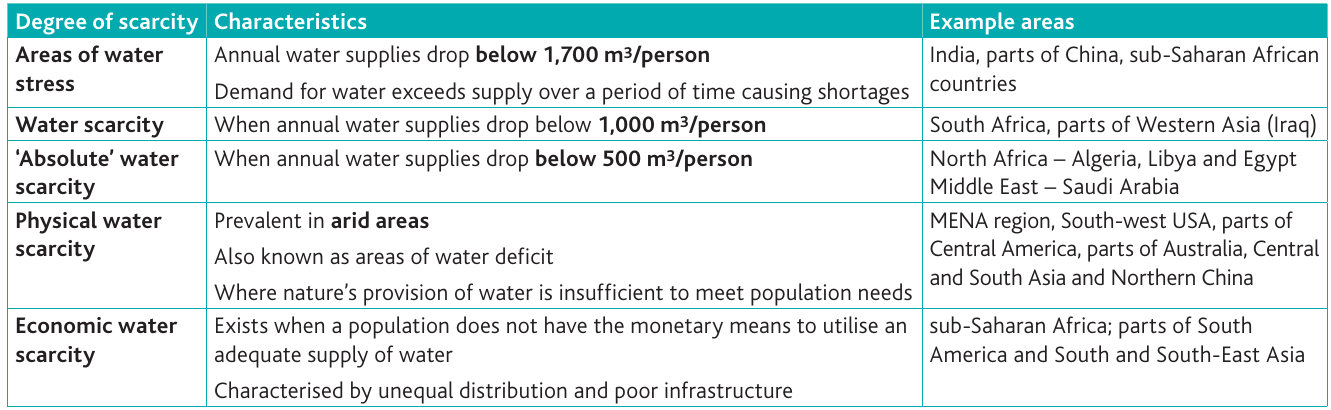
Water stress occurs when annual water supplies drop below 1,700 m³ per person. At this level, demand for water exceeds supply over a period of time, causing shortages.
Important
Water scarcity is reached when annual water supplies fall below 1,000 m³ per person.
Important
Absolute water scarcity represents the most severe level, occurring when annual supplies drop below 500 m³ per person.
Types of water scarcity
Water scarcity manifests in two distinct forms:
Physical water scarcity:
Physical water scarcity is prevalent in arid areas where natural conditions limit water availability. It occurs where nature's provision of water cannot meet population needs - the water resources themselves are insufficient. This type of scarcity is common in the MENA (Middle East and North Africa) region, south-western USA, parts of Central America, parts of Australia, Central and South Asia, and Northern China.
Economic water scarcity:
Economic water scarcity exists when populations lack the monetary resources to utilise available water supplies adequately. It is characterised by unequal distribution and poor infrastructure. Natural water may be present, but people cannot afford to access it through wells, pipes, or treatment. This type of scarcity is prevalent in sub-Saharan Africa, parts of South America, and South-East Asia.
Note
The Poverty-Water Connection
Economic water scarcity affects some of the world's poorest countries, particularly across sub-Saharan Africa, parts of Central America, and South Asia. Around 20 per cent of the global population experiences water shortages because their countries lack the infrastructure to supply water effectively - not because water is unavailable in nature.
Progress and remaining challenges
The international community has made progress addressing economic water scarcity. Millennium Development Goal 7, which aimed to halve the proportion of people without access to safe drinking water, was achieved five years ahead of schedule in 2010. The UN Sustainable Development Goal 6 builds on this progress, aiming to improve sanitation levels and provide improved water supplies to the remaining 10 per cent of the world's population by 2030.
Regional patterns of water scarcity
Most countries experiencing water scarcity are located in:
- The Middle East and North Africa (MENA region)
- Central Asia
- Parts of the Indian sub-continent
- Sub-Saharan Africa (which has the largest number of water-stressed countries)
Arid regions are most strongly associated with physical water scarcity. However, an increasing number of regions worldwide face water scarcity brought about by human factors rather than natural conditions alone.
Case study: The Ogallala aquifer
Example
Case Study: The Ogallala Aquifer - Unsustainable Water Management
The Ogallala aquifer provides a clear example of unsustainable water management leading to scarcity. This underground water source spans eight US states and serves as the most important source for domestic, industrial, and agricultural needs in the mid-western states.
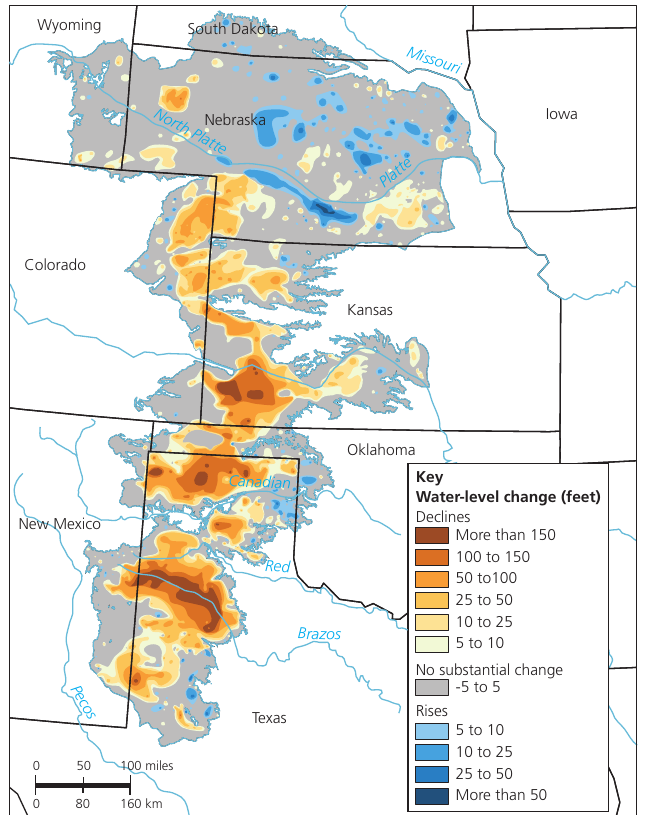
The Problem: Water is being extracted from the aquifer at rates thousands of times greater than the natural recharge rate. This extraction is unsustainable, and experts estimate the aquifer will be fully depleted within 25 to 30 years. The depletion is particularly severe in the Texas Panhandle and south-western Kansas, where water levels have declined by more than 150 feet in some areas.
The Lesson: This example demonstrates how even regions with access to water resources can face scarcity through over-exploitation and poor management. The seemingly abundant water of the Colorado River basin is also being over-abstracted and unsustainably managed, leading to serious physical water scarcity challenges downstream.
Consequences of water shortages
Water scarcity creates multiple interconnected problems:
- Agricultural impacts: Droughts kill crops and livestock, eventually threatening human populations
- Health impacts: Increases in water-borne diseases such as cholera occur when people use contaminated water sources
- Economic impacts: Creates barriers to industrial development as businesses require reliable water supplies
- Environmental impacts: Over-exploitation of remaining water resources, creating a downward spiral
Patterns of demand for water
Global water demand varies significantly between regions, influenced by development levels, climate, and agricultural practices.
[IMAGE
]Regional variations in water withdrawal
North America and West and Central Asia have the highest per capita water withdrawal globally. Both regions are heavily dedicated to agricultural production and experience drier conditions in summer, requiring extensive irrigation. Water for cotton and cereal production is particularly important in western Central Asian countries such as Turkmenistan and Uzbekistan.
North America, being a more developed region, places considerable demand on water for:
- Industrial processes
- Domestic uses (dishwashers, washing machines)
- Personal hygiene (high standards maintained)
- Recreational purposes (swimming pools, golf course maintenance)
Sub-Saharan Africa's low water usage
Sub-Saharan Africa has the lowest per capita water usage globally. This low usage occurs not by choice but because:
- Rainfall patterns are unreliable
- Infrastructure to supply water on tap is lacking
- Populations must be careful with the limited water resources they can access
- Water is used primarily for essential irrigation rather than broader applications
Note
Low Usage ≠ Adequate Supply
It's crucial to understand that Sub-Saharan Africa's low water usage doesn't reflect adequate water access or conservation success. Rather, it reflects the harsh reality of limited infrastructure and unreliable water sources forcing populations to use less water than they actually need.
Development and water demand
The relationship between development and water use is not straightforward. Whilst developed nations often have higher per capita water withdrawal for domestic and industrial purposes, some developing nations also have high withdrawal rates due to irrigation-intensive agriculture.
Geopolitics of water resource distributions
Important
Hydropolitics refers to negotiations that focus on resolving conflicts caused by the shared use of water resources. As water becomes scarcer, tensions among different users intensify at local, national, and international scales.
Water as a strategic resource
Access to and control over water sources provides strategic benefits, giving water underlying geopolitical importance. Water is a less traded commodity than energy, but securing access to it is potentially an even greater cause of conflict. This is because water is:
- Shared by many countries
- Essential with no alternative
- Increasingly scarce in many regions
Transboundary water resources
Transboundary river basins are shared by two or more countries. Without formal agreements, any changes made within a river basin can lead to transboundary tensions. Currently, 276 river basins are transboundary, with 148 countries having territory within at least one such basin. Thirty-nine of these countries have more than 90 per cent of their territory within transboundary basins.
Transboundary aquifers number approximately 200 globally. These underground water sources have also been identified as sources of over-abstraction by one country, affecting neighbouring nations.
Potential for conflict
When the demand for water reaches the limits of supply in certain areas, conflicts may arise between nations sharing freshwater reserves. The UN recognises the potential for up to 60 conflict 'hotspots' globally, affecting more than 50 countries where five continents might become caught up in disputes.
Important
Preventing Water Conflicts
Conflicts are most likely to develop unless agreements on how to share rivers, reservoirs, and aquifers are established. Problems arise when one country unilaterally makes development plans without consulting those with whom it shares water resources.
Example
Example: China and the Water Tower of Asia
China controls the Tibetan Plateau, known as the 'Water Tower of Asia', because it serves as the source for ten major Asian rivers.
The Geopolitical Challenge: Decisions made by China regarding water extraction or dam construction can significantly affect downstream countries, potentially creating international tensions if not managed through cooperative agreements.
The Risk: When water supplies are polluted, diverted, blocked, or over-abstracted by one country, this can reduce the life chances of neighbouring countries' populations. If major projects such as dams or large-scale abstraction proceed without regional collaboration, they can heighten regional instability and create lasting geopolitical challenges.
Remember!
Summary
Key Points to Remember:
-
Global water paradox: Earth has enough freshwater for everyone, but 785 million people lack access due to uneven distribution, waste, and poor management
-
Availability varies dramatically: South America has over 100 times more water per person than Northern Africa, showing how geography and climate create vast inequalities
-
Two types of scarcity exist: Physical water scarcity (not enough water naturally) and economic water scarcity (water exists but people can't afford to access it through infrastructure)
-
Human factors matter as much as natural ones: Even areas with low rainfall like Russia and the USA can maintain water surplus through effective management, whilst areas with water resources can face shortages through over-exploitation
-
Water is a geopolitical issue: With 276 transboundary river basins and 200 transboundary aquifers, shared water resources create potential for international conflict, making cooperation and agreements essential for water security