Resource Issues (AQA A-Level Geography): Revision Notes
📚Revision Notes
Resource Issues
Introduction to water as a resource
Water is a renewable resource that plays an essential role in sustaining life on Earth. However, despite being renewable, it faces mounting pressure due to global population growth. Water serves multiple critical functions beyond providing drinking water. It is vital for:
- Irrigation systems to grow food crops
- Maintaining health and hygiene standards
- Preventing the spread of diseases through proper sanitation
- Various industrial production processes
Note
All these uses contribute to water consumption, creating what is known as 'virtual water' – the hidden water used in producing goods and services. For example, producing a single cotton t-shirt requires approximately 2,700 litres of water throughout the manufacturing process.
Key issues concerning water security
There are several pressing concerns related to ensuring adequate water supplies for the global population:
- Variable access to clean, safe, potable or improved drinking water across different regions
- The need to balance water supplies with demand and conserve existing water resources
- Improving both the supply and quality of drinking water, particularly in developing nations
- Reducing tensions and conflicts that arise from competition over access to water supplies
- Improving trans-boundary cooperation when water resources are shared between countries
- Ensuring sufficient water supply for food production through irrigation
- Reducing the environmental impacts caused by water extraction and use
- Addressing water stress in regions where demand exceeds available supply
Key terminology
Note
Improved drinking water – A source of water that has been protected from outside contamination through treatment processes, particularly from faecal matter.
Note
Potable water – Water that is suitable for drinking. It does not need to be completely pure but must not contain unacceptable levels of hazardous materials, nor have an unpleasant look, taste or smell.
Note
Safe drinking water – Water that is safe for human consumption. The water must be free from harmful pollutants and bacteria that could make people ill.
Note
Water stress – This occurs when the demand for water exceeds the amount of water available during a certain period, or when poor water quality restricts its availability for human use.
Note
Water surplus (areas) – Areas where there is more than sufficient water available to meet human needs.
UN Sustainable Development Goals for water
The United Nations has established specific targets to address global water challenges:
-
Sustainable Development Goal 6 aims to achieve 'clean water and sanitation'. This global goal emphasizes that clean, accessible water for all is an essential part of the world we want to live in, and there is sufficient fresh water on the planet to achieve this target.
-
The earlier Millennium Development Goals (MDGs) from 2000-2015 made significant progress towards improving water access. As a result, 90 per cent of the world's population now has access to improved sources of drinking water.
Important
To improve sanitation and access to drinking water further by 2030, investment is needed in management of freshwater ecosystems and sanitation facilities. This investment must occur at a local level in several developing countries, particularly within sub-Saharan Africa and in parts of Central, South and East Asia.
Key facts about water availability
Understanding the scale of the global water challenge requires examining some stark statistics:
-
71 per cent of the global population (5.3 billion people) use a safely managed drinking water service. This means water is located on premises, available when needed, and free from contamination.
-
10 per cent of the global population (785 million people) lack access to even a basic drinking water service. An improved drinking water source must be within a round trip of 30 minutes to collect water.
Important
Critical Health Concerns:
-
Two billion people use a drinking water source contaminated with faeces, which poses serious health risks.
-
Contaminated water can transmit diseases such as diarrhoea, cholera, dysentery and typhoid. Contaminated drinking water is estimated to cause 485,000 diarrhoeal deaths each year.
-
By 2025, half of the world's population will be living in water-stressed areas where demand exceeds supply.
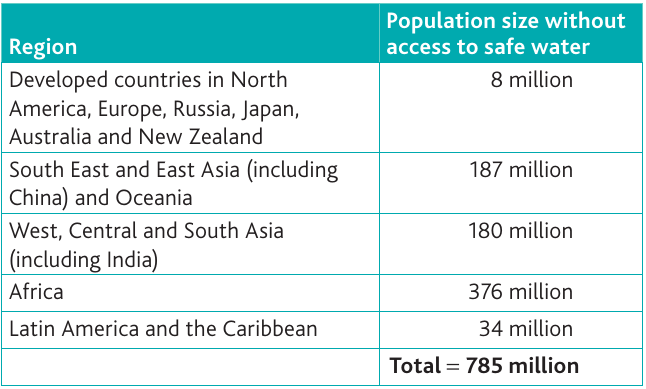
As the table shows, Africa has the highest number of people without access to safe water at 376 million, followed by South and East Asia (including China and Oceania) at 187 million.
Human rights and water access
In July 2010, the UN General Assembly passed a resolution declaring that having access to sufficient water and sanitation is a human right. This means:
- Supplies must be safe, acceptable, affordable and physically accessible
- The water source should be within 1,000 metres of the home
- Collection time should not exceed 30 minutes
Note
According to the World Health Organization (WHO), between 50 and 100 litres of water per person per day are needed to ensure that most basic needs are met, including irrigation for food supply.
Most people categorised as lacking access to clean water use about five litres a day. This is one-tenth of the average daily amount used by people in rich countries just to flush toilets. At minimum, people need at least two litres of safe water per day for drinking and for food preparation.
Wealthier countries have greater capacity to build reservoirs to store water or afford borehole drills and pumps to access aquifers underground. These countries will place more pressure on their water sources as populations increase.
Case study: The Ogallala aquifer
Important
Critical Water Depletion Crisis
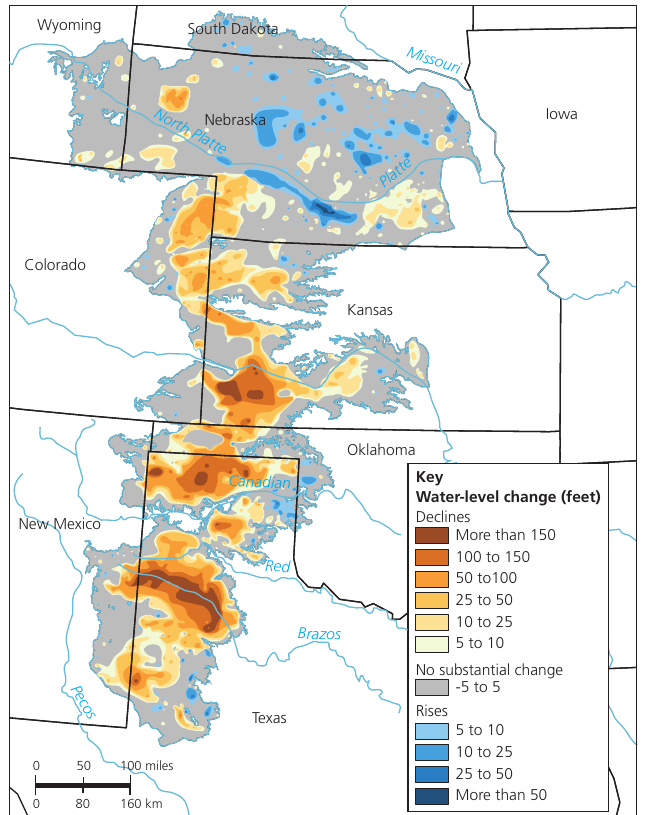
A major concern in the USA is the depletion of the giant Ogallala aquifer. This underground water source lies beneath the High Plains, stretching from north to south across eight states.
It serves as the most important underground water source for:
- Domestic water supply
- Industrial uses
- Agricultural needs, particularly for irrigation in the mid-West states
Water is being extracted from the aquifer at rates thousands of times greater than the natural recharge rate. This extraction is not sustainable. Current estimates suggest that the aquifer will be fully depleted within the next 25 to 30 years if extraction continues at present rates.
Note
The map clearly shows the extent of water-level decline, with the most severe depletion (more than 150 feet decline) concentrated in the Texas Panhandle region, shown in dark brown. Moderate to significant declines of 50-150 feet, shown in orange, affect portions of Kansas, Oklahoma and northern Texas.
Water resources – global patterns of availability and demand
Important
The Distribution Problem
There is enough fresh water on the planet to support seven billion people. However, the key problem is that too much of this water is wasted, polluted or unsustainably managed. Global distribution is also highly uneven.
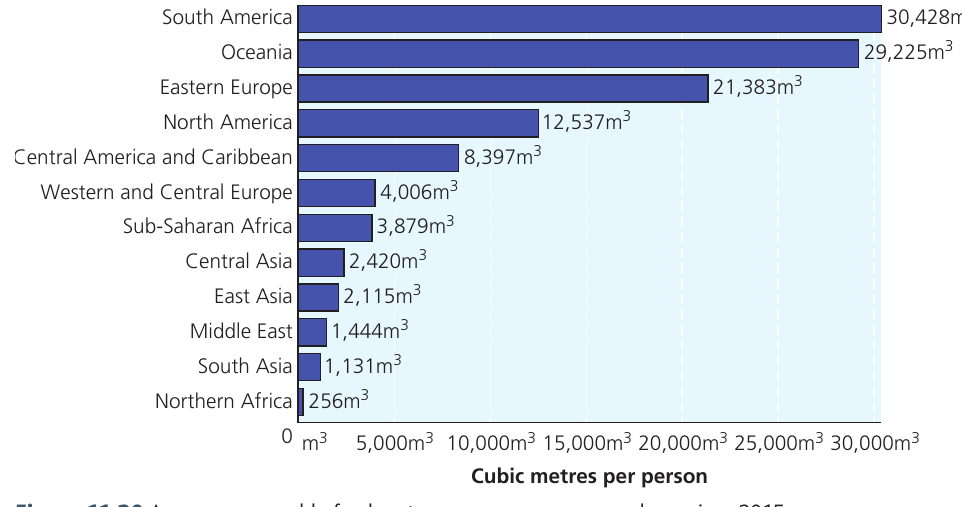
The chart demonstrates dramatic variations in water availability across different world regions. South America has the highest per capita availability at 30,428 cubic metres per person, whilst Northern Africa has the lowest at just 256 cubic metres per person. This represents more than a 100-fold difference in water availability.
Areas most likely to suffer water shortages
Two main categories of countries are at greatest risk:
Countries experiencing rapid population growth:
- Poorer countries in sub-Saharan Africa face particular challenges
- This population growth results in increased demand for drinking water for humans
- More water is needed for livestock and for irrigation to maintain food supplies
- Additional water is required for hygiene to prevent the spread of disease
Regions suffering from physical water shortages:
- Areas affected by prevailing climatic conditions that limit water availability
- Many cases are worsened because of climate change
- Countries in the Middle East and North Africa (MENA) are particularly prone to these problems due to naturally dry climates and limited rainfall
Summary
Key Points to Remember:
-
Water is renewable but faces increasing pressure from population growth, with 785 million people globally lacking access to basic safe drinking water
-
Water stress occurs when demand exceeds supply, and by 2025, half of the world's population will live in water-stressed areas
-
The UN recognises access to safe water and sanitation as a human right, with WHO recommending 50-100 litres per person per day for basic needs
-
Major underground water sources like the USA's Ogallala aquifer are being depleted thousands of times faster than they can naturally recharge, with full depletion expected in 25-30 years
-
Global water distribution is highly uneven – South America has 30,428m³ per person whilst Northern Africa has only 256m³ per person