Strategies to Manage Consumption (AQA A-Level Geography): Revision Notes
📚Revision Notes
Strategies to Manage Consumption
Introduction to water consumption management
In many regions where water scarcity is not an immediate concern, fresh water is frequently taken for granted and wasted. However, regardless of how water is used, there are significant opportunities to reduce consumption and improve water management practices. Effective strategies exist for domestic, industrial, commercial, and agricultural contexts, each offering substantial potential water savings.
Desalination: Increasing supply alongside demand management
Whilst the primary focus is on reducing consumption, it's important to understand desalination as a complementary strategy for increasing water supply in water-stressed areas.
Important
Desalination
Desalination is the process of removing salt from seawater to create potable (drinkable) fresh water. Whilst it provides a huge potential water supply, desalination is expensive, energy-intensive, and generates significant greenhouse gas emissions, making it less sustainable than demand management approaches.
There are two primary desalination methods used globally:
Reverse osmosis
This method filters seawater under very high pressure (typically 600-1,000 PSI) through a partially permeable membrane. The membrane contains tiny polyamide tubes that allow fresh water molecules to pass through whilst blocking salt and other impurities. The process produces two outputs: fresh potable water suitable for consumption, and highly saline water (brine) which is returned to the sea.
Distillation
This technique involves boiling seawater under reduced pressure, which lowers the boiling point and saves energy compared to standard boiling. As the water evaporates into steam, it leaves the salt and minerals behind in the boiler. The steam is then condensed and collected separately as fresh water.
Note
How Distillation Saves Energy
By reducing the pressure around the water, we can make it boil at a lower temperature. This means less energy is needed to heat the water compared to boiling it at normal atmospheric pressure - a clever way to make the process more efficient.
Case study: Thames Water's Beckton desalination plant
Desalination facilities have been established in wealthier nations experiencing water stress, including countries in the Middle East (such as Saudi Arabia, Oman, and the UAE), around the Mediterranean, and in the USA and Australia.
Example
Real-World Application: Thames Water Beckton Plant
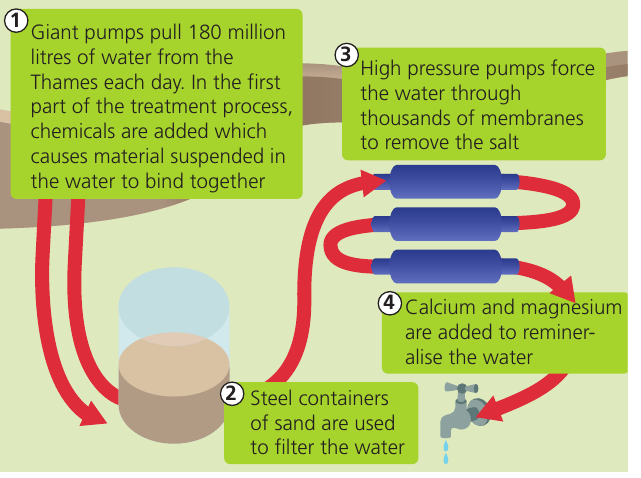
Thames Water operates a desalination plant at Beckton in East London. This facility uses reverse osmosis membrane filtration and has the capacity to produce 180 million litres of water daily, serving approximately 400,000 households.
The plant was built to address water security concerns in South East England, which has been designated an 'Area of Serious Water Stress'.
Managing domestic water consumption
Domestic settings offer numerous opportunities for water conservation. The most effective starting point is ensuring households pay for what they actually use through water metering systems.
Water metering
Water meters measure the volume of water consumed by a household, allowing water companies to charge based on actual usage rather than a fixed rate. This creates a financial incentive to reduce waste. In regions designated as areas of serious water stress, companies such as Southern Water, Thames Water, and South East Water are installing meters to encourage more responsible water consumption.
Reducing toilet water use
Approximately 30% of water used in homes goes towards flushing toilets. This represents a significant opportunity for savings through several methods:
- Displacement devices: Installing a simple device (such as a 'hippo bag' or water-filled bottle) in the toilet cistern reduces the volume of water used per flush
- Low-flush toilets: Modern toilets designed to use less water per flush
- Dual-flush systems: Toilets with two flush options - a reduced flush for liquid waste and a full flush for solid waste
Note
Simple Water-Saving Tip
A displacement device in your toilet cistern can save several litres of water with every flush. Over a year, this simple addition can save thousands of litres per household - and it's often free from water companies!
Personal hygiene modifications
Simple behavioural changes can achieve substantial water savings:
- Taking showers instead of baths uses considerably less water
- Reducing shower duration further decreases consumption
Efficient household appliances
Modern technology offers improved water efficiency across domestic machinery:
- Water-efficient washing machines use less water per cycle
- Efficient dishwashers reduce water consumption compared to older models
- These appliances typically also use less energy, reducing both water and electricity bills
Additional domestic strategies
- Boiling only what you need: Filling kettles with just enough water for immediate requirements
- Rainwater harvesting: Collecting rainwater in water butts for garden irrigation, reducing demand on mains water supplies
Managing industrial and commercial water consumption
Similar principles apply in commercial and industrial settings, though implemented at a larger scale.
Modern buildings and commercial complexes are increasingly designed with water efficiency as a priority from the outset. Key features include:
- Rainwater collection systems: Harvesting rainwater which is filtered and directed into toilet cisterns and washbasin systems
- Reduced abstraction: Using collected rainwater reduces the need to extract water from traditional sources (rivers, aquifers)
- Energy savings: Less water abstraction means less energy required for water treatment and pumping from these sources
Note
Dual Benefits of Commercial Water Systems
Integrated rainwater collection systems in modern buildings provide dual benefits: they conserve water resources by reducing abstraction from natural sources, and they reduce operational costs by decreasing both water consumption and the energy needed for treatment and pumping.
Managing agricultural water consumption
Agriculture accounts for a substantial proportion of global freshwater use, making efficient irrigation particularly important for water security.
Important
Micro-irrigation
Micro-irrigation is the most efficient agricultural irrigation method. It uses low-flow technology to deliver water directly to plant roots at controlled rates, preventing deep percolation (water sinking below root level), evaporation, and surface run-off losses.
Types of micro-irrigation systems
There are three main types of micro-irrigation technology:
Drip feed irrigation: Small irrigation heads deliver water as a slow drip or trickle directly at the base of each plant. This targeted approach ensures water reaches the root zone where it's needed.
Soaker hoses: These are hoses with small perforations along their length that allow water to seep out gradually. They are placed at the plant base and work particularly well with crops planted in rows, delivering water along the entire length of the row.
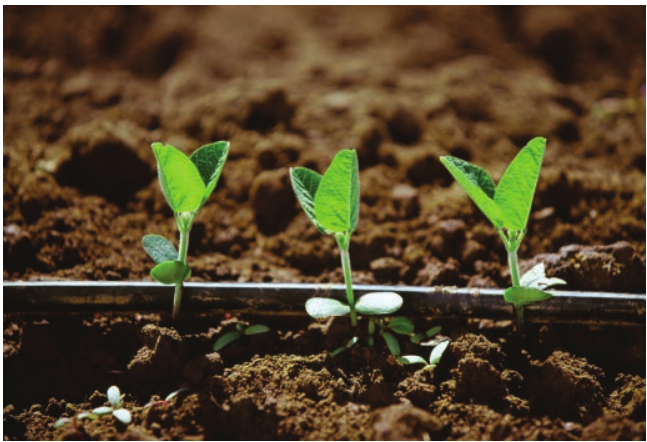
Micro-sprayers: Overhead sprinklers that deliver a fine, controlled mist rather than large water droplets. The fine mist reduces evaporation compared to traditional sprinkler systems whilst still providing even coverage.
Example
Comparing Irrigation Efficiency
Traditional sprinklers: Can lose 30-50% of water to evaporation and run-off
Micro-irrigation systems:
- Drip feed: Delivers water directly to roots with minimal waste
- Soaker hoses: Allows slow seepage at ground level, reducing evaporation
- Micro-sprayers: Fine mist reduces water loss while maintaining coverage
Result: Micro-irrigation can save up to 60% of water compared to traditional methods while improving crop yields.
Additional agricultural water conservation measures
Beyond irrigation technology, farmers and growers can implement various complementary strategies:
- Mulching: Applying organic material (such as straw or wood chips) to soil surfaces wherever possible retains moisture by reducing evaporation
- Storm water collection: Capturing rainfall and irrigation run-off in ditches or drainage systems for reuse
- Strategic timing: Watering early in the morning when temperatures are lower reduces evaporation losses
- Minimal ploughing: Leaving at least 30% of previous crop residue in the field helps retain soil moisture and structure
- Contour ploughing: Ploughing across slopes rather than up and down reduces water run-off
- Organic fertilisers: Using organic matter improves soil structure and moisture retention compared to synthetic fertilisers
- Cover crops: Growing cover crops during winter and fallow periods improves soil quality, reduces erosion, and minimises water loss
Note
Soil Management for Water Conservation
Many of these agricultural techniques work by improving soil structure and moisture retention capacity. Healthy soil acts like a sponge, holding water where plants can access it rather than losing it to deep percolation or surface run-off. This means crops get more benefit from every drop of water applied.
Summary
Key Points to Remember:
-
Desalination provides additional water supply but is expensive and energy-intensive. Reverse osmosis and distillation are the two main methods used globally.
-
Water meters in homes create financial incentives to reduce waste, making them one of the most effective demand management tools, especially in water-stressed regions.
-
Domestic water savings focus on three main areas: toilets (30% of home water use), personal hygiene (showers vs baths), and efficient appliances (washing machines, dishwashers).
-
Micro-irrigation is the most efficient agricultural method, delivering water directly to plant roots through drip systems, soaker hoses, or micro-sprayers, preventing percolation, evaporation and run-off.
-
Complementary measures enhance water savings: These include rainwater harvesting, mulching, strategic timing of irrigation, and soil management practices that retain moisture.