Sustainability Issues (AQA A-Level Geography): Revision Notes
📚Revision Notes
Sustainability issues
Introduction to sustainable water management
Managing water resources sustainably means finding a better long-term balance between the water we have available and the amount we need to use. The key aim is to reduce harmful impacts on the environment whilst ensuring there will be enough water for people living in the future. This approach is particularly crucial in regions already experiencing water stress, where demand is close to or exceeds supply.
Note
The goal of sustainable water management is to balance current water needs with future availability while minimizing environmental damage. This becomes especially critical in water-stressed regions where demand approaches or surpasses supply.
Virtual water trade
Important
Virtual water refers to the volume of water used during the production of agricultural or industrial goods.
When countries buy and sell products internationally, they are also indirectly trading the water that was needed to make those items. This concept helps us understand how water-scarce nations can meet their needs without depleting their own limited water supplies.
Professor Tony Allan developed this idea to explain how countries facing water shortages could still provide food, clothing and other water-intensive products to their populations without using up their domestic water resources. Countries experiencing water scarcity often choose to import goods that need large amounts of water to produce, whilst exporting products or services that require less water to create. This pattern means that water-scarce nations, particularly in the Middle East, become net importers of 'virtual water', helping to ease pressure on their own supplies.
Example
Virtual Water in Practice: Wheat Production
Producing just one tonne of wheat requires approximately of water.
When a country imports wheat, it effectively saves this volume from its own water supplies.
For example, water-scarce countries like Israel may choose to discourage exports of water-intensive products such as oranges to prevent large quantities of water leaving the country indirectly.
Conservation measures
Land use, ecological management and afforestation
One important strategy for conserving water involves carefully managing how land is used within a river basin. This approach affects several key processes:
- Run-off - the flow of water across the surface
- Infiltration rates - how quickly water soaks into the ground
- Groundwater storage - water held underground in aquifers
When impermeable surfaces expand in and around urban areas, they increase surface run-off. This directs water quickly into river channels, which are only short-term storage locations. In contrast, when permeable land uses increase, more water infiltrates the ground and percolates downwards. This process takes water into deeper, long-term groundwater storage, boosting future supply availability.
Note
Vegetation coverage, including forests and tree plantations, plays a vital role in regulating the water cycle. Plants reduce surface run-off and help replenish the water table. When evapotranspiration from leaves isn't excessive, vegetation helps maintain groundwater stores at more sustainable levels.
Afforestation can serve as an effective water conservation tool. Forested catchments supply good quality water suitable for both domestic and agricultural purposes. At a micro-climatic to regional scale, tree planting programmes have often been suggested as methods to increase rainfall.
Important
The Tree Planting Debate
There is ongoing debate about the desirability of tree planting in arid regions. Trees consume water as they grow, and the more developed the root system becomes, the more water they draw from the ground through transpiration. Some experts question whether trees actually provide more water to the system than they remove, particularly in drier environments.
Recycling and grey water
Several conservation approaches focus on reusing water:
Recycling through treatment: Water can be recycled through extensive sewage treatment processes. In London, approximately 90% of used water undergoes recycling by being treated immediately after returning to the drains. However, in the Middle East and North Africa (MENA countries), around 82% of wastewater currently isn't recycled. This represents a significant opportunity to reduce water stress in these regions.
Note
Greywater is water that has already been used for washing or cleaning activities but hasn't come into contact with faecal matter (which is called black water).
Greywater can be reused for purposes where drinking-quality water isn't necessary. Suitable applications include flushing toilets, watering gardens, or providing irrigation.
This recycling approach works particularly well in hotels, leisure centres, and large office or residential buildings, where it can recycle water used in baths and showers to flush toilets.
Leakage control: Improved maintenance of supply pipes, taps and appliances prevents water losses, ensuring more of the treated water reaches its intended destination.
Groundwater management - aquifer recharge
Aquifers naturally take considerable time to refill, but they can be recharged artificially through several methods:
- Artificial infiltration - pumping water underground to replenish aquifer levels
- Diverting rivers to permeable surfaces - redirecting river water to areas where it can soak into the ground more easily
- Diverting storm water into recharge wells - capturing rainwater and directing it underground
Important
Rainwater harvesting involves collecting and storing rainwater to replenish subsurface water supplies.
This technique is used extensively in India and Australia (where the systems are known as 'leaky wells'). Rainwater harvesting provides an excellent method for storing surplus water during periods when supply exceeds demand. The stored water then becomes available during times when supplies are less plentiful. Maintaining aquifers through these techniques helps keep rivers flowing and ensures surface stability.
Water conflicts
Important
Water conflict describes disputes between countries, states or groups with opposing interests concerning access to water resources.
Local scale
When water demand exceeds available supply and no effective management exists, conflicts may develop between different users of that water source. At a local level, these conflicts typically arise because different users want access to a scarce resource. Such situations can lead to sabotage or even escalate into violent protests.
Example
Local Scale Conflict: Chile's Water Code
In Chile, there are competing demands for limited water supplies. Under Chile's Water Code, water is treated as a commodity, meaning companies can request water rights allocated by the government.
In northern Chile, conflicts have emerged between agricultural activities and copper mining operations competing for access to the scarce resource. Mining companies can afford to pay more for water, so supplies have been diverted away from farms. This has led to significant conflict and protests from local farming communities.
Example
Local Scale Conflict: Petorca's 'Green Gold'
More recently, the central town and province of Petorca has become a focal point for water conflicts. This area is a key avocado-growing region. Rising global demand for avocados (locally known as 'green gold') has intensified tensions over water rights.
Conflicts exist between large commercial producers who have established operations in the area and local citizens, including small-scale farmers.
The Issues:
- Campaigners have accused large producers of water theft, claiming they use significantly larger amounts of water than their permitted allocations
- Evidence has been presented showing illegal underground pipes and systems delivering water from rivers to orchards on hillsides
- Rivers are drying up, leaving farmers unable to irrigate their crops
- Citizens in Petorca must rely on water delivery by truck
National scale
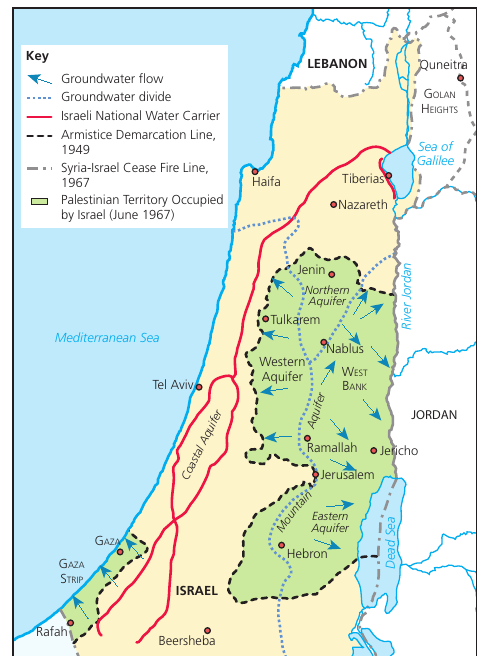
Disputes at this level often result from water scarcity combined with uneven distribution of available resources. Although Israel and the Palestinian Authority are two separate states, they can be examined together at a national scale for water management because much of the Palestinian territory remains under Israeli control.
The region's climate is very arid. With growing populations that share resources, there is increased tension concerning water availability and usage.
Note
The map shows the complex water situation in this region, including:
- Groundwater aquifers (Northern, Western, and Eastern Aquifers)
- The Israeli National Water Carrier infrastructure
- Groundwater flow directions
- Political boundaries including the 1949 Armistice Line and 1967 Cease Fire Line
- Palestinian territories occupied since 1967
- Major water bodies (Mediterranean Sea, Sea of Galilee, Dead Sea)
This geographical context demonstrates how water resources and political boundaries intersect, creating challenges for water distribution and management that affect populations on both sides.
Summary
Key Points to Remember:
-
Sustainable water management balances current needs with future supply whilst minimising environmental damage, particularly important in water-stressed regions.
-
Virtual water trade allows water-scarce countries to import water-intensive products rather than producing them domestically, effectively importing the water used in production.
-
Conservation measures include land use management, afforestation, recycling wastewater, using greywater, controlling leakage, and recharging aquifers through techniques like rainwater harvesting.
-
Water conflicts occur at multiple scales - locally between different user groups (farmers vs. mining companies in Chile; large vs. small producers in Petorca) and nationally between states (Israel and Palestinian Authority).
-
Key statistic: Producing one tonne of wheat requires of water, showing why virtual water trade matters for water-scarce nations.