Water Conflicts (AQA A-Level Geography): Revision Notes
📚Revision Notes
Water Conflicts
What are water conflicts?
A water conflict occurs when different countries, states or groups have opposing interests over how water resources should be accessed and used. These disputes emerge when water becomes scarce and multiple parties compete for limited supplies.
Important
Water conflict is a dispute between countries, states or groups with opposing interests over access to water resources.
Water conflicts can develop at different geographical scales, from local communities competing for a single water source to international disputes over shared river systems. The severity of these conflicts often depends on the level of water scarcity, the effectiveness of water management, and whether resources are distributed fairly between users.
Local scale conflicts
Local water conflicts arise when the demand for water exceeds available supply and there is no effective management system in place. Different users compete for the same scarce water source, which can lead to disagreements, sabotage or even violent protests.
Chile's water commodification
Chile provides a clear example of local water conflict. Under Chile's Water Code, water is treated as a commodity that can be bought and sold. This system allows companies to request water rights from the government, creating a market-based approach to water allocation.
Note
In northern Chile, conflicts have developed between agriculture and copper mining industries. Both sectors need water, but mining companies can afford to pay higher prices. As a result, water has been diverted away from farms to mining operations, leading to protests from local farming communities who have lost access to this essential resource.
The Petorca conflict
The central Chilean town and province of Petorca has become a focal point for water disputes. This area is a major avocado-growing region, and the global popularity of avocados (marketed locally as 'green gold') has intensified competition for water.
Example
Case Study: Petorca's Avocado Water Crisis
Large commercial avocado producers have moved into the Petorca region and compete with small-scale farmers for limited water supplies. Campaigners have accused these big producers of water theft, claiming they use far more water than their official allocations permit. Evidence suggests some operations use illegal underground pipes and systems to divert water from rivers to their orchards on hillsides.
The consequences are severe:
- Rivers are drying up
- Small farmers cannot irrigate their crops
- Citizens of Petorca rely on water delivery by truck
- Local communities have lost access to a resource that was once freely available
National scale conflicts
National scale disputes typically result from water scarcity combined with uneven distribution of available resources. Although these conflicts occur within or between neighbouring states, they often have implications for regional stability.
Israel and Palestine
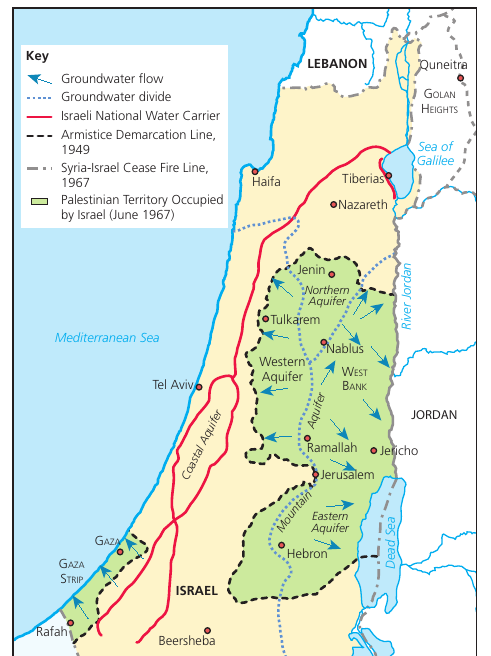
The Israel-Palestine situation demonstrates how water conflicts operate at a national scale, even though the involved parties are technically two separate states. Much of Palestinian territory is controlled by Israel, making water management a shared yet deeply unequal issue.
The region has an arid climate, and growing populations sharing limited resources have created serious tensions over water availability and access. Water has become both a practical necessity and a political weapon in the ongoing conflict.
The role of water as a weapon
Many experts argue that access to water is used as a strategic tool in the Israel-Palestine conflict. Water is essential for both irrigation and settlement development, giving whoever controls it significant power over the region's future.
Important
The Jordan River, which provides vital water supplies, runs dry most years because Israel controls sole use of the Sea of Galilee near the river's source. This prevents water from reaching downstream users in Palestinian territories.
Groundwater and the mountain aquifer
The main source of water in the region is the mountain aquifer, which lies mostly in Palestinian territory within the West Bank. However, Israel controls this aquifer system. The statistics reveal the inequality:
- Israel uses 80 per cent of the mountain aquifer's water
- Palestinians receive only 20 per cent
- Israel has built settlements on Palestinian territory in the West Bank, further securing access to the occupied water source
Water supply challenges
Palestinian farmers struggle with insufficient water for irrigation. Meanwhile, Israel supplements its water supply through desalination technology, which removes salt from seawater. However, this expensive solution is not affordable in Palestinian Gaza.
Note
Israel does sell some water to Gaza and operates the national water carrier system that transports water from the north. However, this carrier stops short of the border, preventing direct water flow into Palestinian territories.
International scale conflicts
International water disputes emerge when countries share transboundary river basins. These conflicts usually develop because an upstream nation's water use affects the quantity or quality available to nations downstream.
How international conflicts develop
When countries share a river system, actions in one country create consequences for others. Dam construction can reduce water flow to downstream nations. Industrial development along shared rivers may increase pollution levels, degrading water quality for all users further down the system. These issues create tensions and can damage diplomatic relations.
International agreements help manage transboundary river basins and prevent conflict. However, disputes still occur even where agreements exist.
Global scale of the issue
Thirteen major river basins worldwide are shared between 5 and 8 different nations. Five basins—the Congo, Niger, Nile, Rhine and Zambezi—are shared between 9 and 11 countries. This complex sharing of vital water resources creates numerous potential conflict points.
Examples of international conflict regions
Example
The Aral Sea Crisis
Kazakhstan and Uzbekistan share the Aral Sea basin. Over-abstraction of water for cotton irrigation from the two rivers feeding the sea (Syr Darya and Amu Darya) has caused an environmental disaster.
The scale of destruction:
- Half of the sea's surface has disappeared
- Loss of approximately 36,000 km² of water
- Volume reduced by two-thirds
- Former seabed now covered by salt, creating a toxic landscape
This represents one of the world's worst man-made environmental catastrophes.
Example
Turkey's River Diversions
Turkey occupies a dominant position upstream on the Tigris and Euphrates rivers. The country has been diverting water from these rivers, which has increased water stress in the already volatile states of Iraq and Syria downstream.
These diversions reduce the water available to millions of people and can destabilise an already fragile region, demonstrating how water control can have far-reaching geopolitical consequences.
'Water wars' and basins at risk
These situations represent what experts call 'basins at risk'—areas where tensions at an international scale could potentially escalate into so-called 'water wars'. The combination of water scarcity, growing populations, and shared resources creates conditions where conflicts over water could intensify significantly.
Summary
Key Points to Remember:
- Water conflicts occur at three main scales: local (between different users), national (within or between neighbouring states), and international (between countries sharing river basins)
- Local conflicts often arise from poor water management and occur when different users compete for scarce supplies, as seen in Chile and Petorca
- At national scale, water can be used as a political weapon, with the Israel-Palestine conflict showing how control of aquifers and water infrastructure creates significant inequality
- International disputes typically involve transboundary river basins, where upstream nations' actions affect downstream countries' water supply and quality
- Major conflict regions include the Aral Sea (Kazakhstan-Uzbekistan) and the Tigris-Euphrates river system (Turkey-Iraq-Syria), representing 'basins at risk' where tensions could escalate into 'water wars'