Resource Frontier (AQA A-Level Geography): Revision Notes
📚Revision Notes
Resource Frontier
What is a resource frontier?
A resource frontier is an area where natural resources are exploited commercially for the first time. These are regions where valuable minerals, fossil fuels, or other resources have been discovered and are now being developed for economic production.
Resource frontiers represent the outer edge of economic development, where previously untapped resources become accessible through new technology, infrastructure, or market conditions. They can exist at various geographical scales, from regional to global levels.
Note
Resource frontiers are dynamic - as technology advances and market conditions change, previously inaccessible resources can suddenly become economically viable to exploit. This means new frontiers are constantly emerging across the globe.
Friedman's core-periphery model
In 1963, geographer John Friedman proposed a spatial development model that helps explain how resource frontiers fit into broader economic patterns. His core-periphery model shows how economic development occurs unevenly across space.
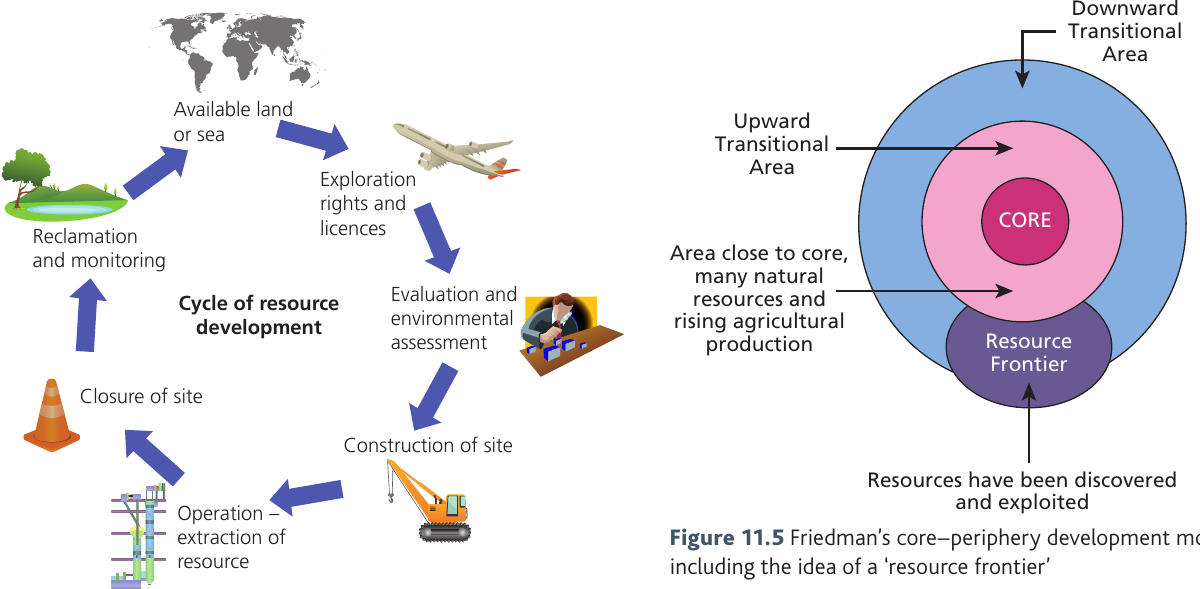
The model consists of several distinct zones:
The core region:
- Wealthy central area that attracts most investment and capital
- Possesses natural advantages due to location
- Contains significant natural resources
- Supports productive agricultural land
- Concentrates economic activity and development
Upward transitional area:
- Zone close to the core
- Benefits from proximity to the wealthy centre
- Experiences development spreading outward from core
- Rising living standards and economic indicators
Downward transitional area:
- Peripheral regions that remain largely underdeveloped
- Fails to attract sufficient investment
- Lags behind in living standards and growth
- Experiences lower development indicators
Resource frontier zone:
- Outermost area where resources have been discovered and are being exploited
- May have poor social development initially
- Experiences rapid economic growth due to resource extraction
- Attracts influx of workers directly or indirectly linked to resource industries
- Creates employment opportunities but social conditions may remain challenging
Note
This model demonstrates that whilst the resource frontier may still have underdeveloped social infrastructure, the economic activity generated by resource extraction can trigger rapid regional transformation. The key insight is that economic growth does not automatically translate to improved social conditions - these often lag behind.
The resource development cycle
Resource development follows a systematic cycle with distinct stages, from initial discovery through to environmental restoration after extraction ends.
Exploration rights and licences
Once potential resource-bearing land or sea areas are identified, extraction companies must obtain legal permission to explore and develop the resources. This involves securing exploration rights and operating licences from relevant authorities.
Evaluation and environmental assessment
Before development begins, thorough evaluation takes place:
- Assessing the size and quality of the resource reserve
- Conducting environmental impact assessments
- Analysing economic viability through cost-benefit analysis
- Determining the most appropriate extraction methods
Important
Cost-benefit analysis
A systematic analysis of the advantages and disadvantages likely to result from a development project. An objective value is allocated to all economic, social and environmental aspects affected by the development.
This comprehensive approach ensures that decisions consider not just profit, but also social and environmental impacts.
Construction of infrastructure
After licences are granted, essential infrastructure must be built to access and extract the resource:
- Road networks to transport equipment, workers and extracted materials
- Pipeline systems (if the resource is oil or gas)
- Port facilities for shipping resources to markets
- Processing plants and storage facilities
- Worker accommodation and support services
This construction phase transforms the landscape and creates initial employment opportunities.
Note
Infrastructure development often has lasting impacts beyond the lifetime of resource extraction. Roads, ports, and other facilities may continue to serve communities long after mining or drilling operations have ceased, potentially supporting alternative economic activities.
Operation and extraction
This is the active production phase where the resource is extracted from the ground or seabed:
- Resource exploitation continues until viable reserves are exhausted
- The operational lifespan varies depending on the type and quantity of resource present
- Exploration programmes often continue during operations to locate additional reserves in adjacent areas
- Finding new deposits extends the operation's life and economic benefits to the region
- Enhanced recovery techniques may be employed as reserves deplete
For valuable resources like oil, secondary and tertiary recovery operations can extend production:
- Using steam injection to reduce oil viscosity
- Applying detergent solutions under pressure to force remaining oil to the surface
- These methods extract resources that would otherwise be uneconomical to recover
Closure of operations
Closure does not necessarily mean the reserve has been completely exhausted. Operations end when:
- Remaining resources become uneconomical to extract
- Costs of extraction exceed the value of remaining reserves
- The residual stock is too difficult or expensive to recover
Important
Many people assume that closure means all resources have been extracted. In reality, a significant residual stock often remains in the ground because it would cost more to extract than it would earn. Future technological advances or price increases might make this residual stock economically viable again.
Reclamation and monitoring
In developed countries with strict environmental regulations, reclamation has become an essential final stage:
- Operating companies are responsible for rectifying environmental damage
- Site restoration attempts to return the area to a natural or usable state
- Ongoing monitoring ensures environmental standards are maintained
- Land is rehabilitated for alternative uses where possible
However, environmental management and reclamation are not always prioritised in developing countries, where regulations may be less stringent or poorly enforced.
Resource frontiers at different scales
Resource frontiers can be identified at various geographical scales, from national to global levels.
National and regional examples
Within the United Kingdom, Scotland can be viewed as a peripheral region situated far from the economic core in south-east England. The development of North Sea oil reserves from the 1980s onwards transformed north-east Scotland into a resource frontier.
The local economy experienced significant transformation:
- Became a base for the oil industry and associated activities
- Developed specialist technology sectors supporting oil extraction
- Created ancillary industries providing services to the oil sector
- Generated employment and boosted regional prosperity
Note
The Scottish experience demonstrates how resource frontiers can transform regional economies. North-east Scotland, particularly Aberdeen, evolved from a relatively peripheral region into an international centre for offshore oil technology and expertise. This shows that resource frontiers can create lasting technological and industrial capabilities that extend beyond simple extraction activities.
Global resource frontiers
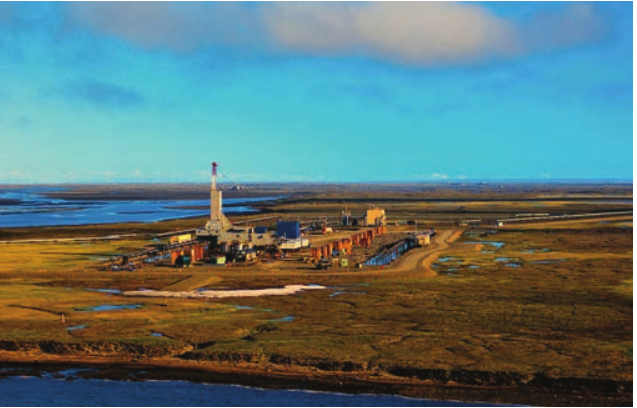
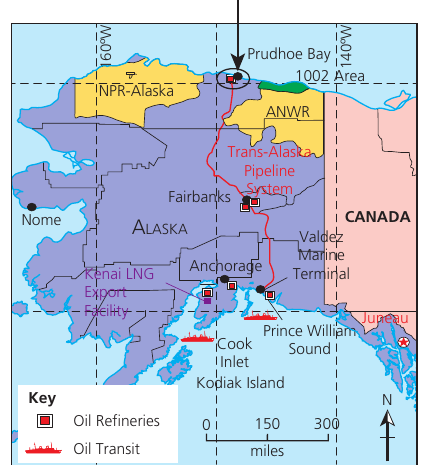
On a global scale, resource depletion in 'core' areas of wealthy nations in North America and Europe has prompted intensive searches for mineral and fossil fuel reserves elsewhere. The growing influence of energy and mining transnational corporations (TNCs), combined with globalisation, has led to discovery of numerous new reserves in lower-income countries.
Alaska and the Trans-Alaska Pipeline provides an excellent example of overcoming geographical challenges to exploit resources. The transportation difficulties of extracting crude oil from the Arctic region of North Alaska were resolved through construction of the Trans-Alaska oil pipeline. This infrastructure development transformed Alaska into a significant resource frontier in the USA.
Countries such as Azerbaijan, China and South Sudan (all with considerable oil reserves) have become 'resource frontiers' on a global scale. These nations in Asia, Africa and Central America now play increasingly important roles in global resource supply chains.
Note
The shift of resource frontiers to developing nations raises important questions about:
- Who benefits from resource extraction - local populations or international corporations?
- Environmental protection standards in countries with weaker regulations
- The potential for "resource curse" - where resource wealth fails to translate into broad-based development
- Geopolitical tensions as major powers compete for access to strategic resources
Resource peak
Important
Resource peak
The resource peak is the point in time when the maximum rate of production of a resource is reached, either from a specific reserve or for the resource as a whole.
The concept of peak oil
The idea of resource peaks developed from the theory of 'peak oil', originally proposed by Shell geophysicist M.K. Hubbert in 1956. Since then, this concept has been applied to other finite energy resources and minerals.
Hubbert made remarkably accurate predictions about conventional oil production patterns. He forecast that conventional oil production from the lower 48 mainland states (excluding Alaska) of the USA would reach its peak between 1965 and 1970, then enter a decline phase.
Important
Conventional oil and gas
Petroleum, or crude oil, and raw natural gas extracted from the ground by conventional means and methods - traditional drilling and pumping techniques.
This contrasts with unconventional reserves that require advanced extraction technologies like hydraulic fracturing (fracking) or thermal recovery methods.
Understanding the Hubbert curve
Hubbert's theory suggests that at any scale - from an individual oil-producing reserve to the entire planet - the rate of oil production tends to follow a bell-shaped curve.
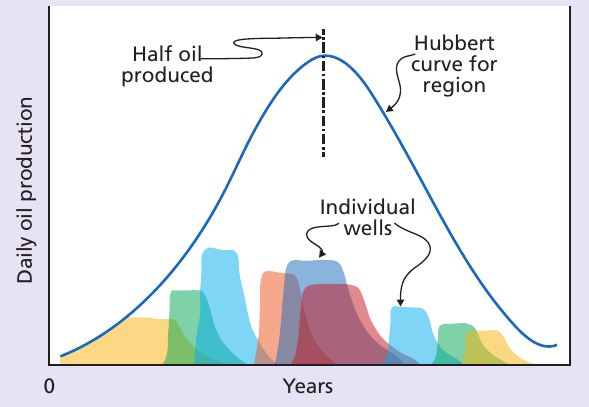
The curve shows:
- Production starts slowly as extraction begins
- Output increases as infrastructure develops and techniques improve
- Production reaches a maximum peak when approximately half the oil has been extracted
- After the peak, production declines as reserves deplete
- Eventually production ceases when remaining reserves are exhausted or uneconomical
Production curves for oil are often called 'Hubbert curves' and can be plotted for all reserves as they are discovered and exploited.
Note
The Hubbert curve reveals an important insight: the peak occurs when approximately 50% of the resource has been extracted, not when reserves are nearly exhausted. This means that half the resource remains after the peak, but it becomes progressively more difficult and expensive to extract. This explains why production rates decline even though substantial reserves still exist underground.
Peak oil versus depletion
It is crucial to understand that peak oil represents the point of maximum production, whilst depletion refers to a period of falling output. The peak comes first, followed by the depletion phase. Peak oil marks the transition between the growth phase and the decline phase of resource extraction.
Important
Unconventional (oil and gas) reserves
Hydrocarbon reservoirs that have low permeability and porosity, making them difficult to produce. They require enhanced recovery techniques such as fracture stimulation. Examples include shale deposits, tar sands and heavy oils.
As conventional reserves deplete and pass their peak, unconventional reserves become increasingly important - but they come with higher extraction costs and greater environmental concerns.
As conventional reserves deplete, attention increasingly turns to unconventional reserves. However, these require more complex and expensive extraction technologies, which impacts their economic viability and environmental consequences.
Remember!
Summary
Key Takeaways: Resource Frontiers
-
Resource frontiers are areas where resources are exploited commercially for the first time, often in peripheral regions far from economic cores
-
Friedman's core-periphery model explains how resource frontiers exist in the outermost zone, experiencing rapid economic growth despite poor social development
-
The resource development cycle involves seven key stages: exploration rights, evaluation, construction, operation/extraction, closure, and reclamation
-
Resource frontiers exist at multiple scales - from national examples like Scotland's North Sea oil to global frontiers in Alaska, Azerbaijan, China and South Sudan
-
Resource peak (especially peak oil) describes the maximum production point following a bell-shaped curve, after which production enters decline - this is different from complete depletion
-
Peak occurs at approximately 50% extraction - significant reserves remain after the peak, but become progressively harder and more expensive to recover
-
Environmental reclamation is essential in developed countries but often neglected in developing nations, raising concerns about long-term environmental damage