Stock Resource Evaluation (AQA A-Level Geography): Revision Notes
📚Revision Notes
Stock Resource Evaluation
What are stock resources?
Mineral deposits located within or upon the Earth's crust form the primary component of stock resources. These deposits represent concentrations of naturally occurring materials that can be solid, liquid, or gaseous in form. They encompass inorganic substances or fossilised organic matter, including precious metals, gemstones, mineral ores (such as iron and copper), and fossil fuels like oil, gas, and coal.
Note
The value of mineral deposits emerges when they are discovered in sufficient quantities and possess adequate quality to make economic extraction a realistic prospect. However, simply finding a mineral deposit doesn't automatically make it valuable – the deposit must meet specific criteria that justify the investment required to extract it.
Understanding the distinction between resources and reserves
A crucial concept in stock resource evaluation involves differentiating between two related but distinct terms: resources and reserves.
Important
Resources encompass all deposits of mineral materials, regardless of whether they are known, yet to be discovered, or discovered but not economically viable to extract. This is the broadest category.
Important
Reserves represent the portions of the resource base that are available for use because they are both economically viable and technically feasible to extract. This is a more specific, practical category.
The boundary between resources and reserves is not fixed – it can shift and become blurred over time. This happens because commodity prices fluctuate considerably, and technological advances occur relatively rapidly. When prices for a particular mineral increase, or when new technology reduces extraction costs, previously uneconomic 'resources' can be converted into economically viable 'reserves'. Similarly, improved technology that provides better access to remote deposits can transform resources into reserves.
The McKelvey classification system
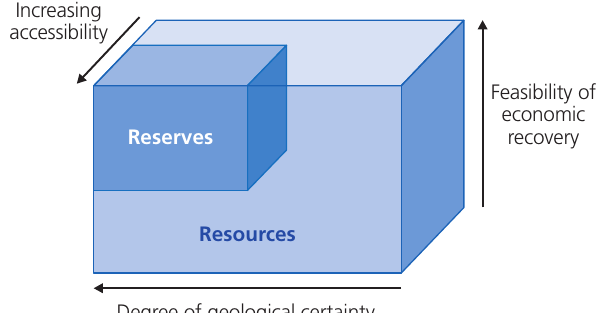
A visual tool called the McKelvey box or diagram (named after US geologist Vincent McKelvey) helps distinguish between resources and reserves whilst showing the differences that exist within these two broad categories.
Note
The Two Key Parameters
The McKelvey diagram uses two distinct parameters to classify mineral deposits:
Geological certainty measures the degree of confidence that a deposit actually exists. This assessment relies on initial survey information covering the deposit's characteristics, including quality, quantity, location, and depth. The more extensive the geological surveying and sampling, the higher the degree of certainty.
Economic viability evaluates whether extracting the deposit would be profitable. This calculation balances the estimated monetary returns from the extracted material against the costs of extraction. Several factors influence economic viability, including technological advances, shifts in global commodity prices, and levels of competition for that specific resource. Transport costs also significantly affect profitability, particularly for deposits in remote locations.
The larger box in the diagram represents the entire resource base for a given mineral, whilst the smaller cube positioned within shows the actual reserve – the portion determined to be economically recoverable based on current market conditions, extraction costs, and accessibility.
Classification by confidence level
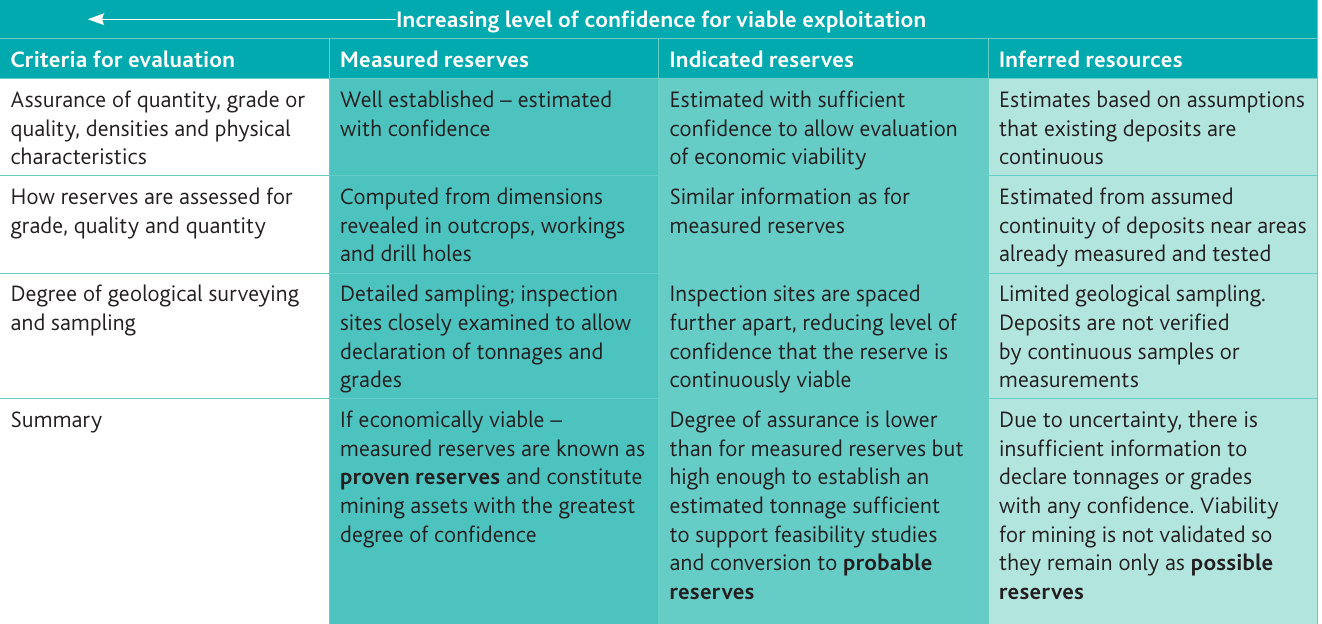
Mineral resources and reserves are subdivided according to increasing levels of geological confidence. The three main categories – measured, indicated, and inferred – follow what's known as the McKelvey concept. Although terminology varies slightly between US, Canadian, and Australian standards, these three major mining nations employ fundamentally the same classification approach based on confidence levels.
Measured reserves (proven reserves)
Measured reserves represent the highest level of confidence in stock resource classification. Characteristics include:
- Quantity assurance: Well established and estimated with considerable confidence
- Assessment approach: Calculated from dimensions revealed in outcrops, workings, and drill holes
- Geological surveying: Involves detailed sampling and inspection, with sites examined closely to establish accurate tonnages and grades through declaration of tonnages
- Economic status: When confirmed as economically viable, measured reserves become proven reserves – these constitute mining assets with the greatest degree of confidence
Important
Proven reserves specifically claim to possess at least a 90% probability of being recoverable under existing economic and technological conditions.
Indicated reserves (probable reserves)
Indicated reserves possess a lower confidence level than measured reserves but still demonstrate sufficient certainty to warrant serious consideration. Features include:
- Quantity assurance: Estimated with enough confidence to permit evaluation of economic viability
- Assessment approach: Similar information sources as measured reserves, though less comprehensive
- Geological surveying: Inspection sites are spaced further apart, which reduces the confidence level whilst still confirming the reserve remains continuously viable
- Economic status: The degree of assurance sits below that of measured reserves, yet proves high enough to establish an estimated tonnage sufficient for supporting feasibility studies and potential conversion to probable reserves
Inferred resources (possible reserves)
Inferred resources rate the lowest level of confidence amongst the three main categories. Their characteristics include:
- Quantity assurance: Estimates based on assumptions that existing deposits continue throughout the geological formation
- Assessment approach: Estimated from assumed continuity of deposits in areas already measured and tested
- Geological surveying: Limited geological sampling means deposits aren't verified by continuous samples or measurements
- Economic status: Uncertainty levels mean insufficient information exists to declare tonnages or grades with any confidence. Mining viability hasn't been validated, so these remain only as possible reserves
Possible resources and future prospects
Beyond the established categories of measured, indicated, and inferred deposits, possible resources represent materials that may become economically viable in the long term. However, confidence in their availability and viability remains considerably lower than for inferred resources, meaning timelines for potential future production extend much longer.
Note
Two Types of Possible Resources
Hypothetical resources comprise undiscovered materials that are reasonably expected to exist in known mining regions under recognised geological conditions. These represent educated projections based on existing geological knowledge of productive areas.
Speculative resources encompass undiscovered materials that may occur in known types of deposits within geological settings where no previous discoveries have been made. These represent the most uncertain category, based purely on geological similarity to productive areas elsewhere.
From resources to reserves: the role of exploration
Advancing technology plays a key role in determining the future availability of and access to more remote resources. However, equally important is the price or value of the resource itself, which may increase and prompt exploration for reserves in more distant locations, as they become more viable for production.
Exploration for mineral deposits that could potentially develop into economic resources proves time-consuming and expensive. Unlocking the economic value of embedded mineral deposits becomes even costlier. For instance, constructing a modern ore mine typically requires a minimum investment of $500 million and can easily reach $1 billion or more.
Note
Consequently, reserves can be classified as either recoverable or possible depending on various factors:
- Recoverable reserves represent amounts of a resource likely to be extracted for commercial use within a specific time period and at a particular level of technology
- Possible reserves are deposits thought to exist because the geological terrain resembles areas that have yielded commercially viable deposits, but no exploration has yet occurred
Only when economic benefits outweigh associated risks will production of a reserve proceed.
Resource development over time
The security of resource supply depends upon a combination of physical risks and geopolitical risks. Both categories require careful evaluation before deciding whether to exploit a resource in a particular area.
Physical risks
Physical risks relate to the accessibility of resources available in an area. They are evaluated against several criteria:
- Quantity: The total amount of the resource that has been discovered in the reserve
- Quality: The grade or purity of the resource within that reserve
- Physical location and accessibility: How easy it is to reach the deposit and extract materials from it
- Technology: The level of technology currently available to access the resource economically
Important
These factors determine whether extraction is technically feasible and economically sensible under current conditions.
Geopolitical risks
Geopolitical risks encompass political and economic factors that could affect resource availability:
- Concentration of production: The degree to which production is focused in a relatively small number of countries, potentially creating supply vulnerabilities
- Trading confidence: The level of confidence that individual countries have in trading relationships with producer nations, who may seek to exert their market power for political or economic advantage
- Conflict and political tensions: The possibility of warfare, political instability, or other major tensions arising in resource-producing regions, which could disrupt supply chains
Important
All these elements require consideration before committing to resource exploitation in any given area.
Cycle of natural resource development
Resource development will vary according to the type of material and its location. Organisations such as transnational corporations (TNCs) must apply for licences from appropriate authorities before exploring for resources in any given area. The development process typically follows this chronology:
Example
Development Process Timeline
Exploration of potential sites can span several years. For underground reserves, geologists employ satellite imagery, conduct geophysical surveys, and gather field data before they can assess the extent and potential quality of the reserve. This initial phase identifies whether sufficient quantities of the resource exist to justify further investigation.
Evaluation follows once discoveries have been made. Deposits must be fully evaluated to determine their viability for production under existing market conditions and production costs. In developed countries, a further assessment of the environmental impacts of operations is usually required before extraction can commence. This ensures that environmental damage is minimised and that the development can proceed sustainably.
Summary
Key Points to Remember:
- Stock resources primarily consist of mineral deposits (solid, liquid, or gaseous) found in Earth's crust, including precious metals, mineral ores, and fossil fuels
- Resources represent ALL deposits (known, unknown, viable or not), whilst reserves are specifically the economically viable and technically feasible portions that can be extracted
- The McKelvey classification system uses two key parameters: geological certainty (how confident we are the deposit exists) and economic viability (whether extraction would be profitable)
- Reserves are categorised by confidence level: measured reserves (proven - 90%+ confidence), indicated reserves (probable), and inferred resources (possible - lowest confidence)
- Physical risks (quantity, quality, location, technology) and geopolitical risks (production concentration, trading relationships, political stability) must both be evaluated before resource development proceeds