The Ending of Involvement in the First World War (AQA A-Level History): Revision Notes
📚Revision Notes
The Ending of Involvement in the First World War
The Bolshevik peace promise and its challenges
The Bolsheviks had seized power in October 1917 with a promise to withdraw Russia from the First World War and deliver peace to the war-weary population. However, achieving this proved extremely difficult. Germany and Austria-Hungary had already occupied large areas of Russian territory and would demand substantial concessions as the price for ending hostilities. The situation was further complicated by deep disagreements within the Bolshevik leadership about how to proceed.
Note
Armistice: a temporary cessation of fighting, agreed by both sides, usually as a preliminary step to formal peace negotiations.
Trotsky had negotiated an initial armistice with Germany in December 1917, but when formal peace negotiations began, the Bolsheviks found themselves divided over whether to accept German terms.
The Lenin-Trotsky divide over peace
Lenin's position
Lenin argued that Russia must accept peace with Germany, even on harsh terms. His reasoning combined both ideological conviction and practical necessity:
Ideologically, Lenin believed that revolution would soon spread to Germany itself. German workers would rise up and join their Russian comrades in building a new world order. Therefore, any peace agreement would only be temporary - a brief pause before international revolution made borders and treaties irrelevant.
Practically, Lenin recognised that the Russian army was in no condition to resist German military power. Continuing the war would be suicidal. A compromise with Germany, however painful, represented the only realistic way to preserve what the Bolsheviks had already gained through revolution.
Note
In a March 1918 speech defending his position, Lenin dismissed those who wanted to continue fighting as romantics who failed to understand modern warfare. He argued that wars were now won through technical skill, railways, and industrial capacity, not enthusiasm. The Russian Revolution needed breathing space to recover and prepare for future struggles.
Trotsky's approach
Bukharin led what became known as the revolutionary war group - Bolsheviks who believed Russia should fight on to defend both socialism and Russian territory. They viewed accepting German terms as a betrayal of the promises the Bolsheviks had made when seizing power.
Trotsky occupied a middle position. He deliberately delayed negotiations, probably hoping that Germany would experience its own revolution before a peace treaty had to be signed, particularly if German military efforts in France and Belgium failed. He adopted the slogan "Neither peace nor war" - Russia would neither sign a peace treaty nor continue fighting.
Important
This approach angered the German negotiators, especially since they knew the Bolsheviks were using propaganda to encourage mutiny among German soldiers. Field Marshal Hindenburg complained that Trotsky behaved as though the Russians were victors rather than the defeated side seeking peace.
The Treaty of Brest-Litovsk
The negotiation process
Eventually, Germany's patience ran out. Frustrated with Trotsky's behaviour, German forces renewed their advance into Russia in early 1918. This military pressure forced the Bolsheviks to choose between accepting German terms or watching their revolution collapse.
The Treaty of Brest-Litovsk was signed on 3 March 1918 and ratified by an emergency Party Congress. Lenin had threatened to resign twice before finally securing agreement to accept the treaty.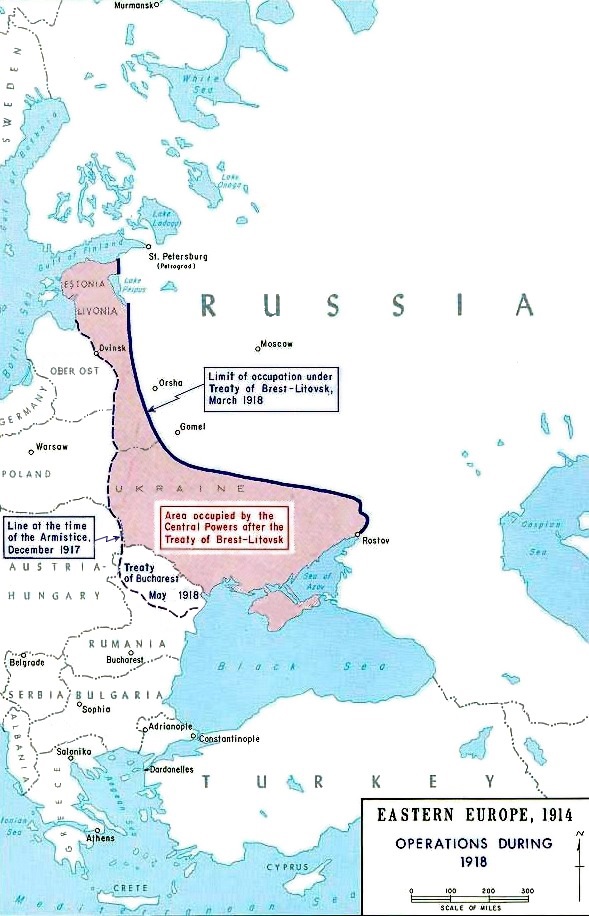
The treaty terms
Important
The terms imposed on Russia were extraordinarily harsh:
Territory lost: Russia surrendered Finland, Estonia, Latvia, Lithuania, Poland, Bessarabia, Georgia, Belarus and Ukraine. Germany and Austria-Hungary were to determine the future fate of these territories in agreement with their populations, though Germany intended to make them economic and political dependencies.
Population lost: The treaty cost Russia approximately 62 million people - one-sixth of its total population.
Economic losses:
- Almost one-third of Russia's agricultural produce came from the ceded territories
- 26% of Russia's railway lines
- 74% of iron ore and coal supplies
Financial penalties: Russia had to pay 3 billion roubles in war reparations to Germany.
Lenin's justification and internal opposition
Lenin acknowledged that the treaty represented a "robber peace" but insisted Russia had to accept the "naked truth" of its military weakness. However, he struggled to persuade other Bolsheviks to accept this view.
Bukharin, Kamenev and Dzerzhinsky voted against accepting the treaty, strongly opposing what they saw as a humiliating capitulation. Despite this opposition from prominent Party members, the treaty was ultimately approved by only a narrow majority.
Consequences for Bolshevik power
Establishing "socialism at home"
The decision to accept the Treaty of Brest-Litovsk established a precedent that would shape Soviet policy for decades. It confirmed that "socialism at home" would take priority over spreading international revolution. The Bolsheviks would focus on building their power within Russia rather than supporting revolutionary movements abroad.
The one-party state confirmed
The treaty debate also confirmed Russia's future as a one-party state. The Left-wing Social Revolutionaries, who had previously cooperated with the Bolsheviks, walked out of the government in protest at the treaty. In March 1918, the Bolsheviks formally adopted the name Communist Party. They now governed alone, treating all other political groupings - whether former opponents or former allies - as enemies.
Summary
Key Points to Remember:
- Lenin's pragmatism defeated Trotsky's revolutionary idealism: peace at any price to preserve Bolshevik power
- The Treaty of Brest-Litovsk (March 1918) cost Russia massive territorial, population and economic losses - one-sixth of population, one-third of agricultural land
- The treaty established a precedent: "socialism at home" would take priority over international revolution
- Left-wing Social Revolutionaries left the government over the treaty, confirming the one-party Communist state