The Chinese Communist Party (CCP) and Mao’s character, leadership and policies (AQA A-Level History): Revision Notes
📚Revision Notes
The Chinese Communist Party (CCP) and Mao's character, leadership and policies
After the May Fourth Movement in 1919, anarchist and Marxist ideas started to spread widely in China, resulting in the establishment of the Chinese Communist Party (CCP or CPC) in 1921.
The party has had sole control over the Chinese government since the establishment of the Republic of China.
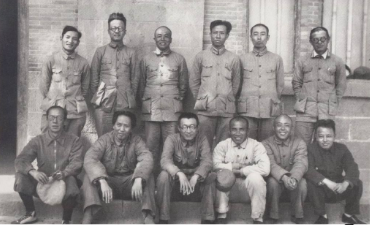
The CCP leadership in 1938
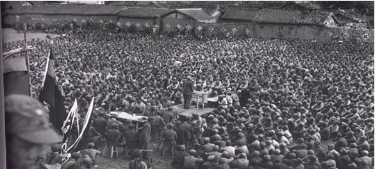
In 1934, Chiang Kai-shek led a massive campaign against the CCP, which forced the latter to escape towards the north. This event was eventually known as the Long March.
In the Long March, the Red Army, comprised of 100,000 soldiers, covered 10,000 km until they reached Shaanxi in 1935. It is said that 95,000 soldiers died and this is the period where Mao Tse-tung gained leadership of the Red Army.
Mao Tse-tung
Mao Tse-tung was born on 26 December 1893 in Shaoshan village, Hunan Province, China, to a poor peasant family. He was a staunch supporter of anti-imperialism in China. While working at Peking University, he adopted Marxism-Leninism, and became a founding member of the CCP in 1911.
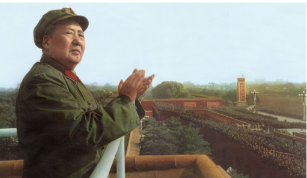
Mao Tse-tung
Later on, Mao's ideas would collectively be termed Maoism and this would be seen in the programmes of the CCP such as the Great Leap Forwards and the Cultural Revolution.
Mao's ideas mainly centred on:
1. Nationalism
2. Feminism
3. Traditional Chinese Philosophy
4. Marxism
At the time of the founding of the CCP, China was still a divided and backwards country ruled by power-greedy warlords. Because of constant wars with other factions, each warlord tried to receive foreign help, which resulted in foreign powers territorially and economically within China. The intellectuals who founded the CCP believed that Marxism would unite, strengthen and modernise China.

Mao believed that communism would be a tool to unify China. He targeted poor peasants, as he believed that they were a clean slate and could be educated thoroughly. In unifying China, he was convinced that his people had all of the skills and expertise needed to mould their own destiny.
In order to unify his country, a strong government under a communist party was needed to defend themselves against foreign control, mainly imperialism.
Mao believed that part of the unification of his country was to maximise the agricultural resources of China. Many were sceptical that communism/Marxism could only work in an industrialised society due to the prevalence of capitalism. Hence, in the CCP's Great Leap Forwards, the agricultural revolution was an important component resulting in a different view of communism.
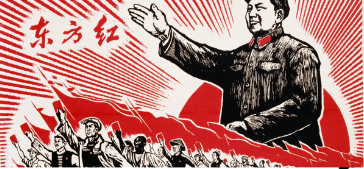
Maoism
During the Chinese Civil War, Mao helped in the establishment of the Chinese Workers' and Peasants' Red Army. He became the leader of the CCP during the Long March. In the establishment of the People's Republic of China, Mao became the Chairman of the CCP from 1949 until his death in 1976.

Strengths of the CCP
- The CCP had control over most of China's northern territory.
- Politically, the CCP had a tactical advantage since the assistant chief of staff for the KMT leader, Liu Fei, was actually a communist spy, as was the head of the Kuomintang War Planning Board.
- There was a ruthless counter-intelligence operation by the CCP run by Kang Sheng, which rendered Chiang Kai-shek deaf and blind to CCP planning. Furthermore, the CCP had a number of outstanding generals such as Lin Biao.
- Mao Tse-tung was an excellent political leader who was calm under pressure and appealed to the masses. When chased out of Yan'an by Chiang's soldiers, he said "We give Chiang Yan'an. He will give us China".
- The Soviet Union was a close political ally, helping the CCP achieve dominance in Manchuria and handing over large quantities of stockpiled Japanese weaponry and ammunition.
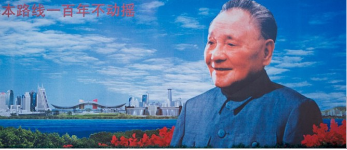
Deng Xiaoping
- The People's Liberation Army had experience of guerrilla warfare from attacking Japanese invaders during WWII.
- The CCP used excellent tactics including blowing up railways between major cities, which helped isolate Kuomintang forces in areas such as Shen-yang and Jinan.
- Deng Xiaoping, one of the key leaders of the CCP, was able to mobilise vast support for the PLA in its 65-day battle at the end of 1948.