The Basic Law of West Germany (AQA A-Level History): Revision Notes
📚Revision Notes
The Basic Law of West Germany
On 23 May 1949, the Basic Law or Grundgesetz of West Germany was created. Through a West German constituent assembly, a constitution and a federal republic were established from the former trizone.
Under the preamble of the Basic Law, the adoption of the document was based on the will of the German people. It also stipulated that all state authority is derived from the people. Articles covering human dignity of the German people were adapted from the Weimar Constitution.
Article 20 of the Grundgesetz highlighted the principles of democracy, republicanism, social responsibility and the rule of law.
Note
Drafters of the Basic Law used the term 'Grundgesetz' which also means Fundamental Law and avoided the term 'Verfassung' meaning constitution.
Coverage of the Grundgesetz
- Articles 1 to 19 covered the basic rights of the German people including equality of men and women, freedom of religion, speech, press, movement, occupation and association.
- Articles 20 to 37 stipulated the federation and the Länder. It identified the FRG as a democratic and social federate state which gave all authority from the people.
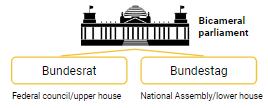
- Articles 38 to 49 identified the functions and rights of the Bundestag.
- Articles 50 to 53 covered the functions and rights of the Bundesrat.
- Articles 54 to 61 specified the role of the federal president.
- Articles 62 to 69 stipulated the structure and functions of the federal government.
- Articles 70 to 82 identified the legislation of the federation.
- Articles 83 to 91 covered the execution of federal laws and the federal administration.
- Articles 92 to 104 identified the administration of justice by the Supreme Federal Court and courts of the Länder.
- Articles 105 to 115 covered federal finances, including imposition and use of taxes, legislation on customs, budget and revenues.
- Articles 115 to 146 stipulated transitional and concluding provisions. Access the detailed Grundgesetz of the Federal Republic of Germany, 1949 using this link:
The Bundestag
-
Under Article 38, deputies of the Bundestag shall be elected by the people in universal, free, equal, direct and secret elections.
-
Any person aged 21 and above shall be eligible to vote, while those aged 25 and above shall be eligible for election. Election of the Bundestag was held every four years.
-
The Bundestag also had the right to elect its president along with the deputies. The Bundesrat
- The Bundesrat is consisted of members of the Länder. The number of representatives of each Land was determined by its population. Each Land had at least three votes, while Länder with more than 2 million people had four and those with more than 6 million people had five votes.
- A president of the Bundesrat is elected every year. The Bundesrat was responsible for informing the Federal Government of its federal affairs.
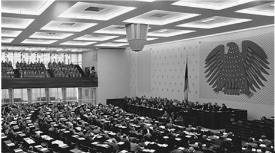
Parliamentary Council, May 1949
Federal President
- The federal president is elected by the federal convention every 5 years and is eligible for one re-election.
- The federal convention is composed of members of the Bundestag and popular representative bodies of the Länder based on the principles of proportional representation.
- In the event of premature vacancy, the position shall be assumed by the president of the Bundesrat.
Note
"I swear that I shall dedicate my strength to the wellbeing of the German people, enhance what is to its advantage, ward off what might harm it, uphold and defend the Basic Law and the laws of the Federation, fulfil my duties conscientiously and do justice to every man. So help me God."
- Oath of the newly elected federal president
- Federal orders required the approval of the federal chancellor.
- Right to appoint and dismiss federal judges.
- The federal president could be impeached by the Bundestag or the Bundesrat before the Federal Constitutional Court.
- On behalf of the federation, the federal president had the power to pardon individual cases.
- The president represents the federation in foreign policies such as treaties.
The Federal Government
- Under Article 62, the federal government consists of the federal chancellor and the federal ministers. The chancellor is elected by the Bundestag based on the proposal of the federal president.
- Based on the proposal of the federal chancellor, the federal president had the right to appoint and dismiss its federal ministers.
- As stipulated in Article 56, the federal chancellor and ministers shall take an oath before the Bundestag.
- The Bundestag may submit a dismissal request or elect a successor of the federal chancellor to the federal president.
- The federal chancellor appoints a federal minister.
The Basic Law introduced the independence of the Federal Constitutional Court from the legislative and executive branches of the government, similar to the United States. At first the FRG was not a sovereign state, decisions concerning foreign relations and trade, industrial production and military security were to be permitted by the Western occupation powers. Moreover, the US, Great Britain and France should also be consulted before any alterations in the Basic Law could be made. Lastly, in an event of emergency in the new West German government, the Western Allies could resume authority of the zones.