Economic policies (AQA A-Level History): Revision Notes
📚Revision Notes
Economic policies
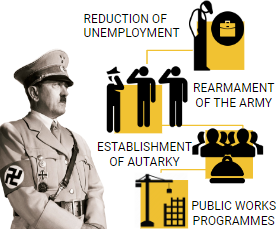
After the Great Depression, the German economy struggled, which resulted in political discontent and unemployment. When Hitler assumed power, he employed several economic policies to make Germany self-sufficient, known as autarky.
Schacht's New Plan
On 17 March 1933, banker Hjalmar Schacht was appointed President of the Reichsbank. With his contributions in overcoming the 1923 hyperinflation crisis, the appointment of Hitler as chancellor and funding of the Nazis, he was made Minister for Economics in 1934. Influenced by the economist John Maynard Keynes, and Franklin Roosevelt's New Deal, Schacht advised Hitler to expand public works.
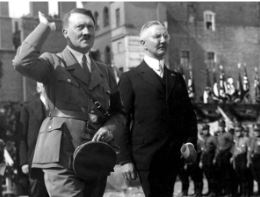
Hitler and Schacht in Berlin, 1934
Note
In addition to Hitler, Schacht was also appointed as president of the Reichsbank by President Friedrich Ebert and Chancellor Gustav Stresemann.
Schacht served as president of the Reichsbank from 1933 until 1939 and Minister of Economics between 1934 and 1937. In 1934, he introduced the New Plan to achieve economic autarky. In addition to construction programmes such as the Autobahnen (motorways), Schacht negotiated international trade agreements in several countries in southeastern Europe and South America. In order to address a currency deficit, he proposed the use of mefo bills or promissory notes as deferred payments. Moreover, foreign trade agreements particularly involving importation of raw materials were paid in Reichsmarks. In May 1935, he was appointed General Plenipotentiary for the War Economy and awarded an honorary membership of the NSDAP.
Schacht began to lose Hitler's favour during the 1935-36 economic crisis. Along with Price Commissioner Carl Friedrich Goerdeler, Schacht suggested to reduce military spending and government control of the economy. The idea was disliked by Hitler. As a result, Hermann Goering was appointed as Plenipotentiary for the Four Year Plan in October 1936. In November 1937, Schacht resigned as Minister of Economics and General Plenipotentiary.
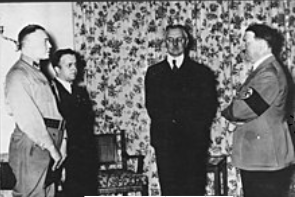
Schacht and Hitler (rightmost) in 1936
Goering's appointment created conflict with Schacht's authority. Despite his resignation in 1937, Schacht remained as President of the Reichsbank until January 1939. In 1944, after Hitler's assassination attempt, Schacht was one of the known Nazi suporters who was arrested and sent to concentration camps.
Note
After the war, Schacht was tried at Nuremberg for conspiracy and crimes against peace. He was acquitted by British judges, but sentenced to 8 years hard labour in the West German denazification trial.
Goering's Four Year Plan
Between 1936 and 1939, Hermann Goering took charge of the Nazi Party's Four-Year Plan. In order to achieve Hitler's aims of autarky and rearmament, Goering employed forced labour.
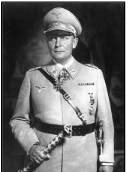
Hermann Goering
In 1935, unemployment in Germany went down to 1 million from 6 million in 1933. This was achieved through the construction of the Autobahnen or motorways as organised by the RAD or the National Labour Service.
It included the building of schools, public establishments and hospitals. Over 80,000 men were given jobs for the construction of the Autobahnen. The Autobahn is a federal-controlled motorway system in Germany.
FOUR-YEAR PLAN
- Readiness of the German armed forces and economy for war.
- To increase agricultural production through government subsidies.
- German self-sufficiency of major raw materials along with control of imports and exports.
One of Hitler's major points of appeal was his promise to revive the German economy by eliminating unemployment. In June 1933, just months after becoming the Führer, Hitler passed the Unemployment Relief Act, which established the National Labour Service or Reichsarbeitsdienst (RAD).
Along with reducing the effects of unemployment, RAD aimed to indoctrinate the German workforce into Nazi ideology and militarise it. At first it was voluntary but by 1935 participation was compulsory.
RAD Requirements
- All men aged 18 to 25
- Complex training for six months
- Use of military uniform
- Receipt of pocket money but not wages
- Live-in camps
- Exposure to military and physical exercises.
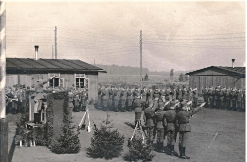
Salute ceremony of RAD members
Note
By 1939, Hitler declared full employment of German workers but the statistics did not reflect Jews who were forced to give up their jobs to non-Jews and women whose jobs were given to men.
By 1933, the motorway system connected Hamburg, Frankfurt and Basel. About 3,000 kilometres of road was built in 1941. The project was used as propaganda for highlighting the Nazi's technological advancement.
Rearmament was initiated by Hitler, which created millions of jobs for the Germans. About 26 billion marks were spent by the Nazi government to produce battle tanks, aircraft and ships between 1933 and 1939. Moreover, this industry tripled the use of oil, steel and iron.
From 1933-39, industrial and weapons companies gained 50% more income. In addition, the Nazis controlled 70% of all German production. Farmers benefited greatly from Nazi policies due to an increase in agricultural prices and wages. Moreover, the Hereditary Farm Law passed in 1933 ensured land to farming families.

Nazi Germany's Autobahn system was a four-lane divided motorway without intersections
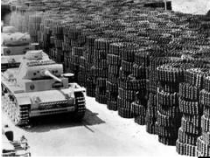
Image of Nazi rearmament
Despite the loss of freedom in many aspects of German life, conforming was necessary in order for them to have jobs and wages.
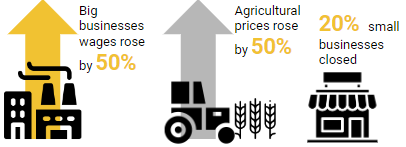
As farmers brought large electoral support, they benefited under the Nazis. By 1937, agricultural prices had increased by 20%, and wages rose more quickly than those in industry. And although farmers had greater security, they were also fixed to their land.
Rules on opening and running small businesses were tightened.
By 1937 monopolies owned 70% of production. Rearmament from 1935 boosted profits and managers saw their wages rise by 50% between 1933 and 1939.
Reoccupation of the Rhineland
Under the 1919 Treaty of Versailles, the Rhineland region was placed under Allied occupation. The German military was forbidden from all territory west of the Rhine. In 1925, the demilitarisation of the region was reasserted by the Locarno treaties. In June 1930, Stresemann negotiated the withdrawal of Allied soldiers in the Rhineland.
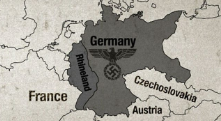
Map showing the location of Rhineland between Germany and France
However, as part of Hitler's rearmament programme, he ordered the invasion and remilitarisation of the Rhineland. In March 1936, Germany marched its troops into the Rhineland, a buffer state between France and Germany. This event signified Germany's willingness and ability to pursue a policy of aggression as this act violated the Treaty of Versailles.
Under the 1919 Treaty of Versailles, Germany was "forbidden to maintain or construct any fortification either on the Left bank of the Rhine or on the Right bank to the west of a line drawn fifty kilometres to the East of the Rhine". In the event that Germany violated this, it was to be regarded as an act of hostility. Hitler continued to march his troops into the Rhineland, to remilitarise and to fortify Germany's border.
Anschluss
Part of Hitler's foreign policy was to create a greater Germany by uniting all the German-speaking people. By 1938, Hitler had unified Germany and his native land, Austria, as signified by the coined event, Anschluss (Union).
25 July 1934, Austrian Nazis attempted a coup that resulted in Chancellor Engelbert Dollfuss' assassination.
10 March 1938
Schuschnigg resigned. A day prior to this he ordered a referendum for Austrians to accept Hitler's proposal. Hitler got furious and ordered the invasion of Austria, which led to Schuschnigg's resignation.

12 February 1938 Hitler invited Austrian chancellor Kurt von Schuschnigg to Germany and coerced him into putting Austrian Nazis in charge of the government. Not actioning this would lead to Germany's invasion of Austria.
11-13 March 1938
Hitler's troops marched into Austria. Hitler formally annexed Austria to Germany.
After Germany's annexation of Austria, Great Britain and France acknowledged this action but did nothing to oppose it. They did not see it as a threat as both countries were German-speaking. It made Germany stronger politically and economically as it expanded its territory and gained more resources.
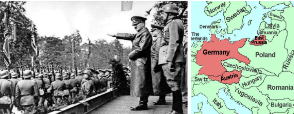
right: Map of Germany and Austria left: Hitler viewing the soldiers in Vienna, 1938