Features of a Terror State, including machinery of terror, courts, SS, Gestapo (AQA A-Level History): Revision Notes
📚Revision Notes
Features of a Terror State, including machinery of terror, courts, SS, Gestapo
Following the suspension of civilian liberties, Hitler and the Nazis used legal terror to intimidate and suppress opponents. The party created the SA, Gestapo and the SS to proliferate fear and establish a terror state.
SA or Sturmabteilung
The storm division was assembled by Hitler in 1921, although it was called the Gymnastic and Sports Division of the party and was mostly composed of unemployed men and former soldiers.
The German term Sturmabteilung literally means 'assault division'. Commonly known as the Brownshirts or Storm Troopers, Hitler founded a paramilitary group for the Nazi Party. It served as the Nazi Party's private army whose role was to protect party meetings and rallies from hecklers.
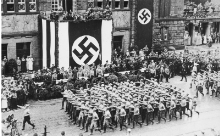
An SA parade in Dortmund, Germany, 1933
The SA was known for its violent intimidation of leftists and Jews during the Nazi regime. This independent army was led by Ernst Röhm, a known anti-capitalist and supporter of Hitler during the initial years. Röhm and Hitler were first acquainted in 1923 during the Beer Hall Putsch.
The collapse of the Freikorps, a right-wing nationalist group in the early years of the Weimar Republic, led many of its former members to join the SA.
By 1933, members of the SA swelled to 2 million. This growth was felt as a threat by Nazi leaders, including Hitler. On 30 June 1934, Hitler, Göring, Goebbels and Hess architected a purging of SA leaders and members. This event became known as the Night of the Long Knives.
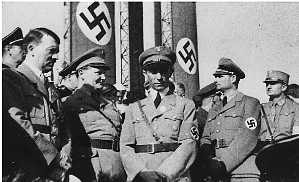
From left to right, Hitler, Göring, Goebbels and Hess
Note
The SS took over total control of the SA role in 1938. After the purging of its leaders, the SA did not regain its position in the Nazi Party.
SS or Schutzstaffel
In April 1925, Hitler established the Schutzstaffel (SS; 'Protective Echelon'), an elite corps of the Nazi party answerable only to the Führer. It was a paramilitary division of Hitler's Brownshirts.
In 1931, a special division was created under the SS, the Sicherheitsdienst (SD). Its main task was to serve as a special intelligence agency for the SS.
They were tasked with ensuring the safety of Hitler and other top Nazi officials. It was headed by Reinhard Heydrich, Himmler's right-hand man.
By 1934, the SS secured Nazi Germany from internal and external enemies.
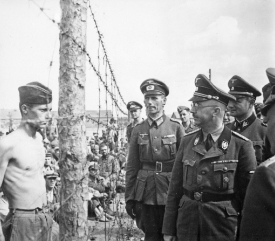
SS leader, Himmler inspecting a Soviet prisoner of war, 1941
In March 1933, Hitler declared the opening of the first Nazi concentration camp in Dachau, Germany. It was intended as a prison camp for the Nazis' political adversaries and was operated by the SS.
Known as SS-VT (Verfügungstruppen), its members were trained military men who agreed to four-year compulsory terms of service. They were housed in military barracks and were at the disposal of Hitler.
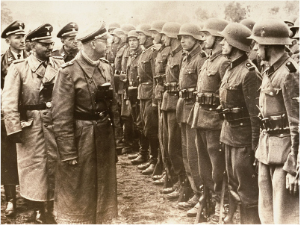
Himmler reviewing troops in 1944
SS Totenkopfverbände (TV) or the 'Death's Head Unit' was so named due to its insignia, a Totenkopf (skull). It signified their faithfulness to Hitler until death. Their main task was to operate Hitler's concentration camps.
Gestapo or Geheime Staatspolizei
On 26 April 1933, Hermann Göring created the Secret Police Office, commonly known as the Gestapo. The Gestapo was originally created to intimidate and silence Hitler's political opponents in Berlin and nearby areas.
Rudolf Diels became the first Gestapo chief. Diels was a member of the Prussian Ministry of the Interior and senior adviser of the police.
Due to rivalry between Göring and another rising Nazi leader, Heinrich Himmler, the former decided to cede the Gestapo.
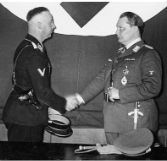
Image of Göring (right) and Himmler (left)
On 10 February 1936, under Himmler, the Gestapo Law was passed, which placed them above the law. The law included this paragraph, "Neither the instructions nor the affairs of the Gestapo will be open to review by the administrative courts."
The Gestapo was given the right to arrest, interrogate and execute anybody without any legal procedure. The majority of Gestapo agents worked as spies, while a few were office personnel. Common Germans had no idea if a person was a member of the Gestapo, as they were plain-clothes agents. As a result, most people exercised self-censorship.
With great control over the police, Hitler ordered door-to-door arrests of political opponents. The SA and Gestapo agents arrested Socialists, Communists, trade union leaders and anyone who spoke out against the Nazis.
Most were sent to concentration camps while others were murdered. By the summer of 1933, democracy was dead in Germany.
The Nazis established detention camps from old warehouses and abandoned buildings. Prisoners were exposed to harsh conditions, including torture and starvation.
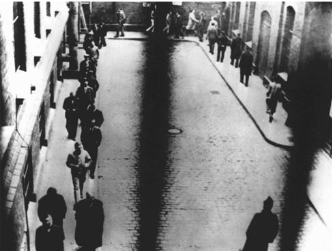
Prisoners arrested during the crackdown on leftists and other targeted groups exercise in the courtyard of the Alexanderplatz prison. Munich, Germany, 10 April 1933.
People's Courts
In response to his dissatisfaction at the Reichstag Fire trial, Hitler ordered the creation of the People's Court or Volksgerichtshof in 1933. This special court worked outside the provisions of the constitution. It had jurisdiction over 'political crimes' including black marketeering, defeatism and treason against the Nazi regime. Such crimes were tried (show trials) in courts and punishable mostly by the death penalty. Significant cases heard in the People's Courts were the conspirators behind Hitler's assassination (July Plot) and youth activists Sophie and Hans Scholl.
Between 1934 and 1945, the People's Courts sent 10,980 people to prison and sentenced 5,179 to the death penalty. Only about 1,000 were acquitted. The majority were arrested again by the Gestapo and sent to camps.
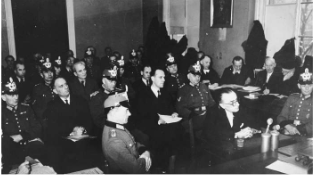
Participants in the July 1944 plot to assassinate Hitler and members of the 'Kreisau Circle' resistance group on trial before the People's Court. Pictured are Dr. Franz Reisert, Dr. Theodor Haubach, Graf von Moltke, Theodor Steltzer and Dr. Eugen Gerstenmaier