German Labour Front and the ‘Strength through Joy’ (AQA A-Level History): Revision Notes
📚Revision Notes
German Labour Front and the 'Strength through Joy'
In order to control industrial workers, the Nazis established the German Labour Front (DAF), Strength Through Joy, and the Beauty of Labour.
The German Labour Front (DAF) replaced trades unions, which Hitler had banned. The DAF was headed by Robert Ley who stated that the main aim of the DAF was 'to create a true social and productive community'.
The DAF was one of the largest Nazi organisations along with the Bank of German Labour. In 1939, the DAF claimed over 35,000 full-time employees. In theory, DAF membership was voluntary. However, non-members had a hard time looking for a job. Membership fees ranged from 15 pfennig to 3 Reichsmarks.

German Labour Front (DAF)
In theory, the DAF aimed to provide a common ground for workers and employees. Through the 12 trustees, wages and security of employment were set. Moreover, leisure activities for workers were also created through the Strength through Joy programme. It was a Nazi scheme that sought to incentivise workers in the rearmament industries into greater productivity by giving rewards for workers' efforts including evening classes, trips to the theatre, picnics and holidays.
The DAF organisation
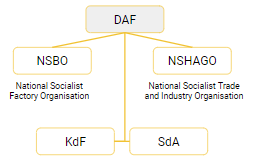
Note
Beauty of Labour was an organisation whose job was to influence Germans into believing that work was good, and that all able-bodied Germans should work. It encouraged factories to improve conditions for its workers.
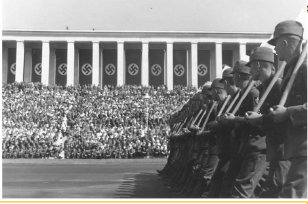
Unit of the DAF (Deutsche Arbeitsfront) marching with shovels at a rally in Nuremberg, in 1937
In 1933, despite the increasing cost of living, the DAF and its trustees employed a wage freeze. To many outside the organisation, the DAF served as a gigantic state prison for workers. Bargaining mechanisms were given to workers, while employees had more freedom.